I review every TSR D&D Starter Set from the ‘90s
There were seven of them! Seven!

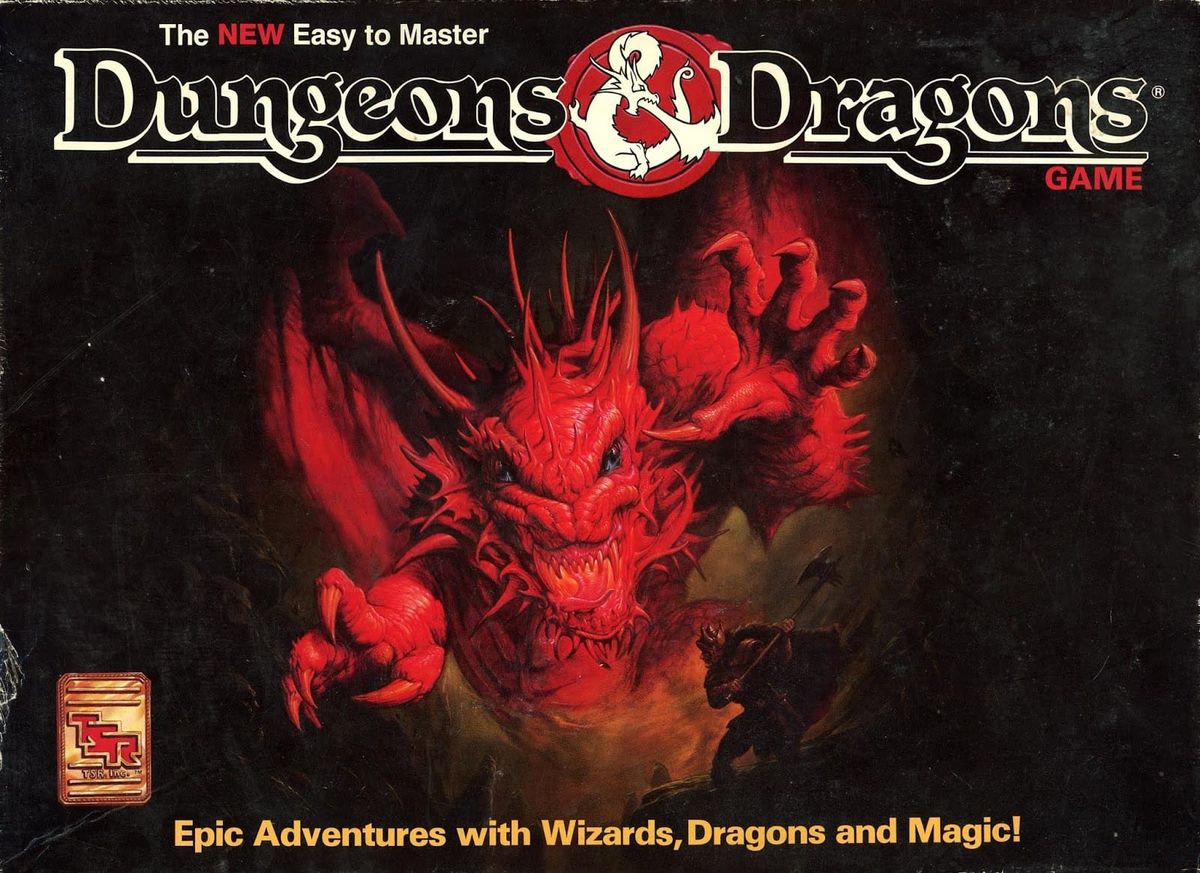
Astute readers will have observed that I possess strongly-held convictions on the subject of starter sets, and while my discerning gaze is mostly directed towards miniature wargames, my feelings apply equally to RPGs. Do you know who else liked starter sets? TSR in the early nineties. Between 1991 and 1995, the original publishers of Dungeons & Dragons released no less than four different products designed to ease new players into D&D, a number that almost doubles to seven if you count repacks and variants.
Contrary to more recent RPG starter sets I’ve perused, most of these products were solidly aimed at kids and sold through traditional retail channels. As I’ve discussed before, fantasy games were all the rage at the time, and I saw every one of these boxes stacked on the shelves in Toys ‘R’ Us and the like. They routinely piled up in discount stores for years after their initial release, which is how I ended up owning most of them — my mum struggled with the Herculean task of buying Christmas and birthday presents for a nerdy adolescent in the dark ages before internet shopping.
With the relentless rush of releases, it’s hard to see this array of starter products as anything but TSR frantically throwing stuff at the wall in the hope that something would stick, especially knowing that the troubled company would be bought by Wizards of the Coast in 1997. Conversely, that doesn’t mean that they were necessarily bad.
Before we go any further, I’d like to give thanks to Shannon Appelcline, whose Designers & Dragons books came up so many times while I was fact-checking my own shoddy memory for this piece that it felt unprofessional not to acknowledge them.
And now, please take my hand as I don my rose-tinted specs and wander down memory lane in search of the D&D Starter Sets of the Early to Mid 1990s!
1991: The NEW Easy to Master Dungeons & Dragons
Back in the heyday of MC Hammer and the Teenage Mutant Ninja Turtles, there were two distinct flavors of D&D: Advanced D&D, which was in its second edition and sold as the three separate hardcover books familiar to players today; and Basic D&D, a series of boxed sets that had their origins in a 1977 product intended as an introduction to AD&D, but had evolved to become their own separate line. The broad strokes were largely the same — the six core stats, D20 rolls, and the like — but the two rulesets weren’t entirely compatible. Basic D&D, for example, didn’t separate classes and races, so elf and dwarf were distinct character types, and picking a cleric meant you were automatically human.
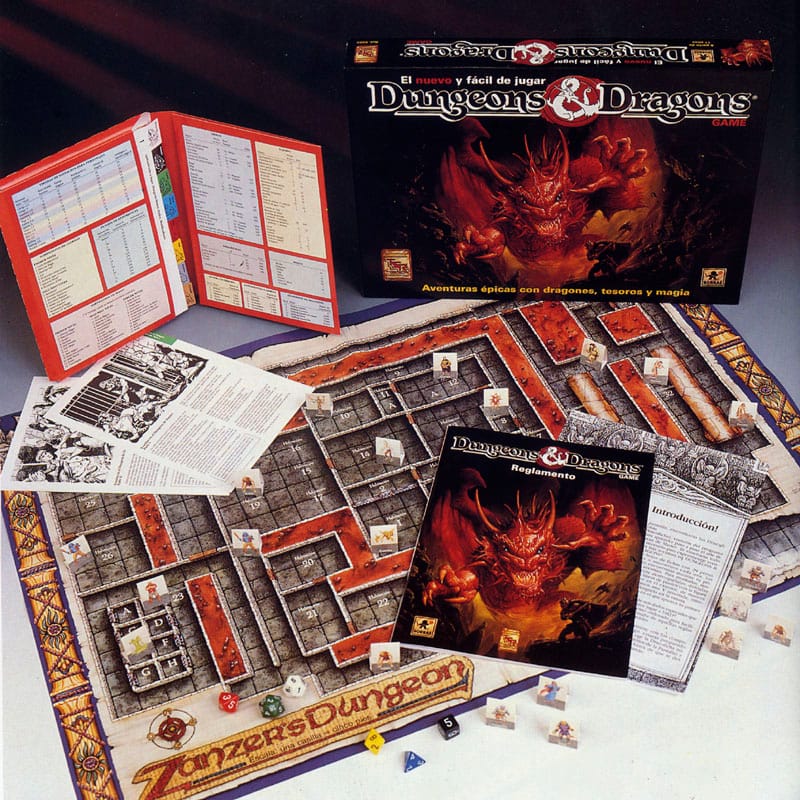
The 1991 “black box” was the follow-up to 1983’s iconic “red box” (roleplayers once again proving that we’re terrible at coming up with names) and the first RPG I ever owned. Leaning into the comfortably familiar form factor of a board game, it eschewed theatre of the mind play in favor of a big map of “Zanzer’s Dungeon,” and folding cardboard standees as playing pieces. While there was a traditional rulebook, the game was also presented as a set of A5 cards that tucked into a pocket in the included Dungeon Master’s screen. This “Dungeon Card Learning Pack” is what allowed me as an eleven year-old to learn what the fuck a roleplaying game actually was, and how to play D&D.
The cards were designed with the assumption that the owner of the box would be DMing a game for their friends. This seemed obvious at the time — you just bought a new game, of course you’d be the one teaching your friends how to play — but in these days of actual play, online sessions, and countless resources for newcomers to the hobby, the idea of a product designed for a prospective DM who had never played an RPG before is quite refreshing. Each of the numbered, color-coded cards explained some roleplaying concept or game rule on the front, and the reverse provided a playable example. They started with the broadest examples of roleplaying, using Choose Your Own Adventure-style passages and decision making, then the concept of player characters, before steadily introducing the rules.
It’s this format that makes the Dungeon Cards the best RPG teaching tool I’ve ever encountered, especially for kids. Having to wait to play a brand new game always sucks, but having to read through and properly comprehend a hefty rulebook first makes matters worse. The Dungeon Cards enabled you to play your new game as soon as you cracked open the box, learning the rules as you did so. What’s more, you didn’t have to learn everything at once. Every so often, there was a folding, double-sized card that contained instructions on how to run a session for your friends using the rules that you’d just learned. It meant you’d have two chances to play the game — once solo, once as the DM for a group — before moving on to the next set of rules.
Genuinely brilliant, and should be shamelessly ripped off by everyone. It’s okay: TSR can’t sue you anymore.
1992: Dragon Quest
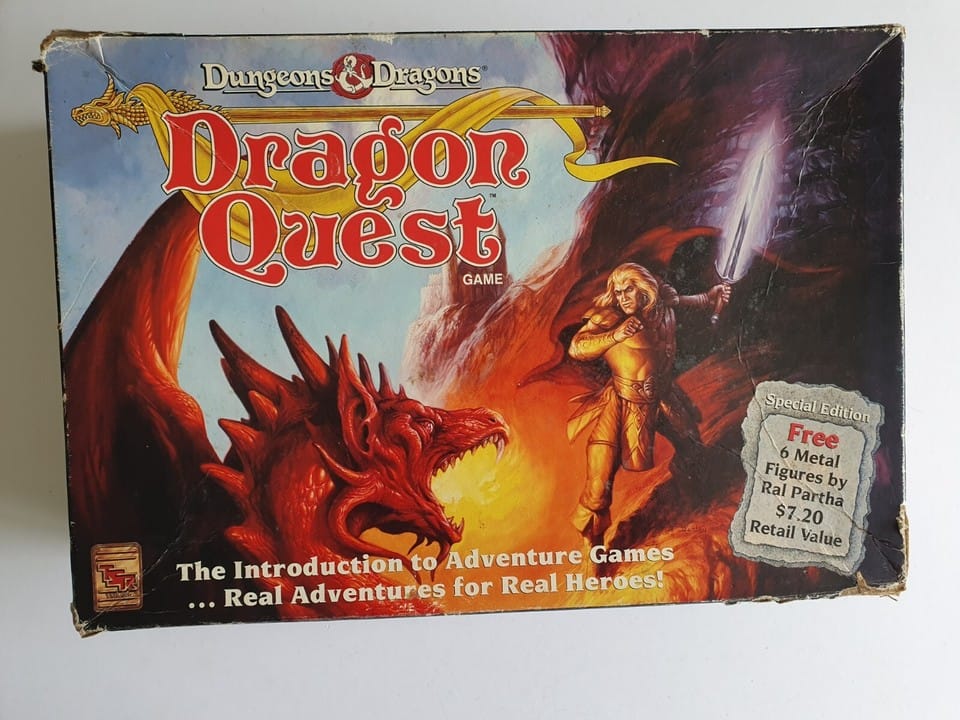
Not to be confused with Dragon Quest, the JRPG videogame series from Square-Enix, or DragonQuest, the 1982 RPG that was later bought by TSR (and was the reason why Dragon Quest (the JRPG) was known as Dragon Warrior in North America until WotC let the DragonQuest and Dragon Quest trademarks lapse), or Dragonquest, the Anne McCaffery novel…
Let me start again.
Despite the existing Basic Set’s boardgame leanings, someone at TSR felt they needed something simpler and even more explicitly board game to compete with HeroQuest, the classic Milton Bradley/Games Workshop adventure board game. Which, of course, is not to be confused with HeroQuest, the 2003 RPG formerly known as Hero Wars, and later on as QuestWorlds, or Hero’s Quest, the original title for the first installment of the Quest for Glory video game series, or…
Oh, for fuck’s sake, I did it again.
Dragon Quest was an even more simplified version of D&D that included plastic miniatures for the heroes and an actual board, rather than the Basic Set’s paper map, although it did reuse the cardboard standees for the monsters. It also came with a second set of metal miniatures for the heroes, from venerable minis producer Ral Partha. I think these may have been the first and only metal miniatures I’ve ever owned explicitly for an RPG, rather than a wargame of some kind. I even painted some of them! There were also cards for monsters, characters, items, and such, with stats and descriptions on one side and glossy full-color illustrations on the other. As far as I’m aware, all the art was reused from other products, since TSR was really squeezing every drop it could from the art budget.That period produced some classic fantasy art, but it did lose a bit of the impact once you’d seen it in a sourcebook, and on a novel cover, and a trading card.
I don’t think I ever actually played Dragon Quest. By the time I received it, probably in ‘95 or ‘96, I had already moved onto AD&D and wasn’t interested in playing an even simpler game than the one I started with. Could have been good, could have been shite. Who knows?
1993: Dragon Strike
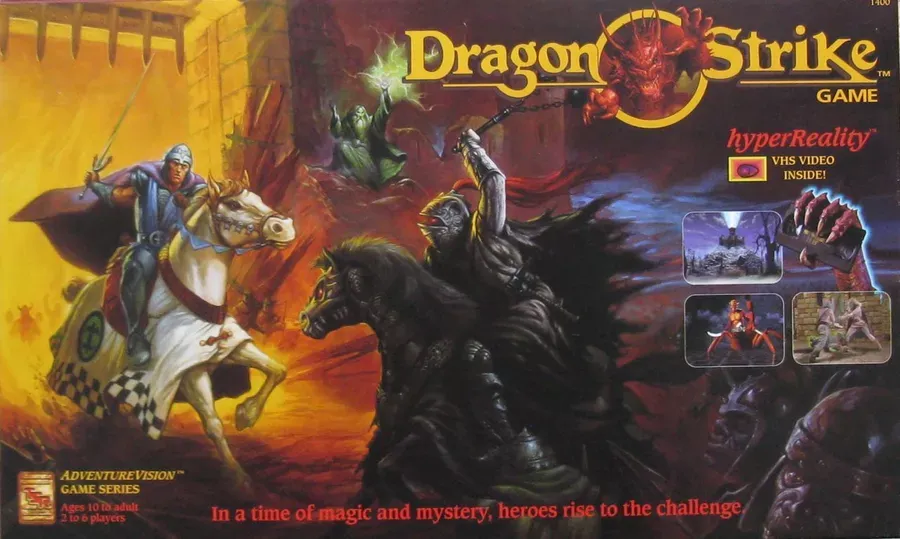
Along with adventure board games, VHS tape games were also an early ‘90s trend. For our younger readers, a VHS tape is like someone 3D printed a storage device for a long TikTok that could be played on a device a bit like a PlayStation 5. Atmosfear is the classic example, using the video recording of a host to act as a timekeeper and sort of pseudo-GM, giving instructions to the players as the game progresses. The original game in the series sold two million copies in two years and even had a Kickstarted 30th anniversary edition in 2021.
Dragon Strike is yet another simplified D&D board game, this time including a VHS tape. Instead of incorporating the video into the game in any way, it serves as an introduction for the game’s “Dragon Master” in the form of a live-action story about a party of adventurers. This is the one game on this list that I have neither owned nor played, so instead of me writing anything about it, let’s just watch the video, which has been helpfully uploaded to YouTube. Hooray for media preservation!
1994: The Classic Dungeons & Dragons Game
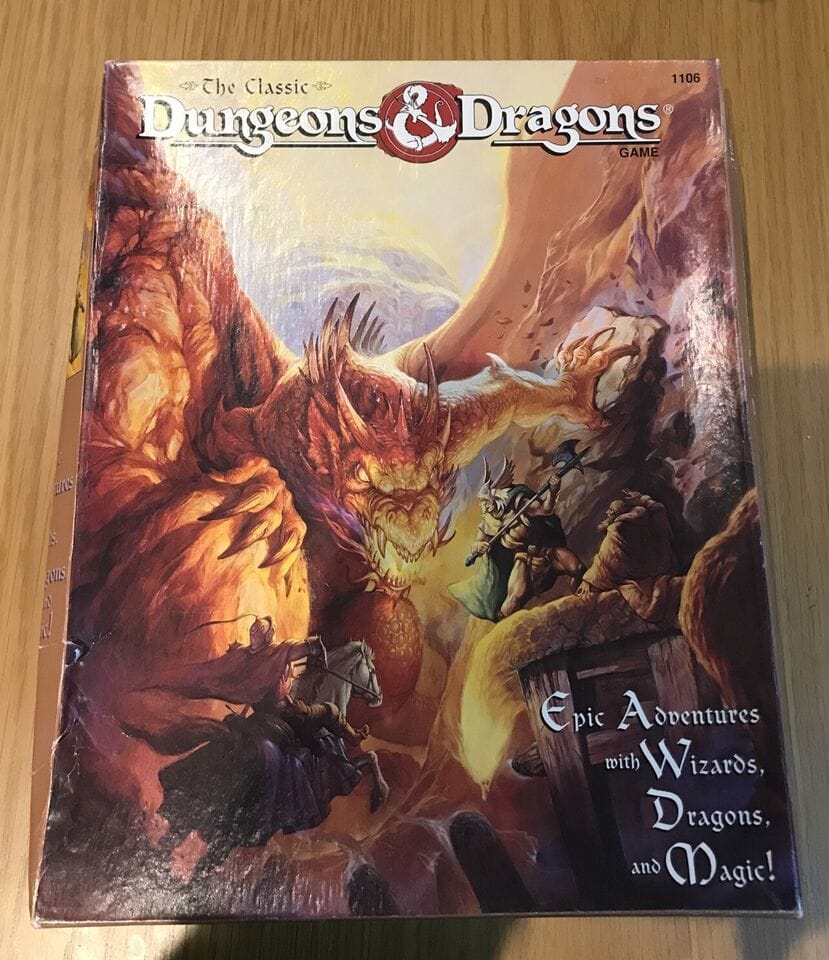
This was a revamp of the 1991 set, which removed the Dungeon Cards and incorporated their material into the rulebook, instead. As far as I’m concerned, this is like removing the toppings from a pizza. This was the year I bought the 1991 box from a car boot sale for the princely sum of £3. In hindsight, I’m very grateful I obtained that version instead of this one.
1994: First Quest
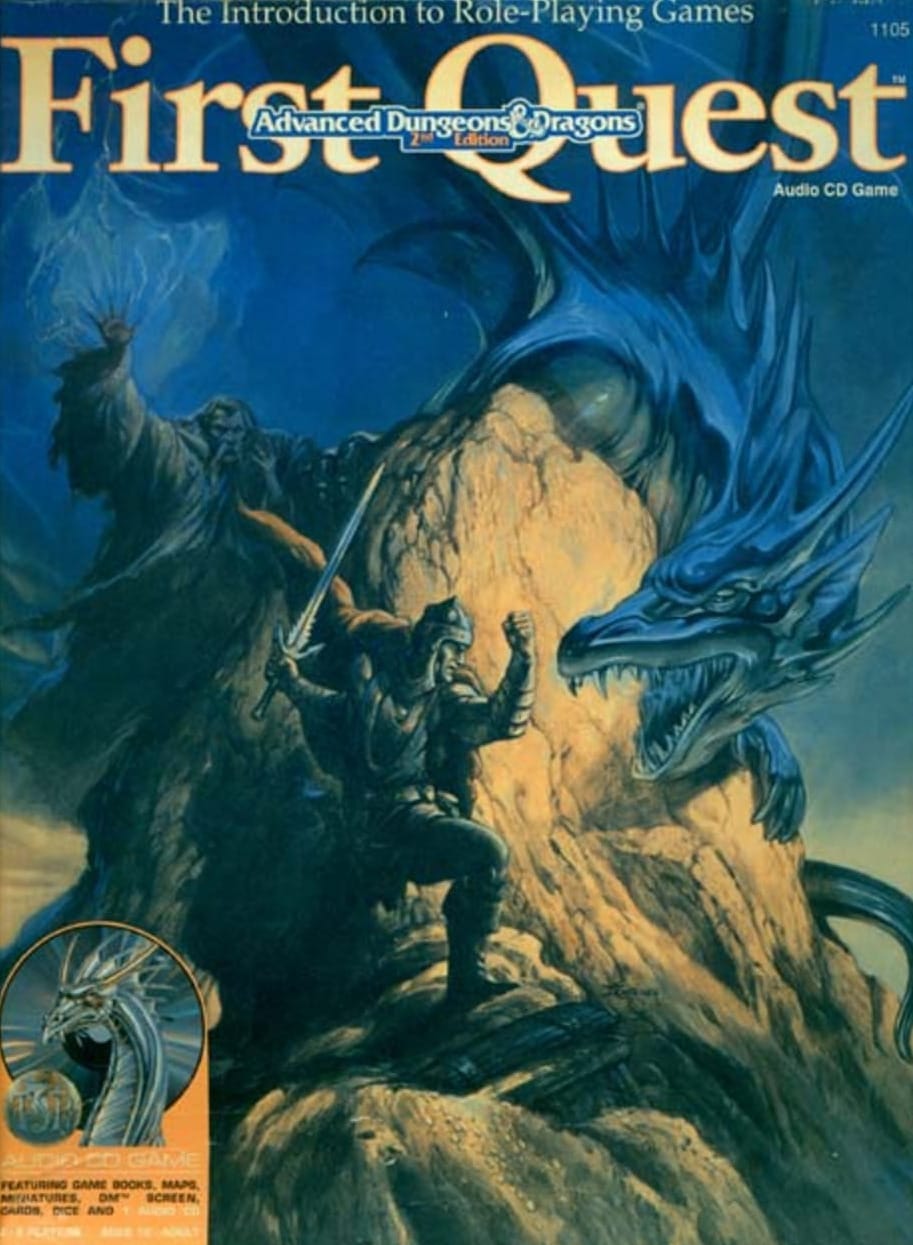
Like Dragon Strike, First Quest was the result of a TSR dalliance with multimedia gaming. Unlike Dragon Strike, First Quest’s sixty track audio CD was used in the game itself. Once again, this was a stripped-down, board game-adjacent ruleset, which TSR had the chutzpah to bill as “The Introduction to Role-Playing Games.” In another departure from previous offerings, First Quest was positioned as an introduction to Advanced Dungeons & Dragons, rather than the Basic variation, which had ceased production. Too bad for anyone who bought Classic Dungeons & Dragons, I guess. The rules were split across three books: the Rules Book, Monsters & Treasure Book, and Adventure Book.
As an existing AD&D player, I remember this set being pretty decent! It wasn’t hard to adapt the adventures to use the full rules, and the audio CD was a fun enhancement. The acting wasn’t quite Critical Role, but I’m sure the monster voices were better than I could do as a teen, and the sound effects were genuinely atmospheric. If this had been my introduction to RPGs, I would have been delighted, although simultaneously disappointed that adventures didn’t usually come with CDs.
Not convinced? Once again, a kind soul has uploaded the entire thing as a YouTube playlist.
1995: Introduction to Advanced Dungeons & Dragons
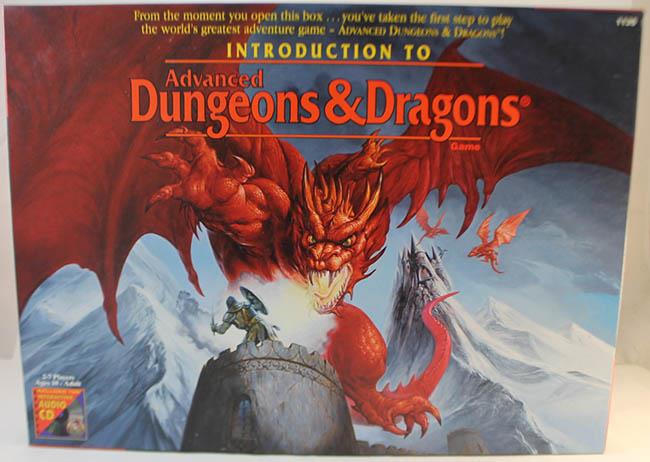
Unwilling to let a year pass without a new introductory D&D box on store shelves, TSR simply repackaged First Quest in a new box. Artwork was replaced and the rules were rejigged into a Player’s Handbook, Dungeon Master’s Guide, and Monstrous Manual, reflecting the hardcovers of the full game.
1996: The Complete Starter Set: Advanced Dungeons & Dragons
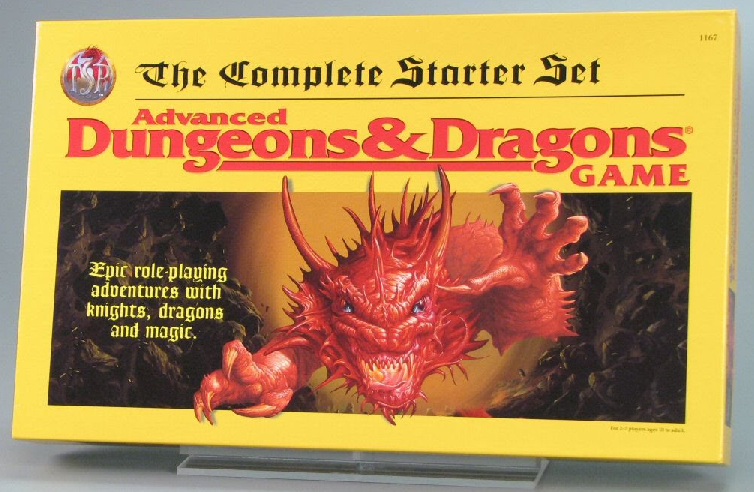
In 1995, TSR released revised editions of the core AD&D books, with striking new black, red, and yellow branding. This provided them with the perfect excuse to repackage First Quest yet again in 1996, this time in an incredibly ugly yellow box. For some reason, they also decided to do away with the CD, replacing it with the Forgotten Realms Book of Lairs. This was the latest incarnation of a long-running series of adventure compilations, with each scenario centering on the home of a specific D&D beastie, hence the name. It’s a somewhat random inclusion, being a full AD&D product tied to a specific campaign setting that was initially published a couple of years prior, but with 35 scenarios, there’s plenty of material for budding DMs.
And that’s your lot! D&D’s new owners would release one starter set for AD&D second edition in 1999, just before the third edition, which unceremoniously dumped the “Advanced” when it showed up in 2000. As you may have guessed, there were starter sets for 3E too, but we’ll save that for History Week 2: The Wacky Wizards of the Coast.*
* There are no plans for History Week 2: The Wacky Wizards of the Coast. Please don’t ask about it, the other Rascals will get annoyed with me. I just wanted to make a deep cut McElroy Brothers reference.