Rascal Reading Club: The Warden’s Operations Manual
The talkback is out, the duology is complete.

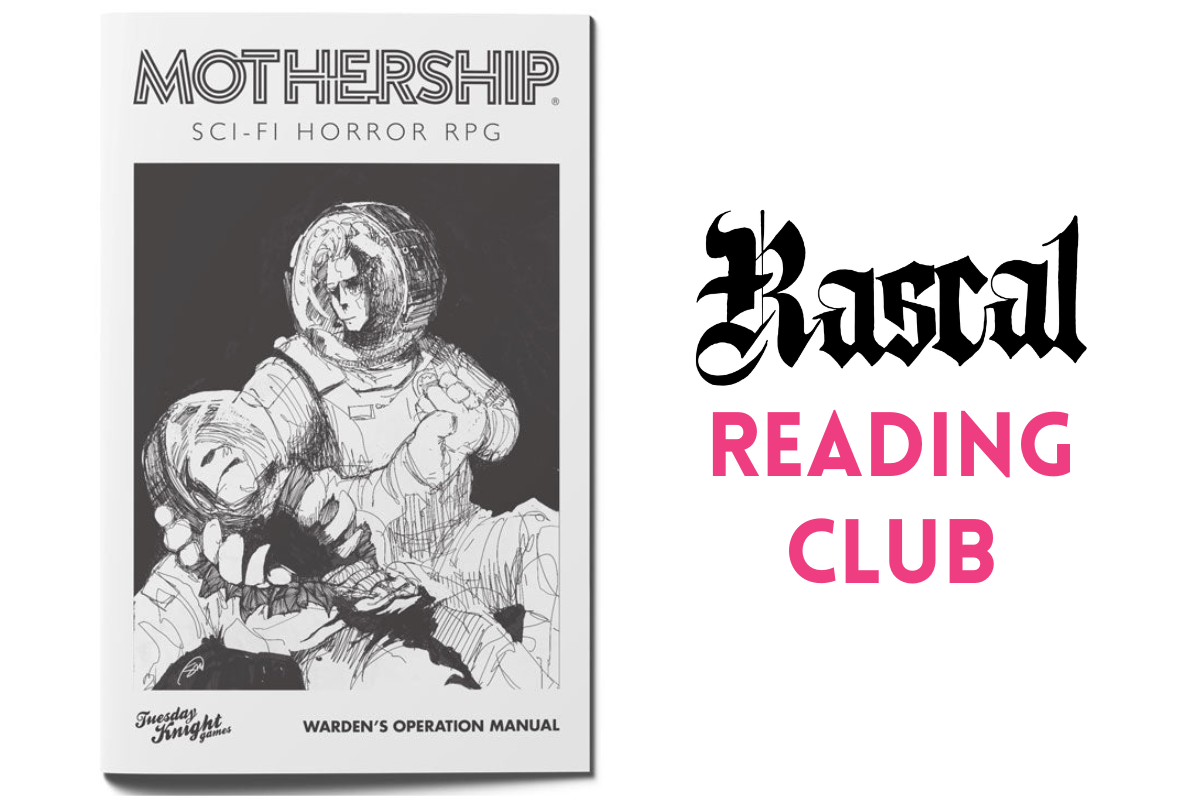
As announced a couple weeks ago, I’m hosting a new podcast, Rascal Reading Club. The first season is all about GMing advice and to kick off, we read the Warden’s Operations Manual by Tuesday Knight Games. It turned out to be an excellent start. We found ourselves discussing everything from game design to human psychology to writing to kitchen table politics.
Here are some excerpts from the main episode:
Scenario Design
“Warden's Operation Manual seems to have a very good and very specific vision for the default adventure of a Mothership game. There's a great line in just this first spread… For ‘choose a starting scenario’, there's a line that says for your first session, “you should throw your players into a bad situation and then make it worse”. That's a good line. And isn't that line like a really good summary for the best first-party Mothership adventures?
Start with economic horror. Start with people being exploited. Start with powerful factions exploiting people, and then add a fucked up alien thing, right? That is the formula for A Pound of Flesh almost exactly, right? It is not the formula for most of the third-party adventure stuff, which again, feels a bit more like video game level design. And that's not a criticism. Video game level designs are cool, but they are different.”
Advice On Running Games
“It's important to say that there are some memorable and important pieces of advice in there, but it never feels thorough or particularly exhaustive. It feels a little rushed sometimes. I think there's no way out of that. There is always going to be a problem with advice, which is the problem between knowledge and wisdom… It's an incredibly pretentious thing to say, but one way to think about it is that like, I can know something, right? I can “know” that combat should not be the default problem solving mode and shouldn’t be the default obstacle I construct. But for me to internalize that… that's when knowledge becomes wisdom, right? And it's you can't just say it to me. Maybe that's a problem a book can't solve.”
Underdesigned Mechanics
“And then comes the advice where I start to ask the question, if you need to give this advice, have you underdesigned your game, right? I use this language for a reason. It's technical. I'm using it because I think it's less judgmental and represents more accurately what I mean…You get this line that says, “Whenever players roll the dice, the chances are good that they will fail more often than they succeed. This means it's important for you not to think of rolling as a binary pass and fail system.
Now I am not thrilled with the idea that you design a game that looks exactly like a binary pass and fail system — d100 against a target number — and say it's vital that you don't think of it as a binary pass and fail system.”
Then, because it’s a book club, we ended the episode with a series of discussion questions directed at listeners:
Discussion Questions
- Do you have thoughts about the Warden's Operations Manual? Do you have a favorite part that I didn't mention?
- Do you think that the Mothership GM guide should have more advice about running pre-written adventures? If so, is there something you would cut from the existing manual to keep it to 60 pages?
- Do you think there is a line where advice becomes so critical to the vision of play that it should be incorporated into the rules design at some point? What do you think about my statement that the core mechanic of the game is "underdesigned"?
- Are there Mothership adventure that plays with horror that feels "real" but isn't economic horror? More gendered or racialized horror, maybe?
- If the rules of Mothership point towards one question, is it "are you dead yet"?
Today, we released the accompanying talkback episode. This is the cool part of the whole project — otherwise it’s me sitting in a room talking to myself, that’s not new — where people wrote in with responses and I got to talk back. We see a range of responses: people agreeing, disagreeing, finding stuff I didn’t see, telling me about stuff I didn’t know. It’s pretty great. It led to some thoughts and ideas that tumbled out rough in the moment but I am excited to polish into a shine in the future.
Here’s an excerpt of that:
Coffee Elemental: This is a tricky one. I come to this experience from a lot of PbtA game experience, some of which was really good and some of which was really bad. (This gets relevant in a moment, I promise.) I think that I agree that the rule about rolls is underdesigned, but I disagree on that being a bad thing - I actually think the rule may be underdesigned on purpose. The way the book sets things up (as my only frame, please keep in mind), I almost feel like they set the game up assuming that you would quickly build up a layer of house rules for partial successes, compromises, etc. rather than ever try to run the game entirely Rules-As-Written (hence: RAW).
I want to compare this to, say, Dungeon World. In theory, the rules in Dungeon World have a really clear rubric for success, partial success, or failure, but because the game is vaguely D&D-adjacent folks I've had run it at my table seem to drown in punitive punishments for partial success. I have come to attribute that to a lack of good guidance on what fair tradeoffs are for a botched role, and I think WOM does a much better job of that because it seems they were expecting you to develop some house-ruled arbitration on the subject. In fact, I'd go as far as saying the level of fuzziness in the roll resolution may do a better job of setting expectations for being more house rules-y in how you handle things - or at least, that's what it encouraged me to take away.
Thomas: This is a really cool subject… I do agree a hundred percent that Mothership thinks of house rules as important and expects you to develop those. But it is sort of murky. For me, saying that one system encourages house ruling, whereas Dungeon World maybe does not encourage it, but is prone to misinterpretation / misalignment of expectations…What is the difference between those two things? Misinterpreting Dungeon World is the same as house ruling Mothership, right? What I mean is that a house rule is not necessarily a good rule. A house rule can end up in say, punitive punishments for partial success, right?
When we talk about house rules, we talk about the ideal method as the GM going, okay, that's a good question, how about we handle it like this? And the players go, yeah, that works for me. And maybe Dungeon World in its sort of rulesiness, when the players do something and the GM goes, okay, I rule that this happens, it's not called a house rule, right? Maybe it skips past an explicit check-in with the players about how we want the game to go? Maybe that is the thing we're pointing at? If there is a distinction between interpreting a rules game and house ruling of a fuzzy game, then it's a question of how much buy-in the GM needs explicitly. That's my reading of it.
And truth be told that itself is like such a fuzzy concept because I'm sure a lot of people houseruling fuzzy games are not getting buy-in. And I'm sure a lot of people running very rules-y games are getting explicit buy-in on their interpretations of it.
If you're a member of Rascal’s Party Member tier, you can nominate a book and decide what we discuss next in the series.
If you'd like to participate in the discussion, stay tuned for the next episode due to release around the 27th of February.