The groovy retrofuture of Blades '68 owes plenty to the past
Designer Tim Denee says modernizing the beloved tabletop RPG was a "reclamation" of his creative roots.

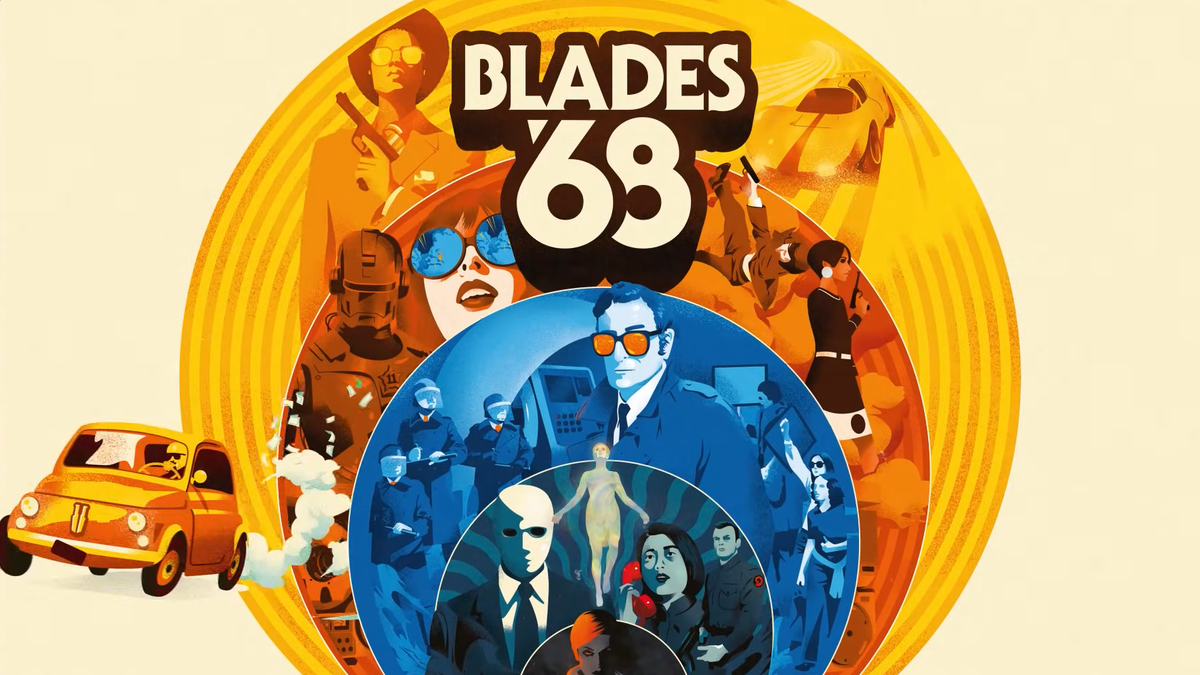
Tim Denee grew up caught between old and new. In his birth country of New Zealand, a national identity was struggling to emerge from soil thick with English influence throughout the 1980s. Music, television, and culture from the UK was losing its monopolistic grip, and in just a few years a suite of neoliberal reforms would combine with the islands' natural isolation to cast the preceding few decades in a nostalgic light that Denee found irresistible. A particular fascination with the 1960s, both real and the melodramatic one portrayed by Bond, Napoleon Solo, Number Six, and even Austin Powers, survived into adulthood and formed the aesthetic foundation of his new RPG: Blades ‘68.
The once steampunk-meets-eldritch city of Doskvol has crashed into gleaming, optimistic modernity. A lot changes in 100 years: the dark has been banished by an artificial sky, the grime of the past has been swept under the rug, and Akoros maintains control through covert espionage and cultural dominance. Original Blades in the Dark sent crews of desperate societal outcasts on jobs for the powers-that-be; Blades ‘68 holds on to that core loop while giving everything a technicolor coat of paint. You’re still working at the edges of reality, of legality, but you can now pretend there’s a corporate ladder to climb into the light of a simulated sun. And all the while, the horrors lurk just beyond Doskvol’s blue haze of imaginary control.
Blades ‘68 is the beneficiary of Denee’s previous career as a commercial illustrator. Its imaginary organizations and government agencies are depicted by business cards and confident, bold typography that advertises a new reality, a new world order. Here, too, he draws on his childhood; organized marches against the South African Sprinkbok rugby team in 1981, and the anti-apartheid sentiment amongst progressive New Zealanders, inspired a wealth of protest art that Denee injected into Doskvol’s more revolutionary, counterculture factions.
In an interview with Rascal, Denee was adamant that Blades ‘68 is not an allegorical work and doesn’t directly tie its simmering sociopolitical tensions to a Western Hemisphere gripped by the Cold War. Like Blades in the Dark’s cultural roots, his modernized setting evokes the 1960s without binding itself to one nation or culture too strongly. If pushed, Denee said he wants to ekove cities like London, Venice, or Prague — their historical roots nourishing a rapidly changing identity, even to its own detriment. There’s more of himself in this description than he admits.
Currently crowdfunding a 450-page book that Denee called an official supplement, Blades ‘68 is audacious in design but familiar enough in mechanics to welcome those already familiar with Forged in the Dark-style RPGs. Crews, jobs, clocks, Stress — it’s all still here, but massaged and tweaked. This is a Blades for a daring and fearless era. This is a Blades with panache, intrigue, and velvet. This is still a Blades haunted at the extremes by something unknowable and terrifying.
This interview has been edited slightly for clarity.