Battle over Yazeba’s Bed & Breakfast contracts leaves the book, relationships, torn apart

Creative collaborators clash with Jay Dragon and Steve Jackson Games over unfair treatment.

Battle over Yazeba’s Bed & Breakfast contracts leaves the book, relationships, torn apart
Credit: Possum Creek Games / Katie Hicks

Yazeba’s Bed & Breakfast is an acclaimed tabletop RPG from small press Possum Creek Games, collecting the stories of several residents of the eponymous house into 48 chapters with distinct rules. Its writing was nominated for a Nebula Award in 2024 and won an Origins Award in the same year for best core product, alongside four ENNIE nominations in 2025 that include best writing and cover art. Its original IndieGoGo campaign raised over $300,000 from roughly 3,600 backers, making it one of the most successful tabletop projects on the platform. Following up on the cultural and critical success of Wanderhome, this book was a big deal.

And yet, you cannot find Yazeba’s Bed & Breakfast anywhere — at least, not in print. Physical copies were fulfilled to backers, and a few lucky people purchased extra stock from Possum Creek Games’ booth at a handful of conventions throughout 2024. Otherwise, empty storefronts. Following a link for physical books on the company’s official itch.io page offers a single clue: “Possum Creek is a pupa right now. We've paused all shipments of physical books while we sort out our backlog and resolve various issues.”

When Possum Creek Games partnered with Steve Jackson Games in February, 2025, it seemed possible that the chunky, pink-covered RPG might finally have found a path to publication, but the arrangement produced no such movement. The reason for such delays was unclear until, in July of 2025, a group of five writers and artists who had been hired to produce significant work in the original version of Yazeba’s Bed & Breakfast emailed Rascal. They believed that the new arrangement between the two companies triggered a renegotiation of their original contracts, and possibly constituted a legal breach of those contracts. 

What Rascal uncovered through interviews and documents was a strained working relationship between the five creators and Possum Creek Games co-founder Jay Dragon, completely soured by the auteur's poor communication, minimal transparency, and perceived betrayal. Dragon has disputed both of the groups’ allegations in emails and messages since January 2025. Steve Jackson Games never explicitly denied the aforementioned claims, instead doggedly pursuing buyouts via a lawyer and killing nearly all other negotiations. The three parties are now snared in a legal tangle that may fundamentally alter Yazeba’s Bed & Breakfast if it is ever to grace a game store shelf.
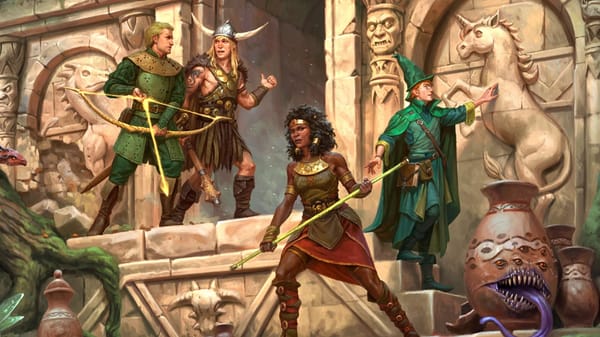
Alongside creators Jay Dragon and M Veselak, two other writers’ names appear prominently in Yazeba’s credits, both on the IndieGoGo campaign and Possum Creek Games’ website: Mercedes Acosta and Lillie J. Harris. Acosta is an author and illustrator with an upcoming graphic novel titled Monster Cabaret, and Harris is a cartoonist and writer who published their graphic novel, Wilderness, through Radiator Comics. The duo told Rascal they were initially thrilled to work for a small press they believed would not only bring on queer people of color to the creative team but grant them material equity in the project. The contracts they signed with Possum Creek Games in December 2021 promised a flat fee of $3,000 before March 2022, 15% of any profit above the crowdfunding campaign’s baseline goal, and additional royalties “equal to 4% of the MSRP of each copy of the physical version of the product, to be paid quarterly, for a period of no less than 5 years.” Rascal independently reviewed and confirmed the contents of these contracts.

Artists Val K. Wise, Ashanti Fortson, and Mar Julia, whose work is featured throughout the book, signed similar contracts, but their royalties were attached to gross revenue from merchandise sales. Regardless of stipulations, everyone considered it a good deal. “I’ve had experiences with big publishers who treat their contractors like shit,” said Wise, a comic and game artist whom other sources recognized as defining Yazeba’s visual style. “So, I was really excited to work for Possum Creek Games, a smaller company that seemed to have the same values that I did — and, honestly, paid me more than I had previously been paid per illustration.”

But payment issues consistently plagued the working relationships between Possum Creek Games and the collaborators. In early 2022, after the IndieGoGo campaign passed a team bonus crowdfunding stretch goal, Acosta and Harris were verbally promised $20,000 flat payments each that would replace a 15% profit share from the campaign, as listed in their initial contracts. In April 2022, a digital document shared within the company’s private Discord server instead only earmarked $10,000 for the writers. No explanation accompanied the document, so Acosta and Harries raised the issue and politely contested the discrepancy with Possum Creek Game’s staff.

When confronted, Dragon and Lavin allegedly said the ballooning cost of paper and printing had chewed into the project’s final net profit. The Russian invasion of Ukraine, the long shadow of the COVID-19 pandemic, and strikes enacted by the Finnish Paperworkers’ Union worked in concert to jam global supply chains just as demand for paper goods of all types was beginning to rise. Printing felt more the effects of symptomatic inflation and skyrocketing energy costs as countries spurned Russian exports, on top of the decades-long struggle against digital media ubiquity.

"I don't know this person. Who is this hypercapitalist pretending to be the soft, queer, indie communist?”

The writers claim the issue would have gone unremarked had they not flagged the discrepancy with Dragon and Lavin. Possum Creek Games allegedly could not produce documentation verifying an agreement on the reduced figure but eventually agreed to pay $10,000 immediately and dole out the remaining $10,000 promised once IndieGoGo dispersed funds. The conflict left a sour taste in the freelancer’s mouths. They characterized this miscommunication as the first instance where Dragon and the company were treating them as hired hands instead of valued members of the team.