Gamefound wants to throw another successful RPG Party after learning hard lessons
"If we can be a third pillar in the RPG space rather than another monolith, that just feels really healthy."

Crowdfunding events feel less momentous these days, flush as we are with months, drives, collaborations, and hype trains. Gamefound’s RPG Party, which debuted in 2025, wanted to set itself apart. The intentionally curated crop of projects were mainly selected from aspirants and first-timers and then paired with professional services — not only mentorships with established publishers such as Chaosium and Magpies Games, but also consultation, workshops, and an advertising budget. All but six campaigns successfully funded, anchored by contributions from partnered companies and Wildsea maker, Mythworks.
Gamefound has opened its submission process for 2026’s event, proving that a platform utterly dominated by big box board games and baroque plastic miniatures can shine a little spotlight on improvisational storytelling. This year’s professional partners include Modiphius Entertainment, Free League, Magpie Games, and Darrington Press, all companies with a proven track record crowdfunding their tabletop products. Gamefound will once again select between 15 and 25 projects from designers who want to create an original work and commit to using Gamefound when it comes time to launch.
Was 2025’s party a success? New business manager and RPG Party’s chief evangelist, Cam Bradley, thought so. Rascal sat down with him to discuss lessons learned and insights gleaned from Gamefound’s bridge-building efforts into the tabletop RPG sphere. Prone to superlatives and not lacking passion, Bradley believes his company is doing something vital and different from platform competitors Kickstarter and BackerKit. He conceives of support that extends beyond the end of 30 days of hype and FOMO, of professional development that might allow designers to create RPGs for a living.
RPG Party wasn’t perfect, and there’s much Bradley can’t yet predict or account for. For example, he attributes the failed projects to an unwillingness or inability to network, to not using the services Gamefound provided. It is perhaps a naive read of a volatile and prickly financial model, but he genuinely sounded curious and disappointed rather than dismissive. RPG Party’s heart rests in fostering new talent, even if the log line ends up ‘and Gamefound is the best place to fund your work’. At the very least, it treats artists less like show ponies and more like people mired in a cutthroat industry. It’s a start.
This interview has been lightly edited for clarity.
 Gamefound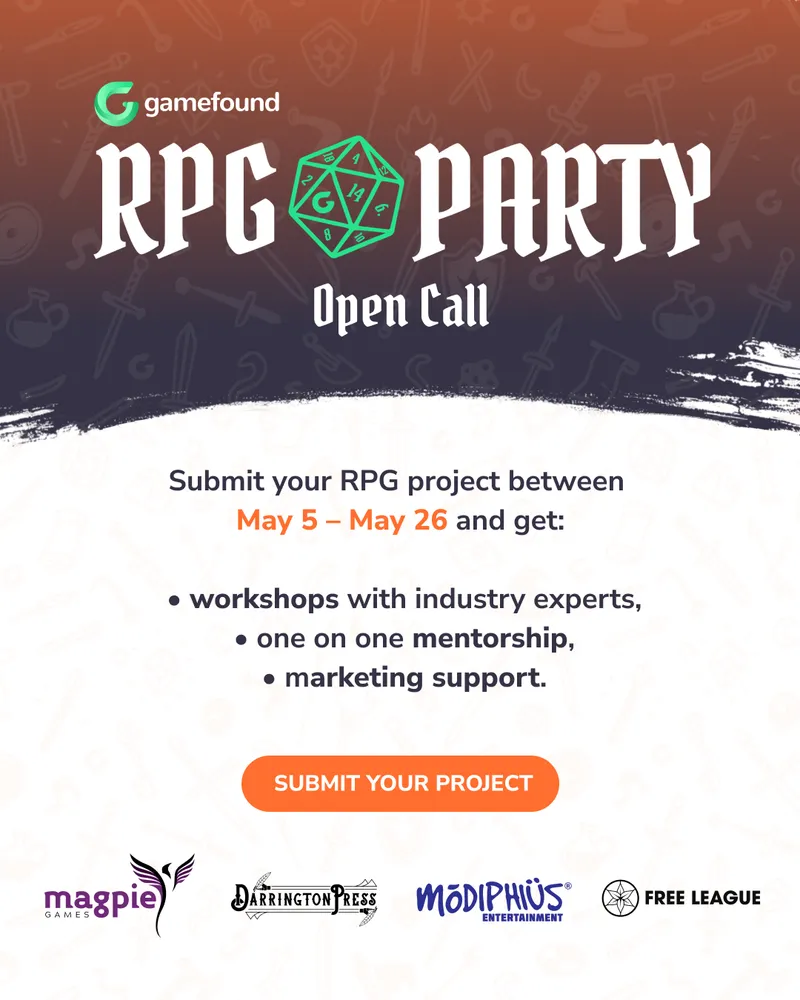
Chase Taylor-Carter: How did the pitch for RPG Party come about? What was the initial thinking around it?
Cam Bradley: When I joined, one of the first things I really wanted to do, especially after learning our toolset on the backend, was to increase the number of RPG projects. Our tool set is so tailored made for tabletop campaigns that it just feels like such a good fit. I love everything tabletop, but TTRPGs are what I play the most. It's also what I've enjoyed in crowdfunding the longest. This is my personal crusade to make happen. If we can get a really big project to launch with us, and we can have that one case study, it'll be the straw that breaks the camel's back or whatever — the little bit to show that we've got this group of concepts. Let's go from there.
That's been incredibly challenging. We've definitely had some quite successful projects, but we're inviting people to a party and those people are asking, well, who else is going? So, instead of trying to chase [success] from the top down, there's a whole bunch of amazing upcoming creators that are doing the exact same thing. Why don't we partner with some established folks in this space to then help nurture up-and-comers? That was how RPG Party came about. Originally, if we could have three mid-size-to-big campaigns that we can announce altogether, that would be the thing. But it was just impossible to coordinate. So then it was like, okay, let's start with grassroots and go from there.
Taylor-Carter: Why was it so difficult to coordinate three larger projects that Gamefound believed would be successful? How do you forecast success?
Bradley: I am not the best at this. I would say Alex [Radcliffe], my manager is. He's got a very numerical mind and a huge amount of experience in games. His estimates are usually conservative, but watching him estimate how projects are going to fund is insane. For me, it's definitely a hearts and minds kind of vibe. What is the project you put together? What's going to be on offer? And obviously how visually compelling it is. That’s a starting point. Based on average pledged values and such, you can work from there. In the case of looking at established folks in the industry, what have they funded before? What are they working on? Is it going to be a continuation of something they’ve done before, or is it something new? And again, looking at some pledge values and what's going to be on offer.
One event that we do across the board for all tabletop projects are what we call Feasts. That was the idea for the first iteration of the RPG Party; let's do a preview reveal event for these multiple projects, anywhere from 10 to upwards of 20 projects all revealed at the same time, if it fits their timeline. Let's do something similar for RPGs, which, well… It was naive because obviously that's a much more established space for us [to enter]. Timelines often shift for a myriad amount of reasons, so trying to line that up was basically possible.
Taylor-Carter: Can you share some of the ways tabletop RPG projects differ from board game projects, from Gamefound’s perspective? How did those discrepancies cause problems?
Bradley: RPG Party wasn't like the way that we usually operate as a platform. A really good comparison is looking at, say, Zine Month or any of the various game months on BackerKit. Which are awesome events, but they're also very much like here's the platform, launch your thing on it rather than being like here's the platform, here's all the things that we're going to do to work it out, and then also some really strict things like your preview needs to be live on this date, or your campaign needs to start on this date. Which was a really interesting challenge because we learned so many things doing the event for the first time. We'd bottlenecked not only ourselves, but also all of these various creative individuals who, again, are operating on various different timelines at various levels of preparedness — all kinds of personal schedules, too. That was a big learning moment for sure.
This isn't necessarily my thought, but it is a generalization that I've heard in the space from a few different folks, and I think it’s worth sharing. I see it at conventions too, which is funny: comparing board game creators to RPG creators very much reminds me in a general sense of people trying to do something very business-like versus people trying to follow their passions and do something creatively fulfilling. It's almost all the RPG folks that are out socializing late into the night but hardly ever the board game folks.
One of the things that we're doing this year that we didn't in 2025 is having a syllabus (for lack of a better word) of things that we're going to be covering and helping with, or getting friends in the industry to come and run workshops in. That said, these are things that you should also be looking into on your own time and that you'll need to have prepared. We're also changing launch dates up to instead tell creators to launch previews by a specific date, and then Gamefound will start promoting them on that specific date forward. Project launches, too: instead of a set window that everyone's launching within — I'm mixed on getting rid of it because there's so much fun being able to celebrate with everybody — they will be able to launch when they want within a set window, which is going to be much more effective.
Taylor-Carter: Sounds like less marketing and more stewardship is the goal.
Bradley: Absolutely. It's kind of funny watching the life cycle of crowdfunding campaigns once they're live. If someone hasn't funded and they are halfway or two thirds of the way through their campaign, you can tell if they're really pushing to fund or if they've just stepped back to wait and see what happens. I'd say 9.5 out of 10 times, stepping back fulfills your own prophecy, and you're not going to be able to cross the funding line. There were a few people last year that I reached out to and asked if it's worth pushing to see if they were able to fund — because I sincerely thought they could, that they had a good chance at it — or if it made sense to shift the conversation into progressing your project after this campaign. Those were incredibly rewarding.
Taylor-Carter: Does leaning into this incubator mode change Gamefound’s selection process for RPG Party?
Bradley: It's pretty similar to last year. One of the things that we omitted on the submission form last year was that you need to be in a country that our payment provider accepts, or have the means to do that. Luckily, that worked out, but that was a very important thing that we omitted. Also, more clarity on what projects we're looking for: it can be almost anything under the sun as long as there’s a physical component, which is one of the strengths for the event. Obviously, it makes it hard to manage all of these various sizes and styles of projects. Last year ranged from zines all the way up to two source books just north of 700 pages, plus a tarot deck and a whole bunch of zine adventures, too.
Taylor-Carter: How involved in 2025’s crop of participants is Gamefound? It seems the company has a direct opportunity to practice that stewardship angle.
Bradley: We have been for sure. The amount of hands-on stuff is a little bit less. We haven't done any workshops, or anything since the crowdfunding stage ended, but we did try to set everybody up with a workshop dedicated specifically on how to make the most of the post-campaign lifecycle and to keep your project going after fulfillment. Retail, networking with other creators, and getting into convention cycles. On a more day-to-day basis, we still have an active Discord community with myself, some of the support team, and then all of the creators from last year. It's definitely quieter than during the lead up to, and during, crowdfunding, but if anyone ever has any questions or problems or wins, it's always shared there.
Taylor-Carter: Do you have any insights into the projects that didn't fund in 2025? What went wrong? What could have been done better?
Bradley: Generally speaking, it was the folks that weren't present in the Discord channel because it turned into this wonderful, gamer-centric community of helping each other out, sharing resources, and bouncing ideas off of each other. There's also a few folks that collaborated on stuff mid-campaign. So, the folks that weren't engaged in the community and didn't attend the workshops were generally the folks that didn't fund anything. I’m happy to take some of the responsibility there, too, because all the workshops we did were done live. We thought if we recorded them, chances are less that people would show up live, and then it's not going to be as good of a workshop. But a lot of people can't make the time to attend an hour-long workshop if they're working. So, this year, the workshops are all recorded.
Also, folks that didn't offer anything physical. There were one or two people who pivoted partway through before launch and changed to a more digital medium, which resulted in a lot less funding.
Taylor-Carter: Is a preference for physical over digital goods true across Gamefound?
Bradley: Yeah, definitely. It goes back to our core audience being very much tabletop miniature-specific. It's grown so much since those days, but that is still the root core. I will be curious going forward if that changes. I have seen a whole bunch of really cool projects across the board offering STL components in their campaigns — more TTRPGs but definitely war games of various kinds. Not everyone has a 3D printer at home, but it's really easy to find someone who does print well locally.
Taylor-Carter: What is RPG Party doing to set Gamefound apart as a crowdfunding platform in the minds of creators and players?
Bradley: Mostly the hands-on support, but also how long it is. Last year, the full RPG Party experience was six to eight months for participants. Part of this mission process is very much prioritizing people who want to launch their first project. Incubator is a great term for it, being able to give these folks a leg up, give them a whole bunch of education and knowledge that they can carry forward. Then there’s the networking connection among all of the other folks in the space, be it the other creators part of this year’s events, creators that were part of previous events, or my own personal network that I leverage for input and advice.
Taylor-Carter: What is GameFound's guidance on setting the public funding goals, especially for the first-timers?
Bradley: Crowdfunding, in general, is such a transparent, community-based industry, but then there's funding goals. The vast majority of time they are not nearly what is actually needed to get a project across the board and delivered. What do you need to fund? Are you going to be doing stretch goals? Are you not doing stretch goals? Here's what some other people in the industry have said that they set their funding goals at. What is your financial situation in case you don't reach where you actually need to be? We talk about it holistically because, especially with attention spans online being five seconds, if you aren't able to get across that funding goal efficiently, it will ultimately hamper your campaign. Do you need to fund on day one or two? Definitely not. But you need to be able to have an accessible goal that you can actually pass.
Taylor-Carter: Another polarizing issue with crowdfunding amongst tabletop RPG creators is using the platform as a risk-free pre-order system, especially by large, established publishers. What is Gamefound’s philosophy on how creators should use the platform, and how are you instructing new artists?
Bradley: Again, it depends on both the project and who is making it. Questions on the submission forum ask things like, how far along is your project? How long do you estimate it will take to fully complete? Some people came with fully completed games, which is always awesome to see. Some others were halfway there but said they would be able to deliver in three months. I was like, no, you won't, but we can talk about where you need to be.
I think it's fair to say that the golden age of crowdfunding was pre-COVID with so many stretch goals and so many crazy things getting added onto projects that really, really distanced timelines. I think people funding unfinished dreams is the root of crowdfunding that should always remain. That said, I do think it's a net positive that the industry has shifted to making sure we get this to you within an appropriate timeframe. And if that timeframe slips by a couple of months, that's totally fine in my opinion.
Taylor-Carter: Is Gamefound looking to grow its reach with, and revenue from, RPGs in a way that matches BackerKit and Kickstarter? Or remain a small but vibrant slice?
Bradley: We definitely have growth plans. I can't share any specifics, but we have some much larger-scale campaigns that are going to be launching with us in the near future, which is really exciting. I’ve been trying to make it happen for a long time. What I would personally love to see — and I think this would be the healthiest, as well — is rather than Gamefound being the go-to spot for RPGs, it being a serious contender. Crowdfunding is in a very interesting place and has continued to evolve and change, but I think one of the biggest tricks of it right now is not having the monopoly on where to launch your stuff. That is a benefit for everyone. If we can be a third pillar in the RPG space rather than another monolith, that feels really healthy.
Taylor-Carter: What were some of the more useful pieces of feedback that Gamefound received from last year's participants in RPG Party?
Bradley: One was timelines; they were way too quick for the first one. Workshops were really beneficial, but a lot of people weren't able to make them, which is part of the reason why we're recording these ones. Digital fulfillment was an interesting one, because it's a tool that I've been trying to champion behind the scenes for a long time. A surprising amount of RPG creators said no, they wouldn’t need it, but a lot of those people were also on BackerKit using digital fulfillment. So, it was kind of a funny catch-22. Discoverability was an interesting one because I'd say, on average, the projects received a lot less followers than a board game project would — and a lot less engagement from said followers — but a higher conversion rate. Again, that's napkin math, but I'm pretty sure their conversion rates were quite solid for those that funded.
Taylor-Carter: What do you believe GameFound could or should do as a platform to best help RPGs as a creative industry? Especially pertaining first-time creators surviving beyond their first project.
Bradley: There are so many pieces to a project that you don't see moving when you're backing the project. I'm looking to launch my first, tiny project in the next year or two, and my big fears are taxes and distribution. More tools and assistance there is really important because I think in almost any industry, there's always either one or maybe a couple routes to go. Publishing is a great example: you have traditional publishing, which you need to work your ass off and maybe, maybe you'll get in; and self-publishing, which you need to work your ass off and maybe find success. Navigating crowdfunding is similar: you have your platform choice; what kind of marketing are you doing; who are you going to market with; are you going to do your own marketing? And then how are you going to fulfill? What kind of printing are you going to do? At a glance, those aren't big questions, but there's so many questions that are a part of each of those steps. More guidance there would be so cool to see.
Something Gamefound has been big on is having a one-stop shop for everything. What if crowdfunding platforms were able to step in directly and help fulfill things, too? One thing we are slowly working on — it was put on hold last year, and it looks like it's coming back soon — is how to get projects retail ready. How do you engage with various store owners? That's something that's existed forever. We talk to established creators about how they interface with retail pledges, and a really common answer is an Excel sheet. GameFound has a public-facing store feature, and after we launched that, a creator at a convention asked if we’d ever thought about changing that into a B2B functionality? We hadn't, but now we definitely are because that's a great idea.
Taylor-Carter: It seems Gamefound wants to be very receptive to feedback and doing what's best for the creators. Will that conviction hold up through years that are not as successful? Is there a chance the platform puts RPG Party on ice if it doesn’t consistently perform well financially?
Bradley: I've worked customer service my entire life. The biggest thing for me is relationships and being able to build and succeed together. One of my favorite things about being part of the Gamefound team is how open they are to feedback. I was pretty sure that we'd be able to come back and do RPG Party again, but there were a lot of resources that went into it behind the scenes. Objectively, it was a financial loss, but that's also not the goal of the event. I'm sure there'll come a time when that needs to be revisited, but the whole goal of the event is to be able to give back while also growing on our own.
What it's going to look like years from now is hard to say, but as long as I'm here — and I have no intentions of leaving — the goal is to be able to nurture and mentor up-and-comers in the space and celebrate that with established people in the industry.
RPG Party’s call for submissions is open until May 26.