License to Kill: A Tale of Two Hellboys
In this column about licensed RPGs, let’s look at two adaptations of the Big Red guy.

License to Kill is my relatively informal column about licensed games. It’s an exploratory exercise and will have more questions than answers, more quick references than deep dives. To get a sense of where I’m starting from, read the opening entry.
Like gods, licensed games have incarnations. Different authors take them up at different times, and, thus, they become different things aimed at different people. For the inaugural column, I wanted to look at two adaptations of the same property and see what they can tell us about why and how these RPGS were made.
So, let’s talk about Hellboy Sourcebook and Roleplaying Game (2002, Steve Jackson Games) and Hellboy: The Roleplaying Game (2020-ish, Mantic Games). But that’s a mouthful so we’ll call them GURPS Hellboy and 5e Hellboy to keep it simple.
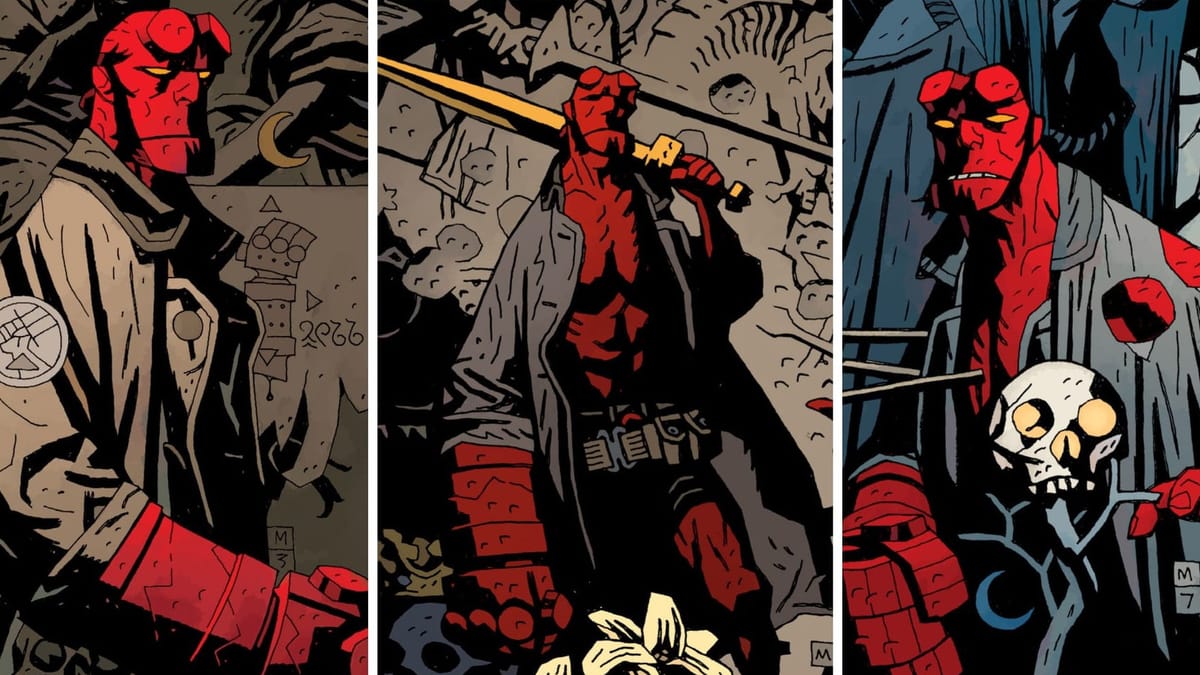
For those who have never heard of GURPS, it stands for Generic Universal RolePlaying System, was created in 1986 by Steve Jackson Games, and since then has accumulated a mind-boggling array of supplements and sourcebooks. The idea was ‘whatever you can think of, you can do it in GURPS’ — the last system you need to learn, and so on. Which should sound familiar to anyone who’s ever interacted with an overzealous defender of the other system being used here: D&D 5e. A lot of games that build on the 5e chassis are easy targets because there’s no synergy between what they’re adapting. But that’s not necessarily true for Hellboy. Mike Mignola’s comic series is about a team of powerful weirdos saving the day. It was an obvious choice for an RPG in 2002, and it remained one in 2020.

Of course, in 2002, there was a lot less of Hellboy to cover. Jonathan Woodward was one of the designers of GURPS Hellboy. He’s also a reader and got in touch to share his experience. “I wrote [GURPS Ogre], and apparently did a fairly good job because, I think even before that one was published, they said, ‘hey, are you familiar with Hellboy?,’” said Woodward in an interview with Rascal. SJG explicitly called it a ‘sourcebook’ so that it might appeal to comics fans as a bible of sorts for everything that had happened so far. They also made it the exact dimensions of the Hellboy comics so it could be shelved alongside them.
Steve Jackson Games had made adaptations before and so gave their writers a structure for the book: introduction, character creation, monsters & villains, magic, running the game, and so on. The bulk of the design work was an act of translation — articulating Mignola’s work through the language of GURPS and fitting it into that book structure. “I was reading [the comics] with a notepad at my side, and anytime Hellboy demonstrated a skill, I had to make a note, okay, he can do that,” said Woodward. “He can pull random stuff out of his pockets, and GURPS, that's the gizmo advantage. He speaks ancient Sumerian, I gotta give him that language skill.”
Probably, the most common challenge across game adaptations is translating magic — something that is usually strange and chaotic must be systematized and brought to heel. “Some people have psychic powers, and some people do ritual magic, and some people, like Rasputin, actually cast spells,” said Woodward. “I'm gonna have to put all three of these things in the same book in a way that will work for newcomers.”
Woodward had little communication with the licensors. Their primary interaction was when he had questions or clarifications. He remembers asking if the BPRD’s headquarters was meant to be a Frank Lloyd Wright building and got back an answer that amounted to: please don’t say that in the book.