Children of Time: The Roleplaying Game puts the fate of two civilizations in players’ hands
Your own personal "facsimile Adrian" Tchaikovsky.

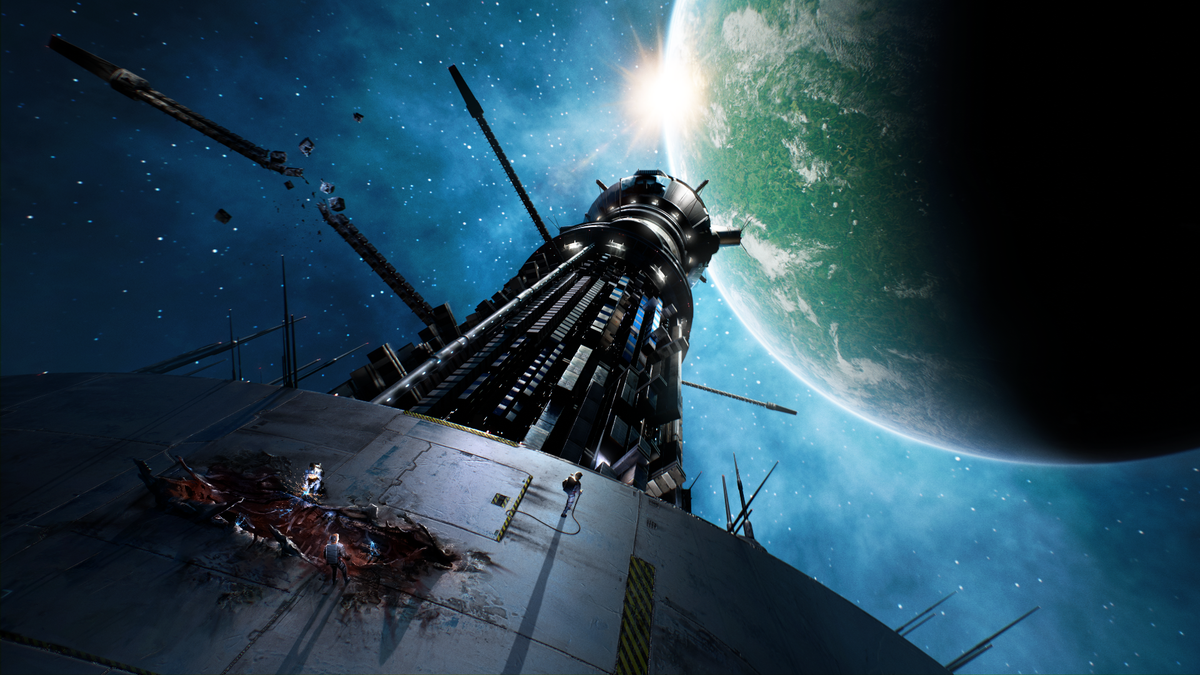
Whether or not they jumped at the concept of artificially uplifted spiders in the Children of Time, tabletop players will soon have the chance to tell their own version. Rowan, Rook, and Decard is adapting Adrian Tchaikovsky’s popular science fiction book series into Children of Time: The Roleplaying Game, which hits crowdfunding on June 16. A trio of RPG books will guide groups through tales of generational strife, tribulation, and an ultimate encounter between the remnants of humanity and the decidedly non-human beneficiaries of its lost accomplishments.
Leading the adaptation is Minærva McJanda, the creator of Voidheart Symphony, Rhapsody of Blood, and Legacy: Life Among the Ruin. That last RPG’s focus on communities in flux provides the backbone to RRD’s adaptation — sessions revolve around small but pivotal character decisions that can reverberate through time and space as the metaphorical camera zooms out from the personal to cohorts and then entire societies.
The rest of the team includes RRD co-founder Grant Howitt and publisher Elaine Lithgow offering additional writing, and illustrator Sam Lamont will bring Tchaikovsky’s world of beleaguered exocolonists and arachnid Portiids to life. Tchaikovsky is playing an active, if restrained, role in developing the RPG through playtesting, open communication, and trusting McJanda — the pair showcased an easy rapport and mutual creative respect. For the author, roleplay and writing have always been an act of cross-pollination, and he said allowing players and fans to not just explore his world, but make it their own, is a singular joy.
Children of Time: The Roleplaying Game is intentionally split across three books, the first of which will guide players through the grand, interstellar expansion and near-fatal collapse of human civilization. Worlds half-terraformed will be left to spin out on their own evolutionary journeys, and from one will rise an uplifted species set on a collision course with Earth’s final escapees. The second book will cover the ark ship that bears the latter through light years of space and millennia of time, while the third will help construct the exoplanet that will serve as a fateful collision of cultures.
McJanda and Tchaikovsky describe the RPG as an engine for dramatic irony, of tackling immediate dangers at the hands of engineers, scientists, or security guards, then collaborating on how the ramifications of those choices affect reputations, shift internal politics, angle the ark ship away from (or directly towards) unseen peril, and plant seeds that won’t bear fruit until they find a potential home already occupied.
The team said they labored to make telling good story its own reward, but that drive is scaffolded heavily by the shape of sessions: Individual characters, which can be piloted by anyone, have their own desires; cohorts work towards specialized projects or goals; and crises will interrupt all these well-laid plans. The books will instruct groups on how to roleplay as characters, narrators, and the dooms visited upon them, as well as how to leap forward 1,000 years into the future, away from apocalyptic Earth and into a future of their own crafting.
Rascal spoke further with McJanda and Tchaikovsky on how this project came about and the particulars of bridging the gap between speculative fiction readers and roleplayers empowered to tell stories together, intelligent Portia labiata or otherwise.
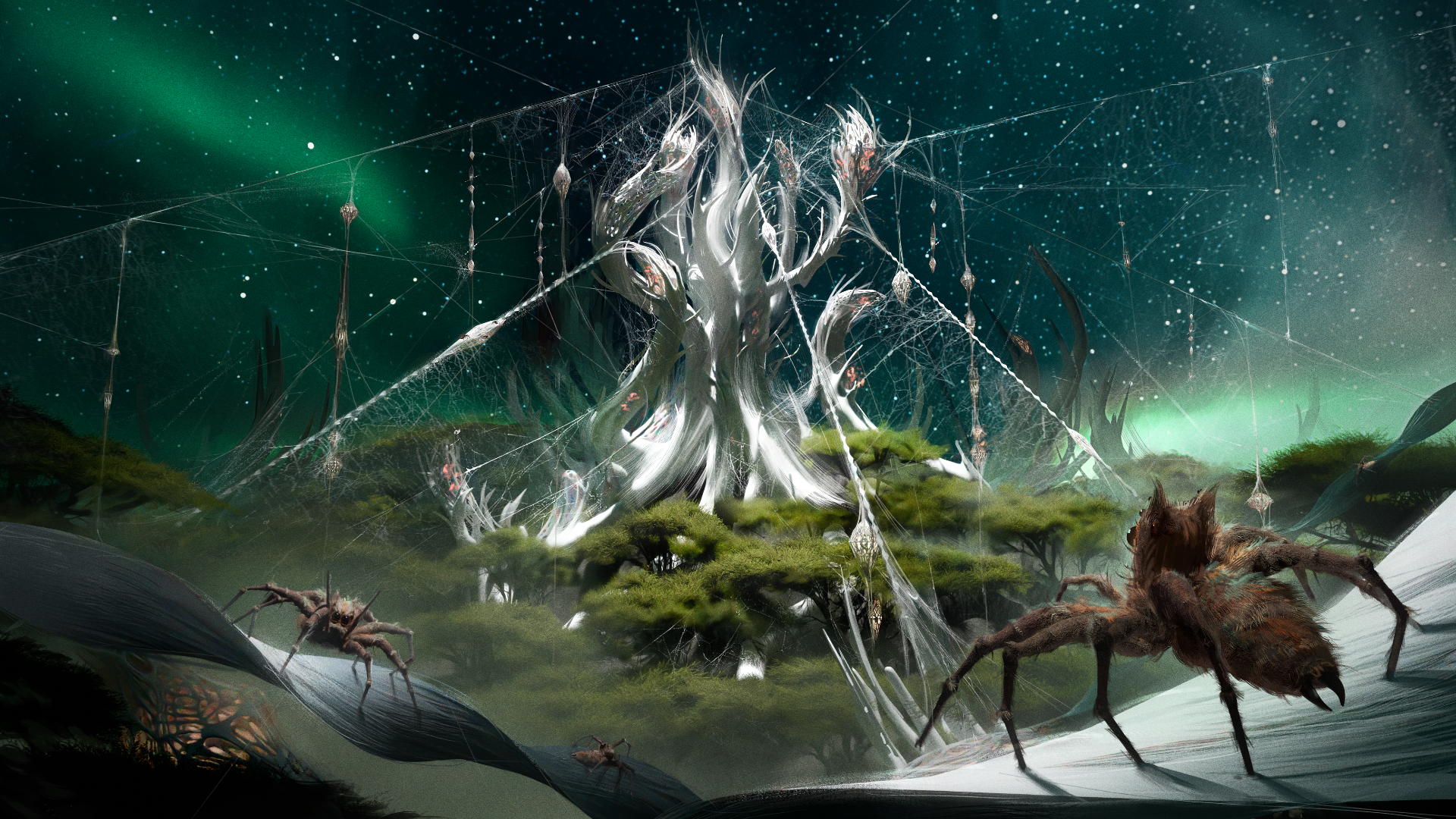
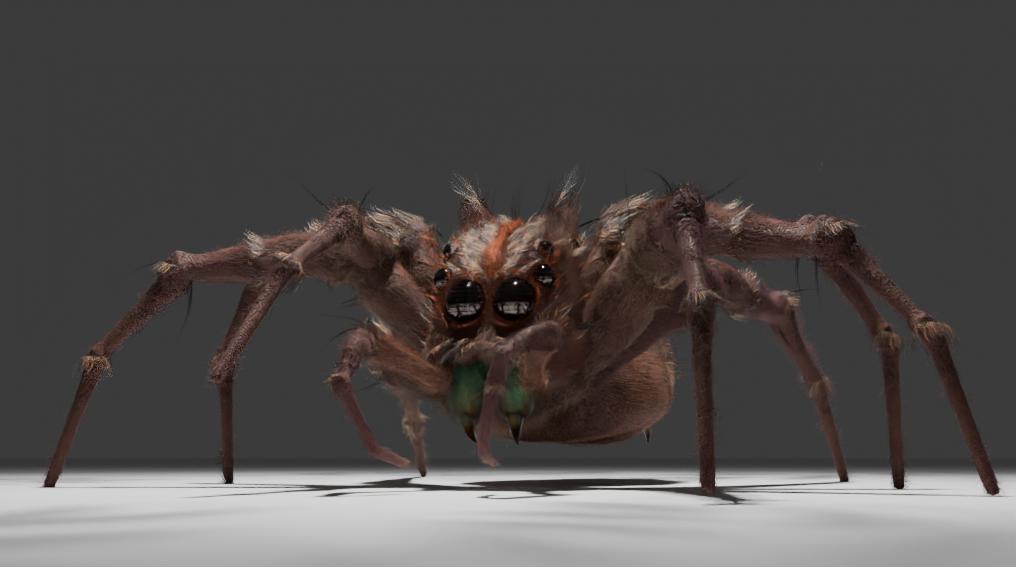
This interview has been edited for clarity. Also, a warning that the promotional art below includes prominent spider imagery.
Chase Taylor-Carter: A good place to start is how you came to work with Rowan, Rook, and Decard and, specifically, Minærva on the Children of Time: The Roleplaying Game.
Adrian Tchaikovsky: As well as an author, I'm a lifelong roleplayer. It's kind of a bucket list thing for me, and has been for some considerable time, that there might be a roleplaying game of any of my books. I'm also a big fan of Rowan, Rook, and Decard's work, especially Spire and Heart. I met up with them at Thought Bubble in Harrogate a few years ago to talk about a completely different project which didn't go anywhere, but at the time they were saying, have you had any thoughts about Children of Time? It's my best known series of books. I thought it would be really, really difficult to bring to the roleplaying game table. The only way you could do it is probably something a bit like Legacy: Life Among the Ruins, which has this longitudinal view: you're playing characters, and you're playing factions, but you're also kind of playing the history of the world.
The Children of Time series, especially the first book, focus on evolution and societal development over very long periods of time. And if you were just to do a standard role playing game in that kind of setting, you'd be sort of missing the point of the book. You could certainly do it, but you could use any sort of science fiction rules set — here you are in an ark ship, perhaps some ark ship adventures or whatever — but it's that transition through time that the book is about. As it happened, Rowan, Rook, and Decard had just acquired Legacy and were thinking about a new edition. It was just the perfect marriage of opportunity and timing really. Because it is the best known book, it is the one that I've also had a number of just unsolicited people asking, would you consider a roleplaying game of that? Literally the only way you could really make a game that actually represented what's going on in the books is with this particular system and setup.
Minærva McJanda: I've had momentary acquaintances with Adrian over the years. I remember selling you a copy of Generation Ship, the Legacy 2E hack at Nine Worlds in London, and being like, oh, this is basically Children of Time the RPG — or at least the ark ship side of it. I very much enjoy making games about societies and how they evolve and change over time, which is partly why I really loved the Children of Time book series. It's about societal evolution and entropy and these two opposing forces trying to make something nice and things going wrong, and how you adapt and change and how those changes reverberate through time. I studied zoology at university and then disease and viral evolution. The pressures of evolution and long time scales are very dear to my heart.
Taylor-Carter: How much of Legacy’s other rules, beyond that societal framework, will be present in the Children of Time RPG?
McJanda: We've mostly been focusing in playtests on a single era of play because the way the game works is a series of linked one shots where you say, okay, we're refreshing the board. Here's the new situation for our society. Here's the crisis they're facing. Let's introduce some characters who are dealing with the crisis. For example, for the ark ship side of play, the crisis might be food stocks are spoiled, or one of the decks is on fire, or we need to rotate the ship so we can start slowing it down. You bring characters to the table, which might be returning characters or new ones, but those characters aren't just all the individuals. They're members of a cohort in society. For the ship, that might be the command crew or the engineers or the medics who manage people in cryo sleep. For the planet side, it's more general — the providers or the protectors
You play through resolving this crisis with a mix of both big picture looks at the ship in general, but occasionally you'll zoom in, move behind the eyes of a character and go out into the world and try to achieve something that might be dangerous, difficult, and even controversial. Other people pick up characters as needed or start playing the crowd, or the ark ship around the person. Or, you can play from the perspective of the crisis to make things worse for people. Eventually, you zoom back out and see how that's affected the general state. Once that crisis reaches an ending, you zoom out even further. You resolve everything that happens there. You move the clock forward a hundred years, or maybe a thousand, and you say, this is how society changed as a result. People now view leadership with suspicion or they view them with hope, maybe just, this is how they view the engineers. Then you reset the board, you make a new crisis, you make a new situation that you have to deal with, and you continue playing.
The real secret sauce of this game is that it wouldn't be Children of Time if it didn't have two different perspectives. After your initial prologue session, where you play those terraformers setting up this planet, the game then plays out in two halves. On the one hand, you are the life that is developing on that terraformed planet, absence of human management, growing more intelligent, creating their own societies, creating their own ideas and ways of being. And on the other hand, you play the survivors of post-apocalyptic Earth who have cobbled together an ark ship out of old parts and found stories of these paradise worlds out there in the void beyond poor, toxic, infected Earth. You jump from one to the other and back again, and you're gradually telling the story of how these two societies deal with the different pressures they're under as they come closer together — until they eventually meet as the ark ship enters the planet’s orbit, and you work out what happens next. That's something only your group can decide.
Tchaikovsky: One of the things I tend to do in writing is whilst I may plan out quite a lot, I will never plan out the end of a book. It's very obvious to the reader that the spider culture and the human culture are going to meet, but precisely what happens when they do is very much something I was discovering as we hit the final leg of the book, as much as the reader would be discovering it when they were reading. So it does feel like the game is following a very similar pattern in the way that the players will be making their own discoveries and writing their own narrative of this collision of cultures.
Taylor-Carter: How does it feel to have your novels become this prototypical storytelling form? You are stripping away the specifics of Children of Time in order to create a skeleton on which groups can lay the musculature and connective tissue for their own games.
Tchaikovsky: Honestly, that's always the way I have wanted this to go. Games of any sort based on existing books or films can go a variety of ways. Sometimes you retell this particular thing — reenacting a civil war battle — and you get the idea that you're going dot-to-dot through the plot. Various points will be game mechanics and you will score points, or whatever. But at the end of the day, you're telling the same story. That's very much not what I would ever look for in a roleplaying game based on my work. The idea is you're giving that framework and structure that people can then write their own stories in.
Children of Time is spiders, but what is waiting for people, what has been steadily building its own society, on the planet when your particular ark ship gets there is going to be something completely different and something completely yours. To my mind, that's the only way it could really work. What we’re doing is absolutely the optimal way of bringing that about.
Taylor-Carter: It won’t be spiders by default, but it could be spiders. You want the RPG to support anything?
Tchaikovsky: If you also like spiders, it can be spiders. But there's no prescription that it has to be spiders. The idea of accelerated uplift in Children of Time will be the baseline [assumption]. Obviously, the imagination of players is limitless, and there will be all manner of different things you could slot into that particular section once you've started to play around.
McJanda: One of the things I'm really excited to get to in terms of writing are the planet sections where you consider this creature as your uplift candidate. What's it like when it's ants? What's it like when it's dolphins, camels, goats or hawks? Part of the fascination of the series as a whole, for me, is saying, this creature as we know it right now has these traits. If you add the uplift virus with its greater kin awareness, greater intelligence, inheritance of ideas, how's that going to change this creature as opposed to that creature? The books are an example of how your campaign could go more than the foreground [while] your characters are twiddling about in the back. I don't think there was any other way to adapt it, really.
Taylor-Carter: Minerva, how do you feel about adaptive RPGs, licensed RPGs? How are you approaching Children of Time to make sure that it’s successful in its purpose?
McJanda: I'm not speaking for everyone here, but you go to a license for one of two reasons: One is you think it's the route to make a lot of money; and the other is you're excited about the stories the IP tells. They're not mutually exclusive, but I enjoy making games when I am creating a framework. I want to mechanise telling stories in this vein. Most of my design sparks off of watching or reading some kind of media and thinking, this is really cool. I want to build a game that helps people tell stories like this. The original Legacy was largely [inspired by] A Canticle for Leibowitz, the book of post-apocalyptic monks illuminating circuit diagrams and such. If I have the opportunity to directly reference in the game the source material that so inspired me, I'll take it.
It creates some issues: the spiders are very pivotal to the book series, and we've had quite involved conversations about how much we foreground the spiders in our advertising material and in the book’s art. People coming to Children of Time RPG who know the book series, they want to see spiders, they expect spiders, but then the book is going to say it doesn't have to be spiders. How do you thread that needle? When you're using the license to excite people, the license needs to be strong enough that it can excite them in a lot of different ways. Free League's The One Ring RPG does a very good job of setting up Middle-earth and the time of The Lord of the Rings as a place to have stories that aren't the story of The Lord of the Rings. If you wanted to perfectly match the story of a work, that's not an RPG to me. That's, maybe, an adventure path or campaign. But if you're creating an RPG, you have a greater responsibility to set up the narrative framework for that entire world. If that can only tell one story, it's a bad model to me.
Taylor-Carter: Adrian, how involved day-to-day are you in the development of the game, and how much would you like to be?
Tchaikovsky: I'm very keen, but I'm also very aware I'm not a game designer. We had a very frank conversation where I was asked, how much would you like to be involved? We've now got this capital medium where at particular milestones, they'll give me a shout. We had an actual online playtest session a week or so ago, which was great fun. And that feels like the level of engagement I'm comfortable with. Obviously, I am writing books and doing edits and all the other stuff that comes with that. If [RRD] were constantly waiting for me to okay every full stop, the whole process would take about as long as it would take to get to the planet in the first place.
The creativity and thought processes that are involved in playing a game and in writing a book both overlap with designing a game, but designing a game also has its own entire segment of skills involved, which are not anything I've got any particular expertise in. I am mortified by the idea of just being this CEO person turning up and saying we should do this without having any idea of how anything works. I've got a finger on the pulse, but without any kind of micromanaging going on.
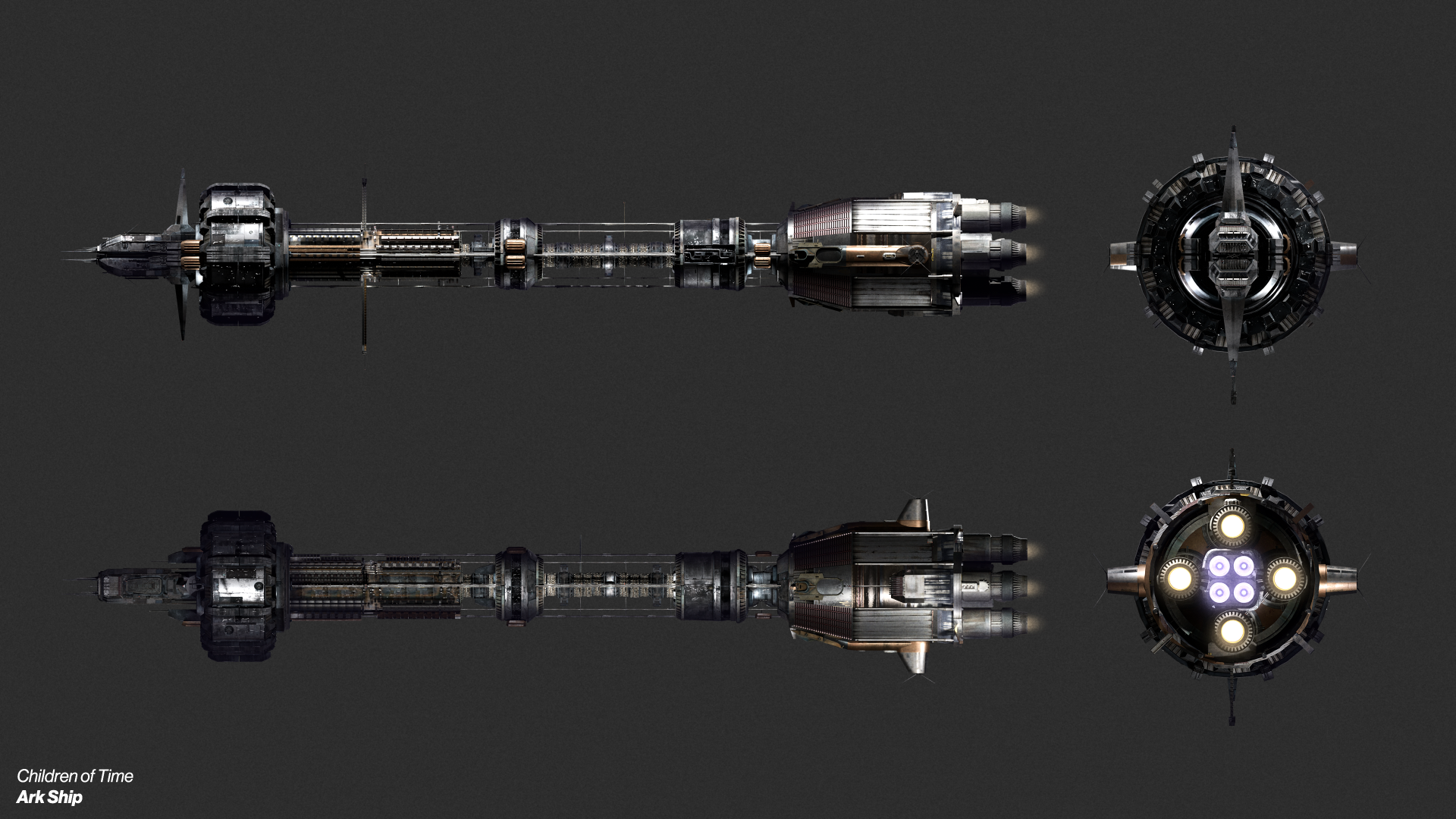
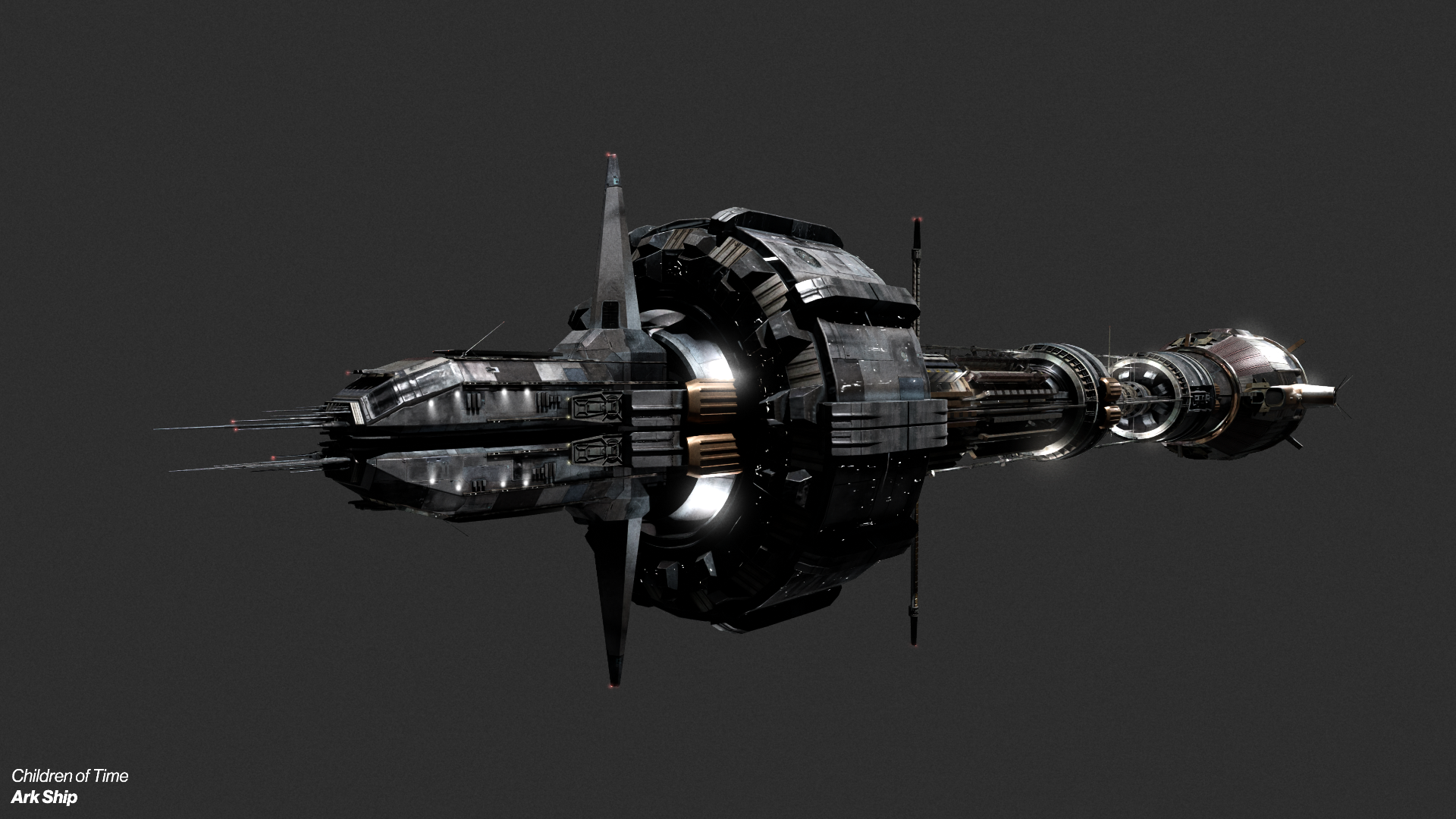
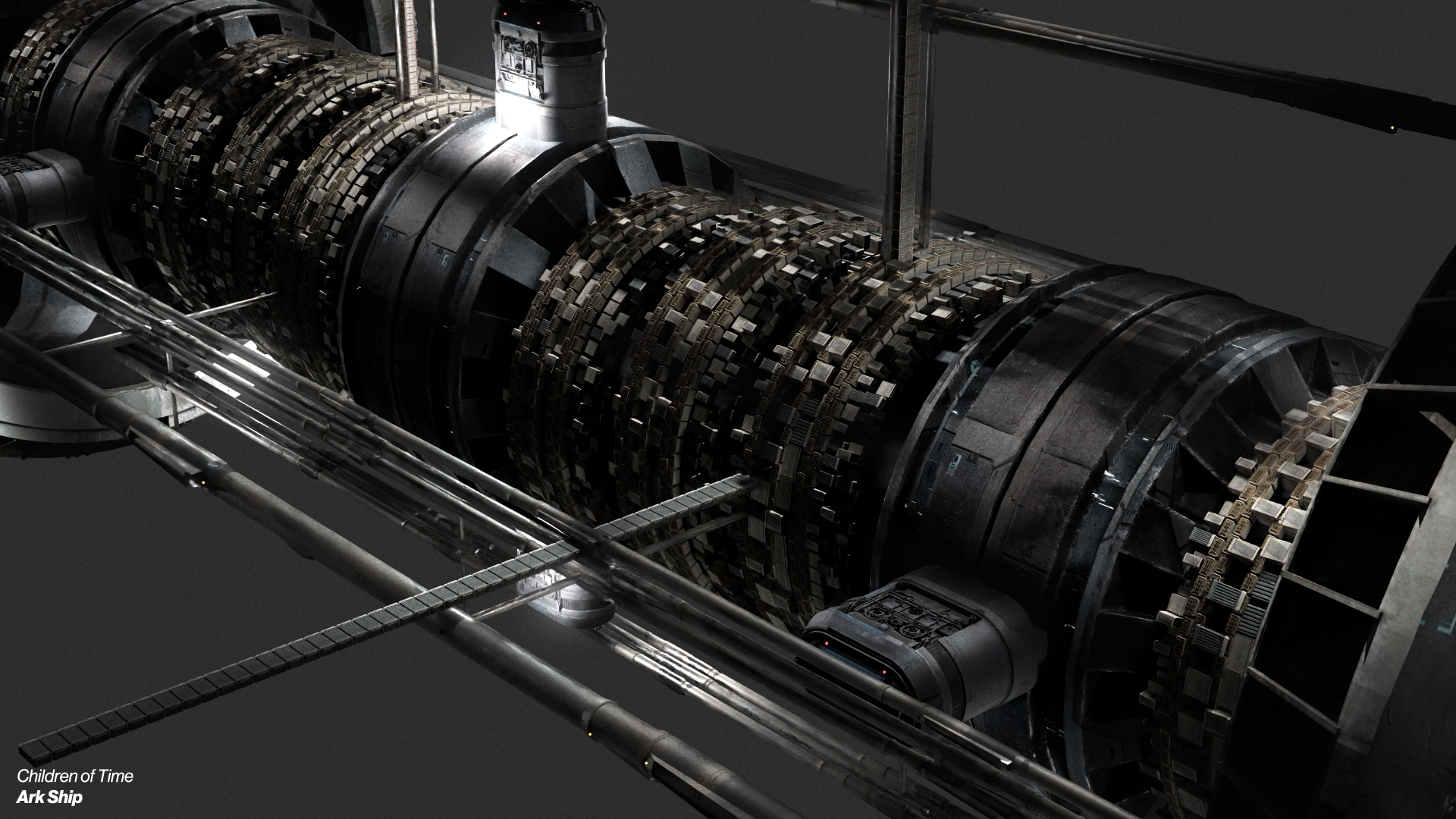
Mockups of the ark ship carrying the last of Earth's humans across the stars. (Note: not final art) | Credit: Sam Lamont / Rowan, Rook, and Decard
Taylor-Carter: I ask because there is often a perceived confidence from fans and readers in the success of the project when the author is directly, and heavily, involved. Specifically, this happens with your professional peers, Brandon Sanderson and George R. R. Martin. It seems like you fall into the camp that believes writing novels and writing screenplays, RPGs, etc. are all very different kinds of labor.
Tchaikovsky: Unlike screenplays or other media, I suppose there is the aspect that a lot of writers have at least played games. They are, I think, a more immersive experience than watching a film because you become more aware of the design and the nuts and bolts. Unlike a lot of writers, I have no interest in doing screenplays. I can at least offer a sort of an informed viewpoint when we do get together on the game side of things. But there are so many things going on under the hood with game design that, as a player, you don't necessarily pick up on. If they're being done properly, you're not supposed to notice them. Things just kind of work. I feel we've got the right level of engagement in that I'm not being left out of the loop. At the same time, I'm not being constantly called on to make trivial decisions, and also I'm not constantly looking over people's shoulders.
Taylor-Carter: What should give readers confidence that this project will meet whatever expectations they may have for a Children of Time RPG?
McJanda: I mean, I've been making games inspired by Children of Time for a while, and this is the first one I've made with Adrian's direct involvement. Another thing is poking at Elaine [Lithgow, RRD producer and designer], who is perhaps the most Children's super fan I've ever met. She has such a good memory for all the different items of the books and will bring up these little fragments of lore even during playtesting, and it's just very exciting to have these course corrections. What should hopefully give fans confidence, I think, is that we're trying to make a game that excites us more than we're trying to make a game that will appeal to fans. We're trying to make a game that will appeal to these fans. I'm doing my best to make a game that I can look at and say that's Children of Time to me.
Taylor-Carter: Note for transcript: Mina pointed two thumbs back at themself.
McJanda: One of our big design goals is to do all we can to make sure that each table can have a facsimile Adrian at the table. Give them the tools to be their own Adrian, to have their own interesting ideas about societies and creatures and evolution and change.
Tchaikovsky: I don't know if anyone has recollections of playing Middle-earth Role Playing back in the day and thinking this is very wizard heavy for a Tolkien game. This feels a lot more like D&D than Lord of the Rings. [Children of Time RPG] is trying to avoid that. The fact that we're doing it at all, the fact that this particular sort of system is the only way to pull off a Children of Time RPG is hopefully what people will take confidence from.
Elaine Lithgow: Something that keeps coming up a lot during the playtest is trying to make a game that lets you make speculative science fiction. There's so much above-the-table talk, which is not something that we see done a whole lot in roleplaying games. Having that small Adrian at the table and letting your group make speculative fiction are going hand in hand with the way we're talking about the game.
Taylor-Carter: Adrian, does playing RPGs affect the books you write, or does your writing process affect how you approach roleplay?
Tchaikovsky: I'm only a writer because of roleplaying games. I was a gamer, first and foremost. When I was about 17-ish, I ran into the Dragonlance chronicles, which are basically novelizations of people's game campaigns. That was this light bulb moment of, this is the thing I could do. This is where you meet a border that you can cross between playing games and writing about them. The big thing I carry over from games into writing is that I'm always writing about a world. In the same way I was creating worlds for people to play in, I'm always writing about a world that extends considerably beyond what you see on the page, whether it is like the four-dimensional world of Children of Time or the fantasy world of the Tyrant Philosophers series.
Hopefully, I'm writing a world that, because it's so much bigger than the book, has space for more stories. Whilst that's personally convenient because it means I can go back and write a sequel easily enough, it also means that if it does become a game setting — and I hear about quite a few people who homebrew games based on my work and that is always enormously gratifying to hear — it means I've created a world that people can have their own adventures in. For something completely unrelated to this particular game, I'm now thinking I have a setting in mind for a book that maybe I'd like to game out first, which is something I've not done for an absolute age. It might be fun to explore the world with a group of players before actually committing stuff to paper.
Taylor-Carter: One of the more interesting parts of adapting something like a book series to an RPG is you must consider the visual elements. How did you conceive of the visual element of these novels coming into the game becoming a real, physical object with layout and graphic design?
Tchaikovsky: You only have to look at the vast majority of my book covers to know that what is on the cover does not necessarily represent the actual details of what's in the book. You learn, as an author, to take a bit of a backseat on the visualization. I am used to working with the idea that whatever I put on the page, readers will have their own idea of what things look like, which may or may not even follow the explicit things I'm describing, let alone anything I'm leaving up to the imagination. Players should be making their games their own, instead of something that I'm necessarily trying to mandate.
McJanda: It's valid to put games out as text, but layout and art direction are game design to me. When you put a book or rule set in front of someone, that's the start of the process. The players picking up the book and telling stories with it is the rest of the process. As a designer, you never put down a machine that people will press a button to output story. You're giving them a set of tools. Graphic design and art, and even things like character sheet design, show them where to aim for. The art shows them how it should feel to fight a monster — is it desperate or glorious?
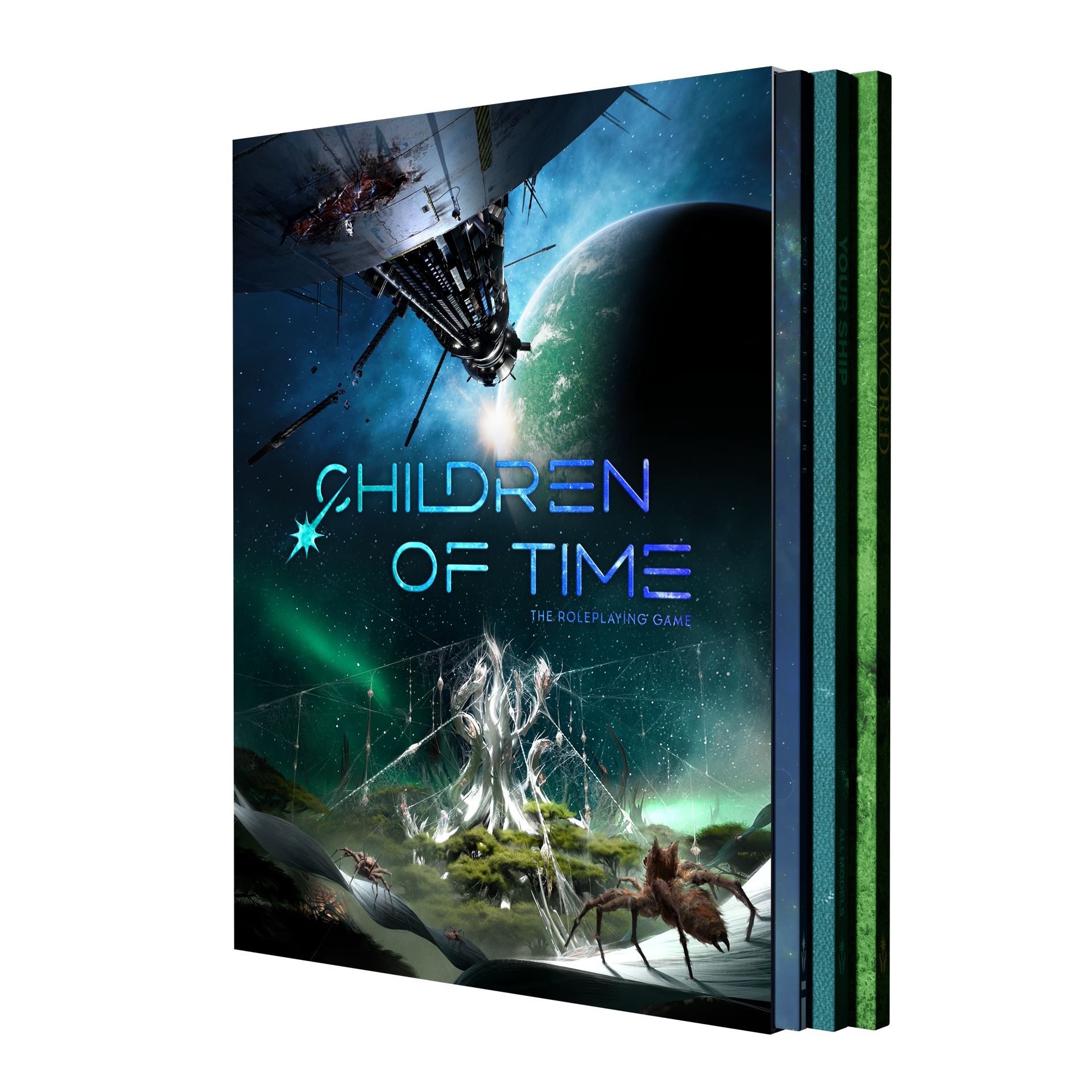
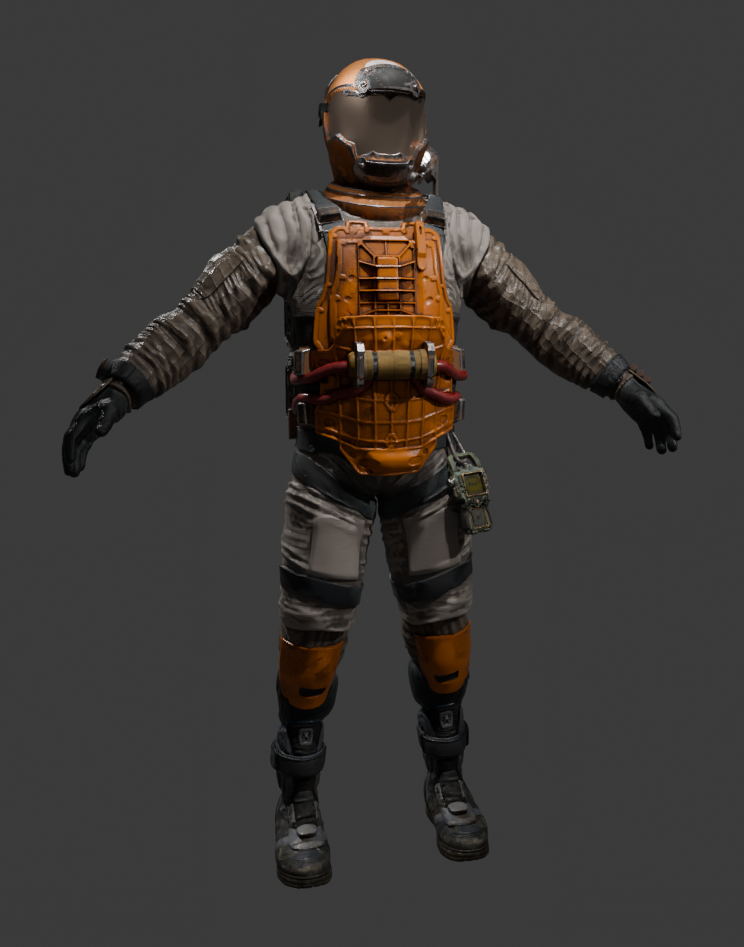
I am the sort of person who gets excited about paper. One of the things we decided ahead of time is that this game isn't a single book. It's three books in a set. One for the terraformer precursors (that's where you’ll find the core rules), one for your ark ship, and one for the planet. Each of those will have its own layout style, paper type, and illustration style. The terraforming book portrays the height of humanity; it's glossy, it's slick, it's very much investment prospectus-coded but getting more and more messed up as it goes. Part of the setting is this information virus that corrodes any and all digital systems. The ship book is going to be this rugged looking thing, a sort of Haynes manual, printed on dot matrix printer that's been well used and thumbed through and which people have relied on for years. They don't quite understand all the machinery around them, but this manual helps them survive. Finally, the planet book is going to be lots of color splashes, vellum texture, and wild and organic layout.
Taylor-Carter: Good to know RRD has not dropped its reputation for being absolute perverts for beautiful books.
McJanda: It's wild when you talk to other RPG creators, and they don't even know what paper they're using.
Taylor-Carter: How will the different modes of the game you’ve both described fit into a play loop across both a single session and a full campaign?
McJanda: There are three core modes you’re flitting between. The first is speculation, where the table talks about the situation, what's going on, what's happening in the society. Then, there's background action, where it's just flipping through one role per scene of day in the life character stuff for the whole table. Finally, there's a viewpoint action where a player takes up one of the characters as foci for different scenes of story as you all try to work this through these deep, involved sessions. Those might have knock-on impacts on the world that you've built together. All the different locations on your ship or on your planet have their own traits that can be affected by this stuff.
If things go bad, they might get lingering fallout that you have to deal with for the rest of this era. Maybe it goes well, at which point you start ticking closer towards resolving your current problem. As you're doing that, players are trying to hit the various beats they’ve picked for their characters. Maybe when you started this era, you wanted to see this person pass responsibility onto someone else for a problem they caused. Or they wanted to find a new family. As you do, characters can grow and change, they can shift how their cohort of society is seen. Once you're done with intense action, you zoom back out and see how that's changed the wider situation before moving forward.
What I've described there might be half a session or one session, but you just go through that loop until you're done with this era. The mechanics will simply tell you how society has grown and shifted between this era and the next one. Maybe the lens of the story stays with the ark or the planet, or maybe you jump somewhere else. The nice thing about the various crises that we're designing, which are page-sized adventure seeds in some ways, is each of them have little tags that tell your group what kind of thing you'll be dealing with. Maybe there’s a health crisis on the ark with too many people now and not enough food. Let's go to the planet, and see how they deal with overpopulation. You're building up these points of similarity and difference between the two venues of play, which will help you discuss how these societies are both different and similar when they finally meet.
I'm viewing the standard campaign length, from setting up both of these societies to them finally meeting, as 25 sessions, depending on how in-depth your group goes with things. But it's definitely intended to be a campaign-length game.
Lithgow: It's worth sort of framing the old empire book as session zero. You play as your terraformers, you learn the rules, you design the planet that is the target for terraforming, which informs the type of crises that will appear. After you're done with that, there's a lot of different ways that GMs and groups can approach it. Because of the way that this almost can work like a West Marches campaign, the GM could have one group that plays as the ark ship, and one group that plays as the planet in isolation. You don't know what's going to happen until the end, or you could jump back and forth.
McJanda: There is a lot of technology from games like Dream Askew in the various play roles that you can adopt. Part of the game’s set up procedure is like, how do we feel about this? Do we want one person to hold all of these out-of-character roles, talking about the ship or talking about the crowds or talking about the doom, et cetera? Can one person hold all of these and everyone else only holds their characters? You can open it up and say every character on the table is free for everyone to play, and we'll just perfectly flow between all the different roles. Or, you can shift that from era to era. There can be this very natural flow from the big picture to the small picture, from shared narrative authority to specific narrative authority, according to your group's comfort level.
Taylor-Carter: Licensed RPGs are often seen as a gateway into the hobby for folks unfamiliar with a roleplay tradition. Were there concerns with all of these untraditional modes of play we’ve been discussing? Are you thinking about how to onboard new folks with certain popular, D&D-shaped preconceptions?
McJanda: This is another way in which the design process has benefited from having Adrian on board. Correct me if I'm speaking wrong, but you're pretty trad in your sensibilities. You want there to be a GM, and you want there to be characters in a campaign.
Tchaikovsky: Given that I've been gaming since the ‘80s, I do come very much from that sort of [understanding] that this is the portfolio the GM brings, and this is what the players bring, and this is what each you're expecting to get out of the experience. That loosens up over time as you do encounter more games like Legacy. But I think it's still quite bred into me, so to speak.
McJanda: It was nice to see, during playtesting, how quickly you took to the play roles model of alternating between characters and the bigger world. But, yes, a large part of that onboarding process for people who haven't played games like this before, or any role playing games, is making sure they have the tools and the guidance that will help them at the table. A large part of it is not couching the game in all the ways it's not D&D. Don’t even say, you might be expecting this, but it's like this. Instead, clearly present what this is and write it in a way that is welcoming and accepting. That's a better method to adopt.
Tchaikovsky: There are a remarkable number of games out there whose selling point is, hey, this isn't D&D, and what it tends to boil down into is, in this game, no one has an alignment. And I go, I don't think that's as revolutionary as you think it is.
Children of Time: The Roleplaying Game will launch a crowdfunding campaign on June 16.