Rascal Reading Club: Deathmatch Island
The Most Impossible Fun Thing gets more possible.

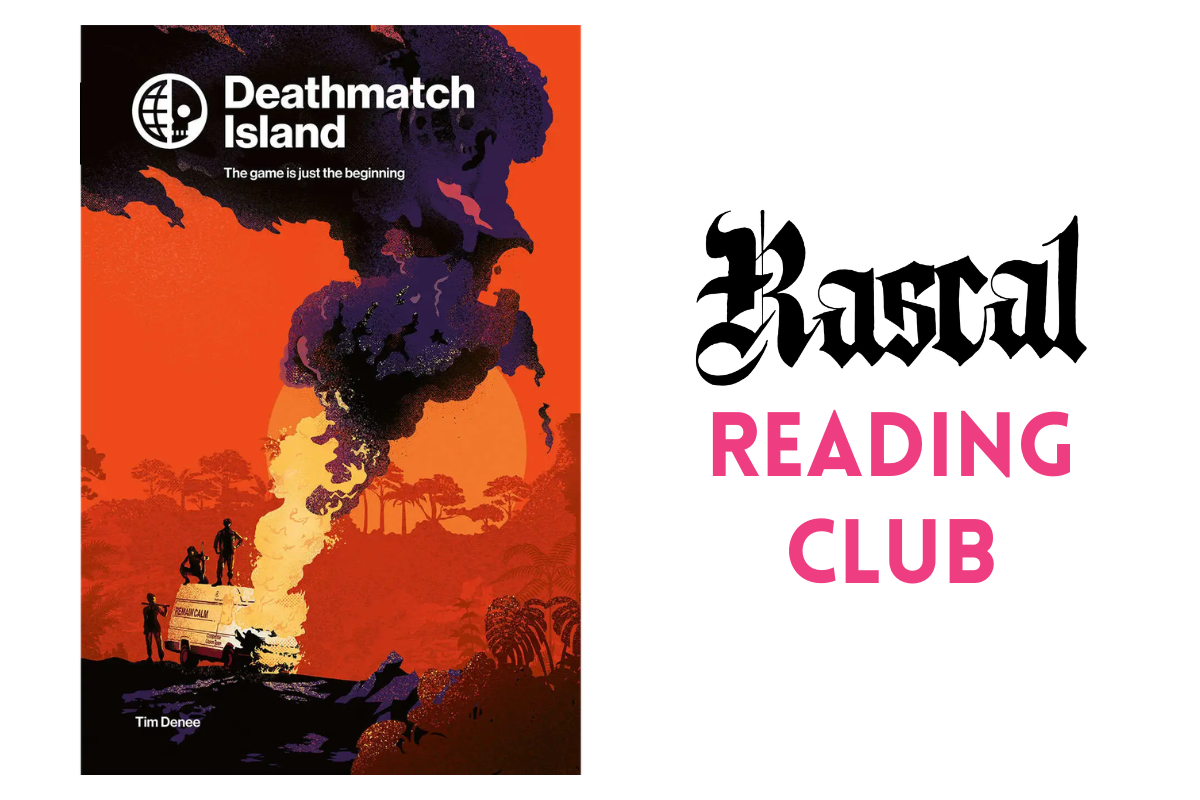
Deathmatch Island, released in 2023, is the first collaboration between Tim Denee and Evil Hat. It's pitched as Squid Games meets LOST — a game of ordinary people being thrown into a deadly game and learning to either trust each other or survive at any cost. It's a hack of Agon 2e by John Harper and Sean Nittner. And while I have played Agon, I haven't played Deathmatch Island.
It still was a fun episode, I hope. Like with every game in our first season, The Most Impossible Fun Thing, we're focusing on how Deathmatch Island works as a GM resource. I thought I'd be down on the game but something much more interesting happens.
Excerpt:
So stepping back and thinking about what Deathmatch Island is and trying to think about what Deathmatch Island is specifically from a GM point of view is that the whole thing is kind of a GM guide. And what I mean by that is that the rules are the sort of tight structural procedure where everything is spelled out in a kind of phase by phase, turn by turn, moment by moment basis. You do this, and then you do that, and then you do that. And that's kind of all laid out. There isn't necessarily the free flowing unstructured experience you might get from a traditional game.
So there is a procedure and then there is all the fictional detailing provided. The world is sketched out, the physical geography, the non-player characters, the types of challenges, how hard they should be...Like I said, it's like an adventure, right? The adventure module side of it is also there.
So you've got these tight structure rules. You've got a full smorgasbord of fictional detail laid out exactly what you might need spelled out specifically. And then you have the GM advice section, which is not really GM advice because is it GM advice when I explain the rules to you? Because a lot of it is just when it says, oh, don't let theory crafting become the focus of the game, make sure the focus is on the characters and their experiences. That's advice, technically. But it's also like when you buy a knife and it says, don't let children use it, it's sharp. It's a part of the instructions for the thing that's provided to you. It could be in the GM advice section. It could be in the section where the theory crafting is explained.
I understand that it is, you could get into some semantic arguments here, but for the sake of my argument, what I'm trying to say is you can think of a lot of this GM advice as just explanation for how to use these mechanics, procedures, and fictions that the game provides. In that sense the only generic GM advice is essentially one page or two pages. And I think it's not too harsh a criticism to say that if it wasn't in the game, it would be fine.
...What would have been probably more useful is stuff that helps players and talks to the players about doing the thing about making their own fun, about what it's like for you to sort of be in charge of telling this story. The GM has a world and this might look like a traditional game, but the GM is much more reactive. The setup is maybe 20 % of the fun — the weird NPC competitors, the wacky challenges, like that's at best 30 % of the fun. And the only way that you're going to access that other 70% is if you as players just really sort of bite into the stuff that the game and the GM are serving up to you. You have to really make your own fun with this.
And it is interesting that even as I'm saying this, I'm like, oh, but you'll have to write it as GM advice. And that advice will be, GM, here's how to make your players understand this. There's the sense that you can't really write player advice in the book because players don't read books. They're like fae spirits. They just wander in and out. Oh, these poor illiterate babies. I mean this with love. There's this sense that you can write a GM advice section, but a player advice section is an act of hubris.And I only said it because I noticed it. I noticed myself feeling like, oh, you can't write player advice... And it's obviously not entirely true. There are of course many, many, many, many tables in which players do a lot of reading. There's also just many, many, many tables in which players really don't do any reading and that you can't and you can't really rely on that.
As always, you can participate in the discussion! Please respond by April 7th, either by posting in the official discord or writing to thomas@rascal.news and we'll include your responses in the talkback episode.
Participation is open to everyone, including non-subscribers!
Discussion Questions
- What do you think of Deathmatch Island? What do you think of its GM section?
- Do you think that it needed a more robust GM section? Do you agree that the combination of a tight procedure and clear setting is much more robust GM support than any generic advice?
- What do you think of the idea of player advice? Do you think that there is the sense that “players don’t read” or "players don't want/need advice" and that’s why we don’t really have a well-established format for giving that kind of advice?
- What’s your favorite bit of player advice that you received within a game?
If you're a member of Rascal’s Party Member tier, you can nominate a book and decide what we discuss next in the series.