Why does the January 6 wargame even exist?
A conversation with the creators of Fight for America! about art, politics, and player safety.

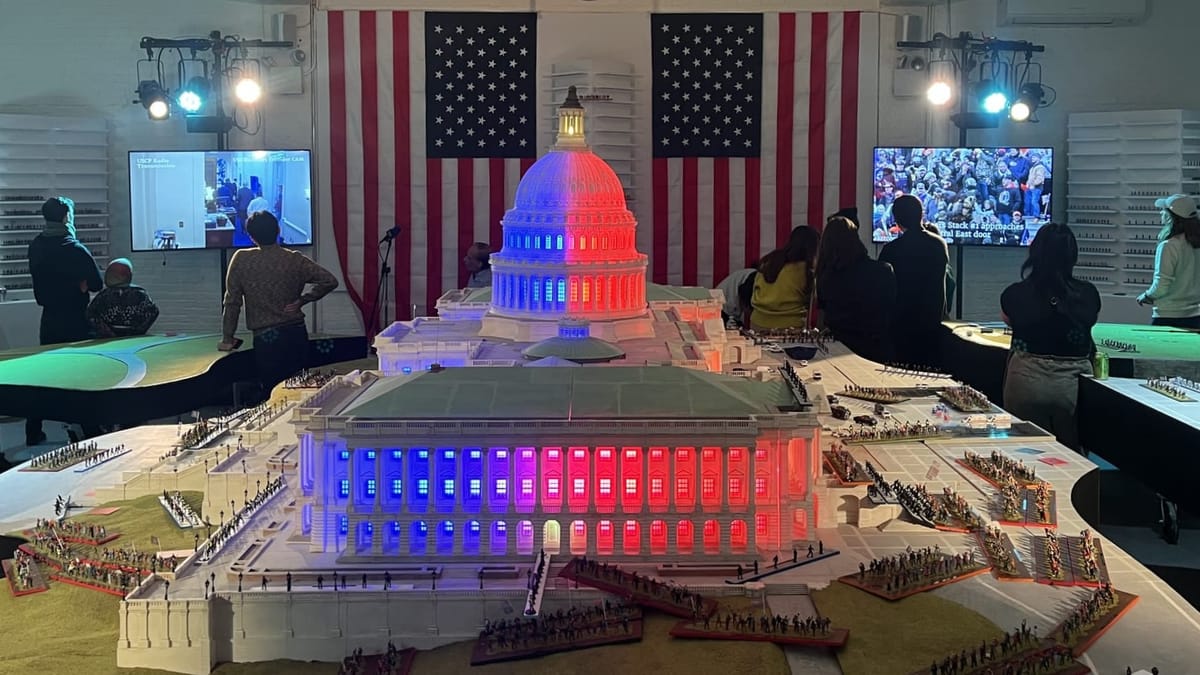
Earlier this month, I attended Fight for America! an immersive wargame installation based on the events of January 6. While powerful as a work of art, the piece itself left me with a number of questions regarding an artist’s responsibility to both the subject of their work and those experiencing it, especially in the context of an interactive art piece. Given that champions of violent technofascist white supremacy and post-constitutional rule have been given access to the levers of power, how does this speak to resistance? How does it facilitate a collective conversation that doesn’t feel self-serving, removed from the real and present danger of our current political moment? If this piece is meant to evoke a desire to “fight for America” in its participants, how can it do so thoughtfully, safely, and with a tangible call to action?
Rascal sat down with Neal Wilkinson, the game’s lead artist, and Christopher McElroen, artistic director of the game’s not-for-profit production organization the american vicarious, to discuss the game’s origins, potential safety precautions (or lack thereof), and what they believe Fight for America! adds to the understanding of this precarious moment of American history.
While the game itself provided a profound emotional experience, this conversation left me wanting. There are very real dangers that both gaming and political spaces present to marginalized people, including a journalist with an eye towards radical, revolutionary art. Throughout the conversation, it became clear that consideration for the safety of the players involved (and the designers themselves) was little more than an afterthought.
Their responses revealed a shocking lack of knowledge surrounding the risks of running a live action roleplaying game and a naive perspective on what dangers might arise. On a psychological level, bleed — a concept coined by Emily Care Boss to describe the transfer of in-game emotions to the player experiencing them — can cause lasting damage if handled without care. On a physical level, their primary concern regarded players who would be upset at losing the game itself, not the real-world ideologies that inform the very characters they ask people to portray.
They had not considered that pardoned insurrectionists, family members, or their supporters might attend these games; or that the inherently political nature of this game would evoke anything more than conversation in a country where guns can be carried with near-impunity, which is true even for liberal Brooklyn. Their answers regarding everyone involved in that day, referring to both insurrectionists and police as little more than pawns to larger powers, also overlook the very long history of right-wing paramilitary organization that has occurred over the last few decades in preparation for this moment — preparation which enabled this attempted coup in the first place.
Art does not exist outside of the context of its subject, especially when confronting such a volatile political event that has not yet become history. To view themselves as outside the influence and impact of these violent implications is an act of ignorance and privilege that I hope the team behind Fight for America! takes into serious consideration before staging this performance again. If they do not, they run the risk of endangering their players and themselves.
This interview has been condensed and lightly edited for clarity and length.
Rowan Zeoli: How long after January 6th did you decide you were going to do this? And I guess the big question is why?
Neal Wilkinson: Why is a good question. I think the original idea percolated around January 2023. I was reading a lot about the Sedition Panda, his trial was going forward. It really got me thinking, What were they hoping to really accomplish? Was this just a cosplay event that got out of hand on everybody's account? Is there something more to this? So I started thinking about the colorful characters and also about the violence versus the comedy of this.The idea of a tabletop war game kind of came out. [I was a roleplayer in] high school, but I haven't really gamed much since. Maybe players could inhabit and control [these characters] on the battlefield as it were, or in a dungeon crawl sort of experience. What would that do to the history of it?
There's certain topics that people just don't go to because they're too controversial, or because people that have actually lived through it are still around. Making a game might be somehow offensive to those people or offensive to the history or the memories that are still alive. But I thought it was also an amazing opportunity to start a conversation. And, you know, at the time of [the game’s] original proposal, [I didn’t see] a concerted effort to rewrite and erase the history of that day. But that has become more and more apparent, [which] gave the whole endeavor a new responsibility to represent history as it actually was.
Christopher McElroen: I started to investigate January 6th in March of 2021, and did a piece called Liberty, which was inspired by Isaiah Berlin's writing on the concept of negative liberty and positive liberty. Neil collaborated on that project. We did that at the Invisible Dog here in Brooklyn. And it was conceived as one person basically in an installation box, getting a distillation of Isaiah Berlin's lecture, and then asked to sing the song Gloria by Laura Branigan, which was one of the final songs that played at Trump's rally before they marched to the Capitol.
When Neal first shared the idea, it seemed brilliant and very much in keeping with what we do at the american vicarious, which is to create work that explores the things that unite and divide us and to do so in a way that requires a certain level of participation. One of our current projects that we've been working on for about four years is Baldwin vs Buckley, which is a restaging of the historic debate between those two gentlemen at Cambridge University in 1965. At the end of that debate, there is a space for the audience to engage in conversation with one another about the relevancy of the notion and the concept of the American dream and whether that can be achieved without it being at the expense of somebody else.
The idea of creating a piece of participatory art around January 6th that was building on a body of work at the american vicarious was very exciting. I knew nothing about tabletop wargaming. I played Monopoly with my family, which always would get contentious. I had never played Risk before and then proceeded to buy five editions of Risk.
Zeoli: You mentioned the idea of negative liberty and positive liberty. Could you expound on that a little bit and how the idea of liberty is presented in this piece?
McElroen: The basic concept of liberty is “I cannot gain something without taking something from somebody else”. Which is a false premise. In an ideal world, that's not the case. But in America, in the history of America, that tends to be the case. The emancipation of the enslaved is somebody gaining their freedom, but the perception on the other side is, “but you're taking my property from me”. Somebody is gaining liberty at the expense of someone else. So the question becomes, can you succeed in America without it being at the expense of somebody else? As that relates to the events of January 6th and the actions of the president — it pains me to say that — was based on a false narrative that something was stolen from somebody.
That conversation around negative liberty, positive liberty, led Neil and I into a conversation about an infinite game versus a finite game. In game theory, an infinite game doesn't have a winner and a loser. It's based on values. It's never ending. We play the game, I acknowledge that you won, you acknowledge that I have a chance to win the next time we play, and we slowly progress. Our politics in America have become a finite game, a sporting event, where there is a clear winner and a loser, and the only objective is to win the game. It does not matter the toll that exacts on the participants, and the participants become pawns in the pursuit of somebody else's power.
Zeoli: When do you bring in Alessio Cavatore? When did it become this grand spectacle? How does that fall into place, and then how does that shift with the results of the election?
McElroen: With this project, we sent lots of cold emails to random people. When Neil and I first started talking, he was like, “we need to find somebody who is a games person.” I didn't really understand what that meant, so I just started doing research. I came across several videos of game designers, and I emailed a whole bunch of them. Alessio was one of them. At first he said, I can't engage with this because it's within living memory, it's too political. Then we just kind of kept at him and eventually convinced him to come to Cambridge Union in England to see our production of Debate: Baldwin vs Buckley.
I think Alessio saw the sincerity of what Neil and I were trying to do and the way that we handled the sensitive nature of the Baldwin vs. Buckley piece, where you have a staunch progressive versus the father of American conservatism. Those things are in conflict. There are different viewpoints in the room, but at the end is a respectful conversation that unfolds where we listen to one another and actually have a dialogue with people we might not agree with. I think it was out of that where he came on board. As to the mega game, one of the first things Neil said to me was, “we need lasers.”
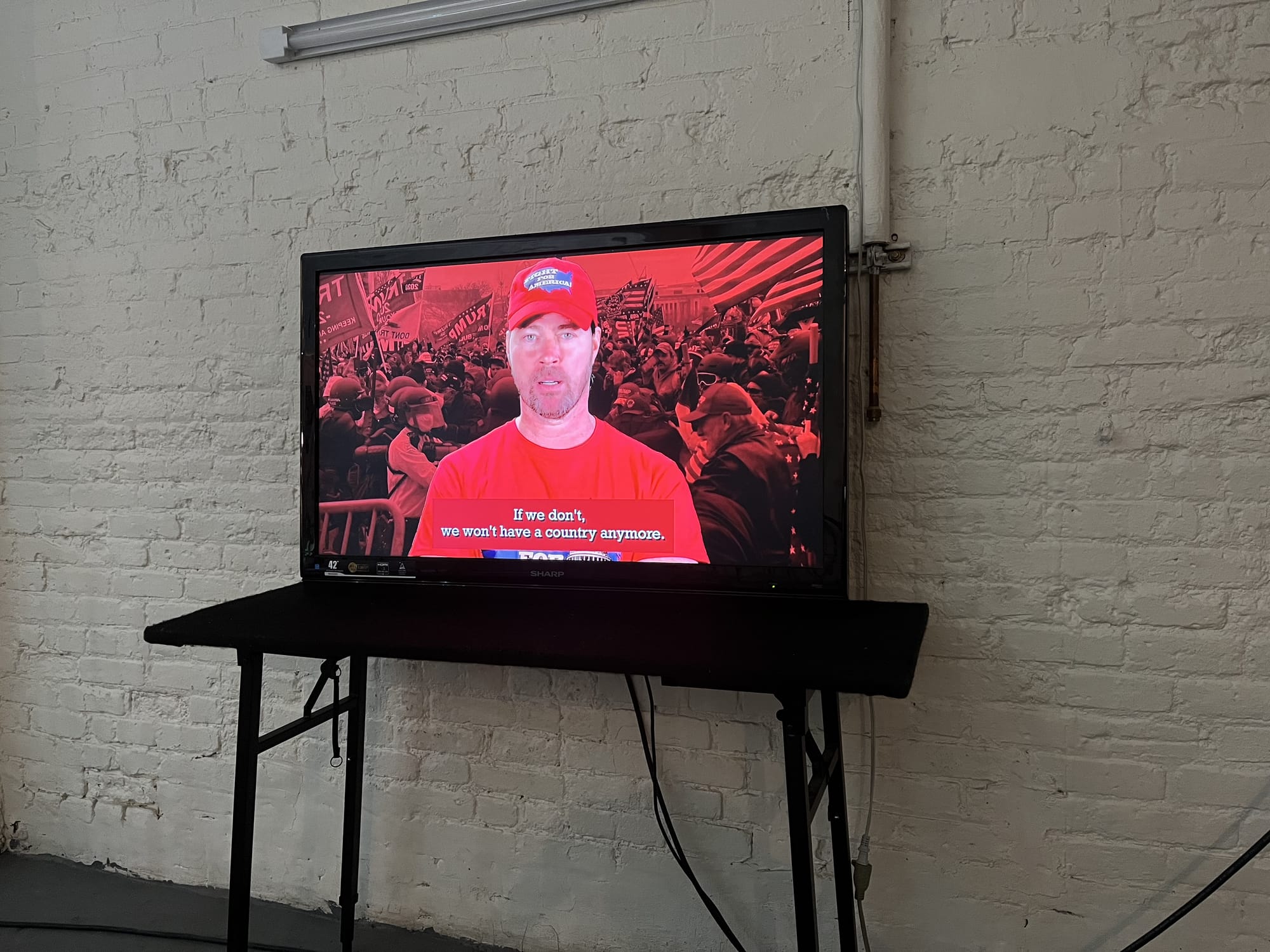
Wilkinson: This project pitch was, “OK, it's a game, but we need to dress it up. We need to make it something that could be watched by audience members that aren't playing.” There's so much material around this with the news, with video, with audio. One of our primary research tools was a website that aggregated all the parlor videos that were shot that day and were used for the pressing of charges against all these individuals. There's just so much content.
McElroen: As we were developing and game testing it over the course of a year and a half, we went back and forth as to how far we lean into the absurdity. We don't want to create a cosplay event where it can be a point of celebration for folks that might have been there that day.
After the election results, we basically paused the project. We were originally supposed to open in New York on January 6th. We decided to pause what we're doing [and] engage in another round of conversations with our collaborators and with folks that we've come across throughout this project.
It was absurd to us that January 6 did not matter in the election booth. That's an absurd notion. And the fact that the history is actively being rewritten led us to lean into the absurdity of the day, which is how we got Dana dressed as Uncle Sam and serving as the game master. We didn't go as far as to put them on a hoverboard.
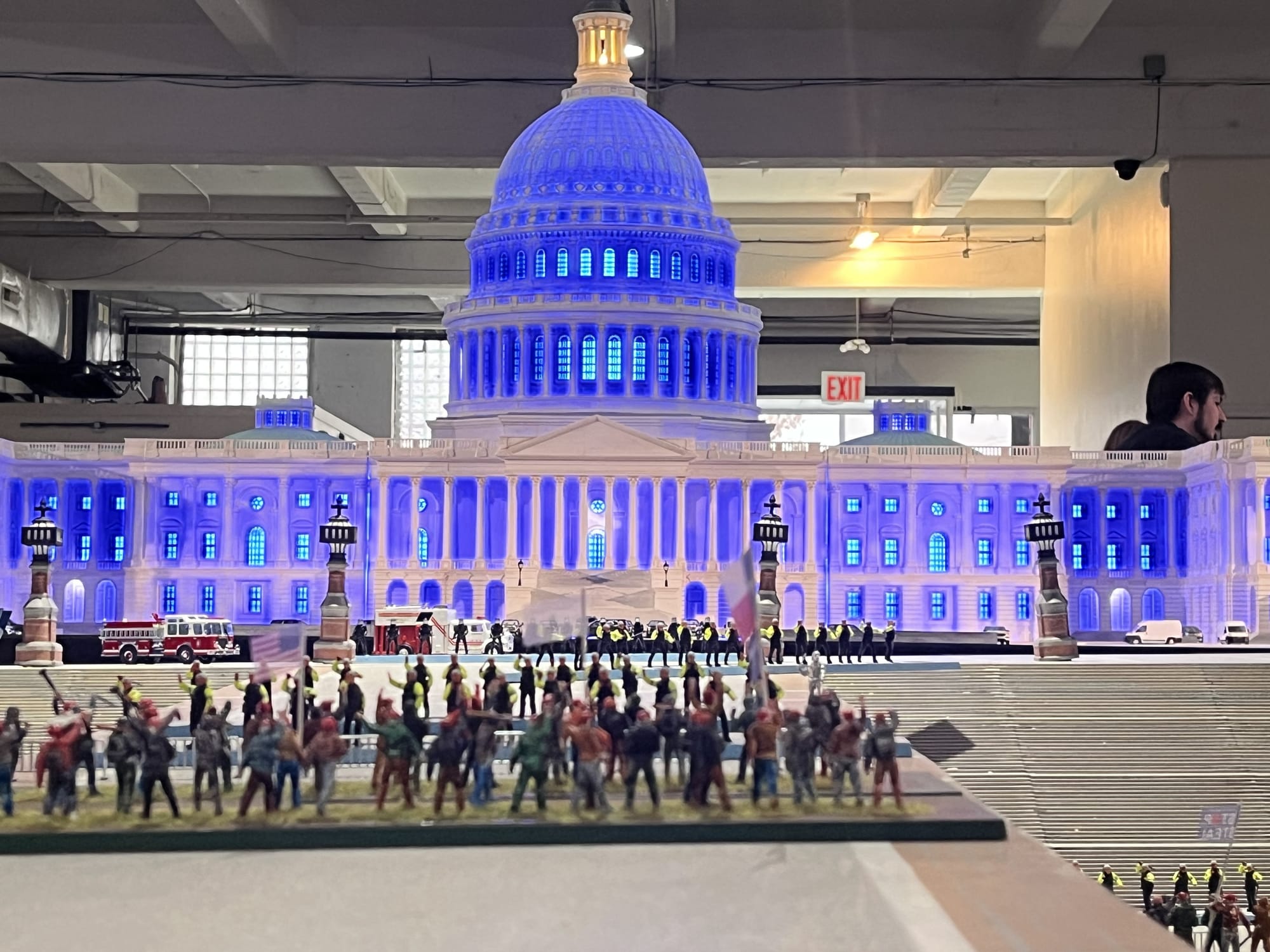
Wilkinson: I also think your conversation with Alessio after the election was very telling. We knew it might go that way, but we didn't expect the popular vote to favor Trump. When Christopher talked to Alessio and had expressed some of these doubts, his response was, it's a historical war game. History hasn't changed. And I think it's all the more important now to represent it as history. And yeah, there are tweaks with the proportions of protesters versus law enforcement. This is not 58 to 1, which was the ratio on the day.
Zeoli: There was a tonal difference between the two nights. Whereas the night that I was present for was very somber, the other night had a bit more of a lighter vibe. What does the line between celebration and surreality look like, and why do you think it was different those two nights?
McElroen: One of the beautiful aspects of this project is that every single night is going to be a different experience because the players and the audience essentially are the actors in a performance. Everybody is bringing their own lived experience to this, their own politics to this level of gamemanship. I think that one of the reasons that Neil's original idea was so brilliant is because it'll never be the same thing twice.
Part of our role on that first night was to keep our foot on the gas and keep things moving forward. And as we went through the three days, I think we started to take our foot off the gas a little bit and allow the game to settle somewhat into the strategy of a tabletop war game and less about it being a piece of participatory art. Ultimately, I think we need to find that balance. That's one of the things that's on the top of our to-do list: find the correct balance of the piece.
Wilkinson: One bit of feedback that I've gotten a lot is, there should be a referee at each table instead of a referee on each side of the room, as we currently have it. And I don't know if I agree with that because there is a communal aspect that I think is very important to this. Ideally we go to places that have different demographics, and it will become all the more important for people to talk to each other about this game as it unfolds, not relying on a staff member to lead them through it.
Zeoli: What safety tools, if any, do you think you need to have in this type of game? LARPs and tabletop games have a long history of necessitating safety tools because of things like bleed, because of genuine dangers, especially with a game dealing with sensitive topics and bad actors. What precautionary measures do you have to avoid physical danger or even lasting emotional danger?
McElroen: I think we're still pulling those threads. The beauty of the workshop weekend was instant community and players taking care of other players. Whether that's, “I'm teaching you the rules or, I see how this mechanic is escalating the violence and we don't want to do that,” or somebody needs to step away from the game. This happened, it wasn't for any specific reason, but I'm just going to step away from this. Somebody was right there to step in and play on until they were ready to come back. We're all having the shared experience and we are playing a game designed in part to make you think about America and what's worth fighting for, and then get you to forget about America on January 6th and just win a game.
Ultimately, it’s still the first time we've done this at scale. It is rooted in the instant community of this. We've had people over a year and a half of game testing it from both sides of the aisle and full political spectrum who engage respectfully.
Wilkinson: We'll obviously learn more about this as we do it more, but I think the players will kind of take care of each other. We're there to step in, to intercede if necessary. I don't know if there is a true risk of physical altercations. I mean, Alessio has warned us that people get really into this, and if they start losing, they can get violent. So we have discussed, do we need security? It would add a whole other layer to the performance and to the meaning of this. We haven't gone there yet, but that's definitely on the table.
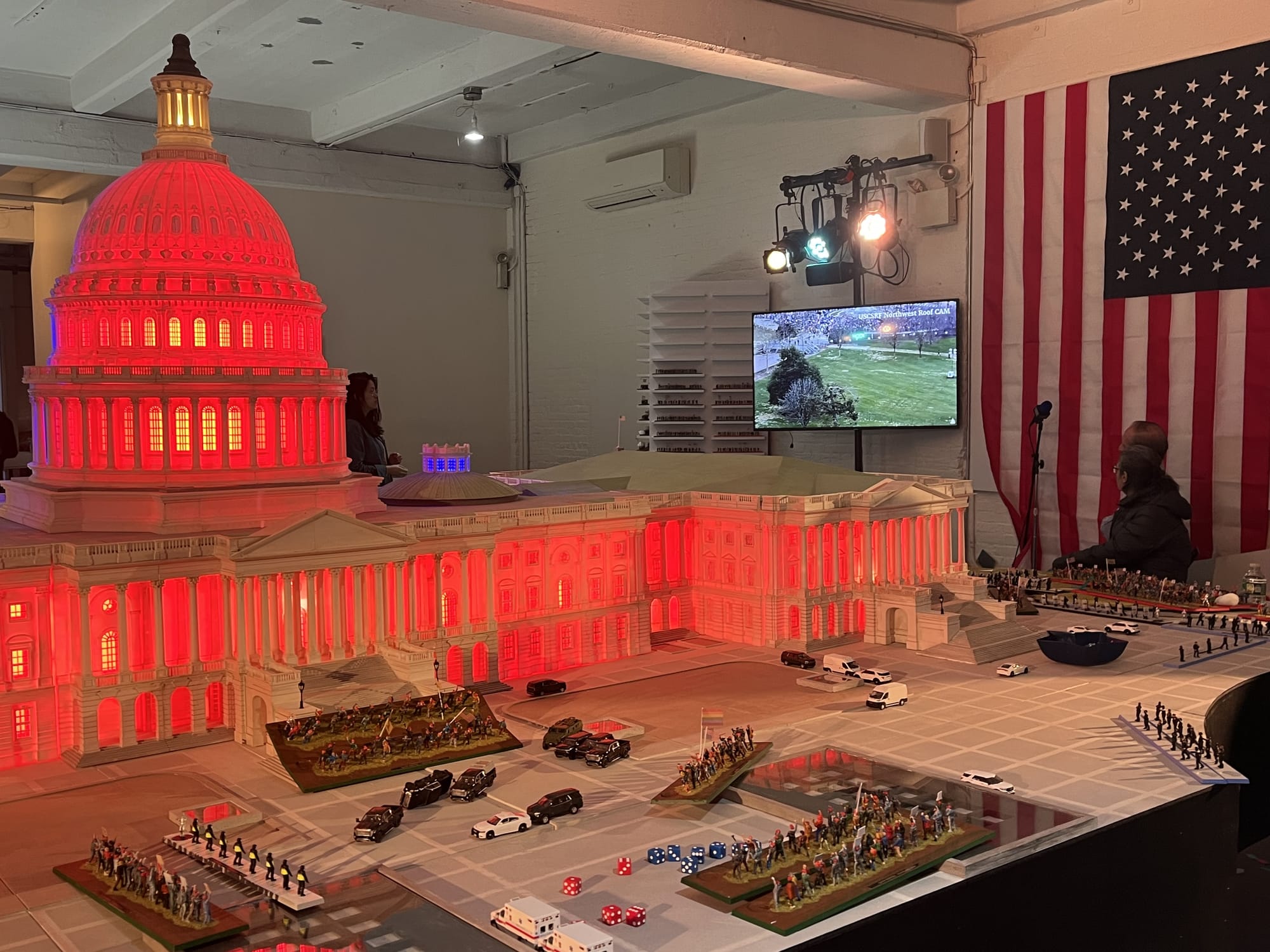
Zeoli: While you do plan on bringing this to London, you're also planning on touring it around the US. There is the very real possibility that the people who this game is about would show up. By the very subject of this game, they’ve proven that they are willing to enact violence and now have been emboldened to continue doing by having been pardoned or commuted.
McElroen: Right.
Zeoli: What have you guys talked about in terms violence at these performances being a real possibility?
McElroen: I don't know if we've really had that conversation yet. So much of our focus, quite literally, has just been building the Capitol and painting miniatures and knowing that this is starting in a workshop in New York City and going to London, where we have 3,000 miles of distance. And then ultimately coming back to New York. By the time we're ready to take it out into the country proper, we will have engaged in lots of conversations with our collaborators and others, and come up with what we hope is an appropriate plan. So it's definitely something we're aware of, but we haven't crossed that bridge yet.
Wilkinson: Yeah, I'm obviously curious about taking it to places that don't agree with us necessarily -
McElroen: I would push back on that a little bit. There's nothing in the piece to agree with or disagree with, I think. They might not agree with us being New Yorkers, our political views, and the way we vote. I think we've worked very hard and give a lot of credit to Alessio to not have a finger on the scale in terms of the game’s framing.
Very specifically, the text talks about both red and blue, and what they believe was stolen from them, what they believe that they're fighting for, and the values that are worth defending. So I would just push back on just that idea of finding something in the piece [that] they could totally disagree with.
Wilkinson: I hypothetically run this through my head, like, well, what would happen? Someone might get angry if they're losing. Any game is like that. People would get angry if we're misrepresenting the truth. We're trying not to do that. The other thing is, well, people at the very end could think that we have faked [footage of the insurrection]. The simple response is, well, we didn't. Personally, I don't believe in trying to convince them of anything they don't believe in. I don't think we're trying to convince anybody of anything other than trying to represent what happened in an interesting way.
Zeoli: I think we are seeing that centrism or the disavowal of all forms of extremism in equal measures has become a scapegoat for allowing one form of extremism to proliferate. Where do you find this falls into the idea of emboldening non-action over resistant action against the encroaching tide of fascism?
Wilkinson: I mean, it's titled Fight for America! with an exclamation point for a reason. For me, there is a call to action about this and a realization that... they fought for what they believed in on January 6. And we might need to fight for what we believe in soon.
Zeoli: Was there a reason to go with the protesters and the individual police units rather than governors, journalists, etc. as the people controlling, manipulating, enacting the larger moves?. Where did that divide fall when you were creating the game?
Wilkinson: I mean, for me, so much about January 6 was [that Trump] lit the match, and then the mass ran with the fire. Even to the point of not knowing what the goal was. If they had found Mike Pence and hung him, they would not have accomplished their goals. The mob was something that I've been interested in for the chaos of it, but also the futility of that day. It was a mob without a head.
McElroen: Yeah, they were all pawns in somebody's pursuit of power. We wanted to represent that to a certain extent we are all pawns in someone else's pursuit of power. There was never really any substantive conversation about the powers that be. It was always a conversation about the folks there that essentially were used for somebody else's gain.