Why We Fight sees a connection between dice and direct action
Play as praxis boasts one ardent defender.

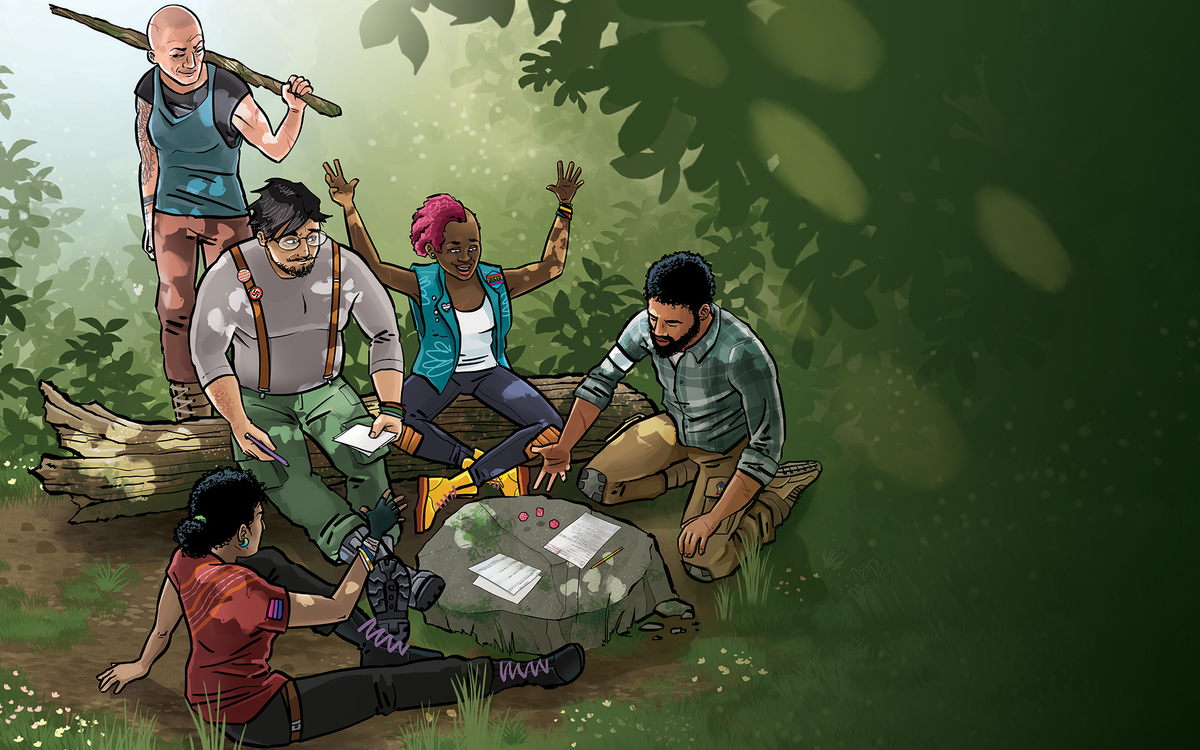
Laurie Blake believes in people. The designer of the new collaborative RPG, Why We Fight, is defiantly optimistic about humanity’s capacity to treat each other better than the institutions governing society. It’s why their game focuses on small collections of individuals pooling their efforts to haul the world out of its post-apocalyptic nadir and towards something better. Utopia? Not quite yet, but at least some version of reality without stratified wealth, artificial scarcity, and heavily exploited labor.
Lead designer at Stop, Drop, and Roll, which previously published the ecologically-minded Earth Rising board game in 2023, Blake decided to pull the metaphorical camera out away from politics-writ-large to focus on the material needs of a post-post-apocalyptic world: how does a population feed, clothe, and house each other? How does it distribute aid and care? How does it protect itself from armed fascists? These are the stakes facing players, each of whom portray their own crew of four characters with their own skills and preferences — and also a suite of personal discoveries that the group will learn as a campaign unfolds.
The mechanics powering Why We Fight’s stories are simple: a 2d6 contest resolution where alignment with ideals or training grants bonus dice. But Blake claimed the stories told with that system, and what they represent, contain the potential for real-world change. They professed a bone-deep belief in tabletop games’ — or, at least their game’s — ability to cultivate an individual’s moral and political outlook. Put more directly: Blake wants Why We Fight to teach people how to organize in their communities, to start equipping them to resist fascism.
Such a bold claim flies directly into countless embattled arguments over the efficacy of RPGs as instructive tools, in the classroom or beyond. Blake themself struggles to bridge the gap between Why We Fight’s fictional stakes and someone donating their weekends to mutual aid networks, nevertheless holding firm to a faith in hope as a guiding force. As they say in their interview with Rascal, hope presupposes that reality can improve. Progress is forged first in a heart that hopes for something more.
Why We Fight’s advertised game table-to-action group pipeline might seem overweening when set against the backdrop of the present moments. Americans living in Minneapolis and other Minnesota cities terrorized by ICE agents are actively organizing to deliver groceries and medications, to protect children traveling to and from school, running food banks through churches and community centers — spurred not by an RPG session, but wholesale domestic terrorism carried out by DHS and the federal government. Then again, exorcising the literal demons of post-capitalism using direct action is the whole deal behind Evie Moriarty’s Mad as Hell. There is precedent.
All of this makes Why We Fight a fascinating project. Games pronouncing themselves “hopepunk” and “solarpunk” have propagated throughout the hobby in the last five years, notably including one of Blake’s cited inspirations: Eco Mofos. There is a real desire for stories and story engines that allow people to hope, to imagine building something better than the world we currently inhabit. Maybe there is something to Blake’s hope in all of us, even if they don’t yet have all the answers.
This interview has been lightly edited for clarity.