Austin Walker's Realis finds the magic in language
When I design a tabletop RPG, I always synthesize Berserk and sentence diagrams.


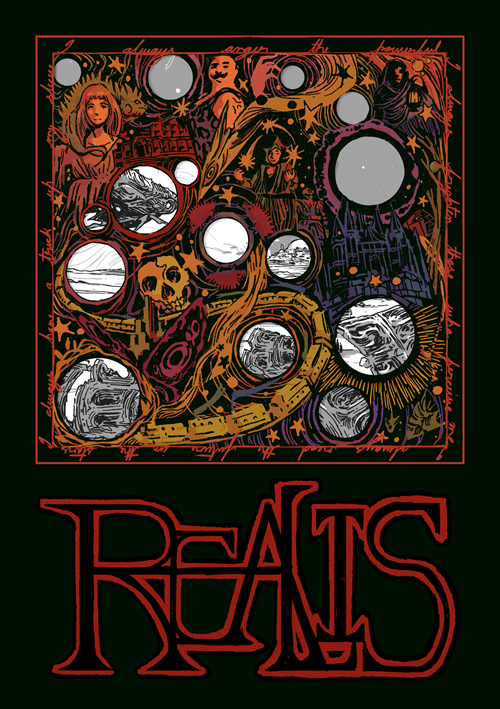
Realis understands the potency of words in relation to each other, as does its designer Austin Walker. The critic, podcaster, and former Waypoint editor-in-chief has been stringing sentences (and Sentences) together over nearly four years to create his first full-length tabletop RPG. Reading through the ashcan, which you can now preorder on itch.io, communicates his profound love of and respect for language. It’s not quite fear: blacksmiths don’t get far being scared of flames.
The storygame empowers GM and player alike with authorial dominion. It trades dice for definitive statements of fact that are true until someone’s much stronger truth comes along and stomps it into the dirt. When does always not mean always? Among the thousand moons of Realis’ science-fantasy world, conviction is a sword tempered by failure. Broad truths are whittled down into razor-sharp scalpels of intent; archetypes become individuals when forged inside experience. Realization is a proper noun in this game, one players use to transmute their handful of general declarations into deadly unequivocation.
In this first entry of a two-part interview, Rascal spoke with Walker about designing Realis from a fever dream into an early version published in partnership with Possible Worlds Games. Playtesting continues ahead of an official release in late 2025 or 2026, and Walker said it’s not clear yet whether the team will seek crowdfunding to print the book. The second part, arriving later today, will focus on mechanical interactions and how exactly a group of declarative statements can bring a character to life through roleplay.
We had a chance to pore over Realis’ 46 classes, endless moons surrounding a dying sun, and the sovereign powers vying for dominion over them. Realis is a deeply personal work and cuts all the better for it. Walker admits it won’t suit everyone’s playstyle, but what game does? He talks about it with excitement stratified by trepidation, sounding like a blacksmith who knows getting burned is simply an occupational hazard. It won’t stop him from working the metal.
This interview has been edited for clarity and length.
Chase Carter: How long have you wanted to design a tabletop game and what kicked it off?
Austin Walker: If you go back and look at the way I've talked about running tabletop games on Friends of the Table, and I've talked about running them for decades now, I was trying my best to do experimental things. Going back to college from 2003 to 2007, we were in the grips of D&D 3.5 even during that first wave of small indie stuff. Running games back then, even big box games like Legend of the Five Rings, I was doing frame stories. I was coming up with mini games for people to play. I was hacking in rules. That's what tabletop games are; tabletop games, in my opinion, are finished at the table. They're finished in play. We were always already hacking tabletop games.
Famously, there is no such thing as the crit or the crit fail in D&D, but every table I ever played at has had it. That's what tabletop games are. We negotiate what the rules say with the stories we want to tell and the characters we want to inhabit and the worlds we want to build, and then together we sometimes adjust the rules at the player level or the GM level.
Ironically, I think to some degree there would be no Realis without Burning Wheel's instincts and Belonging Outside Belonging’s—or No Dice, No Masters’—strong/weak moves. Neither of those are why Realis exists, but they're where I went when I had a feeling I wanted to try to work through. I think there's some Fate in there too, but I don't play Fate. Actually, that's not true. I played Ehdrigore, which is “a high fantasy-slash-horror based roleplaying game set in a world inspired from Lakota mythology and the mythology of various indigenous tribal peoples from around the world.” That was the first time I really sat with Fate Core. The kind of open-endedness of aspects and the way that aspects can apply to places and things and come into roles is [what interested me]. Everything has moves, Everything can affect the role.
And obviously I play so much stuff that's Forged in the Dark or Powered by the Apocalypse, but even though those games don't use the word “aspect”, or any time that you're determining fictional positioning in a Forged in the Dark game, you can kind of think about what aspects does this place have, right? So all of those are the mechanical and the historiographical RPG influences. But the thing that this comes from is – Are you familiar with Berserk?
Carter: Yeah, not all of it, but I am very familiar with the anime just beyond the Eclipse.
Walker: There is a moment in Berserk towards the back half where the little fairy, Puck, steals this thing called the Behelit, which is a little red egg with weird humanoid facial features. Puck grabs it and says something like, I have the advantage when it comes to getting away. More broadly, Berserk is where this game started.
For people who don't know, the Eclipse is this horrific, traumatic, terrible, demonic moment of intense brutality and betrayal, a complete dehumanization of all kinds that's talked about in ways that are like, whoa, what a climax to this story. What a terrible way for this to go for these people. But it's not the climax of the story. In some ways, it's the starting point of what becomes. For me, the rest of that story is about people who have been harmed really, really badly, but not irredeemably. Not irreparably. What comes after that is the repair. What comes after that is finding new people, learning how to trust and love again, building a family, letting yourself care, and—importantly—giving yourself to a suit of armor that is going to kill you slowly because what you want to do is care for people and protect them.
I think it's important to note that safety rules can't make you safe. They can benefit you, but safety isn't a thing arrived at by rules.
I saw lots of other media and games, both in the digital space and in the tabletop space, getting into the symbol of the Eclipse in the sky, or the undying soldier, or the way memory gets played with in odd ways. The darkness, the edginess, the dark medieval fantasy stuff. I didn't see a lot of stuff about how characters in stories like Berserk begin as archetypes and then get chipped down until they're particular instances that are unlike other characters.
So, that's why the Berserker is the first class in the game. You start a new game of Realis, you play as the Berserker. The Berserker says, I always kill my foe. By the end of your campaign, you and another Berserker in the same game will be different people. You'll have been chipped away at, you'll have changed the way that your sentences—your means—change, which reflect the change in who your character is.
Obviously, there's a billion other influences. It's a science fantasy game. It's a pulpy game. Partly it's a response to the types of stories I have not told on Friends at the Table. It also draws on things like Shadow of the Torturer and Book of the New Sun. It draws on things that only I care about, like Reign: the Conqueror, the Alexander the Great anime that Peter Chung did some of the character designs for. It has a bunch of stuff in it that I also started before we did our darkest season on Friends at the Table, Sangfielle, in which we played Heart: the City Beneath. Up until that point, we were very careful not to make games, not to do actual play content, that pushed a lot of boundaries around things like violence or darkness broadly.
Realis is able to go to those places that Friends of the Table had not gone to, [where] most larger actual play content doesn't go. You know, those games aren't built for it, frankly. When I say “those games”, I mean D&D isn't built for it. The games that don't have huge audiences for actual play—there are people out there doing actual play that pushes boundaries and tells deep, intimate personal stories—it's hard to do that in front of an audience. It's hard to do that in a recording studio with a microphone in your face. I think there's a reason why people like to play games that go into those spaces privately with their friends or with people that they're close to, people that they can trust, et cetera.
Carter: But what prompted you to start designing Realis seriously? What prompted you to say, it's time to actually make the damn thing.
Walker: It was a fever dream. I woke up. I messaged [composer and FatT cast member] Jack de Quidt, and I was like, Hey, I have an idea for a little narrative game. If you go back and look at these notes, it's actually extremely funny because I'm saying things like, I think there might be 15 classes in this, as if that's a big number. I start messaging Jack about it on a Monday, and by Thursday, I have the system. Obviously a lot has changed. That was in 2021. I've been working on this for almost four years.
Now, what really happened was that I got a job making video games and didn't have the time to finish it. My goal was to have it out in 2021, and then I got a full-time job as an IP director, doing world building and lead writing at Possibility Space, which was a place where I could do that same sort of creative work, solve design problems about the intersection between story and design. I was also doing two podcasts at the time. So, hard to balance getting the Realis work done, but I did keep chipping away at it. Playtests were happening. I was getting feedback. We have been playtesting it now on Friends of the Table for...a long time.
It really was that I woke up one day with the idea for a little game about sentences. Really early on, we were going to call it the Sentence System because of the way sentences are kind of scary. The word sentence can mean the thing that you say, but it can also mean you're sentenced to jail. You're sentenced to a fate.
Carter: The double entendre.
Walker: The double entendre, right. While trying to figure out words, I realized Realis is kind of the perfect thing. I don't know if you've dug into this at all, but the realis mood is a grammatical mood that [reading online] “is used principally to indicate something that is a statement of fact. In other words, to express what the speaker considers to be a known state of affairs as in a declarative sentence.” That's what the whole game is! And also it sounds right. “Realis.” It has like a sort of dark fantasy, but also potentially a sort of sci-fi touch. It works really well. And also, yes, I have notes on what irrealis is, which is the other mood that'll be, who knows? If I find the time, I'll turn those notes into a game.
Realis is also written from the perspective of a character and a faction that sees the world. They are not the only people in that world, and they're not the only people who are thinking of mechanizing what they see in the world. It's not in there yet, but this is either going to start or end with a note from AW and the translators. There's stuff that doesn't fit in the text since it's supposed to have been written by the Wordwrights.
Carter: I am fascinated with the deployment of the word always. It stakes a hard claim, but it also restricts a lot of the ambiguity within the play space.
Walker: Well, except for the fact that it's a lie. You don't always. You're going to fail. The first time you try something in this game, you will almost certainly fail because the actor loses ties. Unless you're spending your token right away, you're going to fail the first thing that you supposedly always can do. That's the power of the game: I always do this, except I didn't this time. Shit. OK, how is this going to change me? How do I assure I get it next time?
Carter: What does that mean for the kinds of stories you want to tell? Does this point to your own philosophy of storytelling?
Walker: The first thing that I would say is, it's not all here. There's lots of stories I want to tell that this game can't tell, larger and smaller, more violent and less violent, more intimate and more public, more political, et cetera. But I do think that there is a throughline about where I have found myself as a GM and as a game player, which is love it or hate it, I'm a GM. I like GMing. I like having the ability to tell stories and guide players and set up worlds and see how they work. I tend not to be a here is my prep, let's walk through it GM. I tend to be a here is my prep, let's run it or let's work through it and then the second you have a better idea, let's throw it out GM.
I don't care if millions of people play Realis. I made this game because there was a worm in my brain.
I'm a GM who loves it when my players surprise me and do things I could never imagine. In the same way that Realis could have had dice, Realis could have been GM-less. I think when the earliest playtest started, there was a moment when everyone went to play and they're like, wait, this isn't GM-less? I had a playtest group say, we've all read this book. We came away feeling like it was GM-less, but it isn't. I suspect with the full release, I'll have some optional roles to make it GM-less. It's not hard, again, it's Dream Askew. Like, you picked up a faction, you can play as that faction. You picked up the Moon sheet, you can play as that Moon sheet. Maybe you still have a character who's yours. That distribution is completely viable.
My default setting is to give players a deep connection to their characters that is broader than a set of skills or pre-written moves. I've seen a deep connection between players and the Sentences that they end up with by the end of a campaign because they made choices and thought hard about how they wanted to Realize their Sentences. And they remember what led them to Realize the Sentences that way. They remember when they used the Sentence, and it failed. Or when they used it, and it succeeded. It was a big deal, especially in the middle of a campaign. Once the Sentence ranks get all over the place and you don't know what you’re up against. I think that this is a plus two Sentence. God, should I token this? It gets really fun.
To your question of what it says about the types of stories I wanna tell, I like stories where everyone at the table is involved. I also like stories that give people the chance to dig into their characters, embody or understand and think through what it is to be that character. And I like stories where the world is touchable by everybody, and I like stories where parts of the world aren't touchable by anybody. Not mentioned here, but hugely influential in everything I do is the card game Netrunner. I remember sitting down and playing Netrunner for the first time, and the feeling of being the runner and getting to reach across the table, take a card, and look at a card from my opponent's hand or from their deck or from their trash? That's like, my God, the whole table is in play. Breaking through those boundaries has a sort of aesthetic and affective emotional power.
Carter: To be blunt, Realis is a very Austin Walker RPG.
Walker: Of course, it's my first game that I'm putting out. Maybe this works for me and my little curated group of friends that I like and people who I admire. But maybe it won't work for people. Maybe people will look at it and say, I don't know how to run this. I don't know how to play this. I suspect there's a big group of people who want a little more structure than what I'm offering here, who don't want just a Moon with six Sentences. I'm thinking about that a lot for what the full release looks like. Do I offer a little kickoff setup campaign? But I also think that sometimes the game is the game.
I don't care if millions of people play Realis. Would it be cool? It'd be awesome. It would be incredible. That's not why I made this game. I made this game because there was a worm in my brain. You can read about The Worms of the Blister on page 87. I had this idea. I wanted to make it. And then it became so fun to make, so fun to write in the character's voice, so fun to write in the world's voice, that I just have to keep making it. I don't care if this finds a huge audience. I care that it finds an audience that gets it and loves it and wants to engage with it and wants to make stuff for it and wants to play it with their friends. That's a very privileged position. I said that while I had a full-time job. It comes from a place of having some security, but it is also one of the best things I've made because it's one of the rare things I've made where my brain hasn't gone, well, how do I make it grow? How do I make sure everybody who's working on it doesn't go hungry next week? How do we not get laid off? How do we hit our milestone goals? How do we hit our growth goals or our traffic goals?
Everything I've done in the last decade since I left academia and came into the world of media and games had those sort of shackles on it. This is the first thing I've made where it's felt like I don't have to worry about somebody else not having rent money if it doesn't go as well as it needs to. Again, a privileged position to be in, but I work really hard on all the other stuff so that this could be “a side thing.” And now I'm in a position where I was able to give it just the final little bit it needed to get to an Ashcan.
Carter: How does it feel after so long of making “content” and collaborative stuff to do something that's for yourself and of yourself?
Walker: It's really good. Jack is probably going to have an additional design credit on it, Janine Hawkins, also on Friends at the Table, has some additional writing credit. She's an extremely sharp, funny, and thoughtful writer. Janine also worked on Hitman 2 and 3 for IO Interactive and wrote all of the best dialogue that you overhear in that game. If you ever hear a maid flirting with a bodyguard, that's Janine. If you ever hear someone on the most absurd phone call, that's Janine. So, it's not just me, but yes, it has felt good.
Crossing the finish line is hectic. We're coming right off the holidays. Tyler [Crumrine] and I had a conversation about Possible Worlds publishing the ashcan, and our hope is that we will eventually publish the whole big thing. I'm cautious about committing to that for fear it will come out and everybody could hate it. Austin sucks; Austin's clearly an amateur. Then, there's no way you'll be able to raise enough money to put the final thing across the finish line, and we'll have to reevaluate that. It's very exciting that I'll get to talk about it. I'm excited to let the people who've been playing it for years get to talk about it because I know that they are eager to do that. But it's also a project, and I'm grateful that I'm getting to ship something.
Carter: I wanted to ask about your relationship with language, which is very much on display in Realis. You use language with a joy that’s not whimsical, but shows an appreciation of how words can be understood by different groups, in different contexts.
Walker: Yeah, shoutouts to my mom who's a poet and who raised me playing word games. Shoutouts to St. Peter's Catholic School in Pleasantville, New Jersey, which is closed now. My one shoutout was they taught me grammar, they made me diagram sentences. And so I still think about sentences in a diagrammatic structure. Can't shout out a bunch of other stuff about the Catholic Church. Can't shout out the priest of that church who I think was stealing money from the people who went to the church. You do not have to hand it to Father Ron. You do not have to hand it to the Catholic Church.
But as a kid I spent a lot of time around words, both reading them and writing them. Reading out loud was one of my favorite things to do as a kid. Real egotistical, I wanted to hear my own voice, which is funny because I don't like my voice as an adult, but I do enjoy the act of reading. I really like reading out loud. It's like the closest thing I have to singing.
My default setting is to give players a deep connection to their characters that is broader than a set of skills or pre-written moves.
The relationship I have with words is actually funny because Realis felt like letting myself be playful with them in a way I'm not often. I have spent a lot of time rolling my eyes at purple prose and at tryhard shit. I come out of academia and that predisposes me to say words like “predisposes me”. It was really fun to both play with sentences as powerful things and then to write the book in a particular voice and not just dry.
Sometimes, that is still something I fight. I was just telling someone the other day that I wake up at 10 a.m. and when I read this document, I want to get all this purple prose out of here. I need to cut all these big stupid ass words. I have to rename these classes and delete half the rules. These rules could be 20 pages and not 50 pages. And then by 10 p.m., I'm like, hoo hoo hoo, hee hee hee! Time to find another word for “guy who punches”. Physilist! That's nothing. Shut the fuck up, Austin. Thankfully, I do most of the work between those hours and so can find the right blend.
I will say I got a really important note. Someone who didn't play test this game, but who did read it was Sage LaTorra. Early on,this book had the X-card and Lines and Veils in it. And Sage was like, is that the safety tool this game needs? Is that the game? Is that the realest safety tool? What's this book need? I was like, that's a great question. I made a game about the power of sentences that collectively we all sit around and write. Foundation sentences are already there. Just use those. That's still lines and veils-ish. You're still coming up with rules around how you want your table to play.
It's tough because I think it's important to note that safety rules can't make you safe. They can benefit you, but safety isn't a thing arrived at by rules. Best practices help people remain as safe as they can be, but it's like less lethal bullets. Ain't no such thing as non-lethal bullets. The lethality cannot be removed. Pure safety cannot be attained, and you need more than a set of good rules. You need to make sure that the relationships are well maintained, and that's not easy to do just by following a guidebook.
I wanted to arrive at something that felt right for Realis. So Foundation Sentences come out of that desire. It gets you used to thinking about the world and taking Sentences seriously. And also it gets you thinking about them in a kind of open-ended way, not a checklist of good and bad. It's not a tool that everybody will use, but I think it's been a useful tool. Instead just saying, we don't want this in the game, it's a tool where you also can say, I really want this. I really want to make sure we do include X and Y. We get to say, Our story always [blank]. One campaign had, Our story never depicts sexual assault or sexual violence. Our story always shows you where the sword goes, but never shows what it does. And then, Our story always errs on the side of maximalism.
Those sorts of rules come out of a relationship. Two words at the heart of the game is “trust them.” Numbers are really good scaffolding, but sometimes words can do that.
You can preorder the Realis ashcan document on Austin Walker’s itch.io page.