Adepticon in Four Gifts
Understanding a miniatures convention through rats, brothers, and barnacles.

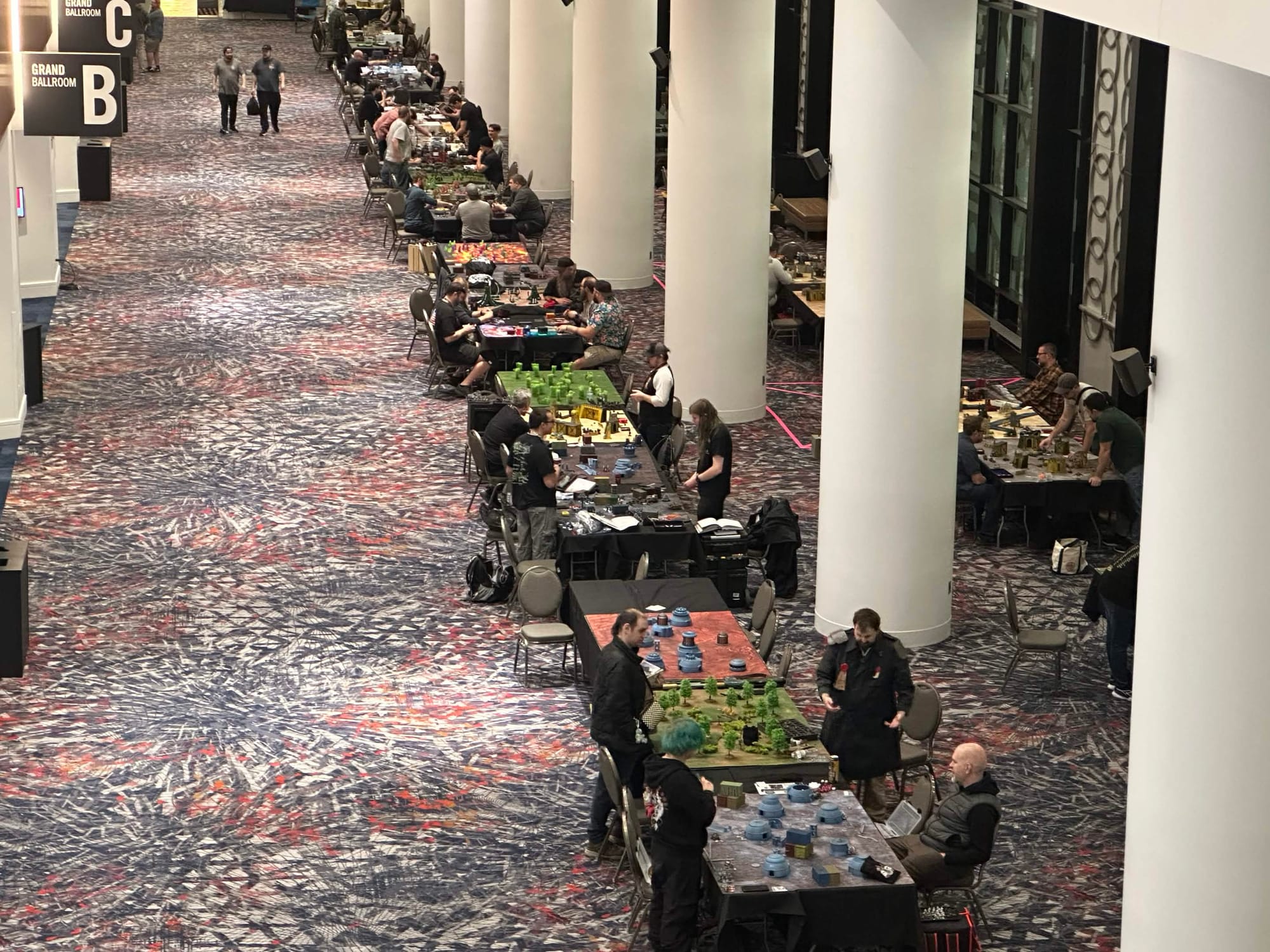
Last year when I went to Adepticon, it was a little bit of a sampler. There was delicious nougat in the form of strong community and interesting, back-street projects, and there was that weird cherry cream candy thing—in this metaphor, that is attending things that I paid a lot of money for that delivered very low value. I spent the time between 2025 and 2026’s Adepticons trying to figure out how to weave a more meaningful experience for myself in my second go around. I knew that I did not want to drink a giant beer all week, which does seem to be a key part of the event’s meaning for at least a few folks, and I wanted to strengthen my understanding of what has been happening in “the hobby” in a way that might only be possible at an in-person event.
So, I got in my car to drive to the airport, realized that I was likely going to miss my flight due to ongoing nightmare TSA issues, and then drove a jaunty 15 hours from my home to sunny Milwaukee, Wisconsin.
When I got there, I felt strangely energetic. Fifteen hours in the car! Not a problem in the world! I spoke with a few people in the dregs of that first day before going back to my hotel room and prepping for the first real day. I have to officially apologize to all of those people I talked to, by the way, because when I got back to the room I realized that the combination of being unshaved, awake, on the road for 15 hours, and generally just sort of anxiously wired for the event meant that I looked like a classical portrait of a madman. That’s on me.
Then I did the Adepticon thing. I was there for a long time. I drove home after that long time, and on that 15-hour drive back I had a lot of time to think about this piece and how to frame it. The best way might be in terms of what was most significant to me, which was the gifts that I received. Not presents, mind you, but gifts—acts of respect and charity and care that were handed to me with no expectation. That is, fundamentally, what my Adepticon was about. But more on that later.
Here’s Adepticon in four gifts.
A game of Adam Vass’s Cybermetal Streets
I met up with Adam fairly early on in my Adepticon experience, and he handed over two new zines that he has released: Cybermetal Streets, a 28mm skirmish game set in his Cybermetal 2012 setting, and Chorus, a miniatures game played on a piano. While we did not have a working piano with us to try the latter, Adam did sit me down fairly quickly to get my hands on Streets and see what he has been cooking up.
From my perspective, miniatures games are in a better spot than they have been in a really long time. There is a huge swell of people just making things and getting them out there, and the assumption set of what must to be in a miniatures game has fundamentally atrophied to the point of diminishment. There is such a massive plurality of where you can get miniatures, who you can learn these games from, and what the core assumptions of the games are that you can literally spend four entire days of a major convention barely interacting with the titanic companies that financially dominate the industry. Do you know how I know that? I did it. And I did it by first sitting down and playing Cybermetal Streets, a game where a falafel cart can constantly orbit the arena, offering healing and powerups. As far I know, Warhammer 40k has never had a falafel cart. We’re already cooking with gas.
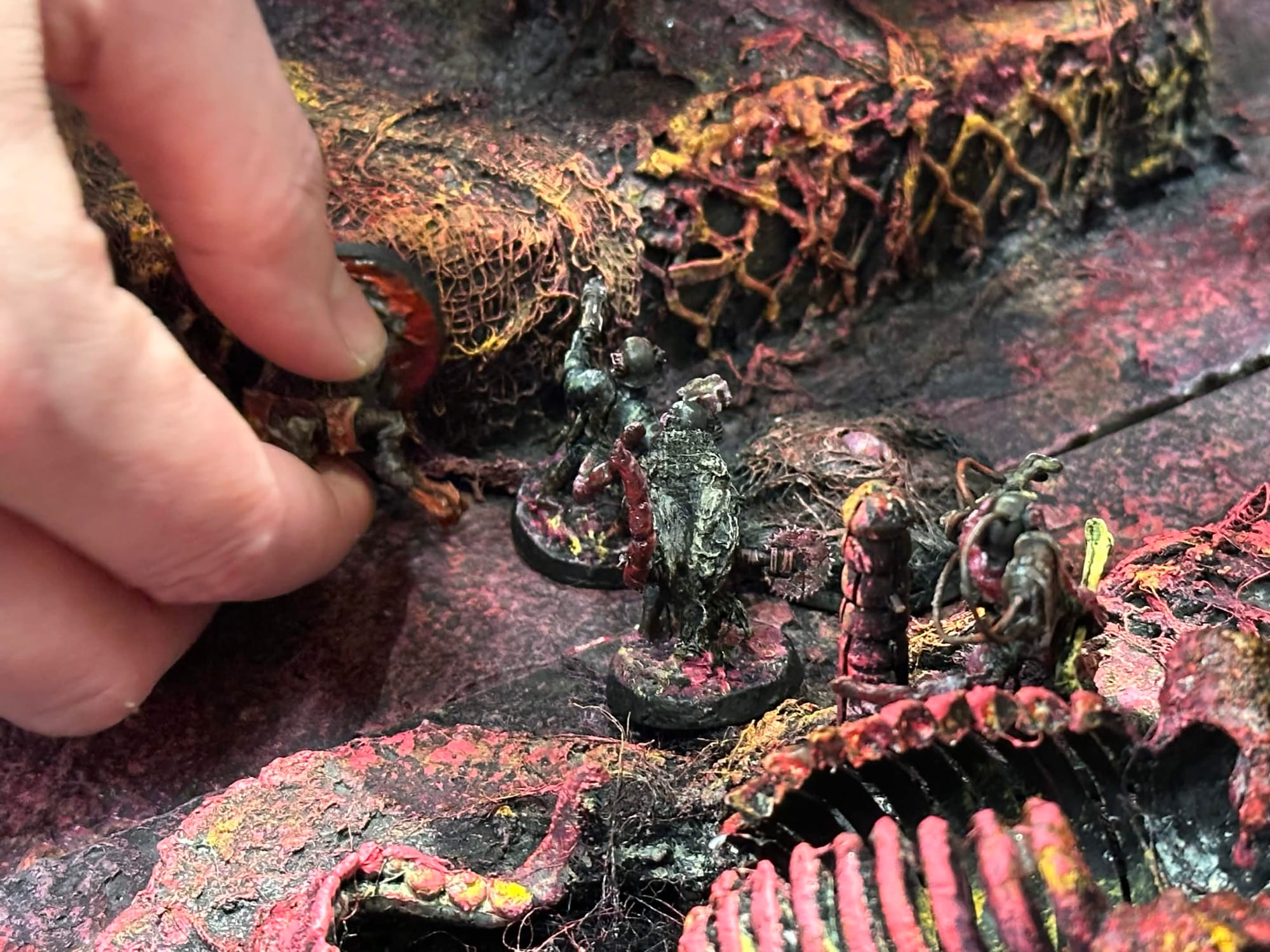
Cybermetal Streets plays into the lore and setting stuff that Vass has already created for his tabletop RPG, and that pre-existing material significantly impacted the assumptions that we made as players coming into it. My opponent, Matto, and I were given some minis that Adam had painted—grotesque beings who had been living in hell on earth, each warped and painted to a grimdark Midwestern standard. We talked through a quick sketch of the rules, and were told to start fighting for ownership of the streets.
Pulling from the Cybermetal vibe, the game as it stands is about fighting over ownership of the streets, but the most intriguing part is how the miniature skirmish game encourages you to do things other than bashing your opponent’s head in. There’s literal dumpster diving as a key mechanic—that’s how you improve your weapons and abilities in the game—but the real scrounging has to do with how Vass has designed the attack system, which has players taking particular undefined skills like Amplify or Bleed and narratively justifying their use and outcome. My husk attacked Matto’s demon using Disable, and we had a short conversation about what a successful attack would mean (a single-round stun?) and what a failure would look like (self-stun?). The negotiation was a friendly one, but it was also happening inside of a game where there would be a real winner and loser. While having several of these conversations I thought: this is what blending tabletop RPGs and miniature gaming could be like. It could be about leaning into the spatial and mechanical quirks of the long-running wargame by feeding it through the thresher of TTRPG freeform discussion.
The real gift here was Adam trusting me to give feedback and play something that is so far away from the “core” set of assumptions that Big Miniature might sell you. Cybermetal Streets has built into its rules some of the community assumptions around narrative play that have developed within the 28mm community for a while, particularly in the big resurgence of community-driven Mordheim, and I think that puts it in a nascent genre with Smash Bash’s Sun Rot (more on that later) and Cauldron, which explicitly tells players to “talk amongst themselves” about changing the rules to allow for interesting or novel actions in the game. The world is getting weirder. It’s good.
The destruction of many rats in Maude Bogbody’s Ratking
“Use your imagination,” the zine rulebook Three Rat Monte says—“it’s all you have left.” Three Rat Monte is the shortform, rules-lighter version of Ratking, a game of dystopian sewer rat warfare. I’m not sure how I ended up playing the game—Adam might have helped me get the seat, or designer Maude might have just asked “who’s in?” But in any case the game of Three Rat that I played was opposite Adam, and the experience was immediately characterized by a huge amount of post- (anti-?)human lore about the history of warlike rats, where they live, why they lived where they lived, and the purpose of Three Rat Monte, which was not what I thought (to introduce a new person to a game) but rather something entirely different (as a game within the world of Ratking that determines who will command rats and who will be killed to make way for those who would command rats).
This is all to say that Adam Vass is more equipped to command rats than I am, and that’s because my rats (and myself) died on one of the most beautiful game boards I have ever seen. It had a working gumball machine in it for distributing treasure.
I have harbored a deep interest in Ratking for more than a year, and I experienced it for the first time by proxy at last year’s convention. I saw an abandoned character sheet where someone had jotted down some stats on very interesting looking paper. What could this be?
It turns out that it’s a world conceptually developed through-and-through by Maude Bogbody. The game rules are special—using a deck of cards and using hand-shaping mechanics, you attempt to put your opponent in disadvantageous spots and come out on top. I had to stop in the middle of playing, look Maude dead in the face, and say that it was extremely elegant design. You really should read through the rulebook.
What struck me the most about the game, overwhelmingly so, is how considered it is from top to bottom. This is the gift to all of us. It’s a complete nightmare world for rats, a reflection of the nightmare world for us. The lore is deep, and she gave us some of it as we began to play, but the gist is that all of this exists in the aftermath of a grand act of chittermancy that created the Hundred-Headed King, a tyrant rat autarch who destroyed all of vermin life and thus was destroyed itself. We play Schememongers who send expeditions into The Black Cellar in an attempt to scrounge new realities out of the realm that was. If there’s hope in the tale, I have a hard time seeing it—it’s a game about the echoing ruin of a species crawling around in the dead dreams of a slain god made by his own people. Hearing, and reading, the lore of Ratking has a general sinking feeling, and the game is fully realized in that way. Cards in the deck go down, resources dwindle, and each rat you control only has so much in it. There’s real synchronicity between how you play and how you feel. When I was done, I did feel as if Rat Adam had put a bullet right between my little, beady eyes. A treasure!
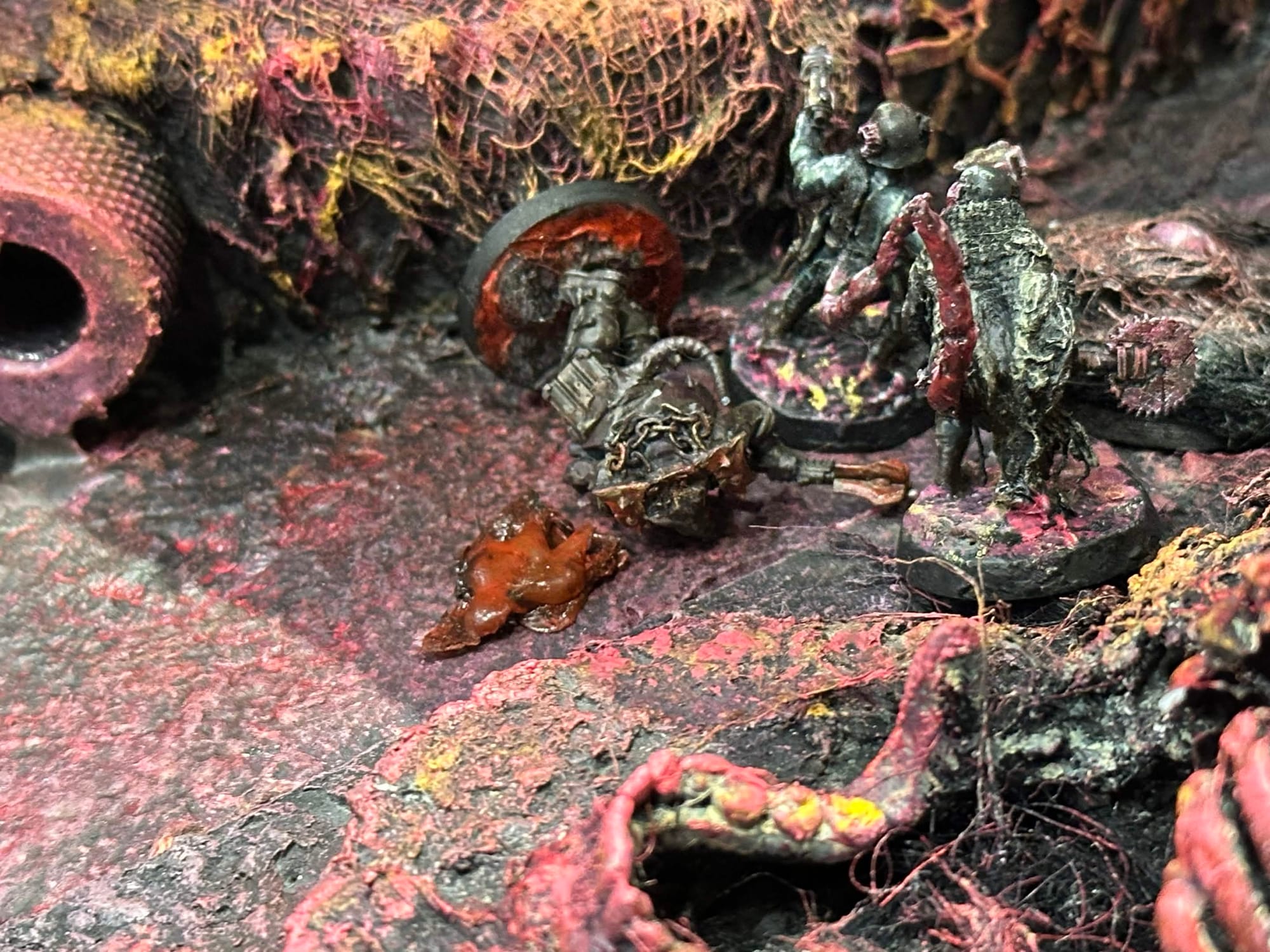
Watching Hive Scum’s Brothers of Promethium 2 event
Gage from Hive Scum was nice enough to give me the opportunity to watch, and document, Brothers of Promethium 2, and it’s the sequel to an event the Hive Scum crew ran a couple years ago. It was invite-only, and the players comprised an assortment of kitbash artists, die-hard indie wargamers, DIY-oriented content creators, and an overall rag-tag group of people that seemingly should all be in a room together. Curated like a good party, everything was set up around a huge collaborative game board with multiple GMs who adjudicated a wargame that I understood about 50% of.
Invited players were asked to bring a vehicle of some sort and an on-foot model of the captain of that vessel, and that’s because BroPro2 was set in an ocean. Made up of a giant table split into quarters and adjudicated by four different GMs, the game seemed to play out like a massive negotiation exercise, with each quarter of the table having several quests they could accomplish based on the terrain and NPCs on their side of the board. If this is hard to visualize, you are not alone, and thankfully terrain maestro blerz has posted some video and photo evidence.
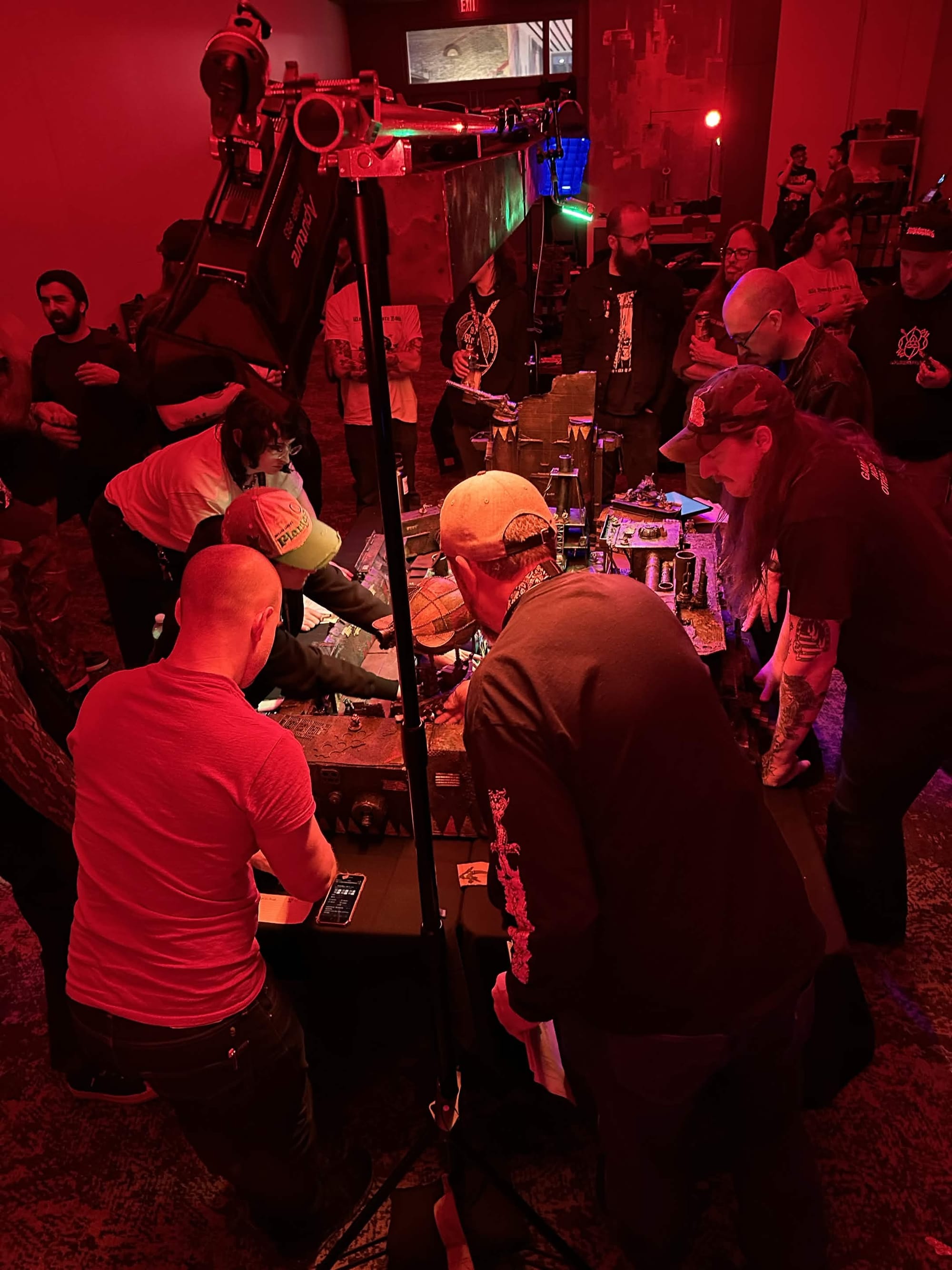
If you moved from that quarter, you were suddenly being GM’d by a different person. It was immediately chaotic, but with some strong parameters that seemed to direct people pretty strongly (you can listen to the back half of this podcast to hear the organizer’s perspectives on some of this). From the beginning, I watched and listened to an unbelievable amount of freeform roleplay combined with wargaming interest, including everything from immediately getting into combat to engaging in extensive engagements and negotiations with teammates to become stronger and more capable.
In the room, I thought of myself like a photographer, listening intently to the conversations that the players were having around the game, and trying to understand how they were adapting to each other within the broad ruleset they were provided. What they were adapting to was a well-planned, engaging party – curated, with a clear goal of getting these people preoccupiedengaged with each other and thinking creatively.
That is, in some ways, Adepticon in a nutshell: an excuse for like-minded people to hang out. The shape of that excuse is what’s interesting to me about the games played there, and BroPro2 was no different. I almost immediately heard Jesse tell a longform backstory about the character he had brought to the event—dead lovers, betrayed interests, and the melancholy decision to continue life. [As a side note, many hours later he would end up giving me this model for some reason I cannot understand.] As the game went on, partnerships and alliances were forged, and players negotiated with each other and their GMs to determine their actions. I heard Steve prompt his players repeatedly with the age-old GM provocation: “What does that look like?” and then listened to elaborate explanations that no game rules could contain. And it happened. Because they agreed that it did.
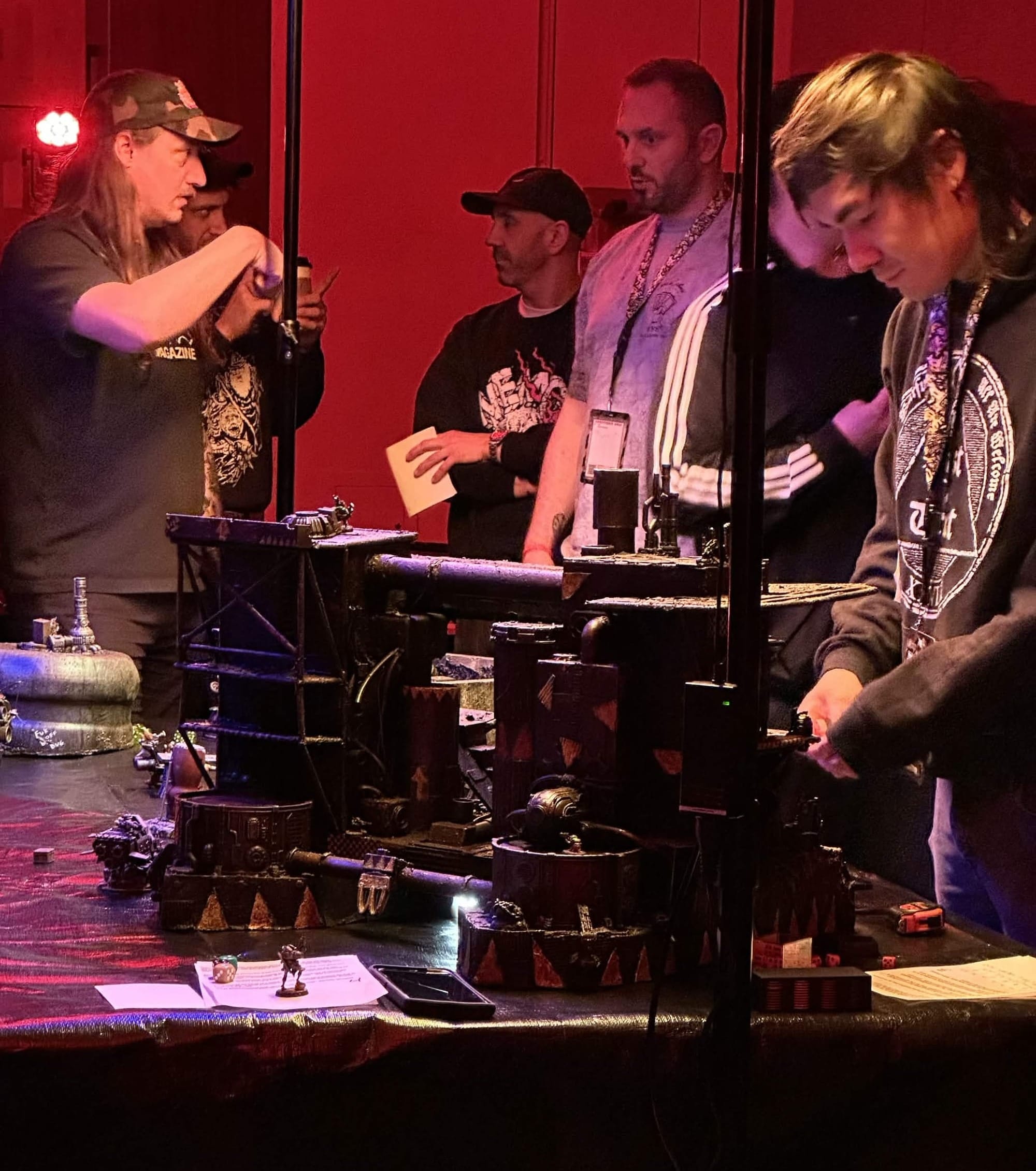
There is a wonder in giving yourself over to that excuse for hanging out. It’s the drive to watch football at the bar, and it’s the magic that allows us all to suddenly give a damn about curling once every many years. There’s something special, though, about putting yourself in a science fiction wargaming hellscape as the way to connect with other people. During the second hour of watching the game and listening to people scramble for supplies, I started to think about that scene in Fear and Loathing In Las Vegas where the man stumbles into the bathroom and sees people getting incredible kicks from things he would never know. I think that might be what a random viewer of this event, and a lot of other serious events at Adepticon, might come away with—there’s magic you might only glimpse through a cracked door, and you might be able to make it yourself one day.
These folks are getting thrills out of measured movement, group storytelling, and random dice rolls that are just as illegible to the historical wargaming enjoyer as it is to a traditional RPG person. It is really and truly its own thing, a full chaos narrative event, better parsable as a party than a game. In the middle of the game, I saw Paul go get paint and put it on a drink can lid so that he could change the base rim color of his miniature to fit the vibe. That’s happening at rare tables, and it is a behavior that sees this whole wargaming thing as an expression of self from top to bottom. It’s unalienated play, this thing we’re all supposedly chasing all the time, come alive in a very real way.
At the midpoint of the event there was a changeover. The players entered a fort, and they fought around it. I watched a plane go down. I saw a barge bust in. Eventually, everyone who was still alive was attacked by a big ork whose disembodied head would become an icon of rulership on the planet, and the players did some rules-based squabbling over who would reign supreme. The protagonist of this essay, Adam Vass, somehow won out.
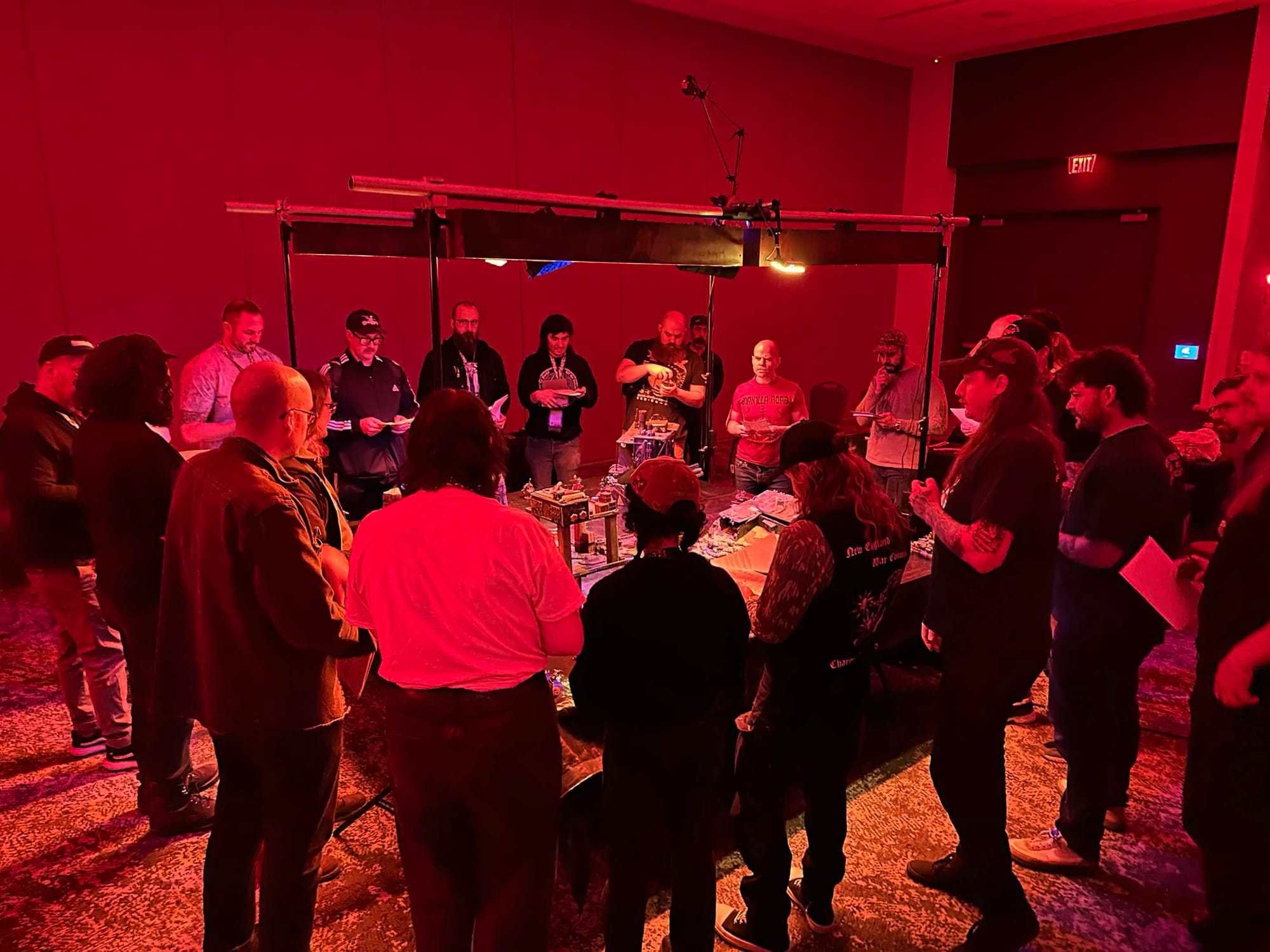
When BroPro2 started, I thought the gift was my chance to be a fly on the wall for this event. That was definitely cool, even though I have caught several pictures where I am in the background frowning my entire ass off as if I am miserable. That’s my listening face! I’m not miserable! During the game, I thought the gift might have been witnessing exactly how one of these things comes together and the miracle of something like 20 people playing a game together creatively and collaboratively to make something that is just generally pretty rare in the world.
In writing this, and revisiting my notes, I think some bonus gifts I received were the snapshots in between. Listening to Scot tell me about some of the game design being done during setup and about his journey to Adepticon, which I salute as a fellow driver. Talking to Dillon about, and then watching him manipulate, the lighting and set design for the event that drew people in and encouraged them to play closely and immersively with one another. Watching Terry completely house a peanut butter sandwich while explaining how Witty bribed an NPC with chocolate to skip some key part of the mission design. It’s all just shadows on the wall that come together very carefully, and very creatively, to create a rich and interweaved experience that it is hard to forget.
Some godforsaken creature from Matt, aka Smash Bash, aka totally_not_panicking
At Adepticon this year, there was something that I heard referred to a few times as the “teeth radius.” This was a zone where the word “teeth” could be heard because people were screaming it at the top of their lungs. It came from the combination Smash Bash and Hive Scum booth, driven mostly (as far as I could tell) by merch table extraordinaire Steve constantly hyping up a crowd to fish into a box to pull out, well, teeth. In the eye of the teeth maelstrom was Matt, creator of Sun Rot (which I briefly mentioned last year) and notable kitbash artist.
Coming to know Matt has been one of Adepticon’s great ongoing gifts to me. I met and interviewed him last year, and we’ve kept in touch to talk about game design and how we make it happen. Last year, I invited him to come work with students in game design and sculpting for a week, and I think we both realized we shared a lot of ideas in common about what the world of games, and thinking about games, could be. We’re maybe cooking something up about that.
At this Adepticon, we didn’t have very much time to hang out. The upcoming release of “big box” Sun Rot and his vendor schedule sort of precluded it—someone has to yell “teeth,” after all. We did have an opportunity on the last day to have dinner with a few excellent folks and to talk art (including how Shaun should have gotten a Golden Demon pin).
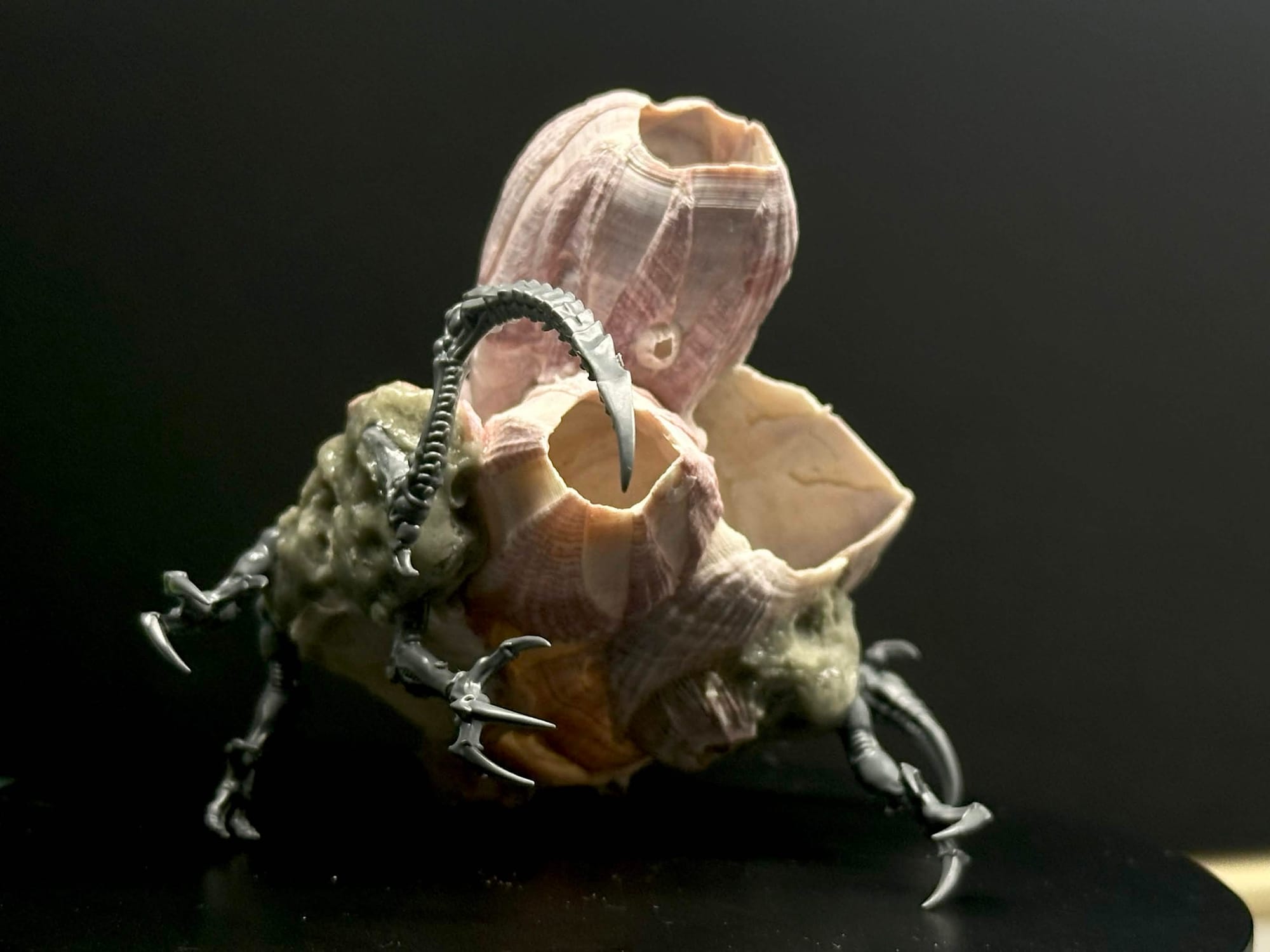
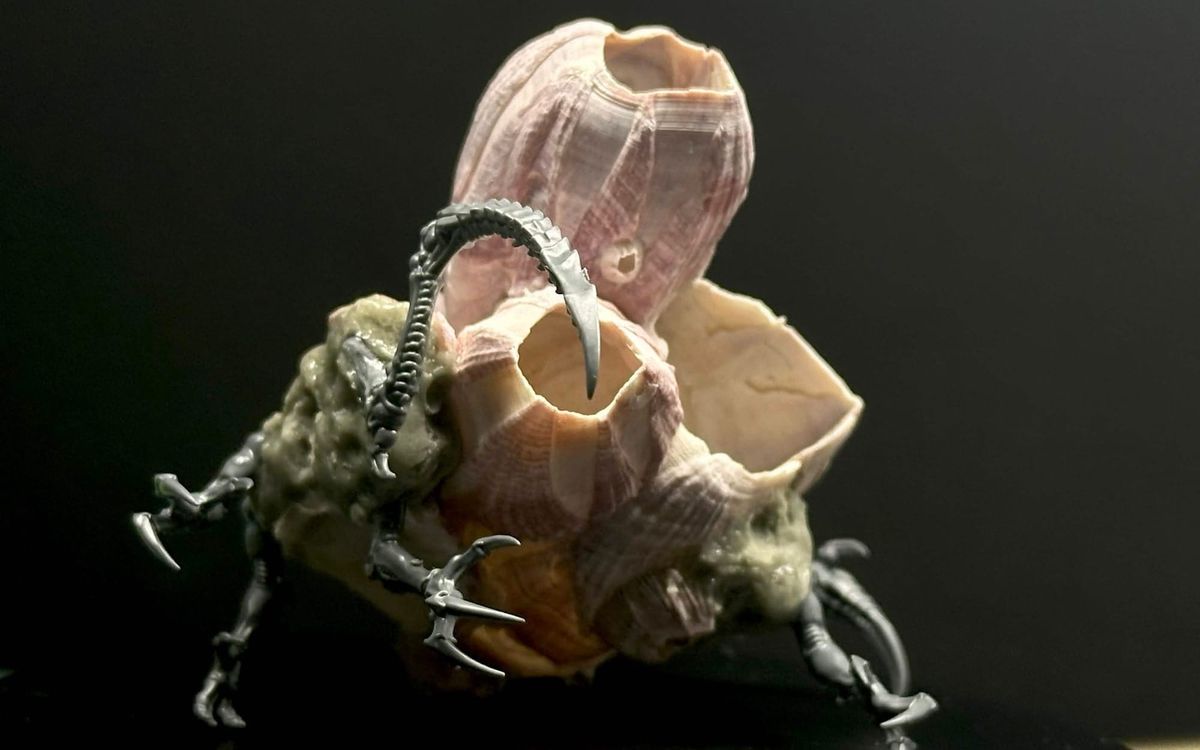
Right before we parted ways he handed off to me some kind of terrible barnacle with legs. We actually didn’t talk about it very much—it was a gift in the true spirit of it, and it was the final gift in a weekend where people constantly handed me zines, stickers, experiences, models, bags of random stuff, and ideas that were freely given, most often without having any idea of who I was or even what my name could be.
The barnacle creature makes me reflect on the experience of Adepticon as an arts event. People are paying to take art classes, sure, and nearly every competitive and casual event has the expectation that you paint (or pay someone to paint) your miniatures before someone will play with you. I made an effort this year to do very few events and instead walk through as many rooms as I could, and I was constantly seeing new boards, units, and armies. I bought a resin cast doubloon out of someone’s backpack. I bought miniatures out of a tackle box on the floor in a hallway. Everywhere I walked there was someone at a table reading or stealing some room to paint, and the Grim Dark Hallway had an active kitbashing table for something like three running days. Half of the money I spent at the con was on art supplies, and the most hype I got was seeing someone’s portable painting station with a light on it.
And the rest of everything
There’s a lot else that I could say about what I enjoyed, and I could do a big rundown of things that I thought were wonderful. Ryan gave me a copy of, and ran me through, Death Cut In Stone, a shootout game where you deploy from the center of the board and which lasted all of two turns as each player sliced and gunned down opponents. I bought a copy of the newest Boss Fight zine and read it all in one sitting. I grabbed a copy of SCVM, the only game that I am aware of that is exclusively about child gangs fighting for dominance at the end of the world. I was one of the lucky few to get a print copy of Wanted! Reward: 10,000 CC, a game that I have been so enchanted by for the last few months that I have spent dozens of hours painting civilian miniatures and building a science fiction city so that I can run it properly. I spoke to Isaac about his sculpting process and was able to hold my all-time favorite miniature, and while I was pretty emotionally zapped after four days of con going, I have teared up more than one time since thinking about it.
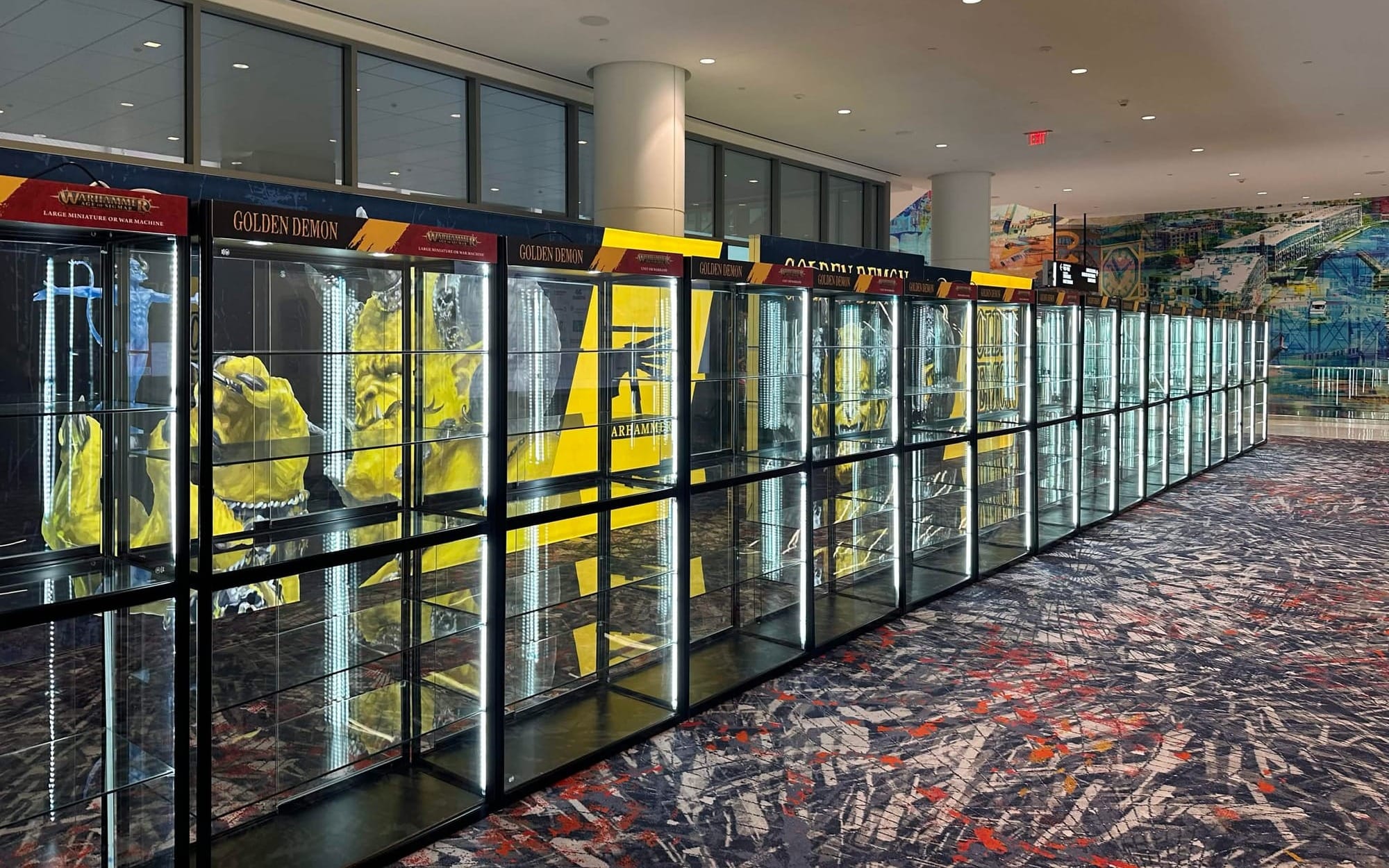
Adepticon is the place where it all plays out in person, these threads of intellectual inquiry and pure appetite. It’s a zone where I assume some people come to chug beer and others wear customized jerseys advertising their local 40k sponsorships. For me, it is an arts event, a place where I can watch a noise band called Orc with Spear Mounted On Giant Wolf & Lizardman play while I am also, somehow, attending a flea market where one of my favorite YouTubers hands me a huge bag of space marines and says, “I don’t know, what about ten bucks?”
There’s no big lesson here. Adepticon is a massive commercial event that has successfully provided a deep, warm art hole inside of it where many communities are growing, fungus-like, within it. I’ve attended a lot of cons, and I talk to a lot of people, and I can’t identify another place I could go and experience a flow of gifts like the ones I got at Adepticon. It’s big, but you can make it small. It’s brash, but you can make it mean something.
And then I drove 15 hours back home, ready to do it again next year.