Flatmates in Space: Gareth Damian Martin talks genre and Citizen Sleeper’s tabletop destiny
A fully realized tabletop RPG lies on the other side of some big questions.


If you’ve read the first part of Rascal’s chat with designer Gareth Damian Martin, you’re familiar with the basic premise of the Citizen Sleeper series. Its second entry, Starward Vector, was released today is a certified banger in direct conversation with Citizen Sleeper’s themes that feels generative, satisfying, and perfect for you big-world-small-story science fiction lovers, to borrow my spouse’s phrase.
It also ventures closer towards a fully realized tabletop RPG. Martin said as much in an interview discussing their third video game and how their relationship to development and tabletop games has evolved over the past three years. The London-based creative recently partnered with Alfred Valley to design Cycles of the Eye, a solo game that uses a tarot deck to simulate an alternate version of the first Citizen Sleeper’s story. That taste of analog creation apparently awakened a hunger in Martin, who is now keen to chart space beyond both Erlin’s Eye and Darkside via character sheets and real dice.
If and when it arrives, Martin said they want it to transcend its inspirations and be more than just a roundabout reinvention of Blades in the Dark. But they are also fully cognizant of the changing landscape for both digital and analog games. “Baldur’s Gate 3 casts a long shadow,” they said, and everyone and their grandmother are rolling digital dice. Maybe clocks, position, and effect aren’t such large asks.
This second installment of a two-part interview has been edited slightly for clarity.
Chase Carter: What prompted you to create a solo RPG set in the world of Citizen Sleeper?
Gareth Damian Martin: It felt like a good first step into making RPGs. I had already worked on In Other Waters’ Tidebreak module with Lone Archivist which created this whole rule set that sits on top of Mothership. I wanted to open things up a lot for Cycles of the Eye. I played Thousand Empty Light and Lay on Hands. The aesthetic of Alfred [Valley's] work is incredible. Lay on Hands specifically was a nice balance between strange and ambiguous, but also being quite systems driven.
I really felt like Alfred's aesthetic would work well for what I wanted Cycles of the Eye to be, which was that kind of zine feel to the whole thing. Something I love about tabletop games is the ability to have more unstructured aesthetics. Funnily enough, I wanted to do a tarot deck with the Citizen Sleeper characters because it felt like they fit so naturally. Then I realized that I didn't want to make a tarot deck without making a game you could play with it. It started out as a pamphlet and ended as an entire two-book game.
Carter: Scope creep comes for us all.
Martin: It really does.
Carter: Cycles of the Eye was your first sort of real outing as a tabletop designer. How was that experience compared to your normal work?
Martin: It was super interesting, and involved a lot of broad thoughts about what I want the effect to be. Then, Alfred would dig through the weeds and make it all work. Because I'd already started work on Citizen Sleeper 2, I had a dice system clear in my mind that was slightly different to the first game. For example, if you roll a one, then you take that dice away. A lot of natural logic followed from that, like having the tarot cards be tasks and assigning those tasks a value that matched the card.
Much of the work was Alfred and I running the game separately and then coming back together and talking about our experiences. The thing that Alfred and I share is liking our rules to be very lightweight and logical, feeling natural and not having to be rechecked all the time. We spent a lot of time designing the most efficient and logical version of the rule set possible. It was a goal of minimalism.
"The core is really about entropy. It's about things falling apart and how you build something in the knowledge that it probably is not going to last."
I was really happy with the game, and it feels very logically playable like solitaire: you roll the dice; they go on this card or that card; then, you clear the card. But when a character comes up, it's an opportunity to narrate a scene to yourself. We tried to put the tarot meanings, the words, physically on the card to reduce the amount of player reference. The problem with solo stuff is you're just constantly looking up rules again.
I haven’t seen anybody who isn't me play Cycles of the Eye or really read anything about people playing it because it's still trickling out into the world. We're working on a retail version, but solo RPGs are a small world at the end of the day. And I’m always looking at the next game project, so it’s hard for me to put too much focus on it now.
Carter: Will you return to tabletop design for another big project?
Martin: I definitely want to do a full tabletop game in the Citizen Sleeper universe. I just need to find the right collaborator. There's so much to be done there, and I don't want to rush it. Making an actual tabletop game is very intimidating, but it's also a really interesting project for me to figure out. A lot of people are like, isn't it obvious? Just make a Forged in the Dark game. But so much of Citizen Sleeper and Citizen Sleeper 2 is solving problems that only exist in video games. Solo tabletop games are not that different from a video game, especially when we've got tarot cards as your game system.
You hit immediate problems when thinking about a full tabletop RPG. Do you have an entire player party of Sleepers? How do dice work for humans? The questions immediately pile up. So there's still a lot of work to do.
Carter: When you bring Citizen Sleeper back to tabletop, a lot of its DNA will have been translated twice back to an origin, of sorts. How are you thinking about that?
Martin: Citizen Sleeper 2 sets the stage for a tabletop adaptation better than the first. Citizen Sleeper 1 adapted nicely into Cycles of the Eye, which I think of as Citizen Sleeper Remix because you're encountering the same characters as you do in the video game, but they might play completely different roles. It's like this weird string theory, many different universes of one story. But that's a very different paradigm to telling new stories within the Citizen Sleeper universe, which is not something that I've explored yet.
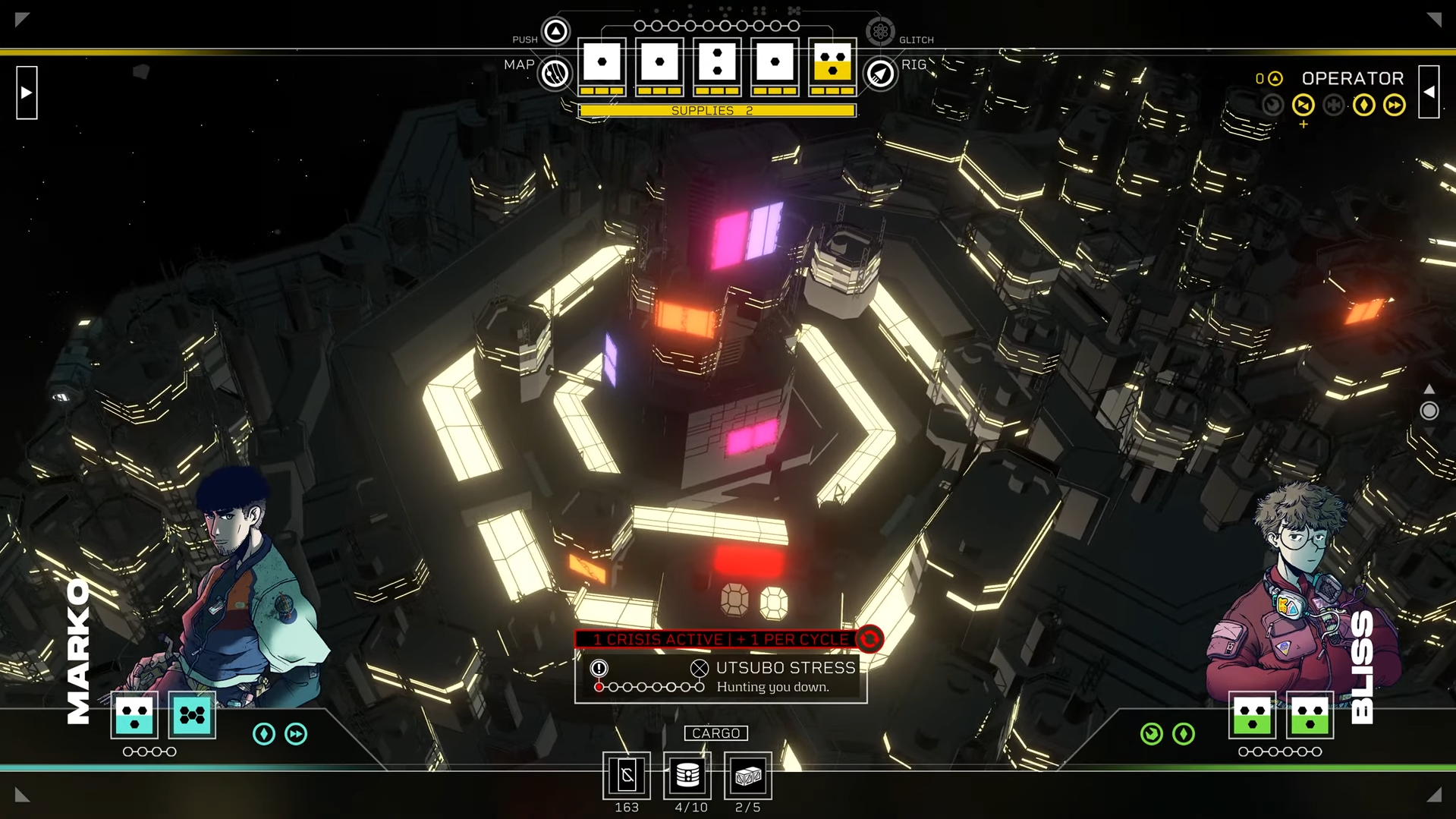
Citizen Sleeper 2 sets up the idea of crews who travel around in ships, take on contracts and have downtime to recover. You also need world structure for a tabletop RPG: why are there groups of people who bands together adventures? Citizen Sleeper’s core is not completely nonviolent, but I think combat and violence is not going to be the centerpiece. Immediately, that's an interesting problem of creating tension that the new game addresses with contracts where you're not fighting enemies or exploring a dungeon, but they do fundamentally play out like a heist.
But the bigger questions revolve around Sleepers' bodies, humans versus sleepers, the roles that humans take, and how to think about character classes when everything has been really condensed around the Sleeper's particular experience. We ran a Citizen Sleeper actual play game, and I had a lot of conversations with Quinns while he was preparing the scenario for that. I had to say to him, “Hey, I'm a player. I can't know what we're actually going to do in this actual play, but I need to tell you about a series of rules that apply to Citizen Sleeper.” Step by step, there's a lot of groundwork that's been done already.
Carter: You mentioned the inspiration for the first game being your experience in the gig economy, and it has inspired folks, post-release, to bring lenses of various marginalizations, whether that's a trans identity or chronic illness and disability. What questions are you digging into with the sequel?
Martin: Citizen Sleeper 2 has this human focus that implies precarity and the idea of dealing with the margins of dysfunctional structure and life within that. This paradigm of existing within a space where something could shift, crush you, and you have to just keep live your life within it. But I also saw the opportunity to play into a genre space that I've always really enjoyed, which is what I call Flatmates In Space: Cowboy Bebop, Firefly, Farscape. I've a big love of those, and I never thought I would write one of those stories because they're much too genre for my tastes.
"I definitely want to do a full tabletop game in the Citizen Sleeper universe. I just need to find the right collaborator."
A lot of what has informed the sequel is a Citizen Sleeper-fication of those shows. Where do they meet? Where do they play against each other, and what comes out of that? And then I actually re-engaged with Citizen Sleeper as an external text. When you've released a game and people bring their own experiences to the table, and you've had all of these discussions and done a lot of podcasts and interviews, this accruing distance happens. It actually felt really productive. I could be more intentional.
To talk about the personal side of it, Citizen Sleeper 2 became very personal. The core is really about entropy. It's about things falling apart and how you build something in the knowledge that it probably is not going to last. I invented a robot that falls apart to talk about how humans are always falling apart. Being self-aware of that, Citizen Sleeper 2 became about modeling the mechanics of falling apart and how that’s also a big concern for all the characters who aren't the Sleeper.
Carter: For tabletop players who really like what Citizen Sleeper is doing and they want more video games in that space, what would you recommend?
Martin: A massive inspiration for Citizen Sleeper was a game called Diaries of a Spaceport Janitor, which I think still holds up. It was the game that really convinced me that I could make something like Citizen Sleeper. What I loved about Spaceport Janitor is it looks like Star Wars, but it plays like my life felt at the time. As someone who loves science fiction, being able to make science fiction that has all of the fun and cool and exciting and escapist genre things, but that can also be affective and reflect your human experience really hit me hard. You can make a colorful space port full of weirdo aliens, but it can actually be about a depressed wage slave.
There's another game called Alien Squatter, which is like a really low-fi RPG where you're an alien trying to get into a futuristic mega city. You're in a refugee camp outside of the city, and you only have like a certain number of steps per day before you collapse. Steps are based on how much food you can scrounge. There are random battles with rats in the squatter's camp, and it has this really mad cap tone balanced against a very down-to-earth and slightly depressing experience.

Carter: What about the other way? Where would you point folks who come to tabletop through Citizen Sleeper?
Martin: It's hard for me to tell if CBR+PNK is actually easy to run, or if it's just because I already know Blades and so it feels easy to run. But it seems like a pretty cool starting point in the sense that the rules are so slight that it feels like you could run it wrong and it wouldn’t matter. I mean, that's true with tabletop games anyway. It’s just like a series of pamphlets, and you just hand them out and have fun with it. I'd obviously send people to Blades in the Dark. You can just not read large portions of the lore sections. Just read the rules. I'm a big fan of making up my own worlds when I run because I'm a lazy GM who doesn't like to prep. It's easier to make shit up than it is to prepare in advance. I also think The Quiet Year is a really cool way to begin with tabletop games. I've played it with quite a few people who have never played a tabletop game before and sort of facilitated the experience.
Carter: Anything else you want to add?
It's funny that Citizen Sleeper 2 has ended up undeniably being an RPG. It was almost on purpose. It's such a different environment now. Baldur's Gate 3 has cast such a long shadow. You have it and Disco Elysium as these two massive design temples, and then hiding in the corners is Citizen Sleeper. It sounds almost arrogant, but I just want the game to be in conversation with Baldur's Gate 3 because it's fun to put small and big things next to each other. It's not that I think they’re not comparable, but there's an interesting interrelation.
Video game RPGs have so much potential for expansion, and I think there's a load of Citizen Sleeper-alikes coming. I keep seeing them around. I'm very curious to see how those go over the next five years. If tabletop people believe they don’t like video game RPGs because they’re all like D&D and Baldur’s Gate 3, hopefully they see my game and realize there’s so much more out there.