I love horny games but I'm also afraid of them
What are we losing if we let people censor the perverted stuff?
I am a pervert.
I would like to make the case that most people are. Not all people, and not all in ways that some perverts consider to be on their level, but most people are perverts about something.
And that means that most things are at risk of being destroyed by those who seek to control our bodies.
It is perhaps far simpler to say that most things can become perverted — a subset of prudish people are always prepared to declare the result of any effort perverted for their own sake. And that means that anything, even the thing you once thought was ultimately pure and righteous throughout, can be at as much risk as the thing you cannot stomach.
Australian anti-porn lobby group Collective Shout's baying to online payment processors such as Visa and Mastercard led to the removal of sexually explicit games first from Steam, and has now struck itch.io. These two rapid censorship plots, as well as Vice owner Savage Venture's attempt to silence Ana Valens' canary-in-the-coalmine initial reporting of Collective Shout's actions affecting Steam, make it even more noteworthy that Valens warned that the same fate could befall even a generally lenient space like itch back in 2021.
Moral panics like these are not new. From the worries of Satan lurking within the dice rolls of Dungeons & Dragons in the 1980s to the exaggerated fear of video game violence in the 1990s, a combination of a lack of media literacy, a devaluation of interactive media, and a distrust of the fans of those media often coalesce into terrible and reactionary politics about art, those who make it, and those who consume it.
Mixed with the crueler impetus to control other people and punish them for stepping out of that status quo, this attitude also comes from a lack of curiosity. One man's yuck is another man's yum, at all times, and refusing to at least wonder what someone else may see in something, or develop a more thorough self-critique of your own lack of interest beyond fear or disgust, limits your ability to experience what the art has to say.
I say this also for myself. This column is literally a space for me to be upsettingly curious, to see games as objects, as markers of culture, and as molecular elements of the zeitgeist, just like other forms of media.
Which means not only being curious about my pervert self, but also about the self beside that self. The part that is far more interested in softer, sweeter, no less intimate but vastly less bawdy things. The part that rejects, that pushes away, that is offended by the notion of being called a pervert.
What am I so afraid of?
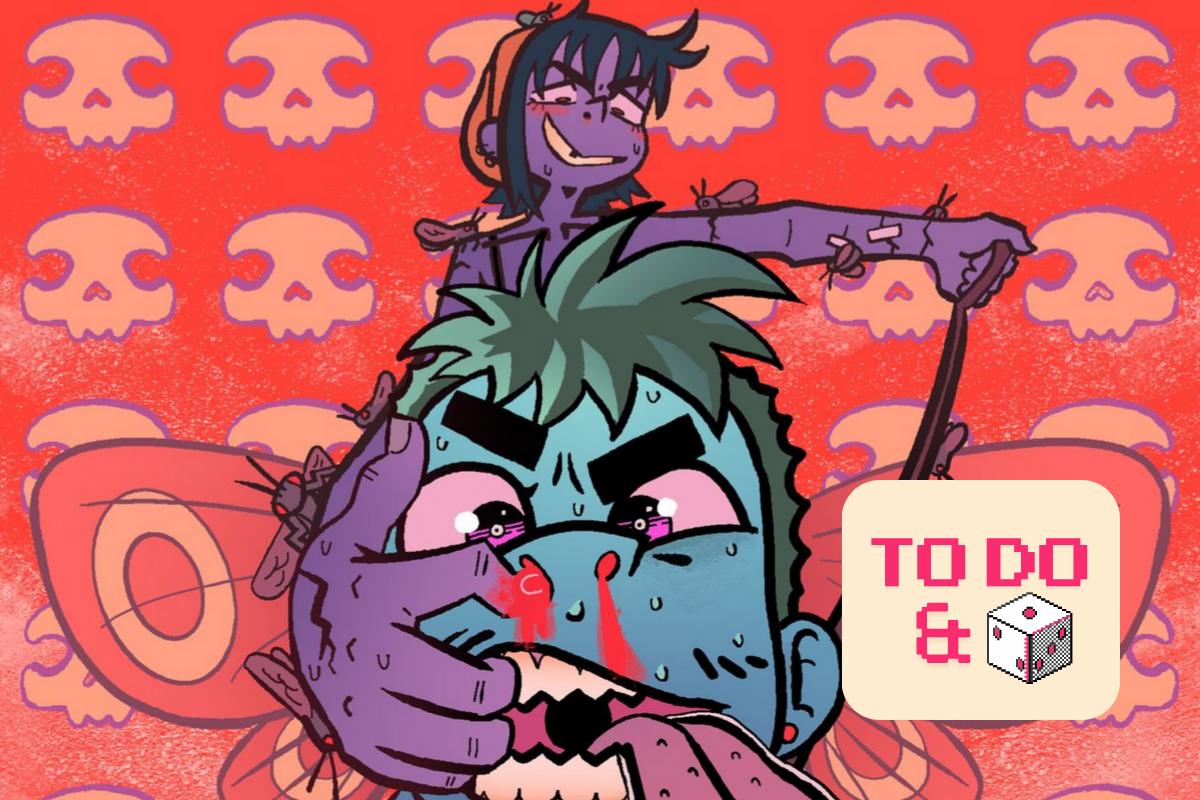
In early March, I read Sage the Anagogue's PRAISE THE HAWKMOTH KING.
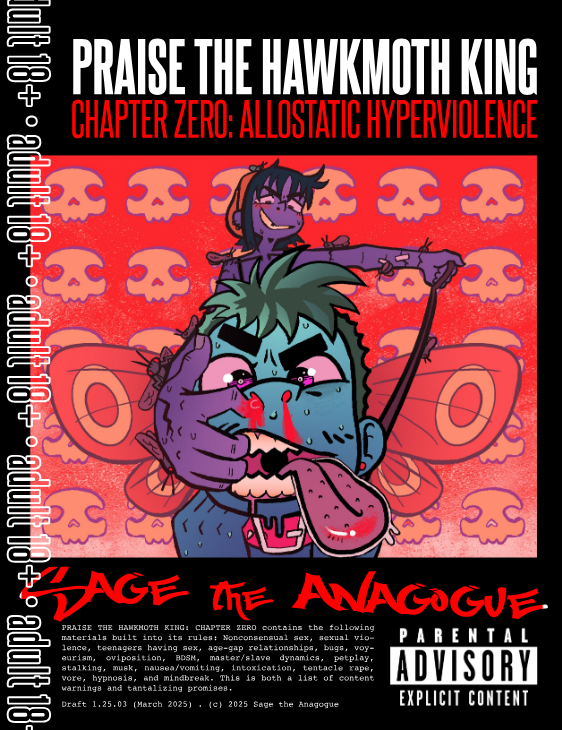
I am not entirely sure how I feel, and I suspect that is (a small part of) the point.
The preview of the game opens with a list of some of the themes that may occur in play, including non-consensual sex, sex between underage PCs, domination, cannibalism, necrophilia, bodily excretions of various kinds, and my personal favourite, mindbreak — the erotic media trope in which assault eventually leads to such an overwhelming betrayal of the body that the victim begins not only to enjoy it, but see it as their sole purpose. The game mentions them not only as content warnings, but as "tantalizing promises".
The premise that content warnings are also invitations is not new to me, and yet the presentation here grabbed me. Here is a game not merely saying, 'we are going to be exploring some raw territory', but instead wearing a sign on the door that reads 'ENTER HERE FOR SOME SICK SHIT'. HAWKMOTH KING is not averse to being thoughtful about sexual violence — it is doing so by kicking the barn doors down and letting you witness these themes in all their messy glory.
HAWKMOTH KING cuts a strong vibe with its content warnings and its narrative setup — as teenage zombies brought back to life to serve a great new lepidopteran god by stopping devils from breaching the veil between the worlds. You’re expected to do this by any means necessary, including and especially by seducing them into revealing their greatest fragilities. Mechanically, I adore this game — its stats (GIRL, BOY, THING, and FLAME), in the Powered by the Apocalypse style, feel more evocative than many of the system's other children, where each one draws an entire connection the PC has with their body, their identity, and their relationship to the power they can exert on the world. The preview rules suggest that players ask and answer the same caliber of questions about position, intention, and power that they may ask about combat when they are performing sex. So much of the game is not only about how PCs gain power over other characters, but also how they lose power to each other and the world. It burrows into the consequences of being at the mercy of others but also being invested in bringing others to heel to us in turn. It is a dizzyingly deliberate and articulate game to read.
I'm just not sure I will ever feel comfortable playing it.
This is not because I am a prude. I actually am quite excited by the notion of playing games such as these. I really wish I did have the opportunity to play it. It knows what it wants, and I am intrigued to explore some of those things with a patient, careful, trusting table. But the game is very clear about what that table is, and I don't think I have one. There are people I enjoy playing games with, folks I trust to tell stories with very challenging themes and vice versa, who I would absolutely dread unlocking kinky matter with.
In Darling Demon Eclipse's very astute manifesto, she identifies one of the virtues of ‘faggot games’ as a 'departure from popular axioms around player and character consent, and broad rejection of the modern safety framework for something more interpersonal and robust'. Given some of the inherent conflicts with the ways we discuss and interact with safety tools presently — how it can very easily lean toward encouraging a kind of play that avoids adventurous narrative territory instead of creating safe space for digging into it deeper and having a way out when it cuts to the bone — this is a virtue I find very inviting. But that interpersonality, that robustness, also clarifies another element of the dichotomy between these two visions of consent: some safety tool frameworks work well for a table full of people you don't know very well, and others demand the same level of trust and control you would have in kink spaces. I don't want or need to cross that bridge with everyone I can play a game with, or with every game. Hell, there are people I want to be kinky with for whom that barrier can only be crossed on a case-by-case basis.
It is radical to offer this framework — to say that it is necessary to challenge the paradigm of accepted wisdom about consent in play. Inviting what Meguey Baker referred to in 2006 as the 'I Will Not Abandon You' framework means being willing to test the waters of very complex, intense play, not only because some players are actually perfectly comfortable with it, but because players want to find their way through play towards greater comfort, understanding, and yes, even risk.
But am I still being too tame by saying that I see that value without touching it — without being touched, without being consumed? Am I still sitting outside the boudoir, having a heady monologue about how much smut means instead of actually fucking?
One of the very obvious critiques that can be made about censorship panics like Collective Shout's is that it gets in the way of telling stories where hardcore sexual themes such as violence and coercion are core to the narrative without aiming to be titillating (or just plain polices queer bodies even when nothing sexual is happening at all). The second, more striking one, is that it isn't even your goddamn business what weird stuff consenting adults are into, so long as no one is actually getting hurt. In fact, policing the minds of conscientious adult consumers actually harms many survivors of trauma who seek these works for catharsis — by definition, these are the people Collective Shout aims to pruriently defend from the realm of seemingly dangerous words and pictures.
But in this way, the group’s aim reveals itself as no more than control. Collective Shout doesn't actually care about seeking complicated art, helping real consumers fathom trauma deeply or helping real artists richly describe their own reality, and it definitely doesn't care about whether people deserve to spend their money in private or deserve to eat off the labor of their hands. The system as it exists is designed to make us struggle to contemplate how complexly, unfathomably strange our bodies and our relationships between them are. It is poetic, then, that this organization bays for the same violence and domination as the rest of the system. I think this relates to not only how it seems to dampen our desires, or punishes us for having them out of turn, but also how it often also polishes so many of the other meaty edges of our bodies into smooth, unjagged, palatable stuff. I do not need to be revolting to be destroyed. Collective Shout doesn't care if I am revolting; it will find some other reason to destroy me. It will even destroy me without a reason, and claim that as justified, too.
To be sure, I mean revolting both as 'wicked, offensive, frightening, full to the gills with grotesque stuff' and 'radical, liberatory, reformative, full to the gills with subversive stuff'.
The page for Titanomachy RPG's #tittyrpg game jam (another wonderful place to source your die-activated smut) clarifies that 'as long as you're not a bigot or fascist,' all are welcome to make a tittyRPG. But it clarifies an additional rule for cishet persons: since their sexuality is not a target of systemic violence by the heteronormative status quo, their game has to be about something other than sexuality or gender, one of the many other loci of threat against the system.
The very suggestion opens up intriguing narrative space: by this metric, what is a Black tittyRPG? Or a disabled tittyRPG? Not only in the sense of what obvious commentaries on the broken nature of heteronormativity can be revealed by a cishet Black man or disabled woman using game design to confront their own body in this system, but in the sense of being curious about all of the other ways the status quo is constructed to police our bodies, and the other messy, nasty, revolting flavors in which resistance manifests.
Perhaps beyond my hexagonal frame of the faggot-lattice, just outside the boudoir constructed in my heart, there is a foyer where my attachment to my body is not through lust or gluttony, but rage and fear: the part where I imagine discovering that I am too monstrous to be loved, where my body is an engine for brutality against my will, anything I do will be viewed as violence by a world that views my body as loathsome. It is the place where I imagine myself being a mythic monster leveraging the world's hatred into more of my power, or the place where I question whether I have gotten stronger only by channeling that which people fear from me. That is not a queer part of my body, but it is a Black one. It is no less revolting against the status quo, in both of its meanings. If the first trait of a 'faggot game' is not caring if it is accessible or palatable to 'cishet people and prudes', there must be an alternate-universe version where a game cut from a similar cloth is not concerned about making play more comfortable for white people.
This fact is also an appeal to our shared vulnerability: some other group of priggish censors will find something to tamp down in all marginalized creation. They target the sexual work first because they suspect that we queer folks will let it slide, that we are prudish just like they are or will look away in order to appear 'normal'. Then, when they come for the other queer work, the stuff we thought was too soft or palatable to be judged, they're hoping everyone else will look away, too. The shouting mouth is never any less hungry.
The culture of the faggot game instead insists that we embrace the vulnerability of never shying away from the parts they hate for the same reason they will never stop targeting us: because we are ever vulnerable, but also because when we are our pure selves, they flinch. If we are always perverts — if nothing we touch is ever pure — then touch everything.
What does it look like to unlock that mode throughout this hobby — in more ways that are deeply kinky, but also in ways that are not at all attached to sex yet no less sensual, no less body-targeted? How do we become more perverted, more unavoidable; more vulnerable, but less fragile?
What fears get in the way of getting to live in that world? Not only the fears of fascist prudes, but the ones I carry with me?
But mine is not to reason why.
The ACLU website currently hosts a petition to compel Mastercard to rescind this current policy. Guidance on how to directly contact Mastercard and other payment providers is included at yellat.money.