Detect Or Die is more than just Disco Elysium brought to tabletop
There’s a hodgepodge of influences.

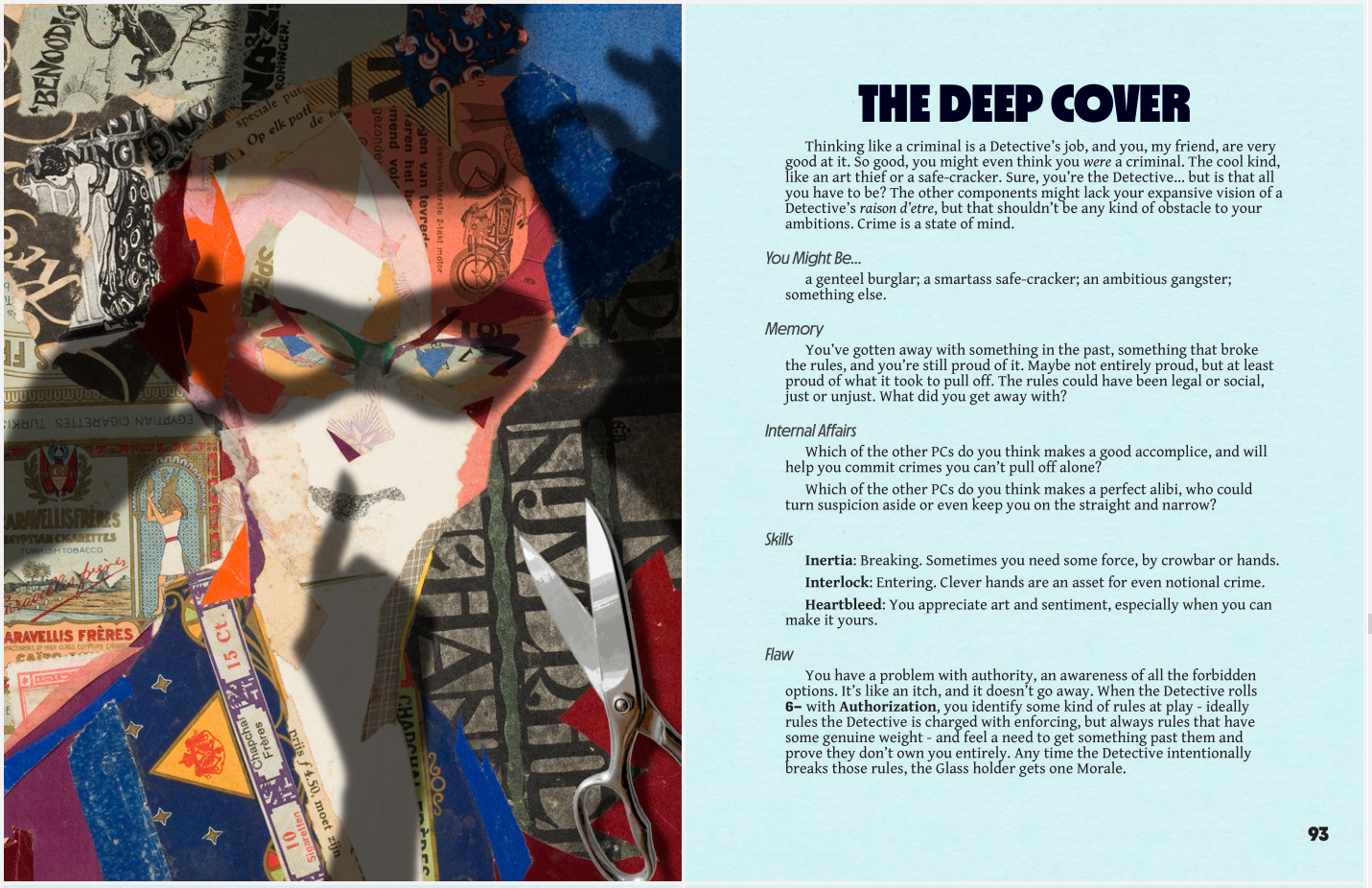
The fingerprints of Disco Elysium is all over Detect or Die, an RPG about an amnesiac detective and his fractured psyche. Like Disco Elysium’s Harry Du Bois, the Detective in Detect or Die only has a few scant memories and several personality components (PCs) that make up his subconscious. To wrestle back some semblance of an identity, the Detective will need to solve their One Big Case by relying on the very PCs that players themselves will embody, from the bitter Volatile Core who’s a simmering pot of pure, unadulterated rage, to the trivia-obssessed Egghead, who possesses an encyclopedic knowledge of esoterica: niche, pointless, but perhaps useful for cracking unconventional cases. They will all chip in at opportune moments to help the Detective recover his memory and complete the investigation.
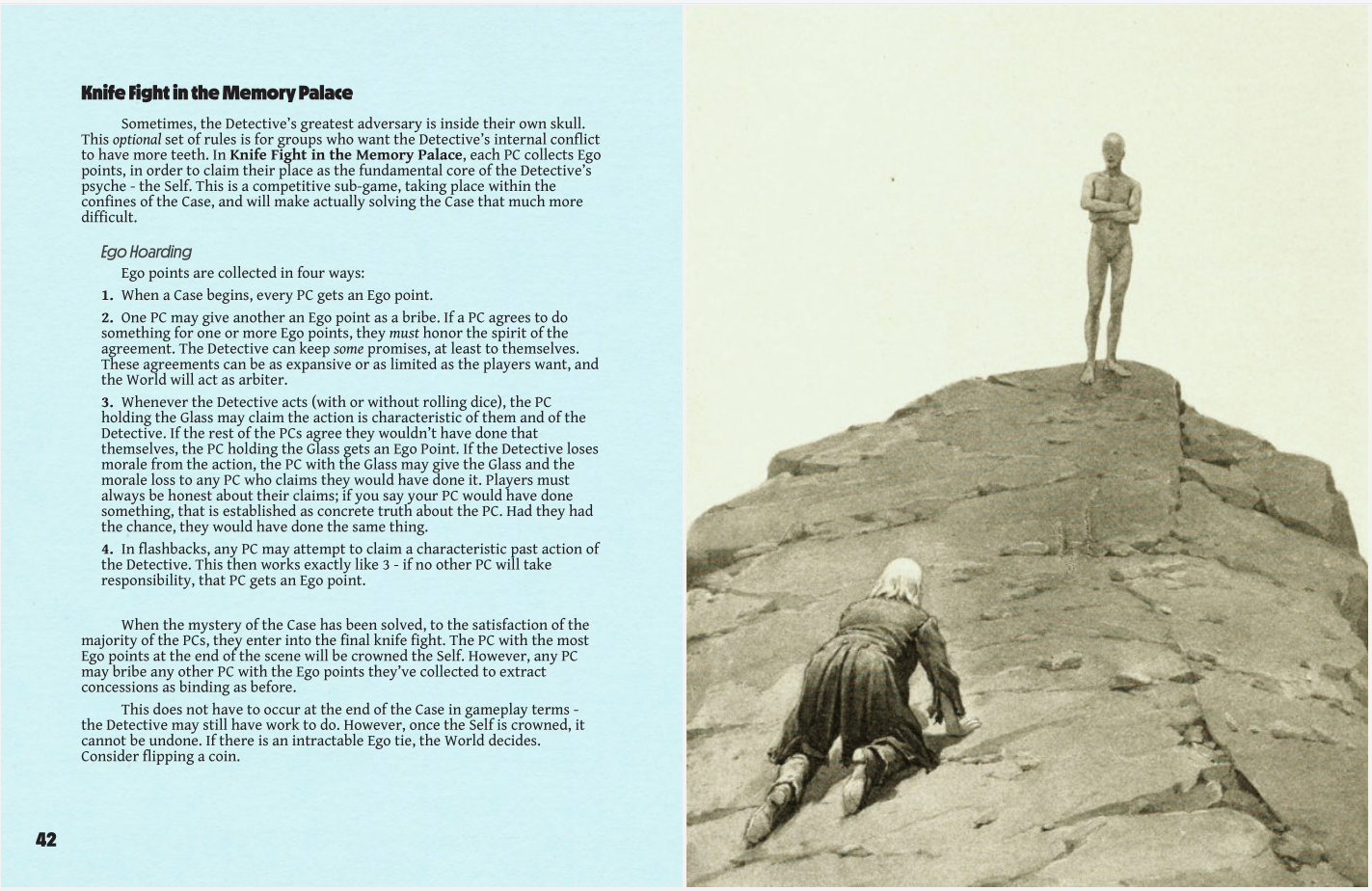
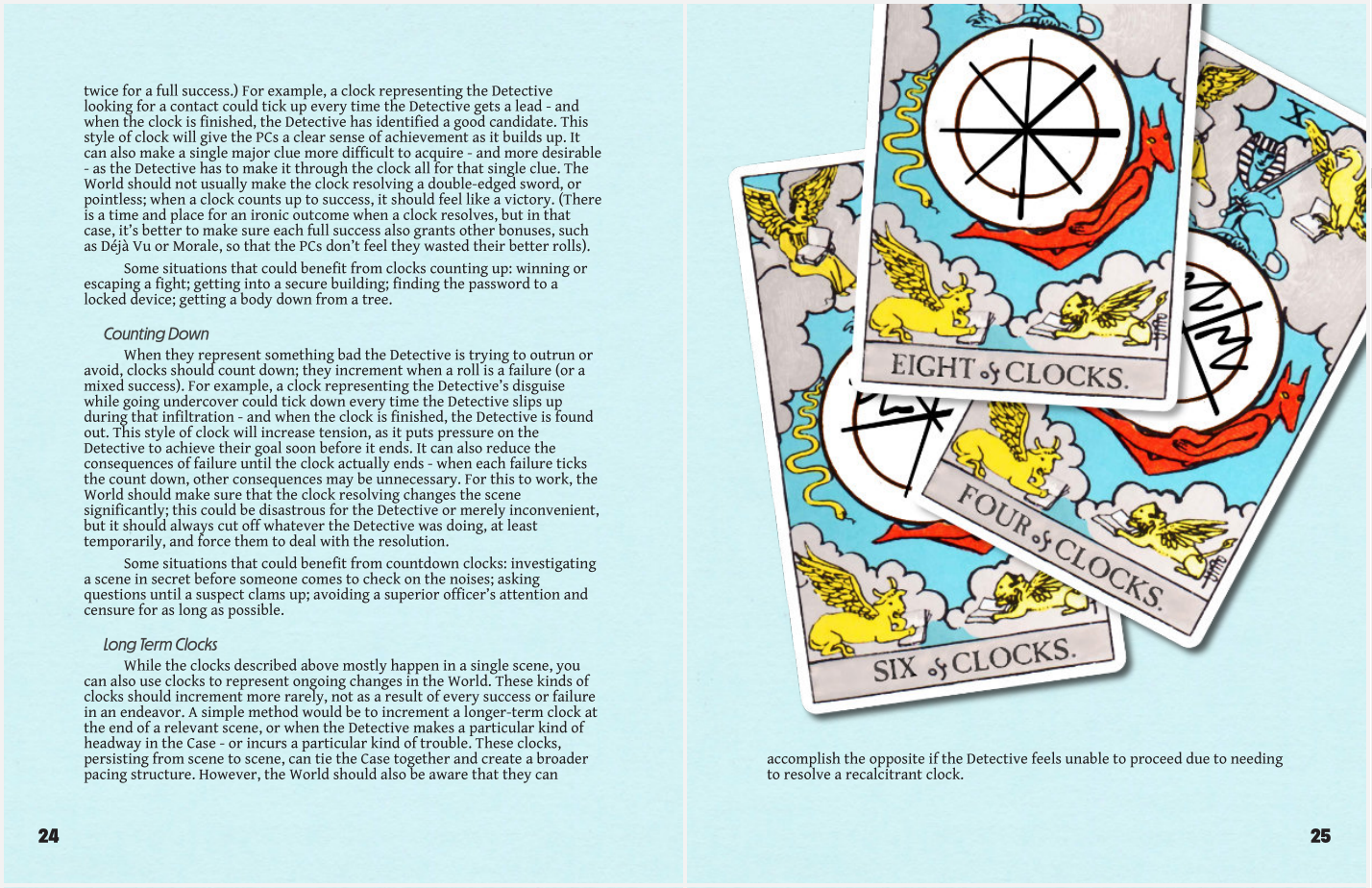
Because the players themselves are the PCs, Detect or Die is, in a way, a collaborative effort, with players portraying one shared character together. Thus driving the melodrama within the game is the interactions among the PCs, which will often be jockeying to become the dominant personality with the Detective. This is determined by the amount of morale you have, with the chosen one determining the Detective’s physical actions, from performing specific actions to conducting the investigation itself. If you have zero morale, you must cede the position to another PC so they take control. Then there’s the secondary currency called Déjà Vu, which are the brief fragments of the Detective’s past that can be exchanged to redeem Flashbacks — the very memories that the Detective has lost — which propels much of the game’s momentum.
Disco Elysium is, however, only the most visible layer amidst Detect of Die’s myriad influences. One game, in particular, has already popularized the concept of playing as distinct fragments of a single personality, even before the video game’s conception. “In coming up with the system, I started with the other inspiration, the feminine horror Powered by the Apocalypse (PBTA) game Bluebeard's Bride from Magpie Games,” said designer and academic Benjamin Klug to Rascal in an email. “What struck me, besides the intensity of the game itself, was the way it arranged the players as the aspects and personalities of a single character. That itself is not a totally new idea, but it's rare, and I had never really considered it because of what seemed too great a gap between how I tend to play ensemble-based games and the singular protagonist.” In Bluebeard’s Bride, players also roleplay as a singular character — the titular Bride — with Detect or Die’s belligerent PCs’ interactions directly inspired by the Ring moves in Bluebeard's Bride; whoever possesses the Bride’s wedding ring will perform her actions. In particular, Klug was taken by the “startling fluidity” of the game’s party-based mechanics, and how it organized players to manage a single character as a party. While working on a separate RPG based on the bildungsroman genre — stories centered around a character’s coming of age — he was astounded by how seamless the system connects to the tale of the amnesiac detective, and immediately hammered a draft out in months.
“I try not to fall into pure mimicry,” said Klug. “The Detect or Die skill roll system is not actually a PBTA move framework; I've tried to do a real move list twice, and neither really came together into the kind of structure I'd hoped it would. But I started with PBTA dice and Bluebeard's Bride specifically as a pattern, and then tried to mutate it, rearrange it, think about the way the moving parts of the machine would direct and engage players, how they would be encouraged to play by the incentives presented.”
On the other hand, Klug admitted that Detect or Die is also designed, “with malice and spite”, against another game in mind: Everyone is John. It’s perhaps a game that can be said to be the antithesis of the single character RPG, featuring a man whose decisions are determined by the chorus of voices in his head. To Klug, the game is fundamentally mean-spirited, and a joke that ridicules the concept of a character with varying impulses (the description of Everyone is John on its own website referred to the protagonist himself as “totally insane”). “I didn't set out to represent plural experience in Detect or Die, but I very firmly did not want to ridicule that identity or experience,” said Klug. “In any case, Everyone is John is the single biggest stumbling block to multi-player, single-character RPG design or play, and my spite against it was a real motivator to make Detect or Die as polished as I could.”
That said, Klug believes that his design allows for players to apply the Detect or Die system across settings, be it on a whaling ship, a space station, or even in Disco Elysium’s Revachol — if that’s what players prefer. He referred to this as a system for doing stories and scenarios that multi-player games may struggle with. “[It’s about making] them work well and capture what that genre really is, rather than gesturing at it and leaving the players to figure out how to juggle it,” he added. But for players who want to dive into a campaign quickly, Klug has included two of them alongside the rulebook: “The Case of the Signal Fire” and “The Case of the Example of Play”.
“I think of RPGs as an intensely formalist medium,” he said. “Ramzi Fawaz, who studies comics here at University of Wisconsin-Madison, once told me that he liked comics because they make all the formal dimensions of literature totally visible: the panel, the speech bubble, everything is right there and you can point to it. RPGs are the same: basically everything they do, they do with visible pieces, because the players at the table have to be the ones to assemble and run the machine.”
Responses have been edited slightly for clarity.
1. If your game had walk-on music or a climactic needle drop, what song would it be?
This is a difficult question, mostly because the setting could be so different across different cases. I think that a good generalizable waking up song for the Detective, [with] the World almost entirely gone, might be "Lazarus" by David Bowie, and for flashbacks (which can really be the climax of the game) "It's Only Love" by Tigercub. A good solution song, as the Detective arrives at their final epiphany and does something about it, might be "Very Bad" by Turbowolf. There's a pretty consistent rock flavor across those, I think, but I'd have a totally different set (and maybe a different flavor of music) for any particular case and Detective.
There is one really firm answer, though, which is that The Case of the Signal Fire, the case file that comes with the book (and which is the only full case file I've managed to put together so far, but I keep intending to do more) has references to Joanna Newsom's album Divers throughout, which is possibly my favorite album. The song "You Will Not Take My Heart Alive" is the needle drop for the Detective there, but I don't want to say more in case I spoil the case for anyone reading.
2. If your game grew like a plant, what was the seed of the whole thing? And what about you made you the right kind of soil to receive and nurture that idea?
I think the seed is fundamentally the genre crux of amnesia, detection, science fiction and (less so, but still present) political fiction, the way they interact with the act of tabletop gaming, the linearity of speech and the interaction of the players. And well, I study that kind of genre operation, and I have what I think is a clear and uncompromising way of looking at those and seeing them as machinery, as system. In a sense, it's an arid soil — but I think there's some things that will only grow in those conditions.
3. If your game was food, what would it be?
Leftovers you don't remember buying — a curry or soup that gets richer and funkier and spicier in the fridge, and that you're only going to identify by investigating, and the longer you investigate the hungrier you're going to get.
4. If your game was a machine and we could break it down into parts, which is the smallest part that you think best captures the essence of what you're trying to do?
I'm very torn. I can think of a few answers, but I think the best is déjà vu, the token currency players collect in play, and which can be spent to have a flashback as memory returns. First, because it specifically encodes part of the experience of the Detective that's outside their control, familiarity without explanation or memory; secondly, because it paces out the slow rediscovery of the past. And third, because I really do mean players: the World (the GM) also collects déjà vu, and when they have enough they can send the Detective into memories they don't necessarily want to recall. This is, in mechanical representation, the operation of amnesia and discovery, gathered details and sudden recollections.
"I think the seed is fundamentally the genre crux of amnesia, detection, science fiction and (less so, but still present) political fiction, the way they interact with the act of tabletop gaming, the linearity of speech and the interaction of the players."
5. If we broke your game down into parts, what's the thing we wouldn't see? What do you think only emerges out of the entire thing moving together?
Looking back to the previous answer — I still described two distinct moving parts, both déjà vu and flashbacks. And they would link further into more parts: being in a flashback, you can only roll to investigate, not to act; you will likely lose morale, which if all the Detective's players are fully demoralized will send the Detective spiraling into self-destructive behaviors in Temporary Personal Katabasis. These shared operations bring the Detective players together, and as the game continues I've often noticed that the glass, control of the body, moves more fluidly between parts of the Detective - they agree on more, work together more, understand each other's strengths and weaknesses better. The Detective goes, slowly, from a shambling mess of perspectives and uncertainty to a single being, complicated and self-contradictory and not always competent but able to move towards a single answer to who they are and what they make of the Case. Not every time, of course; it depends what the players want, how they see themselves, whether they're competing (there's some rules for a competitive mode, if they want) - but that coming-together as the Detective picks themselves up and puts themselves together is compelling to me.
6. If your game had to commit a crime, what crime would it be?
Impersonating a police officer.
7. If your game was to win an Oscar, who would it thank in its acceptance speech?
Well, the Disco Elysium developers thanked Marx and Engels at their awards celebration, so I'd have to follow their lead and thank Darko Suvin, the curmudgeonly Marxist theorist of Science Fiction whose work has had a huge influence on me, and who's quoted over the manifesto in Detect Or Die. It's a game of cognition and estrangement, after all.