Making change matter in Under Hollow Hills
When improvement and experience are off the table, how do immortal characters evolve?


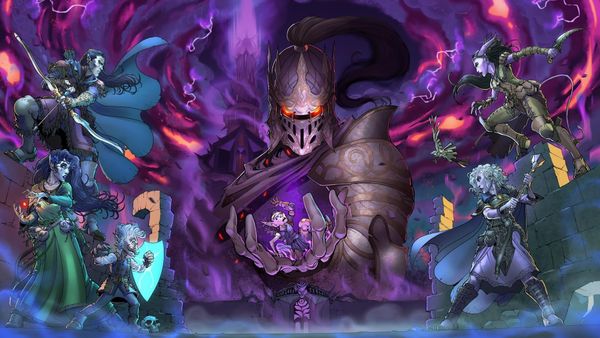
Under Hollow Hills, designed by Vincent and Meguey Baker, follows a fairy circus as it travels between the human and fairy worlds. Player characters are members of a this circus, and they can choose from a variety of playbooks, both fairy and human. Before characters perform the circus show, they spend a bit of time in the area, meeting NPCs, taking stock of the situation, and establishing themselves in the setting. Each character then performs in the circus and is allowed to make a circus move, which changes a single person’s fate or the fate of the entire circus. It is this deliberate decision to center change that separates Under Hollow Hills from the rest of the Bakers’ oeuvre of games.
The crowdfunding campaign for Under Hollow Hills launched in 2020, but Vincent and Meguey Baker had been playtesting their new game for a few years. (It would later be delivered to backers in 2021, and the full book was released in 2022.) On the Kickstarter page, the Bakers state that Under Hollow Hills is their “most profound collaboration, the game so far that most expresses who we are when we work together.” They consider it the best game they’ve ever made. It’s a Powered by the Apocalypse (PbtA) game ten years after they began working on Apocalypse World and in my opinion it shows their growth as designers and as people much more than any other game, including the upcoming Apocalypse World 3e: Burned Over.
Compared to other games that the Bakers have written that they also consider PbtA, like Firebrands: Mobile Frame Zero and The Sundered Lands, it sticks much closer to the original form; playbooks, moves that use 2D6 (called in this game “plays”), a game master (or, in this case, a Mistress of Ceremonies) with principles and agendas. If you’ve played any “classic” PbtA game, it’s a largely familiar format and setup. The differences are more subtle, and only really emerge during play. The most obvious change is evident on the character sheet; there’s no experience track.
When you make your character, you are given a set of options, all of them falling in line with a selection of off-kilter archetypes from fairy tales and folk stories. You get to customize your looks and you assign your dozen-or-so plays a modifier in the typical PbtA array of +2, +1, 0, -1. You don’t have statistics: there’s no Aggro or Cool; there’s just a series of general plays and a selection of playbook specific plays. These plays are, in a lot of ways, extremely equalizing, as the general (or “obvious”) plays are incredibly powerful and the character plays are extremely flavorful but very specific. The majority of them inspire how someone acts towards you, or reacts to you — the game focuses on the subtle shifts of change within your character; not how you “level-up.”
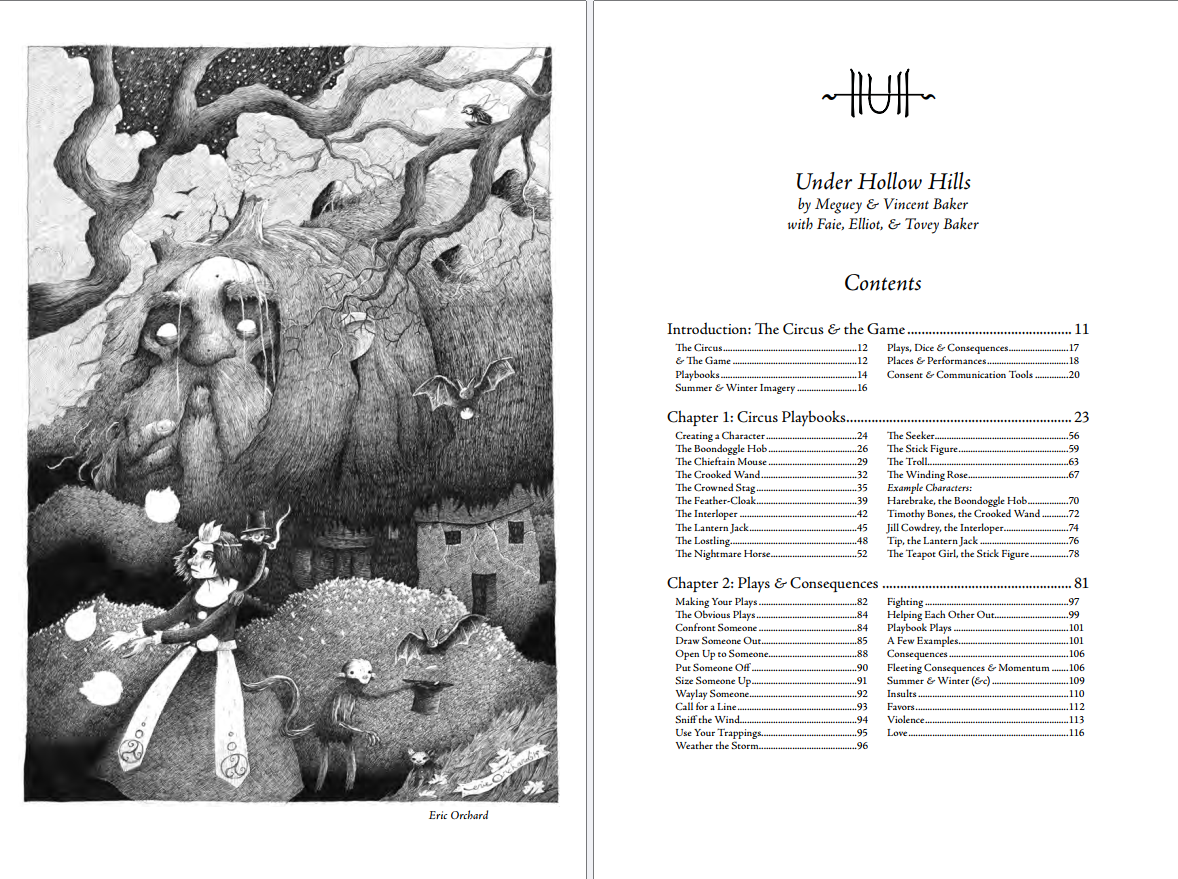
Unlike Apocalypse World, which is largely focused on improving your status in a terrible and hostile world, Under Hollow Hills is concerned with how individual characters can both change and stay the same when given a nearly-endless amount of time. The game does not want you to be concerned with improving your character; it’s concerned with how your character shifts, adapts, grows, mutates.
The introduction to the book lays it out succinctly:
“Wherever you perform, you change: you change the seasons, you change the fortunes of those you perform for, you open their eyes, you awaken their hearts, you loll them to sleep. You change yourselves. This is the game: we change.”
I’m reminded of the verses printed above the first chapter of Octavia Butler’s Parable of the Sower;
All that you touch
You Change.
All that you Change
Changes you.
The only lasting truth
Is Change.
God
Is Change.
Under Hollow Hills is deeply, almost singularly concerned with exploring how individual experiences — and individual interactions — have the power to change characters in measurable, irrefutable ways. These are not immutable or random changes; its stepping-stones. Fairy characters begin with five pairs of character traits framed as opposites, titled summer and winter. A character begins with all five summer traits and through various plays that naturally occur during the game, will be asked to “step into” winter (or summer), subtly adjusting how they’re seen by themselves or others, or how they feel about themselves. When they do this they can also adjust their statistics in two plays up or down one point as a mechanical realignment along their new characteristics. As an example, my current Under Hollow Hills character — a Lantern Jack named John Stamper — has the summer trait “pale green” oppositional to his winter trait "iridescent purple.” He also has “the wick after a candle goes out” opposed to “heat lightning.” What does it mean to step into iridescent purple and suddenly be more capable of “Vanishing” over “Opening Up”? How do people react to the wick after a candle goes out when a minute ago John’s touch was heat lightning?
I’m reminded, interestingly enough, of Jay Dragon’s Sleepaway; a Belonging Outside Belonging game where during character creation you choose your gender from a curated list. (Worth noting is that while Belonging Outside Belonging is its own style of game engine, made with the “No Dice, No Masters” ethos, it is often considered to be Powered by the Apocalypse and draws a lot of inspiration from the PbtA style.) For The Athlete’s playbook, genders listed are “A Glaive, Lightning, Health Goth, Sports Dyke, Barbarian, and Lonely King”. These ephemeral choices become weighty and important, shaping how characters understand themselves and how other characters relate to them.
Under Hollow Hills gives characters — and players — room to lean into who the characters are at their core and learn from the changes that happen to them. If a character really wanted to, they could simply choose two traits and step into and out of pale green and iridescent purple continuously, never touching the other summer and winter characteristics, with no mechanical or narrative penalty. The game wants you to explore change, even stagnated change, or change that only ever swings one way. The disparate molding of individual parts that make up a whole. The section relating to magic explains this as three different levels of change in order of greatest impact to least impact; Nature, Form, and Seeming.
We can suppose that all beings have their nature, whole and unique (if changeable); their form, which may or may not conform to their nature; and their seeming, which is the least reliable of all. If we then suppose some enchantment of transformation, we can imagine that the least enchantment is to change someone’s seeming, then someone’s form, and then most enchantment is to change someone’s nature. So the game conceives it.
Every time a character steps into winter or summer, the game implicitly asks “what does it mean to become a wick after a candle has been blown out?” Does this change John’s nature; who he is at his core? Is it his form, how he has framed himself in his fairy-body? Or is it his seeming; how he appears to others? These decisions allow players to adjust their characters naturally, to tweak and change the game they want to play as a character moves through their different characteristics and adjusts their statistics to be better or worse at certain plays.
Under Hollow Hills also emphasizes this desire to explore change within its session structure. The fairy circus arrives in town. You poke around a bit, see what the occasion is, perhaps participate yourself, and then, you put on a show. Another adjustment between Under Hollow Hills and a lot of PbtA games is that the MC is asked to prep each session within a linear structure. While Apocalypse World asks that you prep threats, Under Hollow Hills asks you to prep the new location, new NPCs, and the specific acts of the session. In the section dedicated to running the game, one of the MC’s agendas is to “daydream fairies and fairyland;” as well as dangers and opportunities for the circus, places, occasions, and audiences.
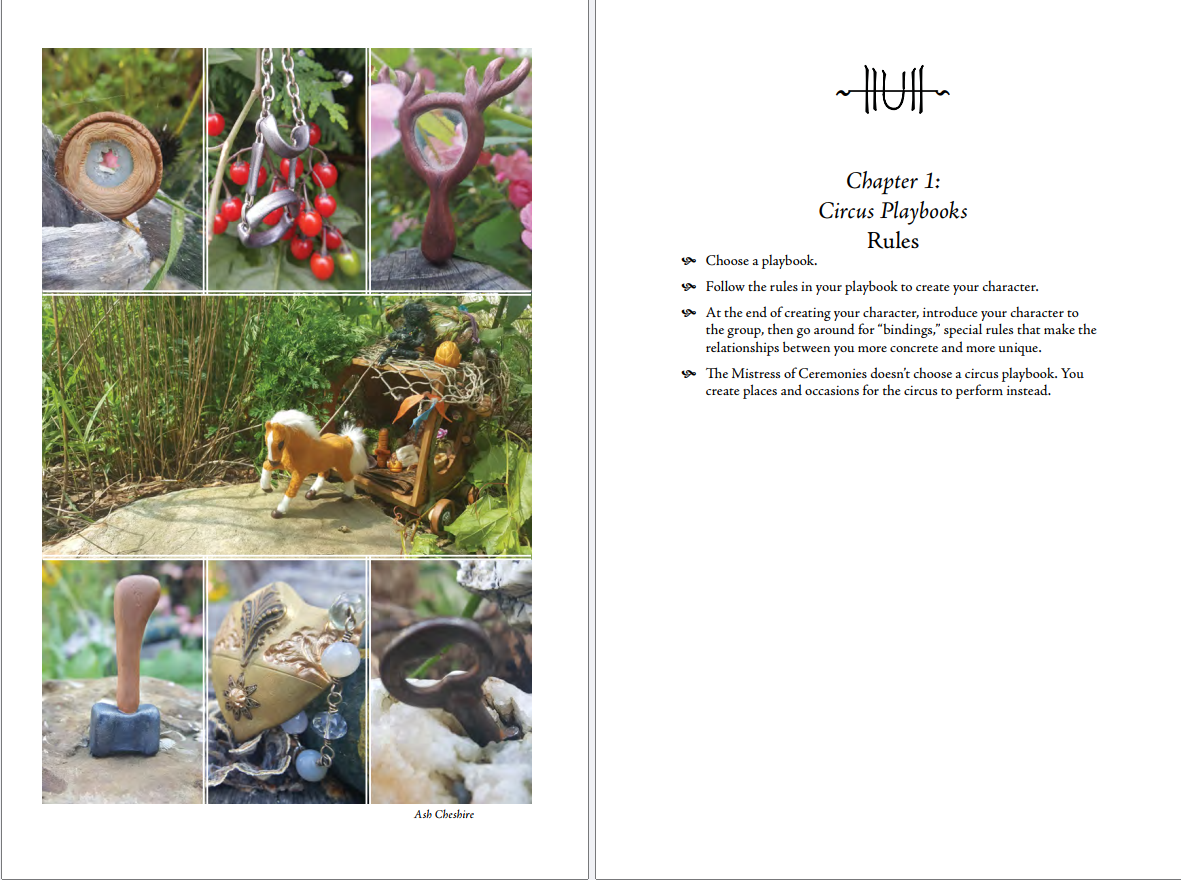
Unlike Apocalypse World, which generally encourages players to move from being bit players in a community to being foundational members of that community (some playbooks, like the Hardholder, push against this norm), Under Hollow Hills implies that the circus is a constantly-liminal, constantly-evolving space. Circus performers come and go, humans and fairy sneak in and hitchhike between worlds, and there’s no mechanical turf or headquarters to protect. No map of danger, no threats from the north, just a place that may or may not be home, that allows you to travel across time and land to appear wherever you are needed.
The game is meant to focus on the impact the circus makes on a space, and how you leave that place better, worse, or different. The circus becomes a thin, veiled thing, not made of walls but something much softer, more malleable. This is exemplified by the Circus Powers, which characters are asked to evoke at the end of their part of the circus performance. You can choose to captivate individuals or an audience, change a place forever, mess with fate itself. The world-altering changes happen during performances.
Change someone’s fortune by name: When you change someone’s fortune, first name them, then name the way you want their fortune to change. You can change anything about them except their nature and their past: their form, their seeming, their luck, their health, their circumstances, the privileges they enjoy or the limitations imposed upon them.
John, as an example, isn’t a performer. He’s the young man in work clothes looking good-for-nothing and not-so-secretly running the show. His performances have been ushering people to their seats, stage managing the intermission, or prepping the music for the Dandyseed Big Top Brass Band. His powers have been big and unsubtle, the kind of necessary work that people assume a fairy circus does on its own — captivating the audience, turning the circus towards a different world. His performance is as a roustabout and flighty, wide-eyed ingenue, performed every day among the people of the circus, allowing him to make these massive changes to the world. He has to imagine what his performance is; what it means to him to keep these "who me?"s believable, to keep the entire circus going, and in those large, unsubtle moments of change he has to decide whether or not he will allow his performance to change him too, or whether he will look on a young girl with a runaway heart and change her fortune instead.
All this change and shifting natures meant that in my game of Under Hollow Hills, I struggled with motivations. The fairy are capricious and flighty, alive in the way the mountains are alive. What does John want? I’m still not totally sure, but I know how he acts, how he plays. There’s an implication with this session-by-session motivational structure that fairy must be, at times, largely bored and have found ways over the millennia to enjoy being just slightly mean, capricious, and cruel to each other, in the way that people in proximity to power become dull-eyed and boring. To reference Parable of the Sower again; all struggles are power struggles. What happens when you struggle to simply be less bored today than you were yesterday?
And the fairy aren’t the only players. Three playbooks; the Interloper, Lostling, and Seeker are human beings in fairyland. Unlike the fairy, these three playbooks come with very clear objectives and goals. The Interloper wants to steal fairy treasure, the Lostling wants to remember the mortal world, and the Seeker wishes to recover something stolen from them. It speaks to the nature of humanity that these are the characters who come with desire built into their playbook. They understand their lives, and their own impact, as finite things. The book recommends having at least one human in the fairy circus, and after a few sessions it’s clear that the tension is tightened along different emotions when a human is in your midst, begging to be taken seriously in a circus full of sprites, pixies, and goblins.
Motivation has coalesced around one of the parts of the rulebook that feels a little buried, entitled “Games Fairies Play.” It reads “Many things which are, to mortal human beings, unchangeable nature, or deadly serious, are to the fairies only games.” The examples it gives include gender, size, time, age, crowned heads, and fairy coin. (That gender is placed first, even above things like “time” and “power,” feels pointed.) A fairy’s purpose is to change. To twist and turn and run riot. Their nature is changeable, their purpose and motivation, changeable, and embracing that alongside more mundane, fleeting desires determined by fate, fortune, and wherever the big top stakes its canvas is the point of the game, and has allowed me to more fully embrace John as a character who is both steady and unsteady.
Under Hollow Hills is a game that focuses on the possibility of change when individuals meet, fight, and flirt a little bit. This potential to change is the charged spark behind every interaction in the game. How you choose to change; how you choose to try to change others, how sometimes you are forced to change in ways that are unexpected. But alongside change, Under Hollow Hills subtly confronts you with how your character remains the same. In many PbtA games, including Apocalypse World, you can, at some point, change playbooks in order to show how your character has changed across the time that you’ve been playing. Under Hollow Hills doesn’t have a written option for that. You are who you are. You can change in many ways, forced into winter, stepping deliberately back into summer, but you play as the same character the whole way through.
By emphasizing change throughout the game, but preventing a character from changing completely and utterly, into something totally new, Under Hollow Hills forces you to think about how and why you’re changing parts of your character. It’s not just that change is inevitable, that it’s the whole point of the game, but by mechanically withholding this one act of transformation, the game seems to say that all change is possible, except that which fundamentally betrays you. John can change his seeming, his form, even his nature, but he’s still the Lantern Jack. He’s still something unique and whole, even amidst the maelstrom of change that the game asks its characters to play into. The star-seed-stuff of you — John, the Lantern Jack, who might not always be wide-eyed and pale green — is you the whole way through your constantly-unending making, unmaking, changing.