A Galaxy of Tactics in Going Rogue
"What is worthy of our sacrifice? When is it more important that we live to fight another day?"


Political movements are never as black and white as fiction, history books, and the hyper-polarized two-party American system make them seem. It is never just Left and Right, Liberal and Conservative, Empire and Rebellion. Within each umbrella, there are as many overlapping ideologies and methodologies as there are people. Each person with a vision for a better world has their own idea of how to get there, an admirable act of radical imagination. Optimistically, this diversity of tactics — a practice and theory first coined by Black thinkers and activists during the American Civil Rights movement — works in tandem as different factions strive towards a common goal. Cynically, it becomes an opportunity for political implosion, one that was taken advantage of by the American government during the FBI’s counterintelligence program, commonly known as COINTELPRO.
As much as leftist infighting has become a meme, the concepts that incite these disagreements are anything but trivial. What actions clear a path for a new world, without recreating the patterns of the old? What means justify what ends? What actions are effective in their goals, and which are merely cathartic? How do we maintain humanity when fighting an enemy that has denied ours and forsaken their own? These are the central questions of every liberation struggle — and ones that lead to unending division in organizing spaces online and in real life.
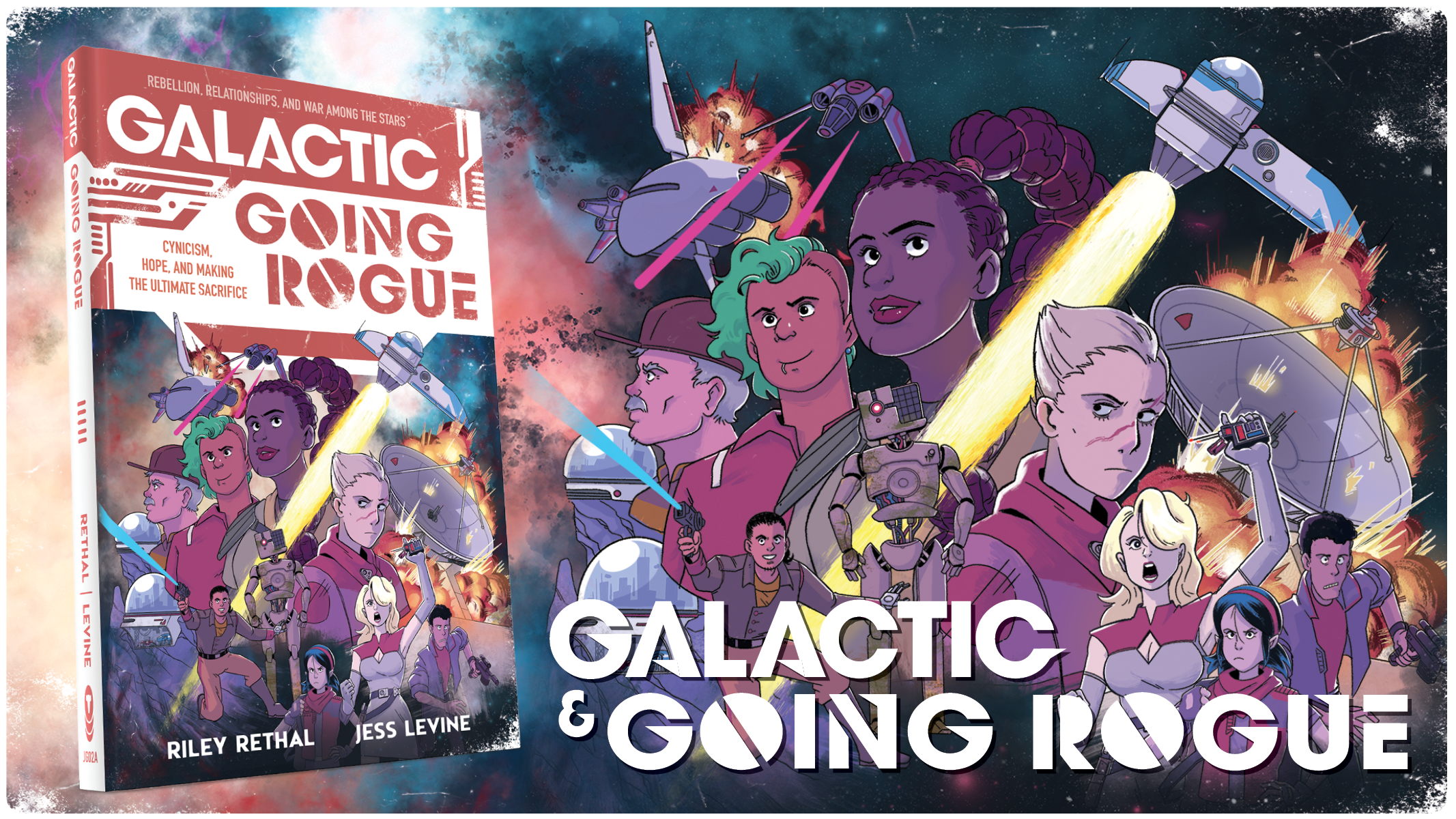
The discussion of radical action, violence versus nonviolence, and effective resistance is undoubtedly safer to explore in the container of a game than on the streets. Throughout her companion game to Riley Rethal’s Galactic, Jess Levine weaves these ideas for players to confront as they move through a galaxy dominated by a fascist, violent regime. Going Rogue is saturated with Levine’s experience as an organizer and activist, bringing the reality of those ideological divisions into the realm of Star Wars-flavored science fantasy.
In the second installment of our two-part interview, Rascal discusses the divisions of liberation movements and presents Levine with Going Rogue’s core thesis questions. You can read the first installment of the interview here.
This interview has been edited for clarity and length.
Rowan Zeoli: Why did you choose to divide the rebellion into The Parliament and The Intelligence, factions that have differing avenues toward similar goals or even distinct goals against a common enemy?
Jess Levine: I was so honored when my comrade Jean Allen said [the game] “does a good job making explicit how Rogue One feels as an organizer.” When I first watched Rogue One in 2016, I was getting my first taste of real political organizing in the form anti-fascist street action in the wake of the first Trump election. When I began writing Going Rogue in 2021, I was on the other side of years of street action, moving from anarchist to communist spaces, and seeing the benefits and drawbacks to each style of organizing. While designing Going Rogue and watching Rogue One’s conflict between the more cautious forces in the Rebel Alliance’s high council and the more direct but unaccountable forces taking orders from General Draven, these experiences were ringing in my head.
One can imagine the Rebel Alliance’s high council in Rogue One as liberals, unwilling to take the fight to fascism, outflanked by the radically left forces of Cassian and his fellow spies and soldiers. Some of my love for Rogue One came from that place, and my frustration with the Democratic party. But when you consider that everyone in that room had already agreed to provide support to an openly violent military rebellion — and when you play Going Rogue — I think it’s more fruitful to think about them as democratic governance that must be present in any liberation movement.
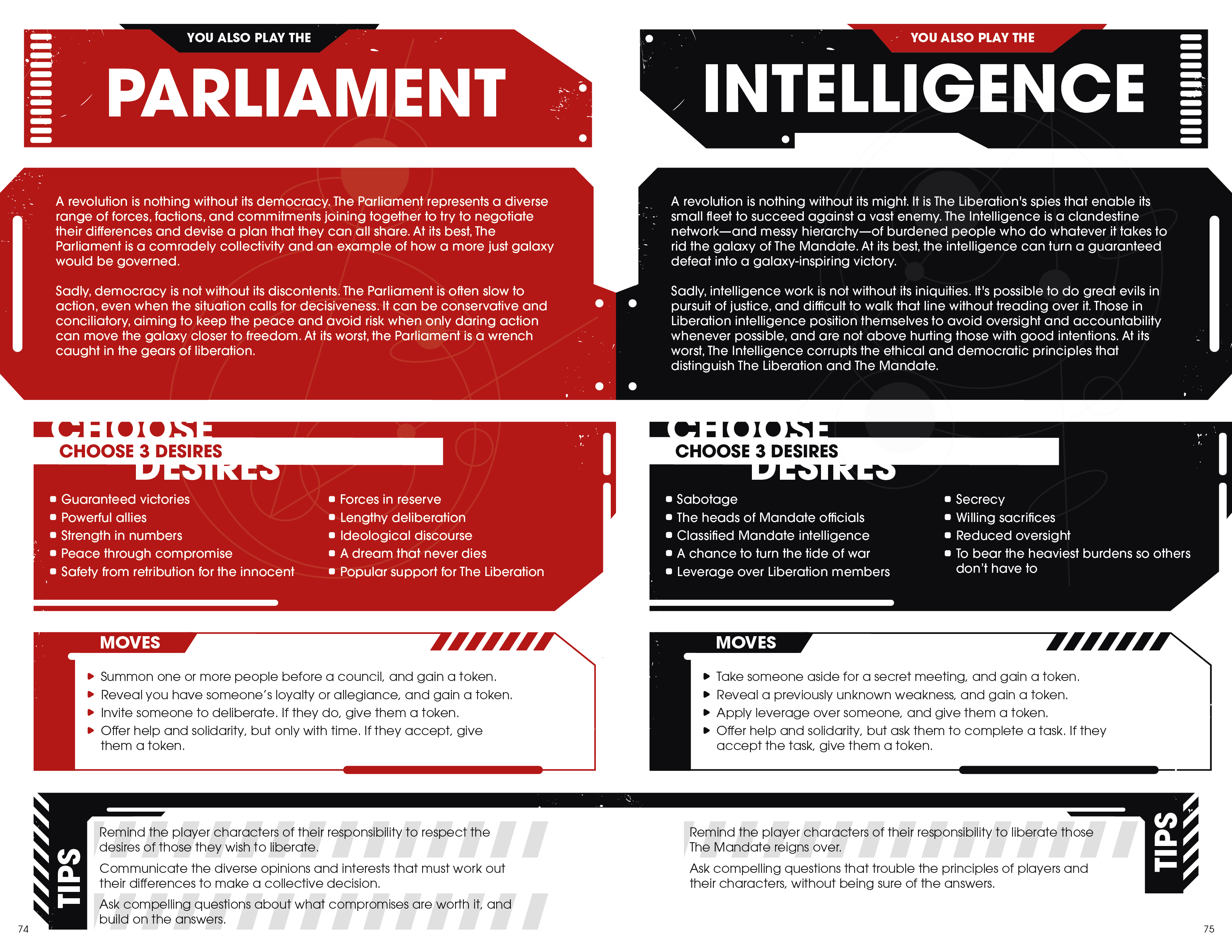
I am careful to say in the rulebook that neither The Parliament, my analogue for the council, or The Intelligence, my analogue for the spies and saboteurs, are “the good guy” or “the bad guy.” In designing the second edition of Going Rogue, satah, [the game’s] system design consultant, really challenged me to ensure the desire choices for The Parliament pillar actually communicated the ways it’s also vital to accomplishing revolution — allies, support, embodying our ideals. Both pillars represent necessary parts of a revolutionary movement that must be balanced for it to succeed. A movement that is too cautious and conciliatory, unable to take risks for fear of ‘optics’ or collateral damage to the innocent, will never overthrow the forces that oppress it. But a movement that is unaccountable to its participants and the people at large and willing to go to any length in its violence without a consideration of the consequences will inevitably replicate many of the oppressive structures it sought to overthrow — a machine whose main output is violence will always continue to produce violence.
For me, one of the greatest historical questions faced by the left is “how do we make a movement decisive and tolerant enough of inevitable collateral damage to actually overthrow capitalism, while remaining democratic and accountable enough that the new government we build still answers to the people.” Communist revolutions have all struggled with this question, and while American propaganda depicts them as more oppressive than they were, it’s quite clear we still haven’t fully succeeded in finding that balance.
"Both pillars represent necessary parts of a revolutionary movement that must be balanced for it to succeed."
I don’t expect playing Going Rogue will answer that question — games aren’t organizing. What I do want Going Rogue to do is to help players involved in liberation struggle to reflect on how they feel about that question. When I wrote it, I was feeling incredibly dispirited by conflicts between local anarchist and communist groups, and even conflicts within anarchist and communist groups I’d been in. They weren’t as high stakes as open violent revolution, but they were still fundamental questions about how decisions were made, who’s accountable to who, how we decide what risks are worth taking, and so on, in situations that often involved the risk of jail time and serious bodily harm.
I wrote these feelings into Going Rogue, and wrote them without answers. It’s a game about having those questions, encouraging players to step into the role of a character and, hopefully, safely explore those feelings in an environment where the stakes are far lower. Its playbooks and pillars force you to look from different perspectives — as a GMless game, you’re inhabiting the role of The Parliament and The Intelligence simultaneously. When I wrote it, I needed that, and there’s no better outcome I could hope for than the idea that it might help other organizers struggling with the same feelings.
Zeoli: You present a couple of main thematic questions in Going Rogue. I'm going to present those questions back to you, and I'm interested to see how you answer them, knowing that the game is meant to have players answer those questions for themselves.
How does cynicism serve us as a coping mechanism? When must we counteract it with hope, and how?
Levine: Cynicism is a tool that lets us cope with fear, but also permits oneself to disengage, either from critical thinking or from liberation struggle itself. When we cynically say, “We can’t win, we can’t make it better than this,” we are absolved of the responsibility to act; if we can’t make it better, why should we try? Moreover, we are spared the particular horrors of uncertainty and loss. If we dare believe that something better is possible, then we might try and fail. But if we cynically decide it’s all over, we avoid not only the fear of the unknown, but also ensure there’s nothing that can be taken from us — after all, we had nothing to begin with. In a political situation as bleak as ours, it is tempting to retreat into that cynicism. Losses are inevitable in any long struggle, and as Walter Benjamin says, so far our “enemy has not ceased to be victorious.” Even if, as Ursula K. Le Guin reminds us, it took centuries of failure before we overturned the divine right of kings, our own centuries of failure to overthrow capitalism still tempts us to say: we can’t win and thus can no longer be disappointed by loss.
However, some degree of cynicism may be necessary. Like with any coping mechanism, it lets us endure intolerable circumstances. If we were never cynical, the amount of disappointment we’d have to endure day to day might be unbearable. But leaned on too heavily, it becomes maladaptive and prevents us from taking the action required to rid ourselves of the problems we are coping with.
Hope isn’t easy to maintain. I am a firm believer that hope is an active practice — not something one has, but something one chooses, even in the face of counter-evidence, and exercises by stating it, celebrating it, [and] sharing it with comrades until you are able to feel it. It’s easier to feel when you win, but also just by being engaged in the struggle to free yourself. A number of texts I was reading about this at the time influenced Going Rogue. In “Picturing Power,” Jewish Currents’ Arielle Angel says of the Muslim Ban airport protests that “This is perhaps protest’s greatest measure of success: that it creates participants who have tasted this feeling of possibility, and who now know the truth of their own power.”
Meanwhile, I was reading “Blessed is the Flame: An introduction to concentration camp resistance and anarcho-nihilism.” I didn’t finish — as a Jew with Holocaust victims in my family, it was just too painful — and I’m not anarcho-nihilist nor anarchist, but despite all that, what I read stuck with me. It argues that resistance is worth it even when the cause is impossible, because the act of resisting provides us with a feeling of humanity that is irreplaceable. It illustrates the impossibility of effective resistance given Nazi security in concentration camps, then shows the victories resisters achieved anyway — and the lethal consequences of doing so. Most importantly, it argues that even though true victory and total liberation from the inside was likely impossible, they lived better for fighting anyway — to surrender would have been to become already dead. Even if failure at the ultimate cost is certain, struggle is worth it.
"Resistance is worth it even when the cause is impossible, because the act of resisting provides us with a feeling of humanity that is irreplaceable."
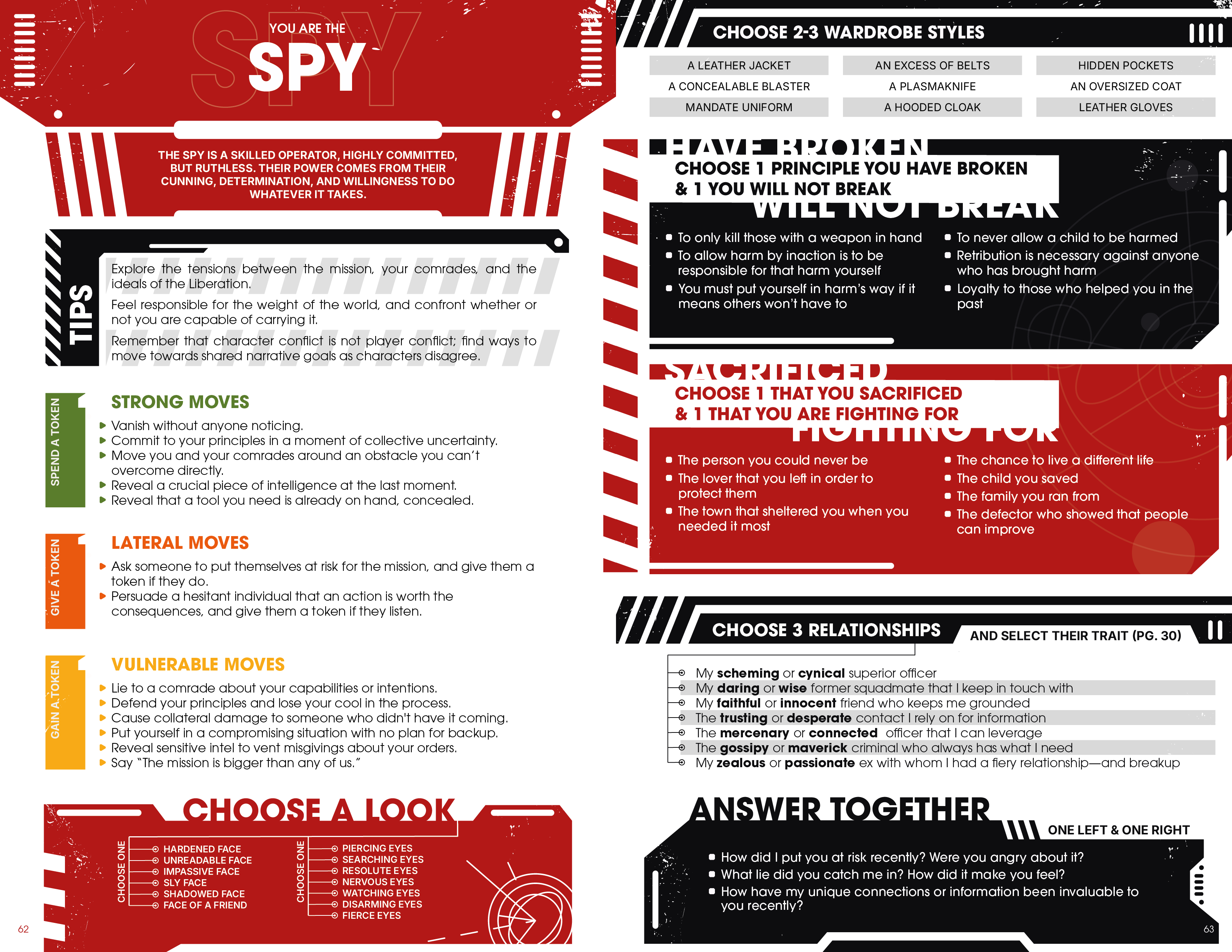
I wrote Going Rogue was while dispirited by failure, questioning if my political work had any impact. I felt myself transitioning from The Convert — Going Rogue’s naive young rebel who sees The Liberation as heroic, uncomplicated, and guaranteed to win — to The Spy, the cynical Liberation veteran who continues to fight because it is all they know, even if they no longer feel that a better world is achievable, or that they have a place in it. These playbooks, like any two in Going Rogue, were designed to pull on each other — The Spy to introduce The Convert to the realities of revolution and ease that transition, and The Convert to remind The Spy of the believer they once were. I needed it. I hoped that in play I would feel it and could carry that feeling with me as kindling. I like to think I succeeded, at least somewhat.
Zeoli: What is worthy of our sacrifice? When is it more important that we live to fight another day?
Levine: Of all these three questions, this most embodies my intent that they be answered through play, because this question can only be answered contextually: what is at risk in this situation? What do we stand to gain?
The sacrifice in Going Rogue is largely a metaphor. There are places where the martyrdom depicted in Going Rogue is not a metaphor — for Palestinians right now, it is a daily reality, and even in the US, martyrs like Heather Heyer [the protester who was killed at an anti-fascist rally in Charlottesville, Virginia in 2017] gave their lives to fight fascism. But for the majority of my expected audience, the sacrifices look different. Time and money we commit, stress and trauma we experience, the risk of jail time, physical injury, doxxing, harassment, and so on. Going Rogue exaggerates this to explore the idea in a satisfying narrative, but fundamentally it’s asking “how does someone — a character, but also you — know that a sacrifice was worth it?” What do they need to feel and experience to be able to say “this was (or will be) worth it”?
While writing, I was struggling to process the risks I took doing anti-fascist street action. Were they worth it? Did what we do actually change anything? Or were they just performative? Why did we sacrifice what we did, if they didn’t accomplish anything? How will we ever know whether they did? It was eating me alive. I wanted so badly to feel it’d been worth it.
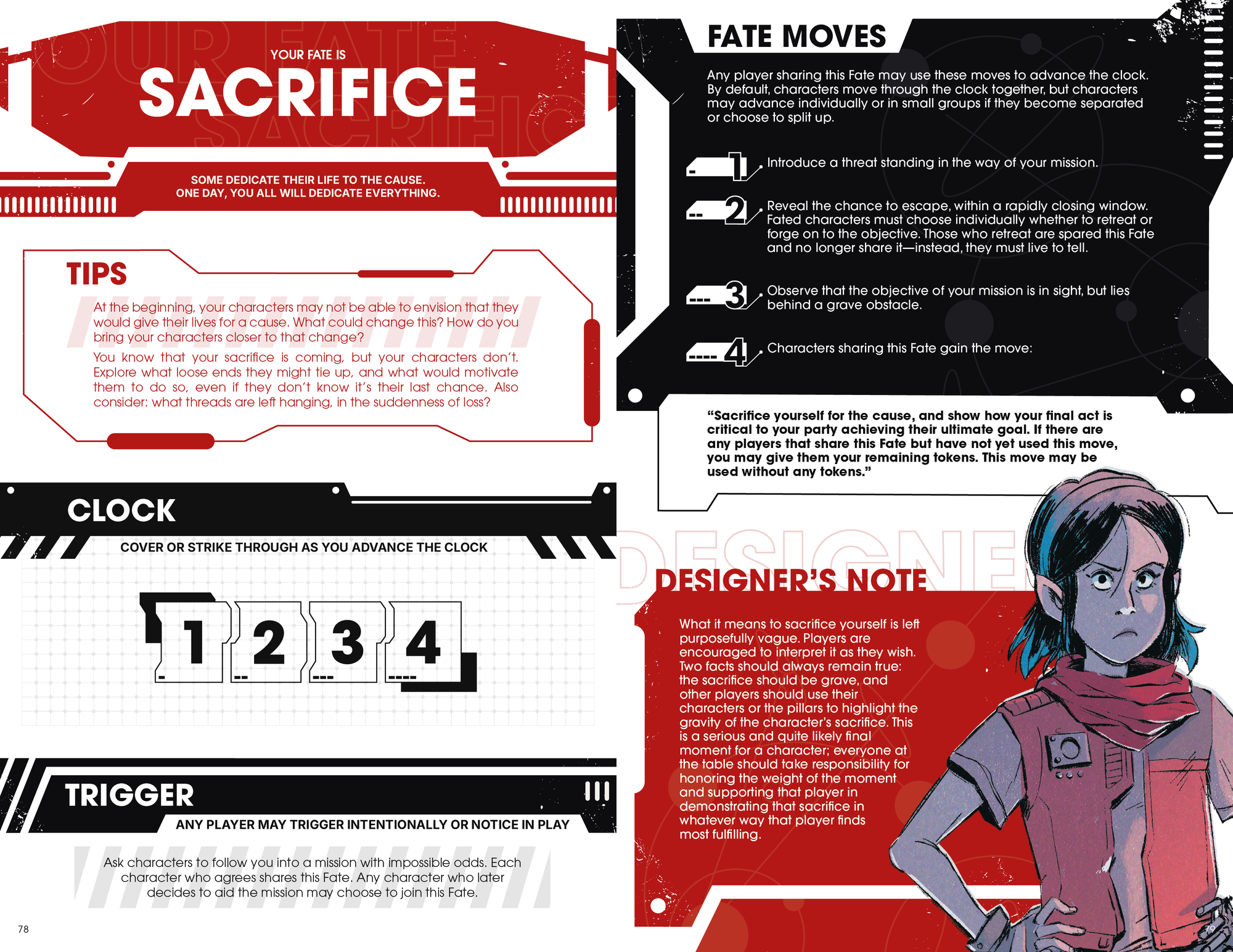
That’s why Going Rogue goes to the extreme of sacrificing your life, and why the game’s mechanics stipulate the sacrifice must move the galaxy closer to freedom — that it must be worth it. Sacrificing your life — knowingly and voluntarily, as the mechanic requires — necessitates a level of surety that I was not feeling, and hoped to feel vicariously through my character. I wanted to experience the bleed of my character’s certainty, and the satisfaction of seeing it transform the galaxy even after my character had died.
I’ve come to believe that left-wing movements are not honest enough with themselves, especially at this moment in America. There is never enough reflection on, “Did that thing we did work? Why didn’t it work? And what can we do differently?” If we honestly engage in that reflection, it’s impossible to know what work was worth it. If we delude ourselves about an action’s effect — if we take action for action’s sake, going to protests and getting arrested for another photoshoot — then we can’t know what’s worthy of the risks we take. The closest I can get to really answering your question about what’s worthy of our sacrifice is to say that we need to be more honest with ourselves. Bail money, jail support, legal defense funds, and so on all take resources from the movement. Are the actions we’re taking worth risking those resources, and our wellbeing? I can’t answer that. It’s contextual, and difficult to evaluate even with context. But I know we do a poor job of asking the question, both before and especially after. “What is worth it” is probably best answered in hindsight, by studying history, and especially the outcomes of our actions, diligently and honestly.