PSI*RUN catches its second wind
Meguey Baker’s PSI*RUN is getting a second edition after fifteen years.

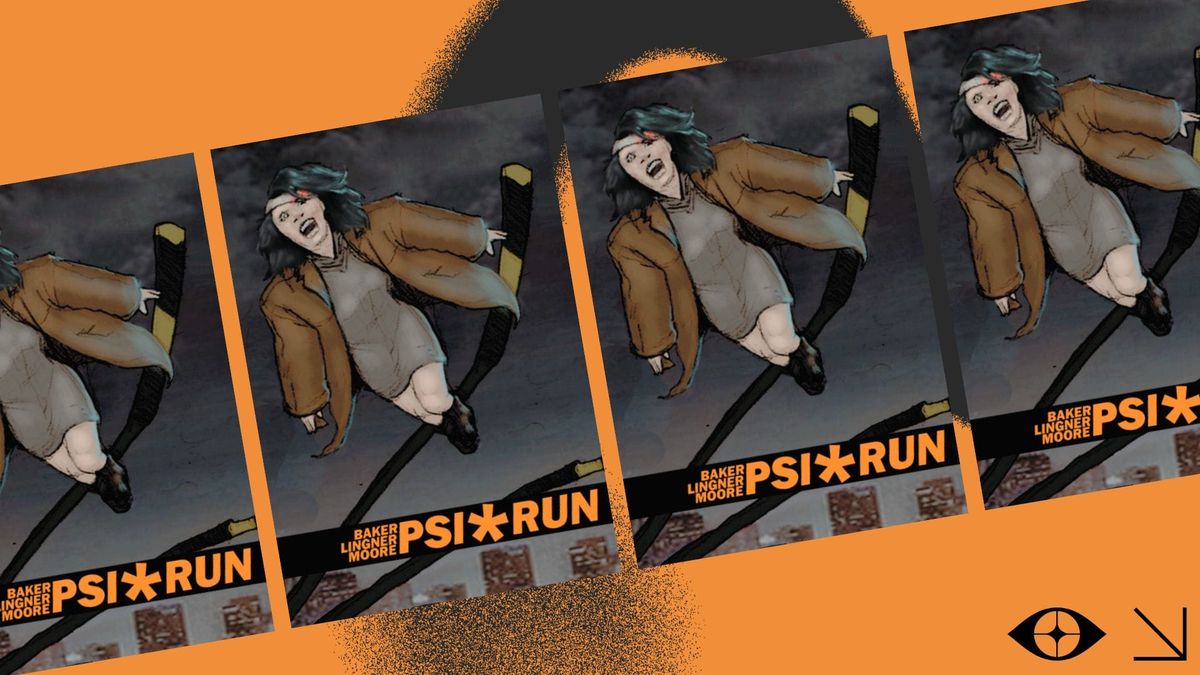
Fifteen years ago, Meguey Baker released PSI*RUN, a “longshot” tabletop roleplaying game about superpowered amnesiacs who are on the run after escaping their captors, based on an ashcan game by two other designers, Chris Moore and Michael Lingner. It was one of the first games with Otherkind dice mechanics (which eventually gave rise to Powered by the Apocalypse) that gives the players a lot of power to determine exactly where and how they succeed—or fail. It pushed a lot of innovative game design in the indie scene at the time and even today it stands up as one of my favorite superhero games.
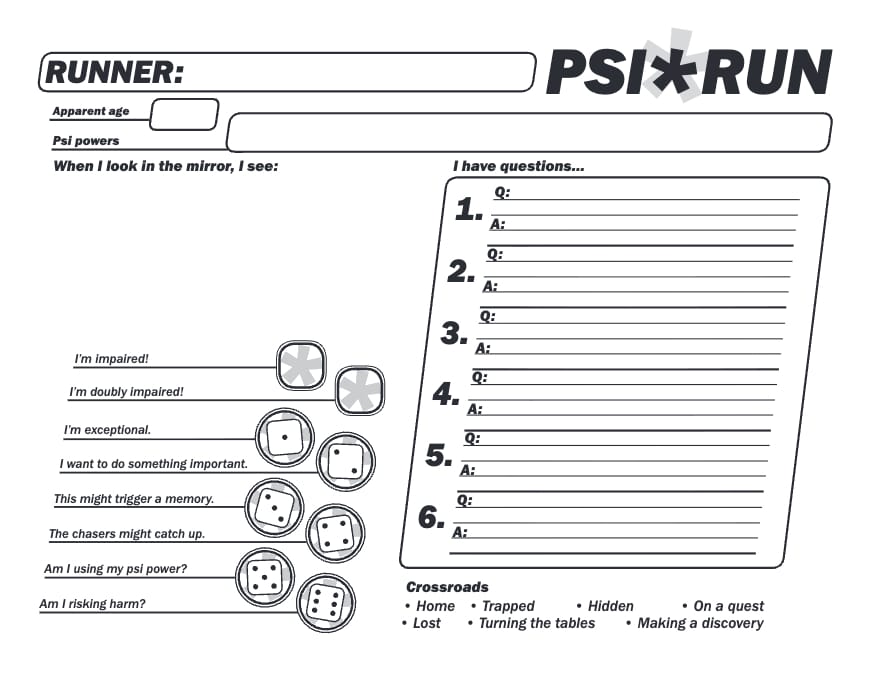
One of the best parts of the game was how every part of its design supported fast play—the game is intended to be played in a single five hour session. An example of this is in character creation, where characters have their past intentionally left blank. Players are asked to “discover the characters' past, together, during play” directly feeding into a fast and loose playstyle. You’re asked to write down questions about your character, which is a brilliant piece of design—it gives the characters goals without restricting them, and gives “play to find out” a focused, structural basis for a short one-to-two-session game. It also gives other players something to latch on to during the game, creating a collaborative environment where character ownership is secondary to the narrative of the game writ large. These decisions both support the story’s narrative and the game’s intended playstyle, creating an exceptionally tightly-designed game.
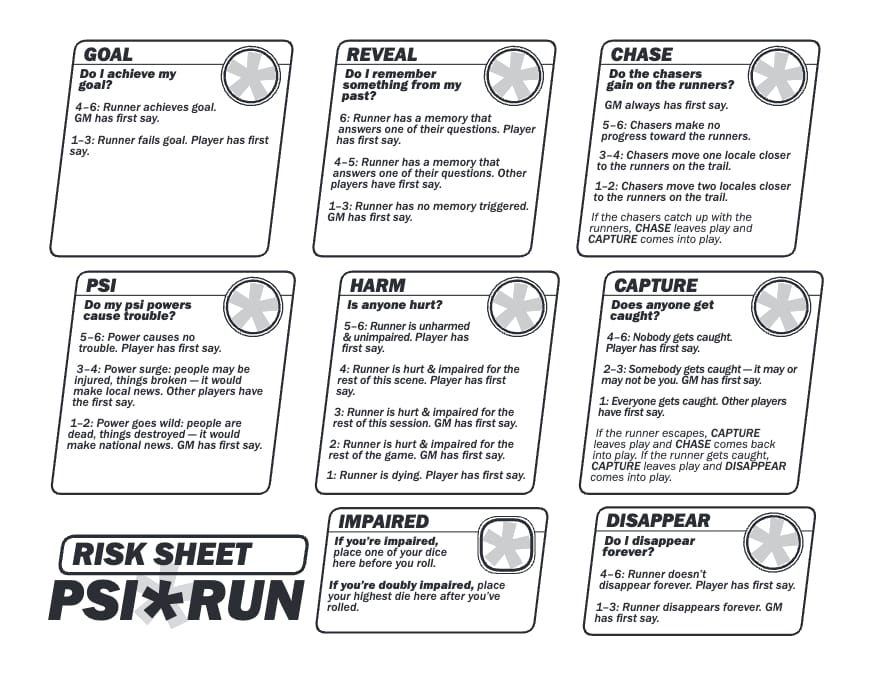
While the GM is still in a very strong position of narrative control, almost every single mechanic seems determined to mitigate this. After rolling their dice pool, players get to determine which dice impact which parts of the narrative. There’s a “first say” mechanic that allows players to determine who gets narrative priority. Players determine where their characters run; it’s up to the Chasers (and the GM) to follow. If a Runner is captured and disappears forever, that player becomes another GM. At nearly every turn, PSI*RUN asks players for above-the-table answers to in-fiction questions, and is a stronger game for it.
PSI*RUN is a great game; focused, action-forward, narrative-driven, and deeply concerned with making sure that the players know the kind of power and agency they have within the game. (To a contemporary reader, some of the writing might feel a little handhold-y, but this was clearly written during a moment in TTRPGs when it was necessary to hold people’s hands.) And now, Meguey Baker is crowdfunding a second edition starting in early May. Baker was kind enough to answer some of our questions about the game and this new edition via email.
Lin Codega: Why did you choose to return to PSI*RUN now?
Meguey Baker: I’ve been thinking about a second edition for a couple years now, but it had to wait till there was a little room in my life, like recovering from cancer surgery in 2023 and 2024. Being declared all clear in March of 2025 opened up a lot of brain space!
Codega: I know it’s not typically in your design ethos to design or develop scenarios for your games, but will you have any “extras” offered for the campaign?
Baker: Actually, yes! Everyone still makes their own characters, so there’s no big change there, but I do have a couple ideas for additional scenarios or material. I’m also excited to be working with artists to include a couple maps as starting places. I’ve had a request to include the mod I did to run over social media, with one Runner posting updates and questions and the rest of the people answering as they can. I’m considering it! There’s a mod I’ve been thinking about for years that’s considerably more serious in tone; I’m not quite sure if it will make it into the final book, but perhaps a digital-only thing.
Codega: You said on Bluesky that PSI*RUN has your favorite mechanics — can you elaborate on that?
Baker: The risk sheet in PSI*RUN is an iteration on the mechanic Vincent and Emily Care Boss and I developed over 26 years ago called Otherkind. In essence, it’s a dice pool allocation mechanic, but as it’s also Powered By The Apocalypse, each die from the pool is assigned to a list of options, to shape the next bit of the fiction. I love being able to look at the dice, look at the choices, and sort of imagine the various possible outcomes before choosing the one that I’m most interested in seeing play out.
Codega: I love how so much of the original game asks the Runners to make hard decisions; how much of the design did you intend to be in the hands of the players? Was this boundary pushing when it was first published?
Baker: Hmm, I think it probably was! Back in 2011, there was a lot of conversation about how the responsibility for the fiction of the game was divided out, and PSI*RUN’s direction to have players make major decisions about the flow of the action was kind of innovative, certainly. That bit will remain clear!
Codega: What were the themes of the game you had in mind while writing PSI*RUN fifteen years ago? How have these themes changed between now and then?
Baker: Two big themes remain constant: super powers and gaps in memory. The whole realm of examining memory is huge and sprawling, far beyond games, but for this, I really like the idea that I as a player may be an unreliable narrator of my own character's story. I still have agency and control of my character and their actions, including veto power if a suggestion is too beyond my sense of story or my comfort, but the reveal mechanic and the flashbacks to fill in the gaps in memory can result in massive upheavals of my understanding of my own character or the course of events that lead to them being where they are. I see this delight in the surprise over and over in other players too, so that's not changing much! And of course superpowers and the whole Saturday morning cartoon / issue of a comic book framework are just fun.
The one big change, if I can tip my hand a bit, is that back in 2011, I had not lost a loved one to dementia, nor watched older friends and colleagues start to battle memory loss. Now, all that is true, and devastatingly sad. And of course, we can now add on COVID "brain fog" and Long Covid debilitation that has hit so many people. There's a bit of a buried thread in the development of the game about how sometimes the world is overwhelming and frightening because one has lost one's place in it, and one does not recall how to get to a secure footing again without a framework. There are so many people out there being super heros in their day-to-day lives, or using all their powers to help people who are just trying to get through the day, even when the day is scary. None of that was really on my mind at all in 2011, but sometimes deeper meanings show up unexpectedly!
Codega: What are some of the updates that we’ll see in the new edition of PSI*RUN?
Baker: I’ve noticed over the years that there are places in the rules that could be stronger, clearer, or more detailed, to better support players. Big overview topics I directly tinker with: pacing, putting the pieces together, more about NPCs, more about Chasers. Possibly more about “what happens next” at the end of the game.
Codega: What are you most excited about the new edition?
Baker: Ok, I have to say how much I’m looking forward to the new art by Jabari Weathers! I’m in the writing [stage] now, I know about it, but the art is something that’s unknown to me as yet! For the game, what I’m most eager to see is how players incorporate and interact with the new stuff on when and where to slow down for a couple beats in the break-neck pace of the premise of the game. It’s still a fully action-packed game, no holding back there, but there’s more of the “solve the mystery” aspect I want to bring out in players. I do think it’s going to be a blast!
Codega: One of the things I love about this game is how nonstop it is—what does investigation add to the game? What does it deepen?
Baker: Part of the game has always been about piecing together the bigger picture, filling in the answers till the player characters have what they consider a clear sense of the situation and a direction for their actions: take down the evil corporation, confront the big bads, deal with the time loop, all that superhero stuff. But it gets glossed over in play enough that me bringing it up makes you ask what it adds, as though it was brand new! So that's a great reinforcement that those rules, that section, needs to be expanded, highlighted, and better articulated. A lot (I'd even say most!) of the tables of PSI*RUN have followed the threads of investigation, but it's time to make it a clearer part of the game.
Codega: Is PSI*RUN still intended to be a "long shot" game at 5 hours or so, or has the format/structure of the game changed to encourage a different kind of timing in play?
Baker: Yep! Still a long one-shot, still with the "well I guess you could generate more questions if you really want to keep playing" rules, but the design is for a leisurely afternoon, or an evening over dinner, with the longest convention slots still in mind. Adding in a few scenes of relative quiet, to focus on putting the pieces together, shouldn't stop the over-all sense of high-speed breakneck action. After all, your characters are Runners!