Down Among The Dead continues to suffer from Pirate Borg’s fundamental flaws
Culture without those who keep it alive.

The swashbuckler-themed tabletop RPG Pirate Borg released in 2023, and since then its popularity has only grown. Earlier this year, expansion Down Among the Dead fulfilled a 2024 Kickstarter that raised half a million dollars. A 148-page collection of adventures and character options, Down Among the Dead jokes it is “a terrible expansion for Pirate Borg, the worst pirate RPG ever made.” In addition to referencing the horror focus of the game, it’s also a tongue-in-cheek warning to those who could bounce off the light nature of the rules and the evocative pastiche of the setting. Down Among The Dead doesn’t want us to take it too seriously, and yet within its pages lie some serious issues.
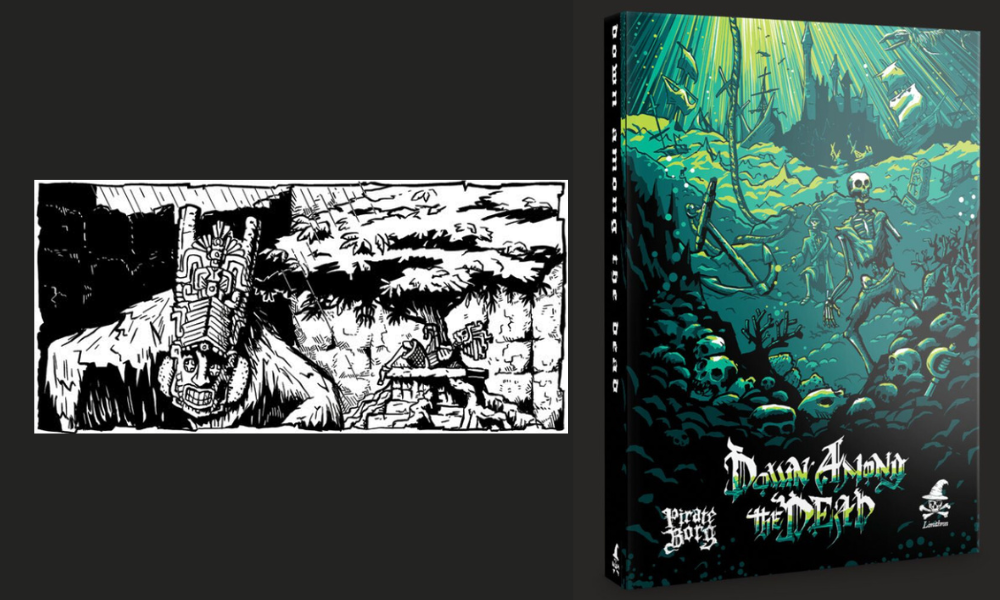
The expansion introduces NPCs and enemies clearly inspired by Mesoamerican cultures. The adventure Into the Maelstrom features an orangutan sorcerer named Ou-Ka-Bong adorned in a mask that seems inspired by Mayan motifs. A figure in the background of the image has a headdress that resembles one belonging to Aztec emperor Montezuma. Searching for “Maya” in Down Among the Dead reveals one result: the name of a little girl living in one adventure’s orphanage. Searching for Aztec returns nothing.
In the second adventure, Venom in the Veins, there’s a shaman called Tezomoc Almotil, a name which resembles the name of a real-world ruler of the Tepanec Empire, Tezozómoc. Tezomoc has turned himself into a snake-man using the ancient magic of an Aztec-like precursor culture. We’re told Tezomoc was entombed “by his people,” but the game doesn’t say if those people were Aztec. It just uses Aztec architecture and symbols in the art. The timeline of the setting included in the adventure skips over the fall of these civilizations; Tezomoc’s people entombed him in the shrine, and hundreds of years later Spanish explorers discovered the site. The Spanish church and French revolutionaries are said to be interested in the shrine, but there’s no mention of any living descendants of Tezomoc’s culture or what happened to it.
It’s not unusual for pirate fantasies to include Mesoamerican motifs. The genre has a lot of overlap with classic pulp adventure stories; strong men like Doc Savage and Allan Quatermain exploring lost cities of gold and ancient temples. The core book is aware of some of the problematic parts of those pulp classics and opens with a statement addressing them: “[this] is not a game about slavery, sexual violence, genocide, or any of the other abhorrent real parts of our history. Please treat these topics with the respect they deserve, or leave them out of the game altogether, and go hunt some skeletons.”
It’s an important message, but it’s immediately followed by something that casts it in a different light; the skeletons it advises us to hunt include dead Indigenous people. And they’re the only ones in the book. Pirate Borg is not about genocide, but piecing together clues from the expansion's setting reveals it’s about the potential for fun in a genocide's aftermath.
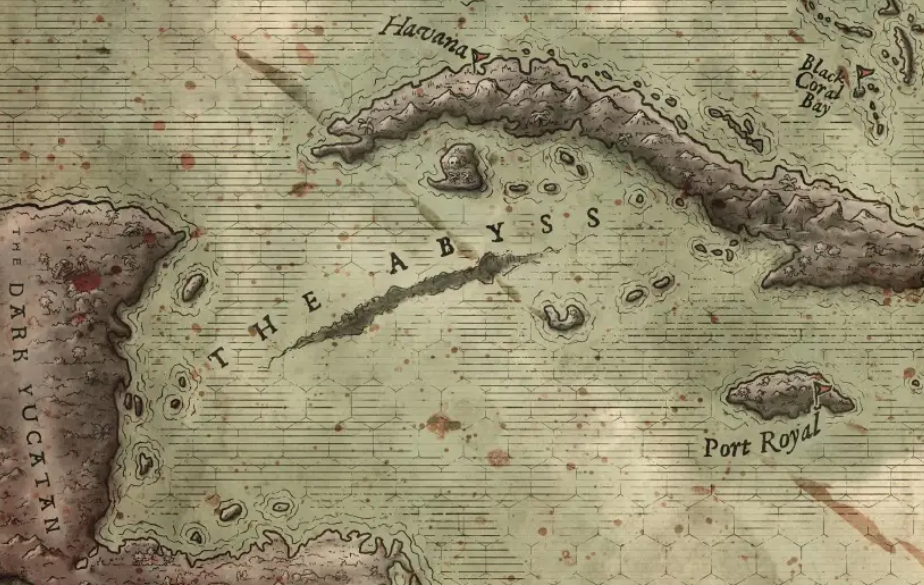
The opening pages of Pirate Borg displays a blood-splattered map of “The Dark Caribbean,” echoing the colonial narratives around wild, strange, and untamed “Darkest Africa.” On the map, the Yucatán Peninsula has been renamed “The Dark Yucatan." The channel between Mexico and Cuba around the real-world Cayman Trench is labeled “The Abyss”, and a spooky skull is stamped over the real-world Isla de la Juventud. Other names such as Havana, Nassau, Guadeloupe, and Maracaibo appear unchanged.
Then, typeset over art of an ominous lighthouse, a shipwreck, and stormy seas comes this short explanation of the game’s setting:
“Early explorers thought the Caribbean was paradise: They found nothing but deserted islands and bountiful treasures. It wasn’t until thousands had left their crowded, blighted homelands and settled in among the islands that they encountered the Scourge…
It began on the solstice. Haunting screams echoed over sandy beaches, and from the death black waves crawled the undead. Terror spread like wildfire. At first they came in single numbers, but hordes gestated and soon settlements were blotted out by a torrent of lifeless, nameless creatures.
Possessed flesh of dead sailors, ghosts of displaced inhabitants, skeletal constructs shrouded in seaweed and muck, and horrible monsters born from the unknowable dark places in the world: they emerged from the sea and consumed all.
The meek had nowhere to flee but to their graves, only to rise again at dusk. Survivors fortified cities and bolstered strongholds. Soon after, the effects of ASH were discovered. A new status quo was born.”
This explanation is intended to be vague and evocative, informing the mood of the setting rather than describing it outright. The most striking part of this description is that the Caribbean of Pirate Borg was abandoned before the colonizers arrived, which means the Scourge either wiped out all Indigenous cultures or uprooted them entirely. They left behind their “bountiful treasures” to be discovered by the Europeans, who have to deal with the “ghosts of displaced inhabitants.” The Scourge is a constant danger in the game, and while its undead ranks include people of all kinds, it’s the only name under which you’ll encounter the natives of the land.
After the book describes its major factions, there’s a section about the “Dark Yucatan.” Like the pirates, British, French, Spanish, and eldritch cults described before it, the section includes full-page art overlaid with evocative text. Everything about this layout primes the reader to expect another faction; but instead of Indigenous Maya or other native inhabitants of the Caribbean like Mexica or Taíno people, Pirate Borg writes:
“Far to the WEST, evil wells in the DARK YUCATAN. Folktales of cities made of gold and temples ripe with untapped fortunes taunt the meek like the befouled carcass taunts the vulture. The borders reek of rot, yet the jungle calls to those who listen. Like the heretic Cortes, none who have ventured into that execrable labyrinth have returned to tell the tale…”
This conspicuous absence is all through the text; if a player randomly generates their character’s name, they’ll find references to real-world pirates such as Stede Bonnet, Anne Bonny, Mary Read, and even a reference to Star Wars. But their name will never be Mexican, Native American, or Afro-Caribbean; it will only evoke European heritage.
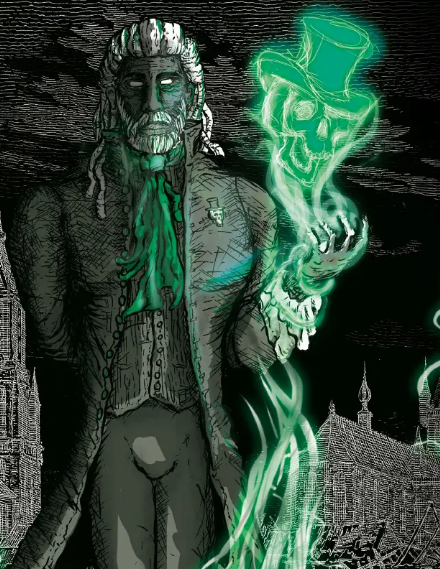
The pattern of side-stepping the people of the Caribbean continues in the character classes the game offers: one, called the “Sorcerer”, is surrounded by skull motifs. The sample figure is Black, wears a top hat and suit, and possesses an affinity for necromancy, power over “natural spirits”, and has ability to put others into a zombie-like sleep. These are all pop cultural trappings of a Haitian Vodou priest, or that of a Louisiana Voodoo witch doctor, similar to the villain of White Zombie (1932) or Doctor Facilier in Disney’s The Princess and the Frog (2009). But given that the book suggests Haiti has been depopulated, who keeps this tradition alive?
There’s a lot of other art and textual references to cultures found around the Caribbean: The spread for the “Dark Yucatan” includes references to cities of gold and ancient temples, as well as art of a pillar resembling Maya pictographs (p 22-23). The “Brute” character class has splash art done in the style of a Mesoamerican relief, a style that continues in the lists of “Dark Fauna” (p 35, 86-89). There’s also a single reference to “Native Medicine” (p.117). In the adventure The Curse of Skeleton Point, the temple was built by “Mesoan settlers” and includes a visual reference to the Mayan calendar (p 146). All of these nods to non-Western cultures are just that: nods.
The repeated inclusion of Mesoamerican aesthetics prompts an interesting question: why did Pirate Borg decide that the Caribbean had to be depopulated, its inhabitants likely destroyed by the Scourge, before the Europeans arrived? In the game’s setting, there was no genocide of the people of the Caribbean and Mesoamerica by colonizers or the empires they belonged to, but there still was a genocide — a worse one, apparently, as it seems to have left no living survivors. This elision also effectively absolves the European colonists of their crimes. When situating their games in certain time periods of history, many designers have had to downplay the true horrors of reality to make play more palatable. But in Pirate Borg, while their culture has been deemed useful for play, it’s as if Indigenous people themselves have been declared inconvenient to the game’s goals. One does not have to be particularly educated about colonialism to point out that the real-world empires depicted in the game felt much the same way.
The conspicuous absence of any existing inhabitants and the presence of the real-world empires who attempted to destroy them means that any close reading of Pirate Borg and its expansions will yield uncomfortable questions about slavery, sexual violence, and genocide, the very topics the game says it isn’t about. The game asks us to treat the “abhorrent real parts of our history” with respect, but unconsciously creates an atmosphere within which they might thrive.
This isn’t the first time the book has been criticized for having blind spots. In 2023, there was controversy over one of the art pieces in the first printing of Pirate Borg. The art, depicting a brown-skinned zombie with dreadlocks, was labeled “The Rope Monkey.” The designer, Luke Stratton, apologized and removed the offending artwork. Free League, who publish and distribute the game, produced stickers to cover up the offending name in the first printing, and game studio Limithron the game’s studio hired a sensitivity reader to review the entire book. They explicitly declared that it is “firmly anti-racist, anti-sexist, anti-bigot, anti-homophobic, anti-transphobic, and do not want anyone to feel like they do not belong at our tables or playing our games.”
While the colonial nature of fantasy adventuring is a broader problem, Pirate Borg could have taken steps to ameliorate the issues of its setting. If it wanted to include indigeneity and non-white, non-Western cultures, the factions and classes would be a natural place to do it. It could have ensured that players take up the roles of returning inhabitants by making it clear that there were survivors, including such names in the list of options. Instead, it describes the dangers of their exotic homelands in a passage that plants the readers firmly in the shoes of the now-innocent colonizers. The game had the opportunity to lend context and a critical lens to a genre laden with racism. It could have included sidebars with advice for how players and GMs could approach these topics in a sensitive, nuanced, respectful way. Even if it wanted to remain an irreverent game, it could have employed multiple writers and sensitivity readers from these cultures to work on the setting and adventures. Despite hiring one for Pirate Borg's core book, there are no sensitivity readers credited in Down Among The Dead.
Another key part of Pirate Borg’s setting is ASH, a psychoactive drug. ASH is unique to the Dark Caribbean and made from the bodies of those infected with the Scourge. If done intentionally and with care, ASH could have been a metaphor for extractive colonialism and the fetishization of exoticized minorities. ASH consumption is similar to the real-world practice of 19th-century Europeans unwrapping and consuming Egyptian mummies. Even the fact that ASH slowly kills its users could be a metaphor for the moral rot of empire.
But ASH is no such metaphor. It’s just a powder made from bone and is only ever employed as shorthand for “very bad drug that turns people into addicts.” One of the game's suggested plotlines culminates in “everyone who has ever used ASH” becoming one of the ravening undead.
Pirate Borg doesn't have any native people in it. It doesn’t contain any knowledge of them. It doesn’t think about their genocide. It wipes them all out in its first lines, and then adorns itself with their cultures and symbols without once crediting them or paying them respect. Like the colonists it depicts, Pirate Borg eats their bones and trips on them.