How quantification and Midwestern culture shaped D&D’s problematic legacies
Aaron Trammell’s new book explores why some things shouldn’t be simplified.

Aaron Trammell’s new book, How Dungeons & Dragons Changed The Way We Play, is a short book that has much more bite to it than its title suggests. In Trammell’s words, it’s a “nostalgia-free critical history that asks hard questions of the game and its influence on other games today.” As a monograph built on work in his early academic career, the book is a wide set of explorations, rather than a singular, deep argument like his book, Repairing Play.
Across nine chapters, Trammell takes aim at different aspects of how the game chooses to quantify people and the world, as well as how those choices spawned a legacy that players and future designers have wrestled with since the game’s inception. Trammell argues that while D&D is often credited with “exploding the imagination”, there’s less conversation about how the game’s design also limits the possibilities of play. He said to Rascal in an interview that D&D “reduced game design for the large part to exercises in quantification, which reduces the imagination, reduces the kinds of dreams that we can put in games.”
Over the course of the interview, Trammell touches on big topics like orientalism as a mode of fantasy, geek masculinity, and the neoliberal mindset of being a good player.
This conversation has been edited for length and clarity.
***
Thomas Manuel: Before we get into quantification, when you're talking about dungeons in the book, you connect them to a sort of cultural anxiety at that time, anxiety about war and the state of the state of society in the US and in the 70s. What’s the connection there?
Aaron Trammell: A big part of the book is trying to situate Dungeons & Dragons within the culture that it was produced: white, male, Midwestern, North American culture. Within this culture, there's a lot of fears and anxieties about a very changing world. You can see this reflected in wargaming magazines all throughout the sixties and seventies. Lots of anxieties around civil rights and civil unrest happening at the time. Then there’s a secondary undercurrent about unspoken anxieties regarding things like nuclear war, because the cold war is also in the background of this point in time, not just hot wars…
One of the connections there that I try to draw in this research is that there was there was a man who worked for the Rand Corporation named Herman Khan, who wrote a book called On Thermonuclear War, which popularized the idea of living in mine shafts as a way to shelter from a nuclear apocalypse. And he's the person that the movie Dr. Strangelove was based on. So his whole thing, and the reason he made money was because he basically said: with math, we can see how to keep the population safe during this awful speculative war. And it involves these grotesque things like having the old eat irradiated food because they're going to die sooner than the young and stuff like that. And these are the sort of things that he argues in the book… I don't necessarily think that someone like Gary Gygax, the designer of Dungeons & Dragons, was reading that book and saying, I want to go into my basement and shelter from these things. [But] people in wargaming circles are reading stuff that's coming out of the Rand Corporation, reading the works of Herman Kahn, and talking about them as they design their games.
But I do think it's interesting that you have this game that is played predominantly in the basement, that then takes place underground in dungeons that then captures the popular imagination of this group of people who are also kind of tuned in to these anxieties about war. And then you look at other popular media like Star Trek, these movies happening in the ‘50s, like the mole people in Journey to the Center of the Earth. And I think you start to get this more complete picture that there was something happening about life underground that was really exciting in the imagination at the time. And I think Dungeons & Dragons is part of that.
You can then even see echoes of this militaristic and almost xenophobic thinking in the game in later things like the Monster Manual. I think the first line of the Monster Manual, Gygax is like, anything you encounter is a monster until you know otherwise. It's dangerous, it's an enemy, right? Xenophobia is the default in the original Dungeons & Dragons. And I think all of this comes back to these safe spaces, these places where people can live free without anxiety. And for sure, the basement is where the game takes place. But I also think paradoxically, the dungeon where you wind up fighting the monsters happens to be one of these places also. Because even though you're fighting monsters in this dangerous place in the story of the game, it's a safe place in the world of our friends and our imagination. And then the other argument that the book wants to layer onto this is you're also then retreating into numbers. Numbers become another very controllable thing within this space.
Manuel: Let me quote the part about the Monster Manual:
Gygax’s understanding of monstrosity includes any identity, subject position, or body that is different from that of the assumed ideal straight white male player. In his 1978 introduction to the Monster Manual, Gygax explains: "The term ‘monster’ is used throughout this work in two manners. Its first, and most important, meaning is to designate any creature encountered—hostile or otherwise, human, humanoid, or beast. Until the encountering party determines what they have come upon, it is a monster. The secondary usage of the term is in the usual sense: a horrible or wicked creature of some sort."
It feels in these moments like Gygax is making a very explicit call to think in a colonial way. I can’t help but read it as “I’m going to tell you the statistics of this brown guy now” which is also a thing that the British Empire was doing in a less fun form not so many decades before.
Trammell: This is an important thing I touch on in the book, that Gary Gygax was an Orientalist. And I want to clarify for any readers what I mean by that, because I think this is a term that often gets used very pejoratively, and there is a sense that we might view it pejoratively for good reason based on the legacy of violence and colonialism. But the meaning of Orientalism, as defined by Edward Said in his book, Orientalism, is actually about control of knowledge. And so, it's about the idea of folks from the West basically defining the knowledge of what the East and this is they would use the term the Orient is. And this is everything from Japan to Russia to the Middle East. All of this is what he would call the Orient. And for Said, that problem isn't necessarily a problem of appropriation, taking things from that culture, so much as people going into that culture and saying, actually, even though I didn't grow up here, even though I don't live here, and even though I don't really have friends here, I will tell you what the culture is. That's what Orientalism is.
Universities used to have positions for Orientalists. M.A.R. Barker, who wrote the early TSR game Empire of the Petal Throne (who was also a white supremacist unfortunately) was hired as an Orientalist. So, there's this troubled legacy of Orientalism in games. But Gary Gygax also saw himself within this vein. So not only was he curating a lot of knowledge to put in what became Oriental Adventures, which was the supplement that really tried to tackle Eastern cultures, Orientalism almost becomes the de facto mode of design for Dungeons & Dragons. It's like taking stuff from other cultures in these places, poaching it, and putting it into the game. And you've got this reductionist sensibility to the Dungeons & Dragons manuals that's been really, really influential in worldbuilding overall. How else are you going to design games than creating encyclopedic entries of all the stuff that goes into them?
James Mendez Hodes has got a great essay on this topic and he's got a scale for how to relate stories in different cultures. If you're a designer trying to think about how to do world building in a non-Orientalist or a non-reductivist way — one of the number one questions my students ask me when I teach classes that go over this material — this is my go-to. Here's somebody who really thinks about it in a thoughtful way, but ground that thought within design thinking so it becomes usable from an output standpoint.
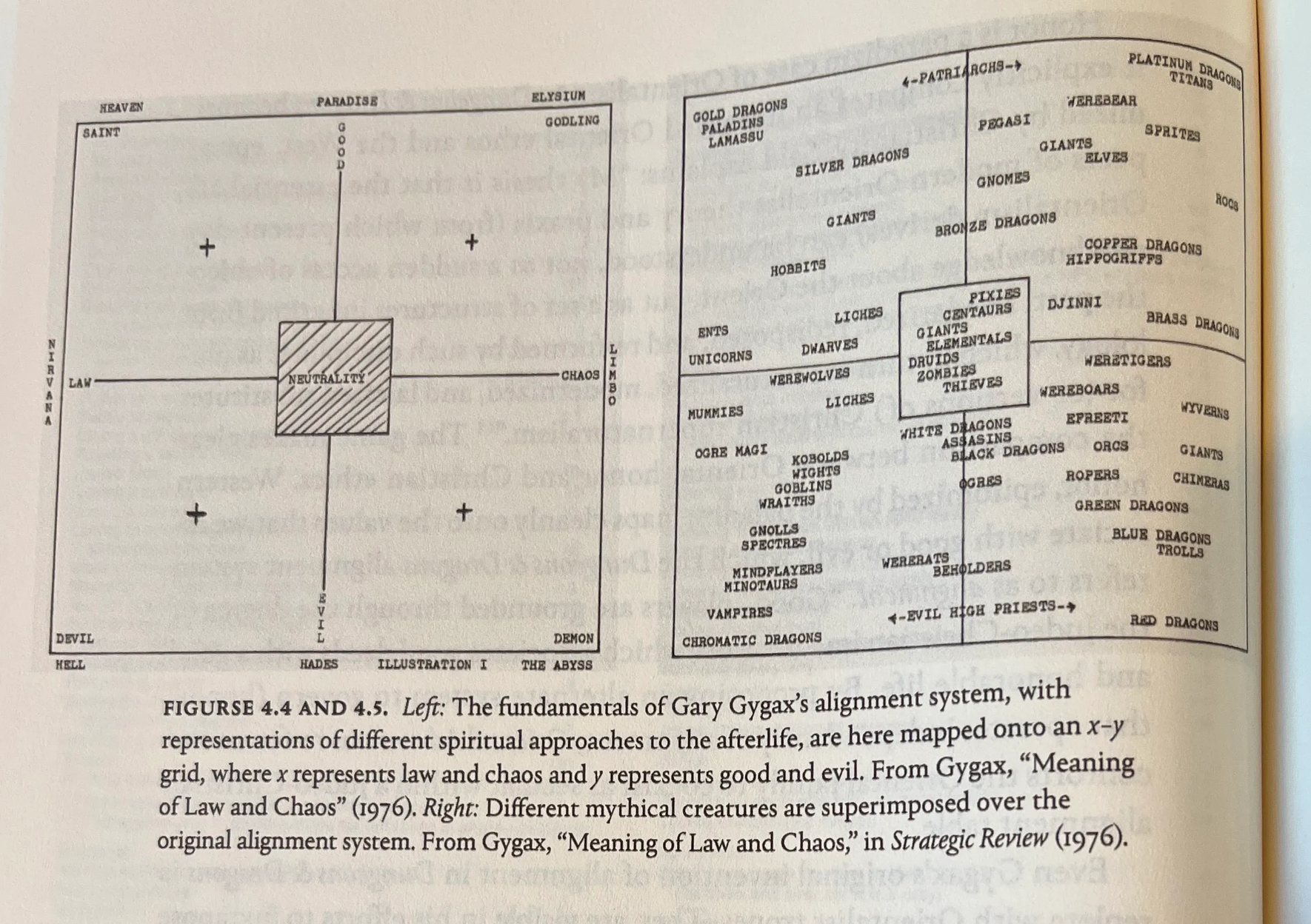
Manuel: You also have an interesting section about alignment. D&D combines law and chaos alongside good and evil, and you connect that to a mid-Western American understanding of the world. Can you share more?
Trammell: I came across Gary Gygax's early sketches of the alignment grid, law and chaos on one side, good and evil on the other. And this was just the most fascinating thing I'd seen in my life. Everything that I tried to understand about what Dungeons & Dragons was came together in one picture. So in these early articles where he builds out the alignment table, he starts plotting out mythological realms from religion onto this axis. Heaven, for example, is a lawful good realm, and so he puts heaven in lawful good. And the Buddhist concept of nirvana, that goes in the center true neutral, and then Elysium from Greek mythology, this is neutral good, and so on and so forth.
To some extent, I've got to give some credit for the genius that was to do this when that hadn't existed before that. But it's really interesting to see that, and then on the next page, he takes all of these monsters that are then in Dungeons & Dragons, but also derived from religious mythology often, like a satyr or something like that. And he starts putting them onto that grid around the kind of realms that they might be existing in. This is, for me, the moment you can see this concept of fantasy, as it mixes with spiritualism in our reality, really getting put into a quantifiable grid for game design so that he could then go in and say, now we actually understand how this monster should behave because we understand what its morality is.
Manuel: Towards the end, you have this chapter about mastery. You say that, to Gygax, a good player of D&D is both somebody who is memorizing statistics and learning rules, but also having a spiritual sense of ownership of the game and a reverence for Gygax. This makes me think about how in 2026, being a good player about D&D is also being the “right kind of fan”.
Trammell: Mastery for me is connected to what many academics call the neoliberal mindset. This is the expectation that nobody's going to look out for you but you, and that is just the way the world is. The state, it's not going to care about you. So within this mindset, which is arguably the kind of world we live in today, mastery becomes a very important value. Because if you can master a thing, you can probably make money off of it. And if you can make money off of it, then you can probably live off of it and you're set. Now to take that back to fan culture, I think the fan is very much a figure that is trying to master their hobby and their interests. There's another academic I love to follow named T.L. Taylor and she's written a lot about geek masculinity — versus what other academics refer to as hegemonic masculinity. Hegemonic masculinity is the jock, the sports guy. Geek masculinity is very different. It's a lot less about locker room talk and a lot more about knowing a lot about a very, very specific thing to the point that you are the smartest person in the room about that thing at any moment.
Manuel: What else are you working on?
Trammell: There's two projects that are up and coming for me. One is about nostalgia and I look at retro gaming communities, not necessarily tabletop communities, but I think there is a nostalgic aspect to tabletop that brings a lot of people to it. It's about nostalgia as a carcerality that we put on ourselves. If we want to believe in a world where there is justice — restorative justice specifically — it means trying to fight against all forms of carcerality. I think often people can be very cynical about nostalgia. I would like to find a way to allow people to enjoy their nostalgia without feeling bad that they are reproducing the evils of them. I just don't see how we move forward without that.
The other project I'm really interested in is the reason that people adopt analog media versus digital media, especially now in the age of AI. I think these questions that have begun in the tabletop space are spinning into bigger questions that are meeting some of the issues of our world and society today in different ways.