Playtest Material is for the writers
The new critical outlet champions long form arguments on why games and gameplay are art.

Laurie O’Connel has been working in games for six years, and in that time, he noticed the same things that Rascal noticed when we first decided to start our publication. There was a dearth of places where writers could hone their critical writing skills, where writing about tabletop roleplaying games was taken seriously, and where a desire to showcase how far the art form has come in the past half a century could be fostered. So, he decided to do something about it.
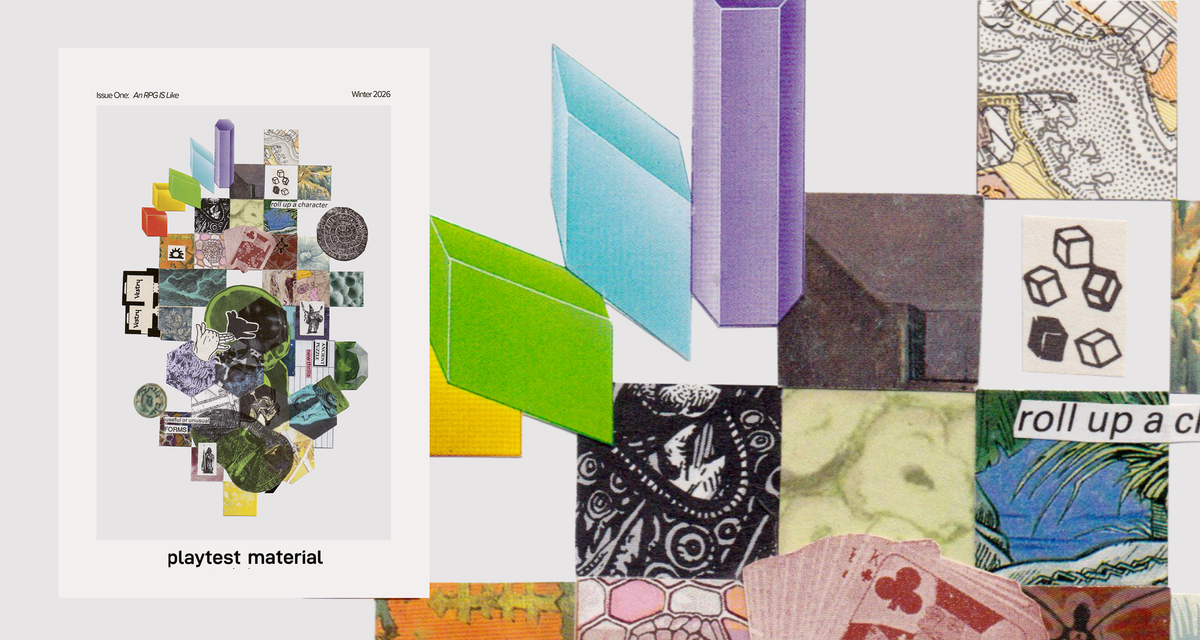
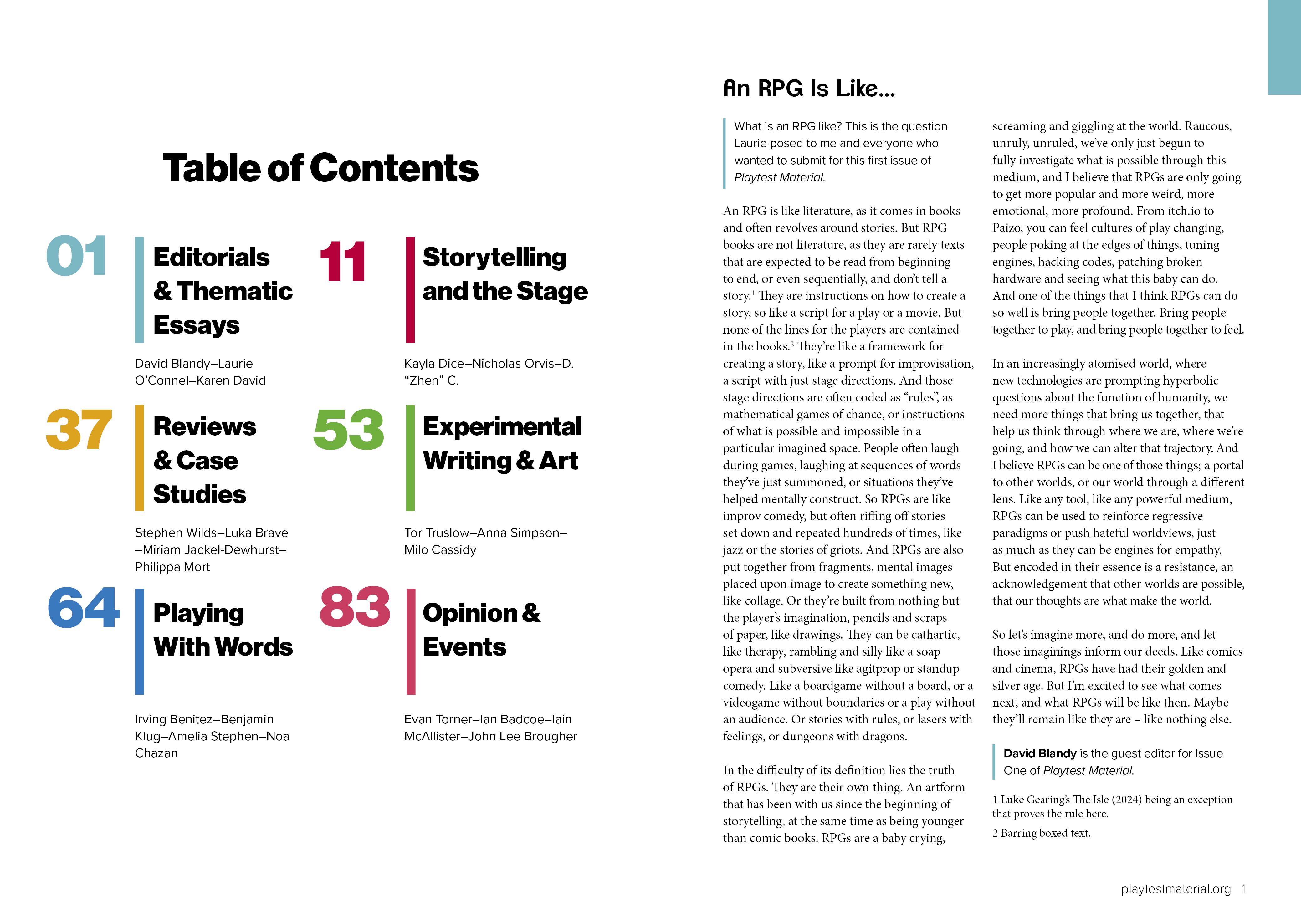
Playtest Material is moving into a new chapter — what had previously existed only as a landing page is going to print. O’Connel has been working for months alongside the first guest editor, David Blandy, to prepare the magazine for its inaugural issue, soliciting work, editing, and, above all, demanding a rigorous and thorough examination of the games. The result is a gorgeous nearly-100 page magazine, free online, and available to purchase in print.
As O'Connel and Blandy worked on the first publication, the two editors have attempted to define, within each piece, and with each writer, what it is about games that deserves all this attention.
The following interview has been edited for clarity:
Lin Codega: An easy one to start off — Tell us about Playtest Material.
Laurie O’Connel: The starting point of Playtest Material was a lot of amazing conversations that I’ve had with people. We’re at a point where you can see new technologies and sensibilities in games developing all the time: Spine, Girl Frame, You Will Die In This Place, and Seven Part Pact are all very recent examples of this. And then there’s the fact that “role-playing games” as we understand them are less than a century old, and a lot of innovations in them are really young. Apocalypse World came out in, what, 2010? It’s not even two decades old. So, there’s a lot of change, a lot of discussions, a lot of amazing stuff happening, and people have very few places to take those discussions once you’re out of the convention bar. I hoped that Playtest Material could be a place where we pause to think, to publish longer articles, reviews, and experiments.
I’ve also keenly felt that there's no real way to train critics in the RPG scene, and that’s an essential factor for a scene to develop further. You have bloggers and YouTubers, and you have academics, but a lot of really smart people with interesting opinions have no place to sharpen their skills of critical writing and reviewing. Playtest Material, from its inception, was for the readers but also for the writers, to be a place that provides the space and support for them to hone that craft.
I was really passionate about making the main magazine open access online. Because I feel that these discussions are essential, and as many people need to be able to read them as possible. But I also wanted to do a print magazine for a couple reasons. Firstly, these magazine issues are curated, the articles fit together so it makes sense to release them together. Secondly, print magazines might well outlive how long I’m able to keep the site hosted. And finally, the print magazine provides a way for us to pay the writers, and the costs of hosting the magazine, which aren’t small.
Codega: Can you talk a little bit about what a ‘scholarly’ magazine seeks to do in the cultural conversation?
O’Connel: So, Playtest Material’s model is as a literary magazine that combines reviews, essays, “scholarly writing” and experimental writing. When I was looking at how the magazine should be structured, I was very inspired by the London Review of Books (in terms of balance of content) and The Stinging Fly (in terms of curation and design). It treats RPGs as an art form, one that, as our first issue discusses, draws from, and relates to all manner of other forms (literature, visual art, theatre, etc) but is its own thing. As a result, it’s a site of discussion and experimentation at the same time. Part of that experimentation is the structure of the magazine, which I expect will develop as time goes on.
Playtest Material does something different to news, in the sense that it’s slower and more curated, most public-facing “game reviews” and essays (which are often marketing-oriented, something we try to avoid at all costs), and academic articles, in the sense that we prioritize accessibility, and we don’t have an academic peer review process. We do ask for references to be provided, but that’s mainly because we want readers to be able to look things up and follow the writers’ train of thought — it has to do with the belief that the magazine is there to start broader discussions and bring people into the conversation.
Writers’ unique styles are welcomed, and they’ll use different tones depending on what they’re trying to communicate. I think that these magazines are very important for any scene, and in the history of literature, for example, you often see brilliant writers coming up through those circles.
Codega: Why did you choose to go for guest editors? Can you tell us a bit about who you’ve asked to guest edit and why?
O’Connel: Having guest editors is a matter of necessity to balance my personal tastes and the fact that I don’t have enough knowledge of everything that games are and could be. It’s also a really good way to make each issue feel like it’s bringing a new perspective. Guest editors bring their own sensibilities, so issues will have a different orientation depending on their point of view. But having a guest editor is a strangely intimate process; you’re bringing your opinions to bear alongside somebody else, and it requires a lot of trust from both parties!
For that reason, I asked guest editors who I know personally and respect, at least for the first few issues, and who are also people I feel are already bringing something critical to the scene. David Blandy, who guest edited Issue One, has a really fantastic perspective on the topic of the issue, being a multidisciplinary artist himself, and he’s also organised a lot of useful events in the UK which discuss role-playing games from a critical perspective. I knew his outlook would be valuable. Wythe, who is editing Issue Two, has a real depth of knowledge about role-playing games and histories, which is the topic of the issue. His podcast, Why We Roll, is a very insightful and nuanced platform for designers that demonstrates a discussion of games which goes beyond deciding whether they are “good” or “bad”. I have a few people in mind for the next few issues, all of whom bring something different, but I am also on the lookout for people I don’t know as well and volunteers.
All humans play, every culture plays, and the illusion that play is for children conceals a long history of recreation through time.
—Laurie O'Connel
Codega: David, you’re guest editing the inaugural magazine; what was the most important thing you looked for when commissioning work?
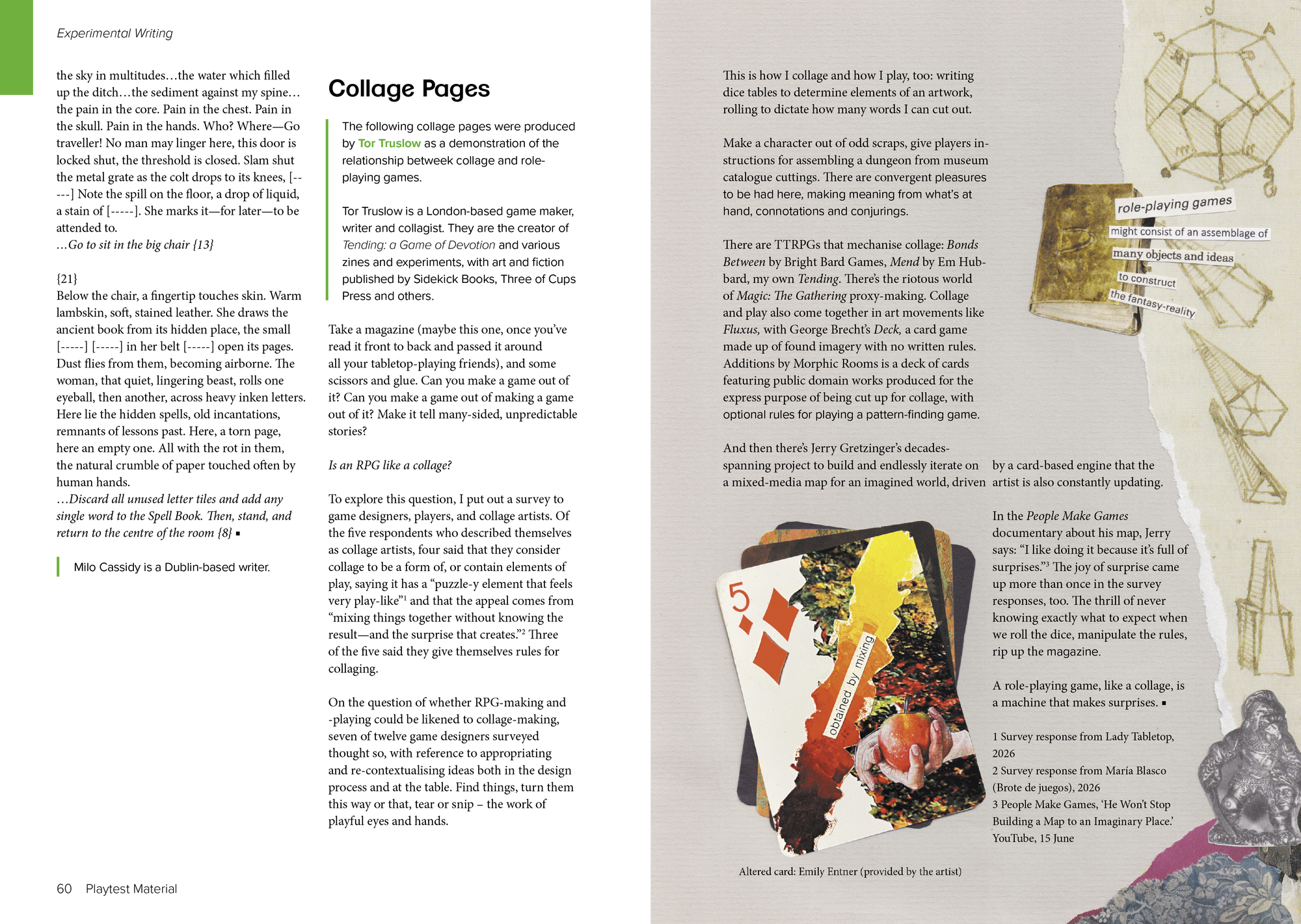
David Blandy: When selecting pieces I was really looking for entirely personal yet rigorous approaches, a thorough analysis of a possibly irrational obsession. That’s where all the fun stuff happens, in seeking to understand an element in your own psyche that doesn’t seem to make sense. Like Karen David’s deep dive into the D&D cartoon of her childhood, now seen through the lens of philosophical theory.
Codega: What is the editorial process like for an article – from selection to editing to publication?
O’Connel: Long, is the honest answer. Especially since we’re only two people who have a lot of other stuff on our plate. Typically, I try to reply to everyone who pitches or submits something (though some may get lost in the inbox, and it may take a while). We’ll either accept their pitch, or at least say why we rejected it and what we feel has legs and what doesn’t.
When I’m selecting pieces, I’m not just looking for if it would be a good article; it has to bring an interesting perspective, be on theme, and contribute to the overall balance of the magazine. I’m often left in a position where I have to seek out certain types of writing: academics tend to jump at the magazine, but when I’m looking for experimental writing and essays, I might have to look a little harder for that.
Then, depending on the scope of the piece, if it's a pitch, I or the other editor will give some initial thoughts and potential pitfalls to avoid, and ask for a plan or draft to be sent to us.
Once we have a detailed draft or submission, it varies. Either it's perfect, and we accept it as-is (maybe with some minor points raised to fix), or we’ll have a longer call/written back-and-forth with the writer where we discuss the piece in detail and work out what the best way forward is. Often the issue isn’t ideas; it’s finding the best through-line and what the most important thing to focus on is. For many of the longer pieces in Playtest Material Issue One, for example our pieces on Rakugo and on critical spectatorship, that was a long road, and the angle of the piece changed multiple times before arriving at what we collectively felt was the best thing. Then it’s line edits, which I currently do, and proofreading, which we are constantly looking for more volunteers for. In short, a lot of curation and editorial labour goes into it, and the goodwill of the writers and their willingness to accept feedback is an absolute necessity.
Codega: What are your thoughts about monetization with regards to this project?
O’Connel: These kinds of magazines rarely make money, but we do pay each of our writers a 2.5% royalty on print sales. To be honest, that’s nothing to write home about, but it’s the principle of the thing. As with most literary magazines, what people get from publication is about more than money. I’m very strongly opposed to paying per word, because we’re carrying all different kinds of writing, and a 600-word experimental piece carries just as much value to the magazine as a 5,000-word essay. I would like to move to an honorarium situation where we pay writers an amount up front based on what we expect the magazine to make. That will rely on the subscriber base improving.
If we had more money, the first thing I’d think of is getting someone to help with layout. The hours I spend on layout and line edits/proofreading would be far, far better spent replying to pitches, developing articles and training up writers. If anyone would like to volunteer help in that regard, or sponsor us, we do accept donations, and you can get in touch with the magazine.
In the long run, who knows? Either the magazine gets the support to continue, or eventually it fulfills its role and withers away. If it’s to be sustainable forever, eventually an editorial stipend will need to emerge and/or we’ll need to access some kind of grant funding; but that’s a long way away, and the magazine will never be a for-profit endeavor.
Codega: How do you see games as important to culture writ large?
O’Connel: That’s a big question, [and] it really depends on the game. I think human social life benefits from more and diverse means of expression, and I see playing as a fundamental part of social life; one which has the potential to be deeply transformative. All humans play, every culture plays, and the illusion that play is for children conceals a long history of recreation through time. What do role-playing games do? Well. I do think they’re filled with a lot of potential, but it’s too much to say in one short answer. I did write about this in my editorial for the magazine, which people can read here. But really the whole first issue is about that. Nicholas Orvis, for example, wrote a fascinating article on theatre, and what theatre could take from RPGs and vice-versa.
Codega: What are you most excited for readers to learn from this magazine?
Blandy: I’m hoping that this issue will inspire people to think more broadly about their own relationship to the hobby, how TTRPGs influence their lives and how TTRPGs can be changed by their thoughts, actions, and writings. Most of all, I hope that it encourages the burgeoning body of analytical writing, grounded in play rather than pure theory.
Codega: What are your hopes for this new publication?
O’Connel: Firstly, it’ll provide something that people are looking for; thoughtful criticism which can help to spawn or develop new ideas — and come to terms with the innovations that have been made over the last few decades. I hope it’ll fill a bit of a void, at least for now, and train good critics and writers who can provide something to the scene on their own terms. I hope that it inspires people to produce similar stuff, and either that it is replaced by new and better magazines, or that people like it enough that we manage to keep it going. Perhaps I also hope, selfishly, that it’ll make me a better writer.
Is Playtest Material also an attempt to legitimize role-playing game-related things (writing, performing, etc.) as art? Maybe. I don’t think we can be the arbiters of what is and isn’t art; that’s a bigger social question. But RPG people at the moment do struggle to access funding sources and spaces that are open to other writers and performers, [and] one hopes that by having a broader critical infrastructure we can begin to open some of those doors.