Rascal Reading Club: Draw Steel
Who is a hero and who is the monster?

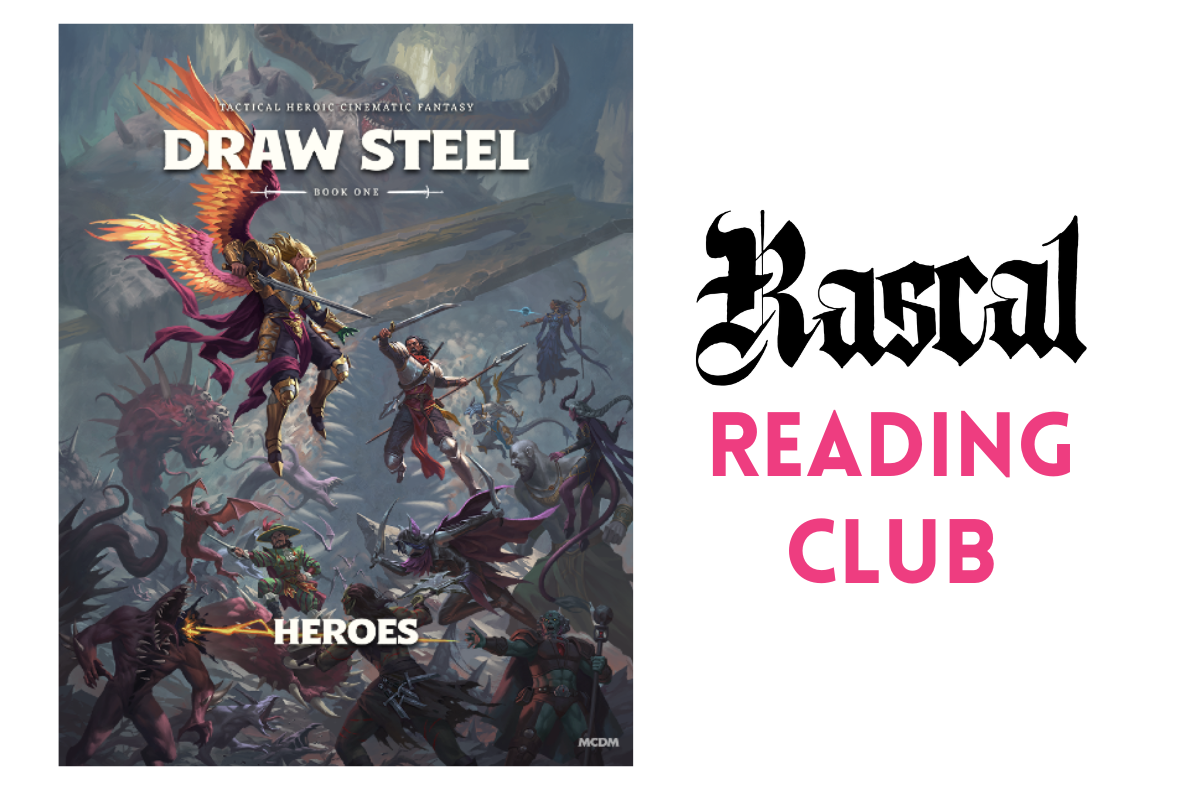
This week, we're discussing Draw Steel, the 2025 tactical fantasy game from MCDM. We explore the differences between this game and others in the series so far — how they differ in terms of their approach to rules, responsibilities of the GM, and more. Also, some hopefully interesting thoughts about the challenges and tensions of traditional heroic fantasy games.
Excerpt:
Let's talk about chapter one of the [Draw Steel] Monsters book. The reason we're talking about it really is because it has advice about one of the hardest things in the game, right? Which is the balanced encounter, If you've ever run any game that was supposed to provide a tactical challenge, then you know that there is the specter of fairness, and the challenge of that and how being a good encounter designer is sometimes impossible to do functionally, right? You start with something, players come into contact with it, you instantly realize all of your assumptions are wrong.
The opening is fascinating because it starts with a section called The Purpose of Monsters, and what's happening here is that the game, in the Heroes book, starts out with "this is a game about fighting monsters". And then you get to the Monsters book and then the game has a kind of a reckoning with that statement. What's seemed so playful and throw away becomes something that they now try to interrogate, try to say like, okay, here's what we mean by monsters.
... There is a section here that I really, really appreciate and that really sort of made me happy to see this in a bestiary. Because a monster book could easily not have this because it's sort of a downer, right? Basically, what it says is: "In the real world, “monster” has come to mean “the other,” or that which is not us. The monster is an unknowable threat until it is either known or is no more. Often, “monster” describes ferocious beasts that can’t be prevented from doing us harm. Horrifyingly more often, “monster” is used as a label for groups of people and whole cultures, usually as a means of denying their humanity."And that's a difficult thing for a game to include in a monster book, because then you have to say something.
It says, "in games, “monster” is a clinical term for an opposing force. The monster is the away team. The word describes game actors who challenge the characters’ capability to achieve their goals. The monster has traits and abilities that the characters must overcome using their own traits and abilities. The monster provides the reason for the characters to have those traits and abilities in the first place. It’s worthwhile to discuss with your players how each of them would like to engage with Draw Steel ahead of embarking on a new adventure. After all, their heroes will inevitably face monsters, and conflict in the game should be more interesting than disagreements around it."
I feel like, in that moment, the game is acknowledging that there is a complexity here, and it's not pretending that people like me don't exist or would not be interested in this game, or would never pick it up, right? Because if you don't include this section, it would be like saying, this book is for gamers, and gamers don't think about this stuff. And that's something kind of horrible about that. And I'm much happier in a world where a section like this exists.
I don't think it's a coincidence that the first monster in the monster book is Ajax, who is, canonically in the setting, the totalitarian fascist that is controlling everything, the empire builder, the imperial force of this world, the invincible overlord, a human, a person. And maybe, they couldn't think of any other monsters that started with 'A' and it's just a coincidence but I don't think so.
As always, you can participate in the discussion! Please respond by May 5th, either by posting in the official discord or writing to thomas@rascal.news and we'll include your responses in the talkback episode.
Participation is open to everyone, including non-subscribers!
Discussion Questions
- What do you think of Draw Steel?
- What do you think of the GM being called a Director? What differences does the evoke from simply the GM? Does it sound cooler than just Gamemaster?
- What do you think about the idea that Mothership and Draw Steel have a different ideology about what rules do? Do you think Apocalypse World has a different view from Draw Steel?
- Do you think a GM of Draw Steel is a game designer in a way that a GM of Apocalypse World isn't?
- As a GM, do you have a way of "making time matter" without using mechanics? Are you able to do with just narrative or fiction?
- Do you think there's a (theoretical) recurring tension between a heroic game and the idea of a more political game?
If you're a member of Rascal’s Party Member tier, you can nominate a book and decide what we discuss next in the series.