Rekindling a decades-long friendship by designing Tacklebox
Hook, line, and reunion.

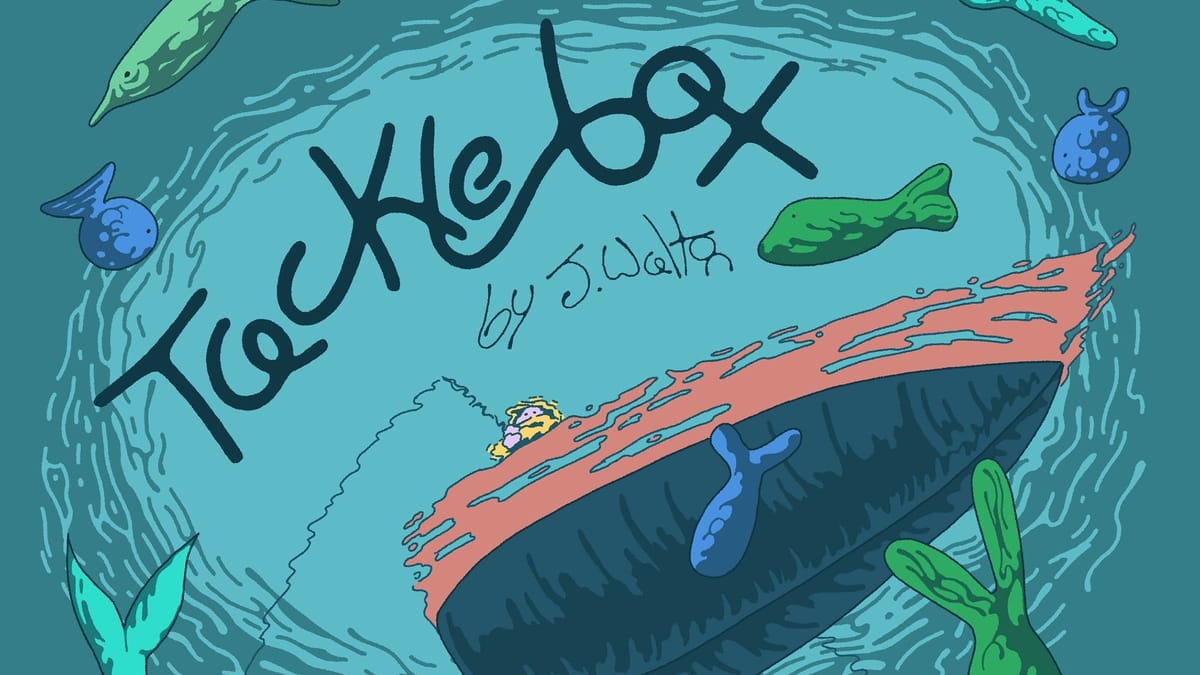
Tacklebox is an RPG about fishing. You are Robin, and your friend is Parker, and you’re both out in a small boat, fishing. You reach into your tacklebox for a lure, and you fish. You converse with one another, catch up on your lives, and discuss how long this trip should take. Once you and Parker have caught enough fish for the day, you wrap things up by disembarking the boat.
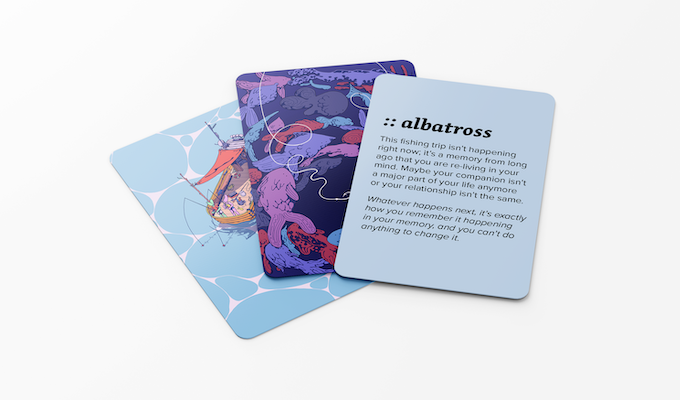
But Tacklebox is also about more than just fishing; it’s about grappling with the unsettling, surreal existence that’s enveloping both you and your companion. Something fishy is happening, even if you can’t quite put your finger on it, yet. As you cast your line into the unknown, you’re encouraged to share your thoughts — or, if you like, remain quiet and meditative — while observing how the world and your own perspective morphs around you. These are done through card prompts you draw from a shuffled deck.
“Tacklebox is a two-player game, supposedly about going fishing with a friend or family member. But it's actually about exploring and subverting the foundations of collaborative play,” said Jonathan Walton, the designer of Tacklebox, in an email to Rascal. “The card prompts don't advance the plot. Whatever happens, you're always just fishing with your companion. Instead, Tacklebox prompts aim to gently adjust each player's internal, unspoken understanding of what's happening in the fiction of the game.” At the same time, the other player is also drawing their own cards, and the two players’ differing understanding of the game’s reality shapes their interactions with one another.
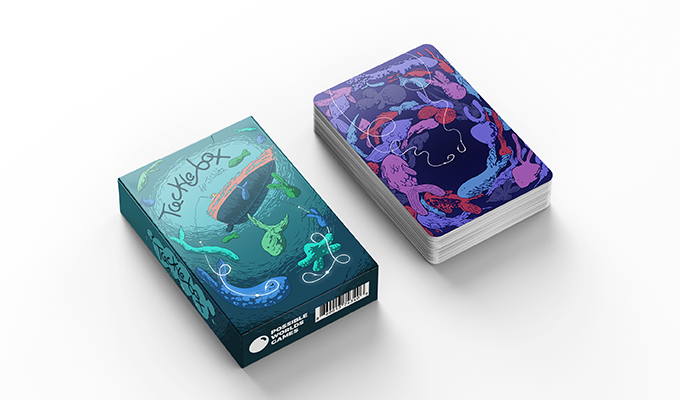
Originally designed for the Golden Cobra Challenge game jam, Tacklebox was inspired by Walton’s love for absurdist media such as Westworld, Inception, Waiting for Godot, and Being John Malkovich — an interest he shared with his collaborator, writer, and childhood friend, James Tadd Adcox. In fact, Walton reconnected with Adcox during its development after a few decades apart. It’s a pretty serendipitous reunion brought by creating a two-player game about building, or negotiating, a shared understanding of a fictional world. “It feels both apt and ironic that Tacklebox is functionally about the surreal qualities that can creep into long-term friendships or family relationships, with folks you know really well but maybe haven't seen in a while,” said Walton.
Initially, Walton had written some of the game’s original prompts, which amounted to roughly 30 cards. But he couldn’t find the time and the emotional bandwidth to flesh out the rest of the game in between juggling a litany of responsibilities: his day job, his family, his anxieties, and even ADHD. Thus, when looking for a writer to craft additional prompts for Tacklebox, Tyler Crumrine of Possible Worlds Games — the publisher for Tacklebox — suggested a contact: Adcox. Walton immediately took to the idea, given their shared history, and the fact that Adcox is already an established experimental and surrealist author. “We grew up literally side-by-side, consuming all of the same media influences, even if we hadn't spent much time together in a while. Tadd immediately understood what the game was about, fluidly adapted to the writing style and cadence of the original cards, and drafted a bunch of new cards that expanded upon and filled in the gaps of the earlier versions,” Walton said.
For his part, Adcox described the writing process as very Oulipian — a reference to the concise literary style of a group of French writers called Oulipo. “Each card needed to be under 75 words, and typically consisted of a ‘main’ prompt, in Roman type, and then a sort of ‘coloring’ prompt, that gave additional context or possibilities, in italics,” he said in an email to Rascal. “I tried to bring in [the concept of the] possible world, no pun intended, that felt like they complemented or pushed at the worlds Jonathan had gestured towards in his original prompts, without overlapping them. My favorite card, which I'm glad made it into the final version, is also the shortest.”
Walton divulged that he had been following Adcox’s literary career since their graduation, years ago, and that he has long been influenced and shaped Walton’s passion for games. “He was the first person I ever met who actually designed their own games, drew their own comics, and wrote their own fiction,” he enthused. The pair were part of a close-knit group of artists and, in his own words, “creative weirdos” in high school, where they devoured RPGs like Paranoia, Toon, TMNT, Rifts, Nightbane, ElfQuest, GURPS IOU, and In Nomine. “When Tadd was writing experimental fiction and I was working in U.S.-China policy — making weird indie RPGs on the side — it felt like we were both pursuing the dreams we’d shared when we were younger.” This influence has continued to shape Walton, with Adcox’s writing on Tacklebox helping him revisit his original design in a new light.
Despite their common interests, Walton revealed that they had never co-designed a game together, even if they did come close, once, many years ago. The duo tossed around ideas for a narrative escape room game called The Four-Chambered Hart. It was about searching for a friend, who has run off into the forest to be the bride of the Deer King — a tale that Walton said resembles a modern fantasy, with elements of Gone Home or Alice is Missing.
While that project didn't end up going anywhere — and Tacklebox successfully released and garnering the attention of critics such as Quinns Quest — Walton hopes that a future collaboration between him and Adcox will, one day, come to fruition. “Even now, with Tadd no longer in Pittsburgh, I hope we can 'get the band back together' at some point and collaborate on something else in the future.”