Fifty Ways To Love Your (Roleplay) Lover
"How to GM Romance" is rules, advice, and some stuff in between.

Years ago, I joined a Discord server where everyone roleplayed as characters from the show Peaky Blinders. The server was divided between those who played the canon characters (the Shelbys, etc.) and those who played original characters around them. As luck or maybe fate would have it, the server had a vacancy among the canon characters: Alfie Solomons. I got the part.
Solomons is a swaggering, sweary character, and Tom Hardy plays him with charm and a menace. I say all this because I was on the server for about fifteen minutes before someone privately messaged me, initiating ERP. Reader, they weren’t interested in Enterprise Resource Planning, they were looking for Erotic RolePlay.
I’m sure you have lots of questions: Why were people pretending to be Peaky Blinders characters? What was I personally doing there? What is Enterprise Resource Planning? I wish I had answers for you. I can tell you that the person who messaged me was banned (because I snitched, sorry), but I felt bad for making that happen and promptly left the server.
All to say, roleplaying romance is tricky. You’ve got to handle your own thoughts, impulses, and feelings — already a challenge. But then there’s this whole other person, who has their own thoughts and feelings and experiences, and could report you to the mods and get you banned, like an absolute bozo. But at the same time, it should be easy, it's the oldest story in the world. It's probably what our fish-ancestors were chasing when they first climbed onto land, evolved legs, and developed dating apps.
So, hypothetically, if someone wanted to make it easier to roleplay romance, what could they do?
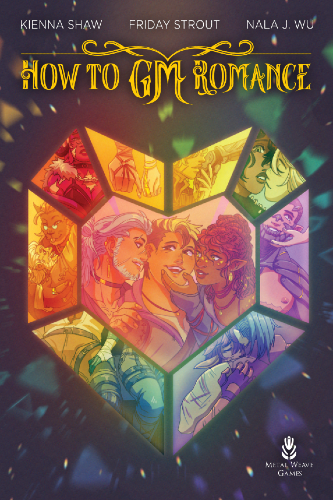
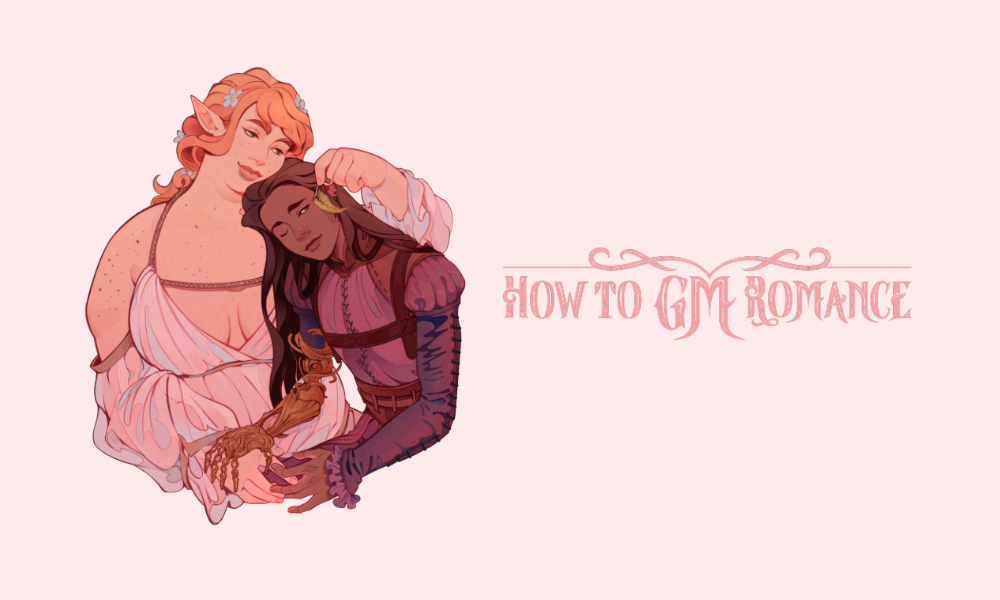
How To GM Romance, co-created by Kienna Shaw, Friday Strout, and Nala J. Wu, is one attempt to answer that question. It’s a mixture of two impulses: the desire for more structure and the need for sensitivity and emotional intelligence. One is a guard rail and the other is a foundation — both are supports, albeit different kinds. The book is divided into systems and essays, but the division isn’t so neat: the systems are essays of a kind, too.
There is a clear but loose connection between the systems. They try to build an encompassing framework meant to hold the hand of a nervous GM as they gently escalate from addressing pre-game awkwardness to the nitty gritty of dating and sex. Safety, consent, and advice on getting on the same page runs through the entire text, across the different sections. If anything, the book repeats itself in this regard — but it’s understandable why it might.
The bedrock of the whole thing is Sebastian Yūe’s Romance Tracking System, which adapts the logic of computer RPGs like Baldur’s Gate 3, where your actions and words directly affect a NPC’s impression of you. Say the wrong thing, embody the wrong value, and your approval goes down. Stand up for the NPC, give them a nice gift, and your approval goes up, and so on. It doesn’t declare outcomes — refusing to resolve the equation for fear of overprescribing. Rather the main idea here is that romance can be prepped for — that time spent sketching out an NPC’s values, insecurities, likes, and dislikes, is the best way to build confidence. Once you do that, it’s a question of paying attention to the emerging relationship and seeing how the two characters are cleaving together or apart.
If they’re butting heads, Friday Strout’s Dispute and Fallout system classifies the directions that altercation might take and provides the lightest touch of rules for tracking when a relationship would end, as well as how it could, under the right conditions, rekindle. Christiana Zambrano provides some mechanics for gift-giving as well as templates for love letters and sonnets. Zambrano’s work is a good example of one of the book’s interesting patterns. What’s the difference between teaching you to write a sonnet in a game versus real life? Which one is the game trying to do?
Kienna Shaw’s Dating System is where this twin purpose is most obvious. As Shaw tries to show how a relationship might grow from First Sparks to Dating to Going Steady to Growing Together or Apart, she also writes a guide on how to do so in real life. It is painfully basic (and sweet) at times: “A date is an opportunity for people to spend time with each other in a romantic context and get to know each other.” This comes out in the questions and prompts, as well. Before the date, the text asks who is taking the initiative to invite the other person, what their goals are for the date (a long time, a good time, something in between), and prompting them to be vulnerable and personal. It is good advice for scene-framing but it also feels like something everybody might benefit from knowing.
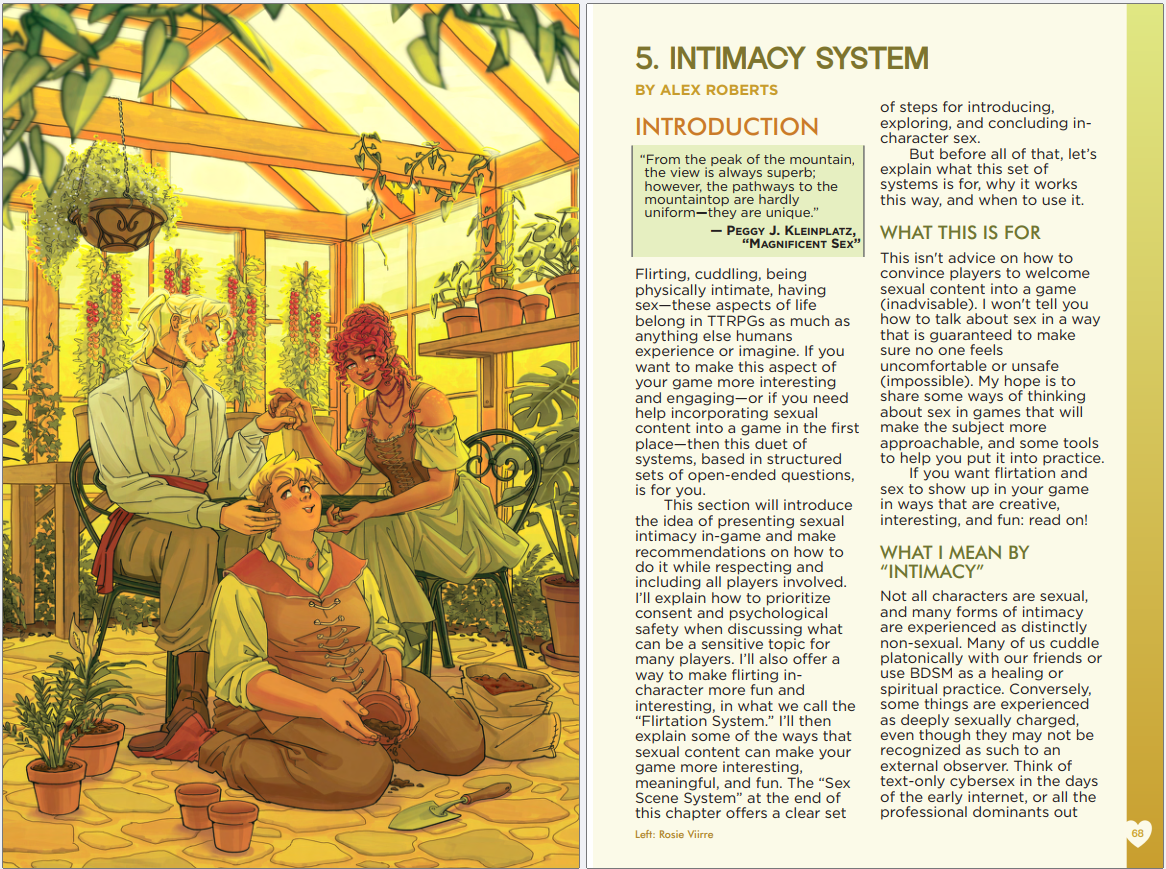
The final system, from the inimitable Alex Roberts, is focused on intimacy and sex and is probably the section that is most useful for people who would consider themselves experienced roleplayers. Roberts is casually insightful, with lines that say a lot in a few words, such as “the way that many game systems are structured does not lend itself well to free, informed, and enthusiastic consent” and “flirting is just showing interest in someone”. Drawing from their work on Star Crossed and For the Queen, there’s excellent advice around how to flirt (“try to hide it”) as well as prompts to make scenes around sex have more narrative impact or thematic resonance, if you want that sort of thing.
(Roberts is also very funny: “It goes without saying that sex can be a sensitive subject… However, as a personal favor to me, the author of this chapter: please don’t talk about it like it’s open heart surgery.")
The latter half of the book is the essays, including some powerful writing about using RPGs to think beyond heteronormativity. The essays push for widening our ambition for what we can escape from and where we can escape into. As Connie Chang puts it, in their essay titled Love Beyond White Supremacy: Liberational Romances In TTRPGs, “When facilitating romance in our games, we necessarily construct narratives about love: who’s worthy of love and who’s not; how love manifests and behaves; and the function of love within our setting.” There’s also Cate Osborn on asexuality, Dillin Apelyan on sex work, Noordin Ali Kadir on embodying characters in love, and more.
Stepping back, the book has a hard task before it. It wants to have material for those at various levels of experience and excitement. It wants to be system agnostic but apply to people running D&D 5e. It wants to support but not prescribe, educate but not lecture, encourage but not downplay the risks. That’s a tall order.
It also surprisingly never really talks about the fact that there are existing games tailor-made for romance that would be useful to any GM looking for experience in the genre — that they could then use to inform their play in other games. A round of Mobile Frame Zero: Firebrands by Meguey and Vincent Baker, for example, was enough to instill in me how characters asking for permission to touch, hold hands, or kiss can be extremely romantic — rather than clumsy or stiff.
But in the end, it’s hard to criticize a book that relentlessly focuses on open communication, actively caring for your players, and taking risks in the pursuit of joy and self-expression. You can’t really go wrong there.
(Disclosure: The author received a digital review copy.)