Six Hours as a Weekend Dictator
An ode to the power of the Carrot Cake Maneuver.

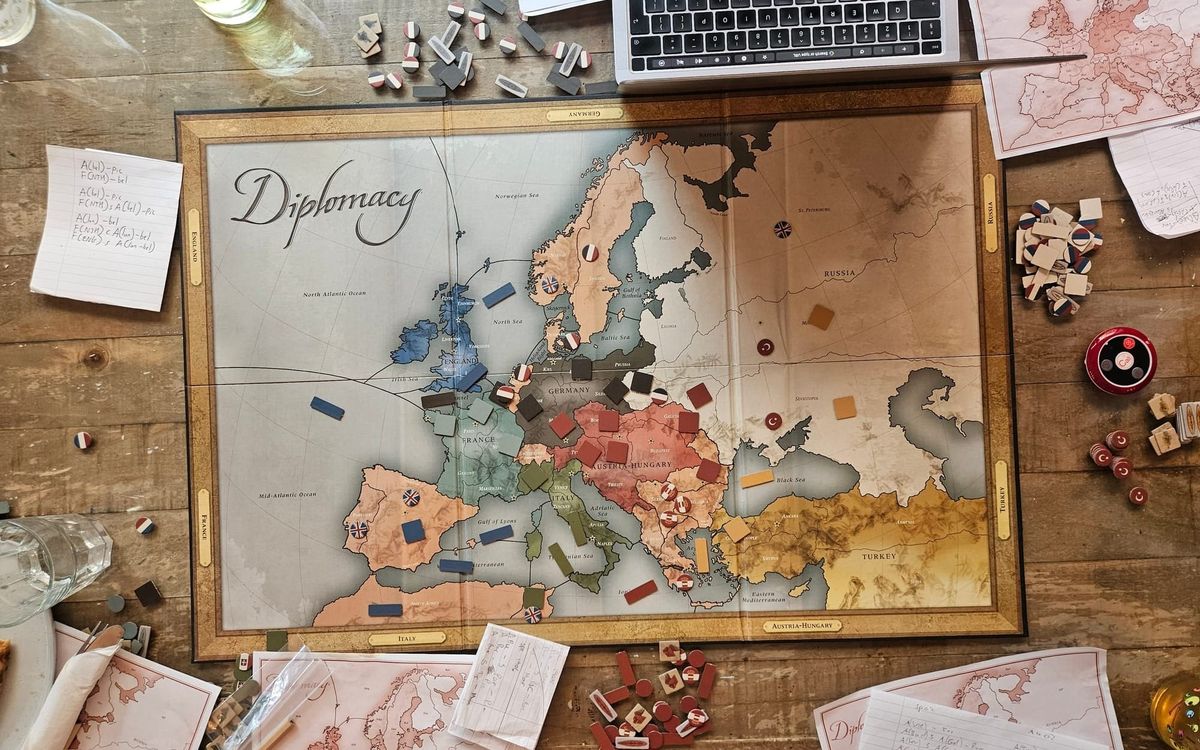
Turkey’s star rose and fell and rose again inside a board game cafe in East Croydon. Seven of us gathered amongst Kallax shelves and coffee mugs to decide the fate of Europe — or, at least a version of Europe circa 1901 that serves as the setting for Diplomacy. Each of us would embody one of the “Great Powers” and squabble over territory by moving ground armies and naval fleets across a map-dominated board. Above the table, a snarl of subterfuge, promises, and backstabbing would decide the actual fate of the Western world.
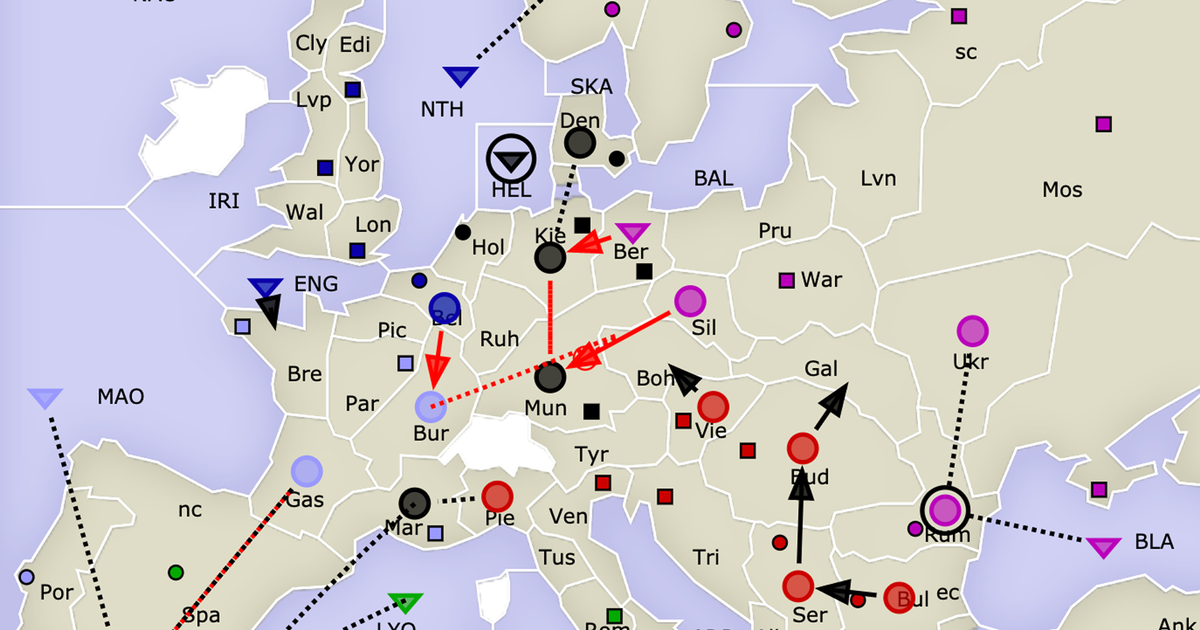
Diplomacy, the classic board game of “pure” negotiation, enjoys a reputation that is equal parts notorious and celebrated. Apocryphal rumors claimed Henry Kissinger swore by its portrayal of brutal realpolitik. A vibrant professional scene contends that elite players can win without lying to opponents. Most people know it as a several-hour crucible that ends friendships, primarily due to all the double — and triple — dealing. Alliances will coalesce and disintegrate from one turn to the next, and you are always one knife in the back away from losing the Mandate of Heaven. Imagine the emotional turbulence of holiday Monopoly games with your family transposed on the interests of an amateur World War I scholar, and you’re close to Diplomacy’s general vibe.
Which is why I chose to spend a full afternoon amongst sweater-clad adults arguing about troop movements and control of integral sea routes while eating cheap pizza and overpriced lattes. I find that kind of stuff fun. The seven representatives sat around the table, and, amidst sheafs of paper and cardboard tokens, drew our fates from an abandoned trilby we found on the shelves. I pulled Turkey; instant deflation at being relegated to the southeastern corner of the map and sandwiched between Russia and Austria-Hungary. The general belief among players is that Turkish rulers either need to draw first blood and keep swinging, or else resign themselves to wait literal hours for a chance to flourish. Lacking confidence amongst mostly strangers, I submitted conservative opening moves and busied myself with the coffee menu.
Diplomacy’s mechanics are intentionally thin. Each player exerts control over territories via landbound armies and seabound ships. Some are marked as containing Supply Centers, which not only increase one’s maximum number of units but also act as the victory condition — the first to dominate 18 of the 34 centers wins the whole enchilada. Most games end with two, three, or four-way ties before slogging over that finish line, but the number 18 will be endlessly bandied as threat and doom amongst the world powers. The golden rule: better you control centers than your opponents. Friends, though? We’ll get to that.
You “play” Diplomacy across years comprising three turns each. Orders submitted during the first two — Spring and Autumn — allow units to perform a very limited set of actions: move into an adjacent territory, hold its position (for a defense bonus), support another unit (including those controlled by other players) in attacking or defending, or, if you’re a ship, convoy ground units across bodies of water. During Winter, players only build or disband armies to match the shifting control of centers. Unit movements are submitted privately and carried out simultaneously. Because no unit is more powerful than another, players must either coordinate multiple armies or curry aid from neighboring countries to win battles. And that requires two elements that are bone-deep critical to Diplomacy: conversation and trust.
After every season, our seven rulers stepped away from the table and dispersed throughout the board game cafe in pairs and trios to discuss the new world order. Sometimes, I would catch a glance from Austria-Hungary or Italy that meant the terms of our shaky Mediterranean alliance had changed. Other times, England’s boisterous player would bluntly announce, “Russia, you and I need to have words.” Bent over maps like secretive viziers, we would strategize and question, demand and implore, beg and shrug over the price of enough aid to see our individual battle plans made real. Nothing promised in Diplomacy is mechanically binding, and we all knew that handshakes were mere sandcastles at high tide. Such stakes paint a dim view of global politics, but it made for thrilling reveals at the table.
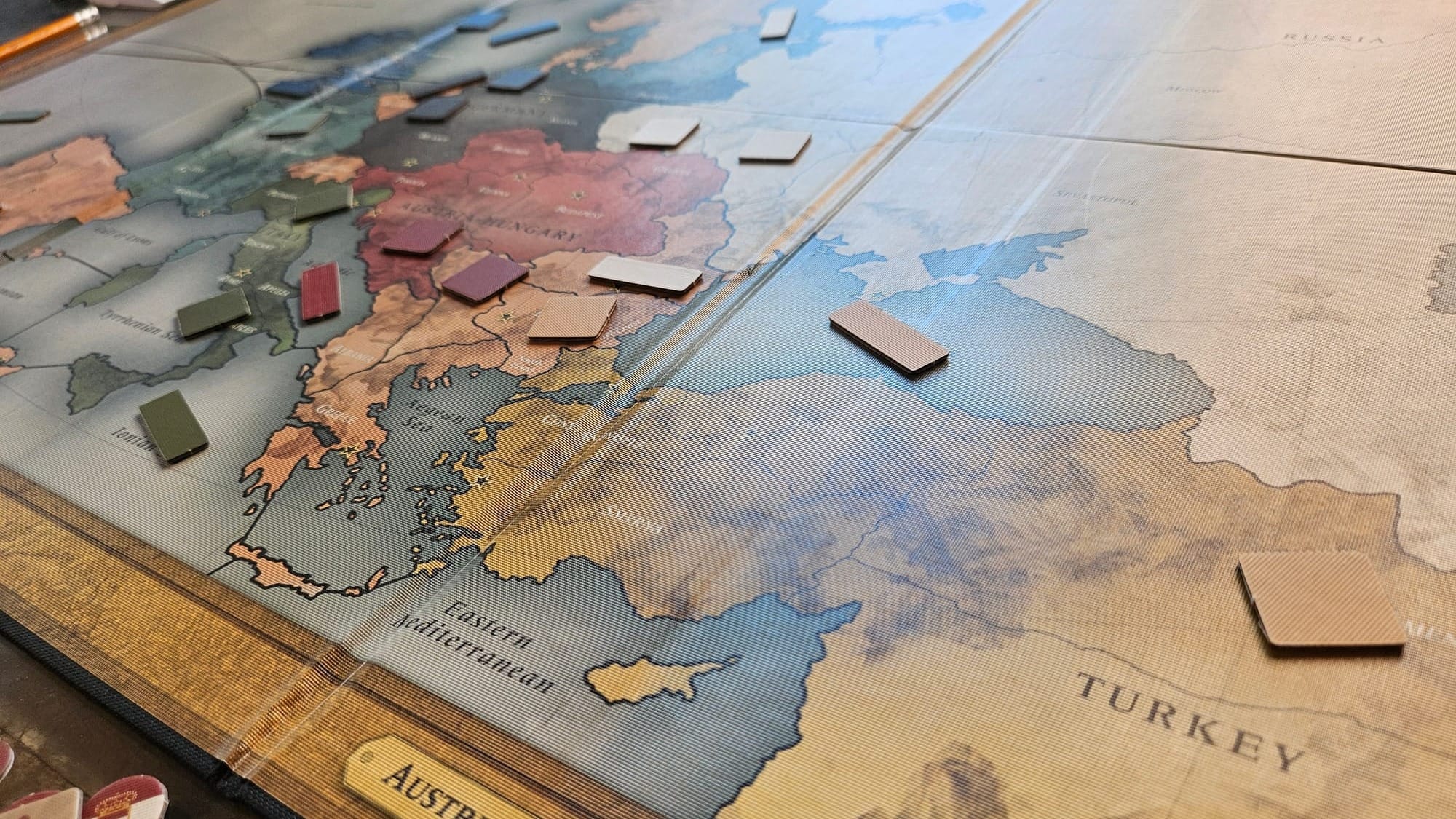
How did I fare as Turkey’s sultan? Initially, poor. Austria-Hungary quickly seized the Balkans while Italy filled the Mediterranean with naval fleets, ostensibly to cut France and England out of a convenient vice. Russia, meanwhile, took my bid for Rumania as a personal slight and loudly announced their intentions to see me pay for this betrayal in blood. So, caught between the proverbial rock and hard place, I spent the first four years of the game (12 turns and about three real-world hours) clutching my meager starting territories and convincing literally everyone else to slay the barbarians knocking down my door. Would I be the first one consumed in the war machine’s churn and go home on the early train? Superior tactics wouldn’t save me, so I turned to the sharper tool in my belt: exploiting human nature.
***
The potential disaster described above was not my first time playing Diplomacy. Earlier this year, the same group had invited me into a digital version of the game mediated through Backstabbr. Virtually similar in all ways but one, the browser-based board game represented its social layer through group chats. Anyone could invite other countries into private rooms or send direct missives to each other. This lended negotiations an air of officialness, as if we were receiving formal communique from prime ministers, presidents, and monarchy. It also allowed me time to carefully craft words and cross-reference conversations with other leaders. I could catch people in lies and reneged promises, and it allowed me to speak confidently out of both sides of my mouth to pretty much everyone. I won that game by virtue of being everyone’s friend but nobody’s ally. Never a threat but always a nuisance, my reign as Russia’s tsar hinged on the affordances of asynchronous statecraft.
An unforeseen benefit to this play-by-post nature was the chance to roleplay. It isn’t a natural or intended part of Diplomacy’s design and arose from Backstabbr’s unique infrastructure, a happy accident that transformed the game into enjoyable little bursts of improv peppered throughout my week. In their opening telegrams, some players would address me with era-appropriate titles and language-appropriate greetings — salut and bonjour from the French, buongiorno from Italy, oy, geezer from the English, etc. — and I (with apologies to native speakers) responded in ceremonial cyrillic to sell my image of an ambitious but slightly naive tsar. Here was someone they not only could trust but perhaps take advantage of. We say too much in front of children when we assume they don’t understand. .
 Johnny Chiodini
Limiting in-person Diplomacy’s politicking to 15-minute intervals, all of which is spent looking your opponent in the eyes, empowers quick, decisive action. Most people just want to know what to expect and how they might benefit. Maslow's hierarchy of needs reduced to a single tier: am I being stabbed in the back? Everything beyond that is gravy. My group’s conversations amongst the board game stacks held no space for theatrics and roleplay. No friendly привет товарищ (hello, comrade) or preening of egos. Instead, most led with a furtive “right, so here’s what’s going to happen” and ended with listless wanderings back to the table as everyone feared the worst. If Backstabbr carried the spirit of mid-2000s forum games, that cafe empowered only a sick lump at the bottom of everyone’s stomach. Diplomacy (and Diplomacy) is a misery machine.
***
Back in meat space, appeals to Austria-Hungary’s pragmatism — that I was a critical ally and wedge against swaggering Russia — fell on deaf ears. Italy was too occupied with both French aggression and Germany’s swelling ranks thanks to early victories. Shoved into the corner of a map that ended with Syria, I assumed the turtle’s posture. I submitted my orders with solemn eyes peppered with a hint of pout, not rising from my seat when everyone rushed to their cliques. Sometimes I would meander and say hello, only to be treated either like a leper or a stray dog that everyone hoped someone else was feeding. At one point, I ordered a slice of carrot cake and ate it alone like some kid whose birthday invitation went completely ignored. Near defeat had transformed me into a social pariah without the power to do anything of consequence, but a quirk of Turkey’s geographic isolation left me nearly impossible to dislodge. Italy and Austria-Hungary tried and failed. Russia could have sealed my fate had they not been obsessed with wringing Scandinavia out of English hands. By the time Moscow called for a tripartite pincer on my territory, the other two had lost the taste for slaughter.
The 1900-and-aughts crawled into the Teens like a trench soldier, grueling and panicked. Russia finally died on an altar of its own hubris, and England’s early naval dominance broke against Italy before spilling into North Africa. France clawed at Germany’s walls searching for purchase, while Austria-Hungary felt itself pulled in every direction. A five-way stalemate began to coalesce in the minds of the remaining players, and everyone searched for a crowbar. That’s when I felt eyes turn in my direction for the first time in hours. Turkey suddenly mattered again, was invited to talks, was grabbed first to discuss how I might benefit from a potential alliance. And, of course, how I might benefit my new allies.
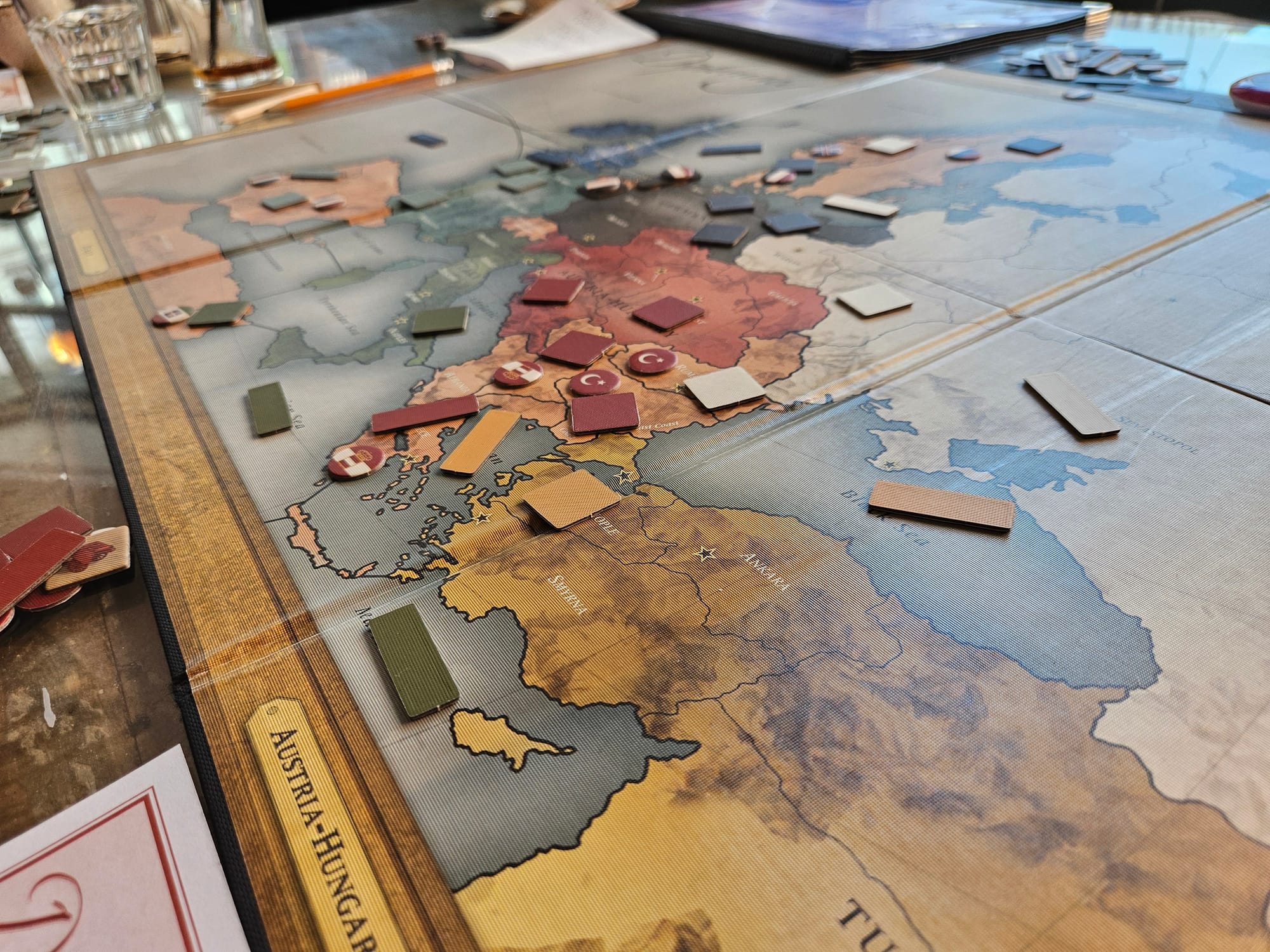
My reintroduction to world politics gradually shifted the balance of power into two factions: Germany and England ascendant in the north, and Austria-Hungary and Italy in the south. France was selling diaphanous neutrality with a smile, policing fleets through a clogged Strait of Gibraltar, but we all knew they were weary of playing lapdog to the English. That left me to choose my date to prom. Everyone agreed Turkey would play kingmaker, and whomever I blessed with allegiance would be set on a path to inevitable victory. We were nearing hour five, and the demands of human bodies in their late 30s and early 40s insisted louder than our desire to reach a conclusion. As the youngest of the group at a spry 36, I prepared for the only sensible tactic: mercilessly flirt with both sides. Nobody has yet won my heart, I told both the North and South coalitions. But, I do have some intelligence to share. My ultimate plan was to snowball to 18 centers, a battlefield vulture engorged on the consequences of their choices.
Sadly, five hours of Diplomacy had emaciated my playmates’ enthusiasm for any teasing Turkish confidence, and my well, well, well, look who comes knocking at Constantinople’s door fell flat. People looked shattered, as the British say. We half-heartedly joked about picking this up another day and apologized to each other for our bodies’ collective failing; aging men barely hiding existential anxiety. The game limped towards hour six until I threw my weight in with erstwhile enemies Austria-Hungary and Italy, a mercy killing that the table immediately accepted as an end. So, a three-way tie — four, if you believe we would have let France scramble onto the victors’ podium. There’s no telling just how long the conflict could have stretched on, as late-game alliances often disintegrate at the knife’s point of a final, poetic backstab.
Walking home, Austria-Hungary’s player confided in me his one moment of weakness. A friendly guy who framed every betrayal within necessary pragmatism, he was responsible both for my early relegation to the dustbin of history but also my dramatic revival. We had stayed friendly by dint of sitting adjacent at the cafe table and sharing a couple of pints, and we had enjoyed wearing the masks of bitter, frustrated rivals during round table discussions. He turned to me as we crouched against a cold Autumn wind and said, “I almost took you out completely early on, but I didn’t.” When I asked why, his answer surprised me. “You were sat there all alone, eating carrot cake. You looked a little pathetic.”
Reader, take that as a lesson. If you can’t outwit your enemies on the board, outwit their hearts. Find the player incapable of kicking a dog and start barking. Sun Tsu would have put the Carrot Cake Maneuver in that book of his, had he been present in East Croydon for my six hours as Turkey’s last sultan. I don’t know if my appetite for Diplomacy will return any time soon, but I’ve already recast the events of that afternoon into a gripping narrative. The measure of any game worth its salt is the stories we tell in its wake. That, and the cinnamon-sweet taste of victory.