Sword World may no longer be revolutionary, but Japan’s dominant fantasy RPG is still more than a historical curiosity
Down the tabbit hole.

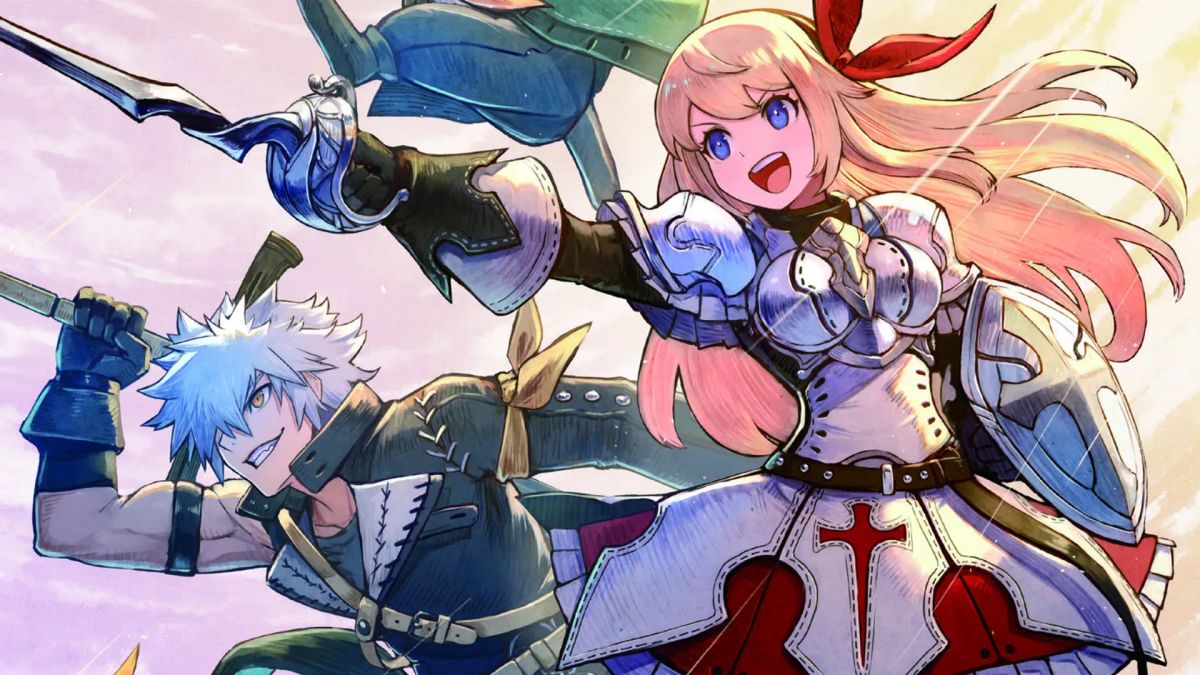
Sword World is one of the most influential RPGs you’ve probably never heard of, only being on your radar if you’re interested in RPG history, a massive fucking weeb or, like me, both. Released in 1989, Sword World soon eclipsed Dungeons & Dragons to become the most popular fantasy RPG in Japan. Later this year, Mugen Games will be running a campaign to crowdfund the first official English translation of Sword World, starting with the current Sword World 2.5 core rules, with plans to support the game with additional expansions and adventures in the future.
Mugen has released an English quickstart for Sword World, which piqued my interest due to its containing a solo adventure. While I do look at plenty of them for work, I don’t particularly enjoy quickstarts — they rarely get to the meat of what makes a game interesting. I make no secret of my love of solo tutorials as a way to learn a game that’s fun and engaging for prospective GMs, rather than feeling a bit like homework. So, I grabbed a pair of d6 (the only dice you’ll need for Sword World) and set off for the port city of Harves!
The adventure wasn’t long, involved or particularly thrilling, but it did do an excellent job of conveying not only Sword World’s basic rules, but what a session of the game is supposed to feel like and how it should proceed. There’s a guild that doles out jobs and provides support to professional adventurers. Newbies register at the guild, form parties, and set off on missions, largely to pay the bills and make it to the next job. The vibe is instantly familiar to anyone with even a passing interest in fantasy anime and manga. However, unlike Fabula Ultima, Sword World isn’t emulating these well-worn tropes — it’s largely responsible for creating them.
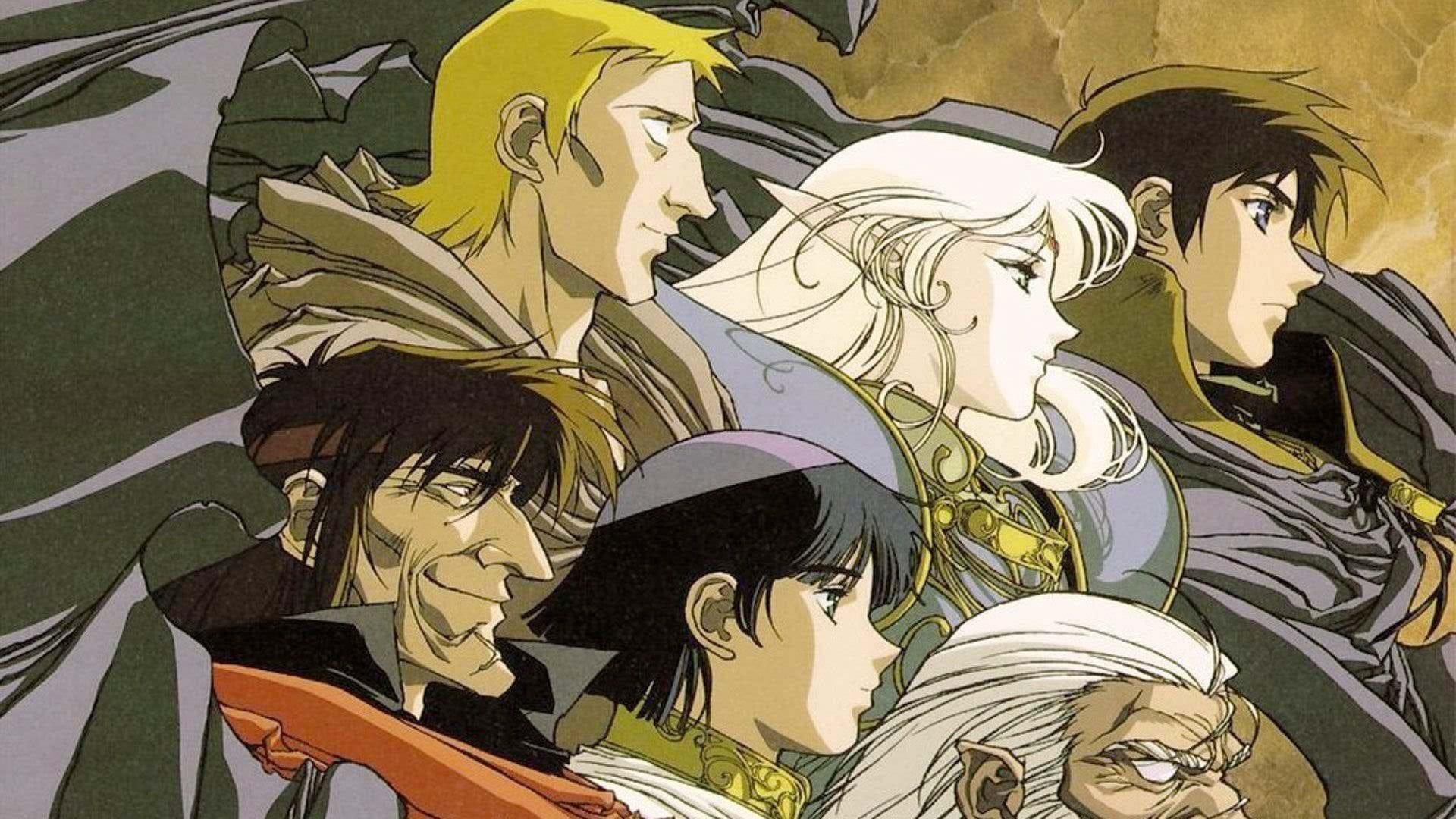
That’s the fascinating thing about Sword World’s influence. While the game hasn’t penetrated into the English-speaking world (outside of fan translations) the Japanese media that owes it a huge debt absolutely has, and it all dates back to 1986 and Record of Lodoss War. Serialised in computer magazine Comptiq, Record of Lodoss War was an “RPG replay” — a written recounting of a D&D campaign run by Ryo Mizuno. D&D-influenced Western fantasy had become popular in Japan via computer games like Ultima and Wizardry, so when a Japanese translation of the red box edition became available in 1985, audiences were well primed for it, and it went on to sell over 200,000 copies. Mizuno and his collaborators who later formed Group SNE wanted to publish paperback collections of Record of Lodoss War but couldn’t come to an agreement with then D&D owners TSR. This led them to abandoning D&D for their sessions and eventually creating Sword World.
Even before the compilations were published, Mizuno began adapting Record of Lodoss War into what are considered some of the earliest examples of light novels. While there isn’t a direct English language equivalent, light novels are broadly young adult-adjacent novels written in an easy-to-read style, and with covers and illustrations by manga artists. Many light novels, particularly in the science fiction and fantasy genres, have gone on to be adapted into internationally popular manga and anime, with Sword Art Online being a notable example which brought light novels to the attention of an English-speaking audience. Record of Lodoss War itself also had several spin-offs, as well as manga, anime and video game adaptations (I’m rather fond of the 2021 metroidvania Deedlit in Wonder Labyrinth, if you fancy dipping a toe in.) Record of Lodoss War and Sword World formed the basis of much later D&D-style fantasy in Japan, much like Dragon Quest and Final Fantasy did in the video game space.
Sword World’s second edition was published in 2009 (for some reason, I find the nineteen year gap rather admirable) with Sword World 2.5 arriving in 2018. Initially hewing closely to the D&D style of Record of Lodoss War, it expanded to encompass a broader range of fantasy styles, incorporating elements like the bestial Lykant species, complete with wolf ears and tail, and sci-fi elements courtesy of the long lost Magitech Empire. Yes, you can be an anime puppy boy with a magic gun.
When discussing Sword World’s dominance of the Japanese fantasy RPG market, it would be remiss not to mention the massive price discrepancy between it and D&D. At the time of Sword World’s release, it cost 640 yen, compared to 4800 yen for the red box. Even today, the game is exceptionally affordable. Sword World 2.5’s core rules come in three volumes. However, they’re arranged sequentially, rather than a D&D-style split across three tomes. Core Rulebook I covers play up to level 6, and the further volumes add extra options and increase the cap to 15. The format is very different — instead of large, full-color hardcovers, they’re small, black & white softcovers known as bunkobon. As a result of these design decisions, new players can pick up Core Rulebook I (which still weighs in at 480 pages) and start playing for just 990 yen — less than US$6.50.
While this is all incredibly interesting, it doesn’t actually answer the question of whether or not Sword World is a good game for an English speaking roleplayer in 2026. I’ve been watching anime for almost as long as I’ve been playing RPGs, and I always enjoyed the Japanese take on D&D-style fantasy and all its idiosyncrasies. Thanks to the superb duo of Frieren: Beyond Journey's End and Delicious in Dungeon, the genre is having a bit of a moment right now, and I’m surely not the only one interested in playing in that space. While I could just tweak an existing system, I’d much rather pick up something that has the precise feel I’m looking to emulate running through its DNA.
Going by the quickstart, Sword World may very well have what I’m looking for. The system is immediately appealing. Characters multiclass by default, their capabilities defined by a combination of Primary and Secondary classes. For example, the human warrior used in the solo tutorial has two levels in the Primary class Fighter, and one level in the Secondary class Ranger. The former gives them their main role as a frontline combatant, while the latter adds some perception and stealth abilities, particularly outdoors. It’s character classes as building blocks, rather than limitations. Everything is resolved with 2d6 rolls against a target number, with bonuses from things like ability scores, or skill groups known as Check Packages. It was the very first example of a skill check that made me think Sword World had the vibe built into its bones, and not just in its presentation. Skill checks are presented in the format [Monster Knowledge check (Knowledge/Sage): 5], meaning that the PC is making a Monster Knowledge skill check against a target number of five, and if they’ve got levels in the Sage class, they can add their Knowledge Check Package bonus. Pretty straightforward, as is the result of a successful check — the player can just look at the monster’s stat block. What was interesting is that the extended example mentioned that only characters with Sage levels could take advantage of monster weaknesses.
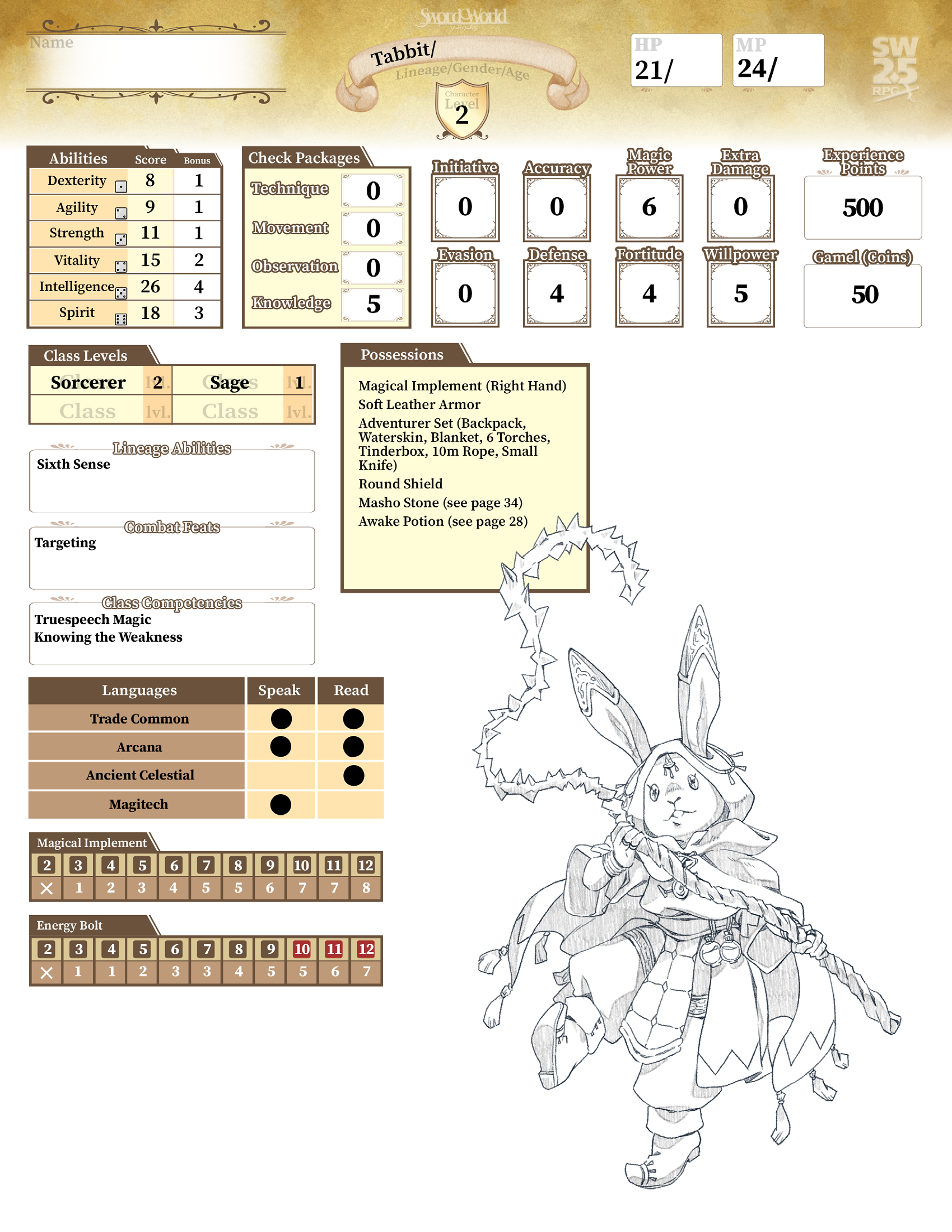
Reading further, it became clear that monsters have built in mechanical weaknesses that can be exploited by the entire party, but only if a Sage succeeds in identifying them. That may not sound like a big deal — plenty of games may involve making some kind of skill check to identify monsters and potential ways of defeating them — but Sword World bakes a certain kind of tactical party banter that is a major feature of this Japanese style fantasy into every encounter. A PC is specifically going to be built with Sage class levels so that they can be knowledgeable about monsters. That PC will then be showing off that expertise and sharing it with the rest of the party for a mechanical benefit.
It neatly sidesteps metagaming (you can know every monster weakness in the book, you still need a Sage to identify them) but it also highlights another focus of Sword World — teamwork. Again, the concept that building a balanced party is a good idea is as old as RPGs, but Sword World makes it essential. Combat uses an abstracted battlemap, dividing the area into three zones, a frontline where melee combatants clash, and a rearguard section for each side. Neither PCs nor monsters can reach their opponent’s rearguard without taking out their frontline first. It’s a good thing, too, since spellcasting PCs are incredibly vulnerable to melee attacks, even more so than you’d expect coming from D&D5e. They’re also limited by their pool of mana points, as there are no free spells to fling about like you’re swinging a sword. I love this design. It makes magic feel powerful and, well, magical, and lets mundane warriors be inherently useful instead of having to invest a bunch of levels and feats into simply being able to stop a monster running past them and ganking the squishy wizard.
Nothing about Sword World feels revolutionary, but it does feel like a game that’s going to enable me to have some fun, anime-flavored adventures with my friends. Sometimes, that’s all you need. While I absolutely refuse to throw around the term cozy (unless I’m talking about thick blankets and hot chocolate with tiny marshmallows) there’s an adjacent vibe shared by a specific strain of Japanese fantasy that is hard to describe and even harder to capture. In some ways, it’s comparable to the nostalgia-driven aspects of OSR, a desire to return to simpler days of adventure and excitement, but it has an upbeat, youthful tone that isn’t ashamed to say “yeah, I wanna be a hero and defeat the demon king!” Sword World delivers that in spades, and after this taste, I can’t wait to get my hands on the real thing.