T. Kingfisher’s Astarion is hilarious, heartbreaking, and utterly tragic
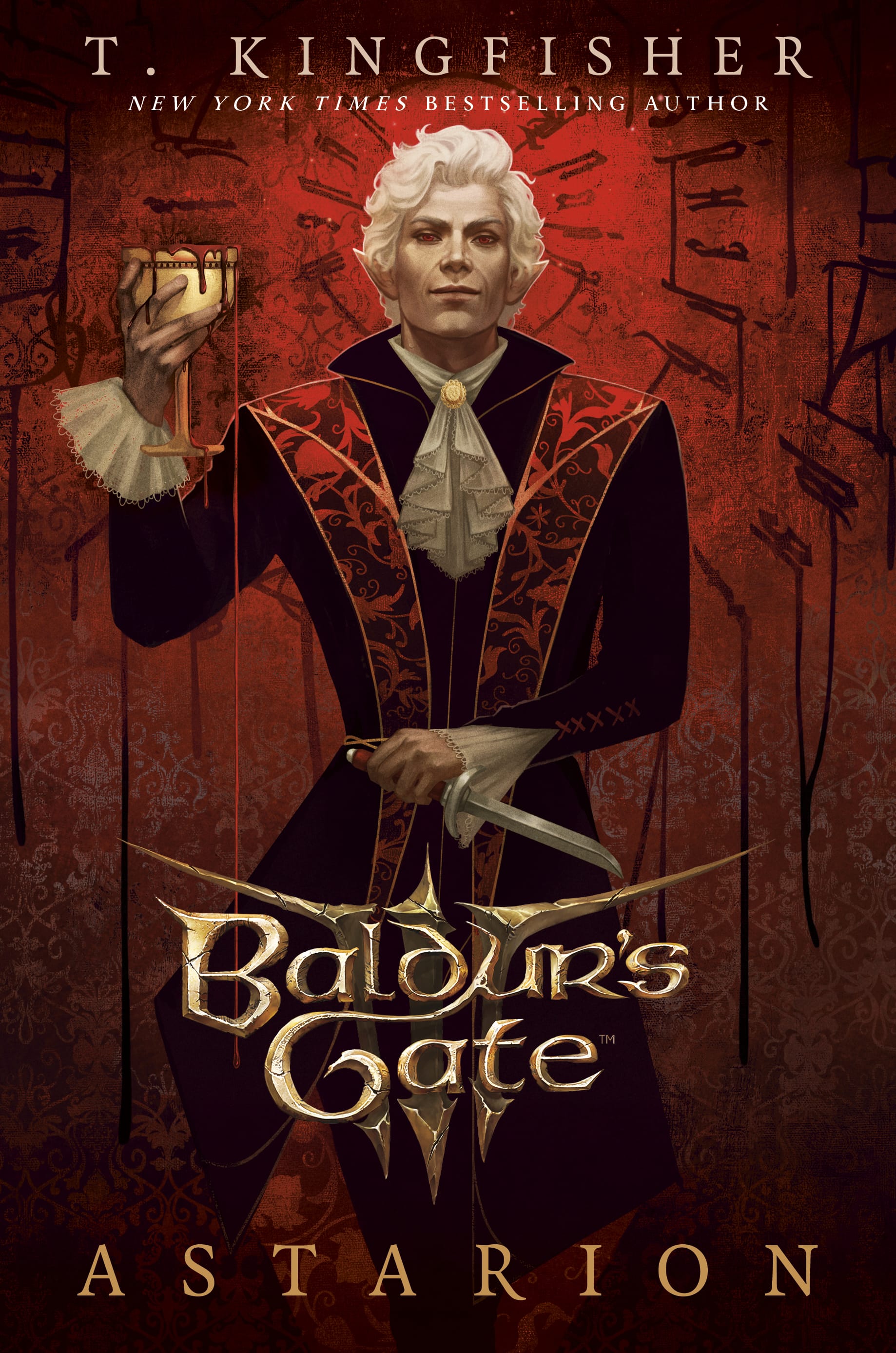
The book perfectly captures Astarion’s voice, and refuses to talk down to the audience through trauma, pain, and the small light of hope.

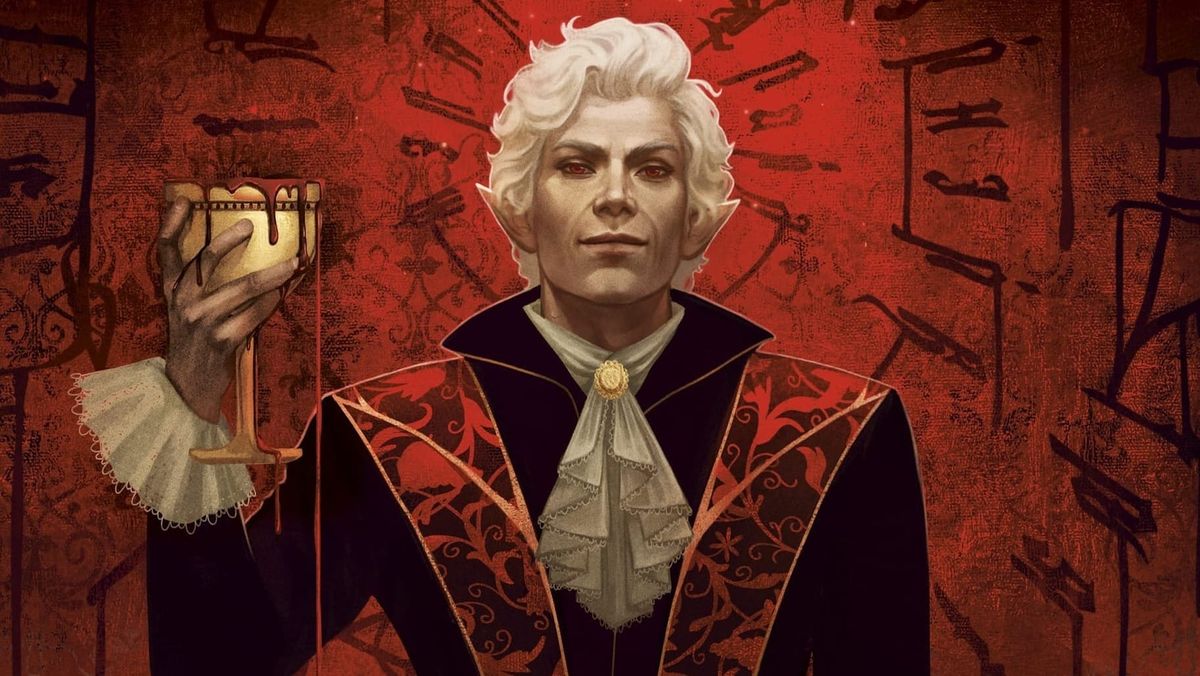
I remember when I fell in love with Astarion. It was in Act One of Baldur’s Gate 3, and we were just about to cross a bridge from the village into another part of the woods where the Goblin Camp is located, and we came across an exsanguinated boar. Two puncture holes in its neck, no sign of a struggle, and when I push Astarion for more information he mentions that it’s clearly the work of a vampire and he didn’t want to worry me — he’ll keep watch tonight.
This man, I thought to myself, absolutely delighted, thinks I’m an idiot. I wonder if he’ll lie to me the entire game? I don’t know why this was doing it for me — probably because every other companion was either absurdly sincere (Wyll, Karlach, Halsin, even Lae’zel) or so wrapped up in being withholding and mysterious (Gale, Shadowheart) that I was interested in a different flavor of manipulative. At least Astarion was a fun character to apply pressure to. Sadly, he comes clean pretty soon after that, but I remember thinking… yeah, I want this piece of shit on my side in any fight.
I’ve blogged a few times about my (mis)adventures in Faerûn, so when it was announced earlier this year that there was going to be an Astarion prequel novel, I was immediately excited and was, in the same breath, immediately worried. Astarion, as a character, has a lot of nuance, no matter how you interact with him; he’s both a victim and perpetrator of sexual assault, “approves” of cruelty and lying, and feels entitled to wield power over others. He can be redeemed… sort of, but as a character, he is selfish, traumatized, angry, and desperate for someone to want him, even if that desire is artificial. And the novel takes place before his redemption arc in Baldur’s Gate 3 happens, when he learns that despite all the shit that’s happened to him, personally, there are still good people who want to help him.
But I took another look, saw that T. Kingfisher had been tapped to pen the novel and all my concerns disappeared like bats in the night. Kingfisher’s work has long been on my auto-read list; earlier in the year I had finished another book of hers — Daggerbound — and if you can’t find a single book on her long list of novels across multiple genres that grabs your attention, I’m sorry that you have so little taste. From the melancholic The Fall of the House of Usher-inspired Sworn Soldier cycle, to her fantasy comedies (Nine Goblins), her romances (Paladin’s Grace) to her straight up horror novels (A House With Good Bones and The Twisted Ones — a book that heavily inspired my own novel!), Kingfisher is the kind of author that I love to see on my shelves and in my emails.
So I cackled like a witch at dusk when I was presented with the offer to interview Kingfisher (sorry to Lauren, the PR rep, who had to deal with me). I met up with the author at the nearly-concluded World Con Los Angeles. It’s the middle of a heatwave. It might be called LACon but it’s actually in Anaheim — twenty miles and 40-80 minutes away. When you exit the convention center you see the facade of Disneyland’s Whatever Mountain and if you walk too close you feel the spray from the Obligatory Water Ride. It’s also Monday afternoon — the last day of the con, and fresh off the Hugos the previous night where Ursula Vernon — T. Kingfisher is a pen name — was the Guest of Honor and toastmaster. She’s had a long night and a longer weekend and still, when she shows up to talk to me she’s not tired of talking yet.
I ask an off the record question and she answers before I even finish asking. We’re off to a great start. I was warned before my interview — in a serendipitous run in with Kingfisher’s assistant/husband/chief chicken wrangler/Game Master, Kevin earlier in the con — not to ask stupid questions. I did my best, but I still had to start off with a familiar one. Why Astarion?
“He’s funny,” Kingfisher said, laughing. “It’s the voice. He’s going through several terrible things at once, but at least he’s funny about it.” Kingfisher’s books are full of clever, funny, quippy characters who alternate between making pragmatic observations of the world and then delivering devastating reads through crossed swords. Kingfisher brings that same wit to Astarion, and absolutely lives up to the writing Larian gave us in the game. “I would listen to like… five minutes of Astarion line compilations on YouTube to get his voice in my head again. He’s just fun.” Niel Newbon’s voice was ringing in my ears as I read this book, so even if you don’t pick up the audiobook (narrated by Newbon himself) fans of the game will definitely be able to hear Astarion in their heads. It was remarkably well done, and so impressive that at every turn I felt like this was an extension of Astarion, a story that fit neatly, even seamlessly, into the two-hundred years before the game begins.
The novel flits in between Astarion’s childhood and an adventure from his time as Cazador’s spawn — set somewhere in between the year he spent buried alive and the night that Cazador carved infernal onto his back. When Cazador sets out a cut-throat competition for his spawn, Astarion is drawn into a classic fetch quest where he must infiltrate the cult of Mask, god of thieves and shadows, in order to steal a vial or two of his still-fresh blood. “Whomst among us hasn’t had a fetch quest gone wrong,” Kingfisher commiserated. When asked how she decided on this story Kingfisher noted that the “unromantic” answer was that “it was the plotline we brainstormed while on the phone. The one thing I was firm on was that we can’t have it all in the palace with him sitting around getting tortured because that will get really old really quick.”
"I can see a scenario in which Astarion runs into a burning building full of orphans... but only if he was getting paid for every orphan."
When I asked about collaborating with Wizards of the Coast, Kingfisher said that “the relationship between [me and Wizards of the Coast] was really good!” She’s had friends who have done IP work for other companies before and related how it often seemed like a "straightjacket" on their creative process. But Wizards was “much less restrictive” than she expected, and she spoke highly of their partnership, and they were “wide open” to whatever she wanted to do. But… she still had to contend with D&D’s… extensive lore.
Like vampire fangs. She wanted them to retract. “I looked through so many manuals to figure out the fangs.” It didn’t make sense for Astarion and the other spawn to be walking around with red eyes and bare fangs — someone was bound to get wise. “Eventually I found an article in Dragon magazine from the ‘90s that said vampire fangs in D&D were retractable and the lore hadn’t been retracted at any point.” A loophole. Tricksy, Kingfisher.
“The other question I had was about whether or not a vampire’s clothes cast reflections,” she said. While it made sense to her if the vampire’s invisibility would affect clothes, like an invisibility spell, she still had to check with the powers that be. “The WotC rep came back a few days later and said there’s no ruling on this… so you get to decide.” And Kingfisher decided that a vampire’s invisibility did not affect their clothing, and did this mostly because there’s a devastating scene in the first third where Astarion watches a mask in a reflection and sees nothing at all. When you get to it you’ll know and you’ll wish that Wizards had told Kingfisher that it all turned invisible.
Beyond just the thousand different D&D editions and rules, Baldur’s Gate 3 is occasionally out of alignment with the official lore. For example, “Astarion makes a Strahd joke—” Baron Richter von Strahd, Vampire Lord of Ravenloft, for the uninitiated— “if you click him often enough. So, I wrote a Strahd joke in the novel, and the Wizards rep responded.” They didn’t know whether or not Astarion would know if Strahd actually exists. Kingfisher looked wounded when she described that he said in the game… “Eventually I was allowed to keep it if I made a note to the effect of… but he didn’t even know if the legendary vampire existed.”
Strahd is technically in the SRD. I’m sure Kingfisher could get away with a Strahd tie-in if she really wanted to. I don’t mention this.
“My favorite edit — which was leaning into LitRPG — I had a line that was ‘don’t think of it as ‘Detect Evil’ think of it as ‘Detect Incompatible Moral System’ and the Wizards rep told me, they laughed, they thought it was funny, and then said that we can’t have Astarion say the names of spells out loud.” But, all in all, “it was remarkably easy.”
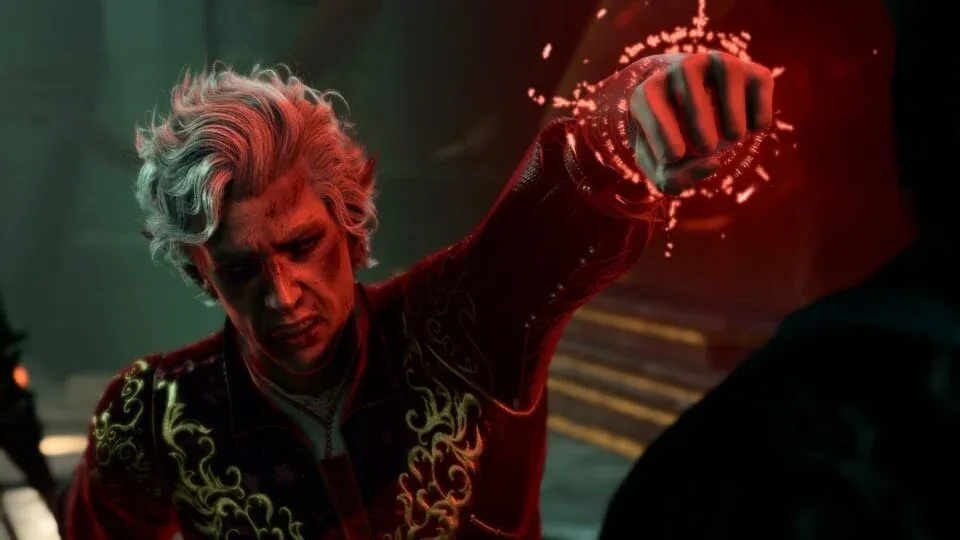
Although I would have loved to see Astarion whip out a THAC0 table mid-fight, this book takes D&D lore and understandings very seriously without veering into absolute absurdity or LitRPG-style mechanics. The first moment I noticed it was when Astarion was remembering dying – the first time – and wondered if any of his friends would be able to pay for revivification, before realizing he didn’t have any friends, and most of the people who were madly in love with him were poets. “They could barely afford wine, let alone dragging someone back from the dead.” Again — this is relatively funny if you know nothing about D&D, is very funny if you know anything about D&D, and hilarious if you played Baldur’s Gate 3 for any amount of time.
Kingfisher, throughout the entire novel, manages to balance this kind of lore and humor with an entirely even hand. Sure, the paladin that appears halfway through the book says “lay on hands,” but even without the D&D of it all readers can certainly understand the dire nature — and inherent comedy — of a holy warrior attempting to heal an undead fiend. It’s an adroit blend of the kind of narrative seriousness D&D clearly wants to espouse within its many pages and the fact that playing D&D is very fucking goofy. “I can be serious for about the length of a short story,” Kingfisher lamented. Besides, Baldur’s Gate 3, as Kingfisher pointed out, has a ton of goofy moments. “I’ve never laughed so hard as when I pissed off the Djinn in Act 3 and was turned into a wheel of cheese.”
While she might say she can’t be serious, Astarion tackles serious topics with a lot of sensitivity. While there has been… let’s call it fervor online relating to Kingfisher’s portrayal of the eponymous vampire, I thought that she was able to balance his survivorship, victimhood, and general bastardish behavior incredibly well. Although there was a lot said and a lot more implied about the level of abuse that Astarion suffered, Kingfished depicted just enough torture and sexual assault on the page to remind the viewer that this man has been through hell. Serious topics by anyone’s measure. “There’s an unfortunate narrative happening that you need to be a perfect victim,” Kingfisher said. “I think that’s bullshit.”
Kingfisher wanted to be sensitive about the fact that he is a constant victim of sexual assault and has in effect been forced into prostitution. But with some rules: “I deliberately shied away from depicting sex with Cazador. We leaned very heavily on the sexual exploitation and torture — which is all bad. But if I had written [a sex scene between Cazador and Astarion] I think it would have gotten sufficiently skin crawling to the point where I would not have been able to suggest people read the book. I could have written it but I would not have wanted to read it.”
Kingfisher mentioned that they had a couple sensitivity readers to make sure that there wasn’t anything “jarringly off” about her depiction. Despite all of the assault he experiences, there is still a part of Astarion that utilizes sex as a tool. “It’s a part of his arsenal,” Kingfisher explained. Even though Astarion is experiencing sexual assault, he still wants to have control over himself and his sexuality. And while attempting this control over Cazador was off the table (with good reason), Kingfisher gave Astarion a hunky paladin to exploit.
Hanh den Suriel, a member of a group that’s like the Order of the Radiant Heart and who displays the standard of the Argent Badger, is bawdy and righteous. He’s a big beefy aasimar do-gooder and he gets put right in Astarion’s way when he needs him most and wants him the least. And, if you didn’t know, this isn’t Kingfisher’s first paladin. She’s writing an ongoing romantasy series — The Saint of Steel series — based on a whole company of them. She likes that “paladins are genuinely trying to be good people,” but is often annoyed that they’re portrayed as stuck up and tight assed. “The ones doing good are probably more lawful catholic than lawful good. The primary motivation isn’t righteousness, it’s guilt. And you can get a lot of mileage out of guilt.”
Den Suriel embodies “the idea that you are trying to do good for a cause higher than yourself and you are desperately aware of what a flawed human being you are,” which Kingfisher finds fascinating. “I hate how paladins are done in D&D — where you can fall at any time if you think about sin funny.” With den Suriel it’s established that he might be the last of his order, and that he’s lived a very, very long time, to the point where grief — and guilt — becomes a constant presence. “There’s something very human in realizing that you’ve lived too long and you’ve outlived your peers, family, and thinking that… nothing, not even [your oath], is worth it, and that’s a much more interesting way to become an oathbreaker.”
Throughout the book, den Suriel and Astarion have quite a few adventures in pursuit of the blood of Mask, and find themselves in… compromising positions. Their romance is short, sweet, and heartbreaking. The end of the book is absolutely devastating, but I will say that I enjoyed every second that den Suriel spent on the page, and his ending — alongside Astarion’s — cemented the book’s arc as a tragedy. "Den Suriel would have probably preferred death over the ending he got," Kingfisher said, "becoming an oathbreaker paladin over a guy he can’t save and won’t see again."
While Astarion grows as a person “to a certain extent,” Kingfisher said that he couldn’t really change all that much. “A redemption arc would feel weird. He’s self centered and amoral and has the perspective that, ‘if i’m doing it, it’s not wrong.’ I can see a scenario in which Astarion runs into a burning building full of orphans... but only if he was getting paid for every orphan,” Kingfisher explains. “I could have made him more of a bastard, but you have to be able to root for him too.”
This was one of the things I admired about the novel. Astarion is allowed to be cruel and vindictive, and he’s allowed to be hurt. “He’s not a good individual.” His redemption arc in Baldur’s Gate 3 is entirely contingent on whether or not the player makes certain choices. But ultimately he’s “still a bad guy who kills a lot of people” and, with only a few exceptions, doesn’t feel bad about it. Part of that is because without that compartmentalization he would lose all sense of himself. “Vampire brains heal themselves,” Kingfisher said, citing both a bit of D&D lore and the book, “or else they’d go mad within a few hundred years.” Guilt is reserved for the paladins.
“His big arc in the game is reclaiming his agency,” Kingfisher said. “His acts of rebellion in this book aren’t how he separates himself from Cazador, but instead, he says I know myself outside of Cazador’s control, I am doing things that he does not know about,” Kingfisher remarked. “The line he walks is always to remain just obedient enough so Cazador stays out of his head.”
For most of the book it works. But unlike a lot of Kingfisher’s other books, Astarion is a tragedy. “I think that one of the things about tragedies is that the ending is inevitable and you can see it coming. You know he’s not going to find true love and it’s going to go to hell.” Kingfisher couldn’t give him what he wanted, she couldn’t fix him, and she could only encourage a bit of character growth. She thinks of the book as missing its third act — which is, of course, where Baldur’s Gate 3 steps in to finish the character growth that this book begins to explore.
“If it wasn’t for the game I’d write a second book and at the end of that, [Astarion and den Suriel] either would be married in the feywilds somewhere, or they’d kill each other.” But that wasn’t going to happen. “It was rough for me,” Kingfisher admits. “I love a happy ending… the equivalent of a happy ending for Astarion was when he went to another spawn and said, ‘tell me this will be over one day,’ and her response was, ‘Yes. Everything dies, eventually’.”