Armageddon out of the Warhammer 40,000 coverage game
Final Liberation*

If you’re even slightly tuned in to the Games Workshop grapevine or you’ve walked into your FLGS in the past few days, you’re probably aware that the eleventh edition of Warhammer 40,000 has just been released in the form of the traditional Big Box**, titled Armageddon. You may also have noticed that Rascal has featured absolutely no coverage of it whatsoever. In fact, I’ve not written anything about Warhammer since November, and I’ve written about Dungeons & Dragons four times since then. This is mostly because we made the decision to remove minis games as one of the core offerings on the site, but even when we made that decision, I’d still planned to cover the new edition.
Writing about Warhammer has been my bread and butter since I started covering minis games professionally in 2022. In those four years, I’ve offered my considered opinions about every single new edition box across all flavours of Warhammer. Legions Imperialis did slip through the cracks though, so I present my mini review: Eh, it’s alright, but I will forever be mad that the Anti-Tank rule doesn’t make something better at shooting tanks, it makes it worse at shooting at everything else. My first article here was my impressions of the Age of Sigmar Skaventide box, which was rescued from the wreck of Dicebreaker (RIP).
What made me decide against it? I blame this guy.
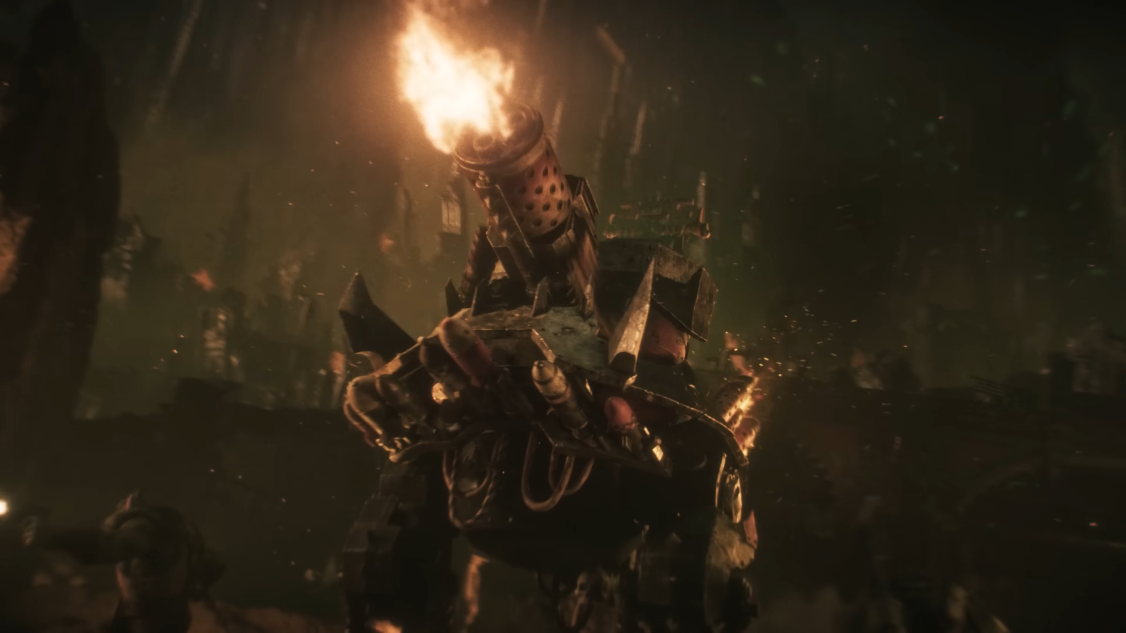
While GW doesn’t have a public release calendar, it does have a predictable schedule. The big summer release gets a reveal in March or April, followed by a couple of months of hype, then turns up in June or July. This is exactly what happened with Armageddon, except that rather than revealing the entire box at contents at once, GW made the baffling decision to drip-feed some of the new minis over the course of a month before doing a full unboxing. Armageddon continues the standard 40K pattern of having space marines arrayed against someone else. In this case, the someone else is orks, a 40K army that I love in theory, but have never felt the pull to collect. The Ork Enjoyers in my circles have assured me that the new minis are very nice and represent some much needed upgrades (and the brand new Big Mek Dakkarig is one of the coolest GW minis I’ve seen in ages) but it’s outside my wheelhouse. It’s the space marines I was looking at.
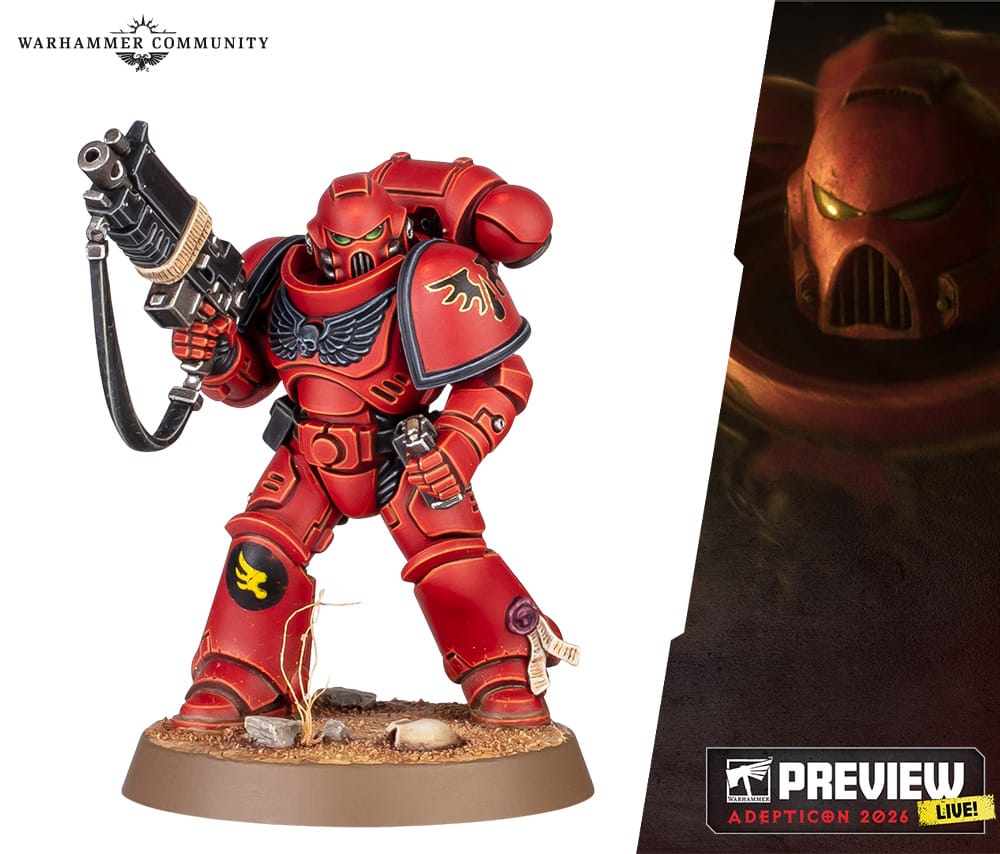
That space marine is the most boring miniature reveal imaginable.
It made me suddenly understand, on a deep, primal level, the folks who say all space marines look the same. For starters, he’s an Intercessor, the most basic of space marines. Space marine players, by and large, do not need more Intercessors, and the current kit is absolutely fine. Unlike the ork equivalent, this mini is not filling any kind of gap or providing an overdue update. He’s also the living embodiment of this Simpsons meme.

Except it’s not a new hat, it’s an old hat. To explain that, we have to dive into some 40K lore, both in and out of universe. Primaris space marines were a new kind of space marine introduced with 40K’s eighth edition in 2017. For a long time, Warhammer miniatures had been experiencing scale creep, which is to say that the average human mini was getting bigger. It’s not necessarily a huge issue unless your army contained a mix of brand new and much older minis, but it had reached the point where space marines, who are supposed to be eight foot genetically engineered super soldiers, were looking a bit small. GW could have opted to produce new versions of existing space marine units that were bigger and with better proportions, however it decided to come up with a story to explain the new wave of embiggened marines with new armor, new weapons and new vehicles, which, coincidentally, allowed it to produce an entirely new range of miniatures.
In the decade since, the Primaris range has expanded, while the older “Firstborn” marines have been phased out. The line between the two has also become increasingly blurred, especially with tenth edition and the release of new Terminator miniatures, which were just improved versions of the classic minis scaled appropriately to the Primaris range. Going into the eleventh edition of the game, the Firstborn have been almost entirely supplanted by Primaris marines, with only a handful of the old kits still available in the 40K range—and with Firstborn marines taking the starring role in The Horus Heresy instead.
But there’s a twist. One of the key features of the Imperium in 40K is that it struggles to make anything new. Very few people understand how any of the technology works. Almost everything dates back to the Horus Heresy ten thousand years previous, and even that is based on rugged frontier tech from the Dark Age of Technology. It’s an interstellar civilisation with a technological base that consists almost entirely of the equivalent of flat pack furniture, and even the experts only know how to read the instructions. Which they do while reciting prayers and anointing everything with holy unguents. Primaris marines and their gear sidestep this by being the result of a genius scientist tinkering for ten thousand years. But on the whole, space marines like their old relics and tend to replace damaged kit with existing parts, or bestow particularly revered components as rewards.
In terms of modelling, this was enabled by Primaris heads and pauldrons being easily swappable with existing Firstborn ones, and there were even some character minis or veteran squads released that had a smattering of Firstborn armor parts. The Intercessor shown alongside the Armageddon announcement has a Mark 7 helmet (Mk. 7 being the most common Firstborn armour pattern, the default from 40K’s second through to seventh editions). It is, quite literally, the same space marine with an old hat.The fact that it’s taken me, someone who has enjoyed space marines for over thirty years, four paragraphs to explain what makes that space marine different from minis that have been available for almost a decade, should tell you why I met that reveal with a resounding shrug. As the rest of the Armageddon box’s contents were slowly unveiled, I continued to be distinctly unimpressed. Don’t get me wrong, there’s nothing inherently bad about the new miniatures — the new land speeder is very cool — but even as someone who has only been sporadically acquiring Primaris space marines for the past five years, there’s nothing in that box that I need and nothing I want enough to pay £185 — of my money or Rascal’s — for. So I decided that I’d let Armageddon pass me by.
And oh boy did that feel liberating.Writing about games, no matter how much you love them, is a job. With Warhammer, particularly 40K, dominating the hobby, I’d felt obligated to write about it. That pressure is enough to suck the fun out of anything. Removing that obligation, deciding that I didn’t have to care about 40K, has actually reinvigorated my interest in the game. I’ve been reading the new rules in this edition, which are evolutionary rather than revolutionary, and they seem solid enough. In a week or so, I’m attending one of my semi-regular gatherings with internet chums, and with 11th edition being the hot new thing, I’m tempted to take down a modest 1000 point army and give the new rules a shot. A few weeks back I sorted out all of my unpainted miniatures and slung most of them into a big box which a friend is taking to the event so that they can be redistributed, freeing me of much of my backlog. I’ve done a spring clean of my hobby.
I like 40K. Much like D&D, it will always have a place in my heart even if it’s far from my favourite game these days. It’s a genuine pleasure to be able to engage with it on my own terms, rather than out of professional duty. I’ll probably play a handful of games over the next three years, and pick up the new Codexes for the armies that I own when they’re released. Does that mean I’m never going to write about it again? Not at all, if I have something interesting or insightful to say (or a massive rant to get off my chest) my words will find their way here as always. For the most part, however, I’m entering my casual Warhammer 40K fan era and I’m loving it.
*If you understand that reference, have a cookie. If you know why it’s technically wrong, you get two. Answers to the Rascal Discord.
**Look, I wrote the entire article without being smug about the fact that GW is including the core rules in a sensibly sized book! Aren’t you proud of me?