Queer games require queer structures
Defy the Gods makes good on its own epithet of “Queer Sword & Sorcery.”


On its cover, Defy the Gods by Chrys Sellers declares itself to be a game of “Queer Sword & Sorcery.” But what exactly makes a game “queer?” Queerness and “queering” textual readings have constantly been in flux as hegemonic resistance and queer desires have become more popular ways to analyze queer media beyond the study of queer characters within the text. Over the past ten years or so, a burgeoning academic study of queer games has attempted to establish how we can close-read tabletop games in order to examine how these texts encourage queer play. Designers such as Avery Alder (Monsterhearts, The Quiet Year) and scholars such as Dr. Persephone Berge, and Dr. Bo Ruberg have worked to refine a queer lens through which we can examine games. It is not enough that games include queerness in the characters and lore of their texts. Representation is good for the expansion of possibilities, but without supportive structures, the game only hints at the inclusion of queerness within the ritual circle, rather than queering the circle itself. Representation adds more seats to the game table; it does not set your place or invite you to sit down. At this point in the development of tabletop RPGs, identifying and including queer markers in the text is not enough to make any game “queer”.
Queer games, as argued by the experts cited above, include supportive, immersive, mechanical structures within various levels of engagement that actively encourage queer play. Alder spoke about what makes up a queerly-structured game at the Ann Arbor District Library Game Con in 2024. In order to create a queer game, the manifestations of power, decision-making, and the context in which those exist must encourage not only queer readings but actively embody how queer people navigate the real world. She identified five themes which a game could utilize to encourage queer play: fluidity and transition, roles and reversals, erasure and coding, absurdity, and collective character ownership. This is not a definitive list of what makes a game queer, but is, according to Alder, a good metric to use as a lens for critical queer readings of games.
Berge wrote in “Monster Power. Rebel Heart. Gay Sword.” that there are many ways in which queer games move beyond representation (called “cueing” in the article, based on the work of Tanja Sihvonen and Jaakko Stenros) in order to create structures that encourage queer play. She identified game mechanics like safety tools, modified health tracks (such as Conditions from Masks, and Ruin from Apocalypse Keys), and a resource-based relationship model (such as Strings from Monsterhearts) as methods for encouraging queer play. While these pieces can all be utilized within contemporary games that do not have an explicitly queer agenda, putting them inside a larger game framework that encourages resistance against larger powers creates many opportunities for anti-hegemonic movement within the game.
Alder explains in her Ann Arbor talk that game mechanics are political, as they determine the ways that power works in the game and give players the framework for change and agency within its narrative. More than that, I would argue that the way that players interact with rules is a form of cultural critique, where the adaptations that players make to the initial structures of the game creates a sense of ownership and reflexive political commentary on power and play. In order to create queer structures, the game has to set up a world that encourages a queering of the text and a queering of the rules within the play. There must be room at the table to write the rules yourself, and to take ownership of larger, high-level storytelling choices within the game.
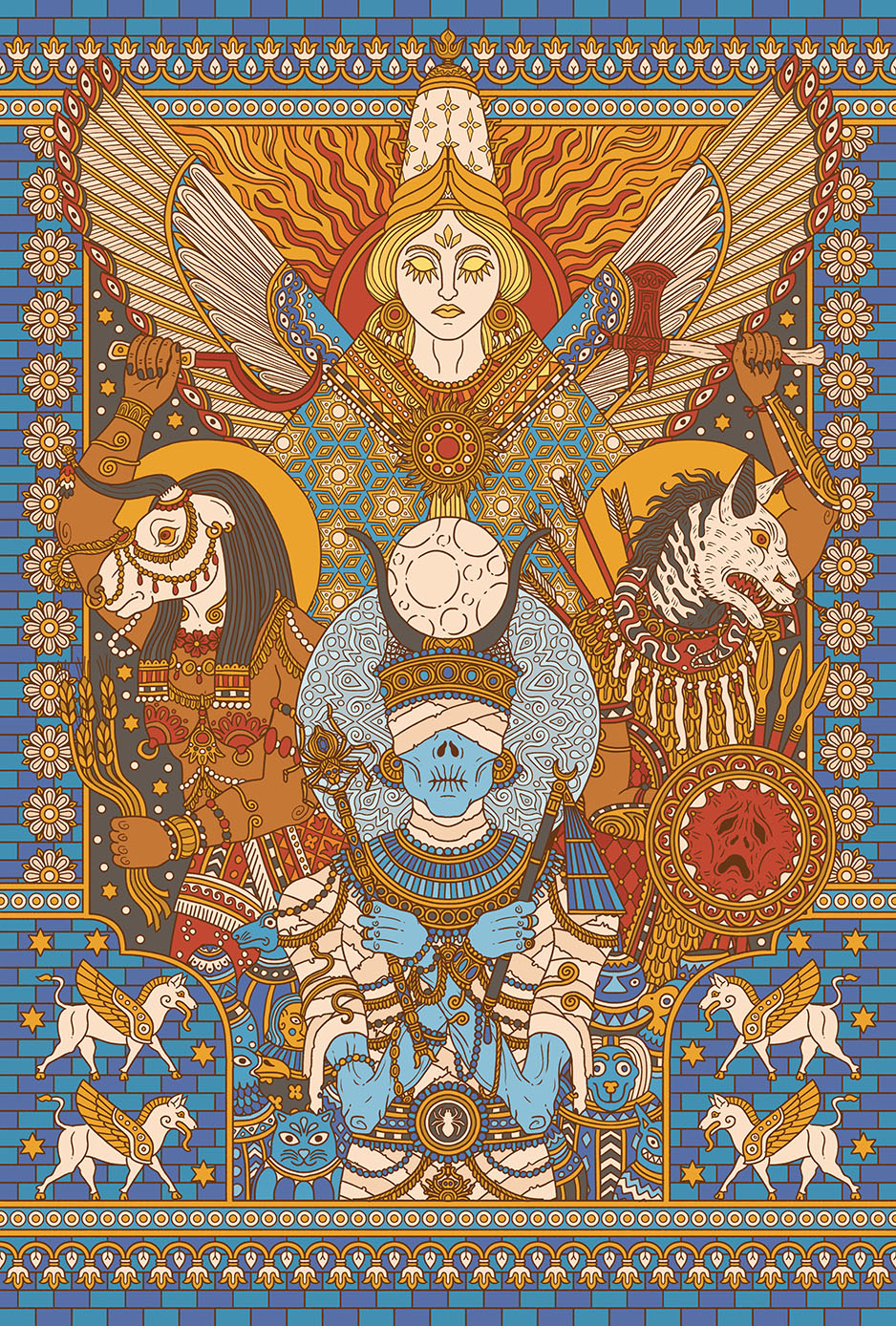
From the beginning, the premise of Defy the Gods sets up thresee player characters as antagonistic to the two hegemonic powers called the World Forces: the City, which oppresses them with laws that call into question their personhood; and the Pantheon, which seeks to consolidate power. Early in the game, Sellers asks players to “calibrate your oppression,” determining why the City and the Pantheon hate you. The three suggested levels are Deep Allegory (where you are hated for your differences, not your queerness), Thin Veil (where queerness has become a shorthand for differences, e.g. only queer people “dabble in sorcery”), and Out in the Open (where it is openly said that queerness is the driving factor in their hatred). When you create your City, you have to choose how the laws oppress you specifically (the City Watch comes into your neighborhoods and harasses you — this can obviously apply to many groups but is reminiscent of how queer enclaves were frequently targeted in major American cities in the 1970s and ‘80s), which provides constant tension when characters operate in the City. This hits on multiple points of Alder’s queer structural reading, asking players to determine coding and roles before ever picking up a character sheet.
Defy the Gods uses a Powered by the Apocalypse structure (including playbooks, 2d6 moves, and clocks), which is largely informed by the additions of Apocalypse Keys by Rae Nedjadi. Defy the Gods not only uses the mixed success common in PbtA games, but also utilizes burning success, which is where you roll so well that your great actions have consequences that blow back on you. The only pure success in Defy the Gods is when you roll between 8 and 10. When you roll an 11 or above, your burning success is likely to wound others, cause a new obstacle to present itself, or you accidentally fall in love with the character you were attempting to Entice. Most often you will be asked to mark Fire — a symbol of your pride and your hubris. Burn too bright, fill your Fire track, and the World Forces take notice. This is an inevitable result of a game that asks you to roll using additional statistics, and is thematically resonant with queerness; Speak too loud, fight too hard, make things too difficult for the World Powers… and eventually one of them will make it their mission to destroy you.
Drawing power from who you are and who you love
One of the unique parts of Defy the Gods is that it utilizes custom Epithets instead of statistics in any specific skill. They are “a phrase that reflects your adventurer’s values, principles, and reputation” and are unique to each character. Although each Playbook has suggested Epithets the game encourages players to materially adjust the Epithets, and essentially, the invocations of their characters to suit their own desires, which I read as a queer structure within the game.
Epithets can be wounded or improved, or (eventually) replaced with a Doom. Wounds modify Epithets and can be physical or emotional. You must protect who you are or you will be Wounded — there’s even a rule that, if fellow players (GM included) point out when you fail to live up to your Epithet, you could be Wounded. By asking players to treat Epithets as open to injury or enhanceable, non-static fixtures of yourself, Defy the Gods treats being true to one’s self as the highest possible calling. Berge writes that this kind of nontraditional harm is a queer reimagining of consequence and establishes a “confronting context for consensual pain,” within the game, and she quotes Ruberg when saying that these changes could force characters — and players — to “feel what they aren’t supposed to feel,” encouraging a “messy possibility” for the game.
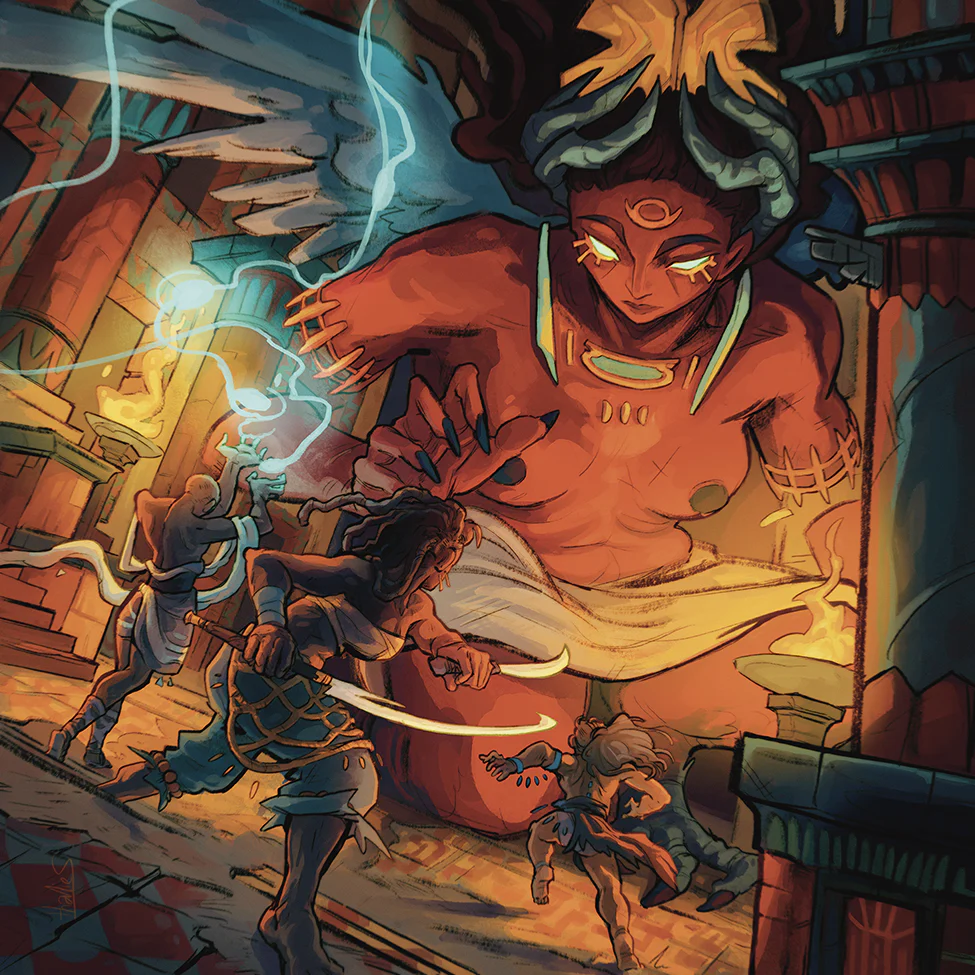
For characters to gain a Doom, they must first get a burning success on a “Defy the Gods” move, which is typically triggered after accumulating too much Fire (similar to Heat in Blades in the Dark). They replace an Epithet with a Doomed Epithet according to the Doom move they choose. This move allows them to invoke great power in the game; However, these moves and Epithets also represent a denial of self and an assimilation of the character into the possession of power at the expense of their own humanity. Berge writes in her analysis of PbtA games that Doom and Ruin mechanics often put characters in tension between protecting themselves and protecting those they love — inviting explicitly queer and transgender readings. As Doom moves utilize oppressive forces to keep the characters down, Doom gives characters access to the same horrors that the characters originally stood against: tyranny, sexual domination, and sacrificing others for the self. The only way to truly Doom yourself is to remove those parts that create community, empathy, and life — a clear analogy to queer lifestyles and the ways in which queer people have survived.
Much like Doom moves ask players to undermine and redefine the core parts of who they are, a Crisis occurs when all of a character’s Epithets have received a Wound, triggering an emotional, traumatic scene. These again call into question a character’s core abilities and invites them to rethink who they fundamentally are. Instead of changing an Epithet to something powerful and over-reaching, like a Doom move would require, a Crisis forces you to question what the community — what your friends — could possibly want with you. It is not just a personal failure, but it also results in a questioning where you belong. Queer people are in constant negotiations with their own communities, compromising responsibilities and obligations in ways that mix the personal and the political. A Crisis exploits the vulnerabilities that queer people feel when they fear losing these communities, or not being of use to their community.
Berge writes that Bonds — expressed in Defy the Gods as Heart — mechanically support a “queer world of social bonds filled with mutual empowerment, grief, love, and desire.” When a Characters gives a Heart away, it is indicative of their emotions towards the object of their affection. Love becomes a part of the game that each character must be generous with, as the only way to earn Hearts to spend is by receiving them from other people. Hearts are resources that can be spent to trigger moves (spend 1 Heart) or gain an Epithet (spend 4 Hearts). Desire, love, and attachments are shown to be vital parts of the game, built into both success and failure. Alder previously said that queer games should assert, re-assert, refine, and redefine relationships throughout play. As roles within the world and relationships to each other shift, queerness is invited in as people continually determine how Heart works within their own frameworks; is Heart a burning erotic love? Is it a belief in someone’s mission? Is it the faithful devotion to a God? Is it the sense of duty one feels to another, or (perhaps unwillingly) to an authority? When players are confronted with so many opportunities to make choices, the queerness becomes more and more apparent, as not every act of giving and spending Heart will be aligned with the authorities' hegemonically-approved exchanges of desire and loyalty.

Heart also allows for a rebellion against powers of authority by subverting the roles given to various antagonistic agents, which is an example of a theme that Alder states supports a queer game structure. By coming in and out of hiding within dangerous situations and using moves like Figure Out a Person, Entice, and Beseech a Force against antagonists and allies of the World Forces, the players are asked to deliberately blur the boundaries in between us and them. Because you can give an unlimited number of Heart, the game allows communities, sympathizers, and allies to grow expansively and naturally, through sincere connections made in the midst of deeply trying situations. Mechanically, Hearts are an obvious way that queerness is encouraged at the table.
Relationships reach their culmination when another character holds four Hearts from a single PC. The player holding the Hearts then bestows an Epithet on the person whose affection they have earned, as they have gained insight into who they are at their core, their very fundamental stuff. Intimacy as a way of understanding and knowing each other is a universal experience but also a common theme in queer media, especially when the social politics of same sex intimacy or the stigmas and potential harm that could come from unprotected sex make intimacy dangerous. Regardless, giving Hearts and receiving an Epithet is a fundamentally positive moment; Epithets are how you know yourself. They are how you keep going.
Inclusive definitions and collective mythology
All of Defy the Gods'Playbooks have clear queer analogies attached to them. The Revenant could be a trans allegory, as someone who has experienced rebirth, or had to move out of a toxic home in order to try to live again. You are a new person, and nobody is willing to recognize it. The Sailor is a playbook that transgresses loyalties and holds allegiances across physical boundaries. The assemblage of support and queer life is embodied in this Playbook, which draws strength from many discrete communities. The Vessel engages with BDSM culture, where the player is the submissive lover in a relationship with a dominant, minor god. Negotiating this relationship is key to this character, and Wounds are the ways in which they are able to draw on the power of the patron. The fluidity and care with which both the player and the GM must leverage this relationship is clearly drawn from kink communities, which have long existed parallel to, and intermingled with, the queer scene.
Within character creation there is also space to define both your gender and your body. Defy the Gods continually asks you to think and present in metaphor. In the Sorcerer playbook, suggestions for describing your gender include “an unread text,” “whispered secret,” and “possessed.” Body suggestions include “vast as the night sky,” “wishing to escape its confines,” and “part stone or wood.” All of these choices open the door for queer interpretations and invite them into the game, and while they could be metaphorical, they could also be very, extremely literal within the imaginations of Defy the Gods, encouraging, as Alder might say, an absurdist perspective of the characters. These definitions also allow characters to defy society, moving beyond norms in order to establish new roles, and fight against assumptive coding. Berge identifies these moments as prompting queer play through “disorienting” narrative possibility (they use examples from Sleepaway by Jay Dragon, but we can assert the same conclusions with Defy the Gods’ gender options) allowing people to play with their character’s own queerness while playing through the game itself — a queer mechanical structure within the text.
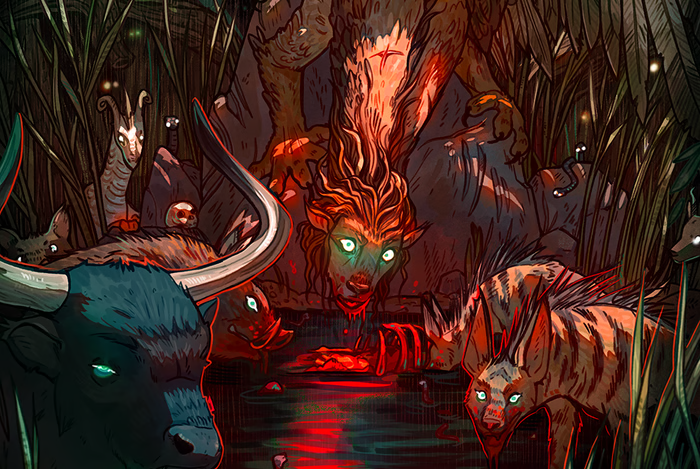
Looking at Defy the Gods’ moves, we can find similarly supportive queer structures. Often a burning success means that you have acted recklessly and with abandon, endangering the people and communities around you. In a few moves, such as Figure Out a Person and Entice, consequences include accidentally falling in love with the other person and giving them a Heart. The Entice move also invites another explicitly queer reading, where “a miss represents you flirting going awry in the worst possible way. You have transgressed a social boundary set by the Pantheon or the City’s Laws. The target of your enticement may take offense because they don’t expect your kind of person to be making eyes at them… However it happens, a World Force finds your actions abhorrent and its representatives make you pay for it… it will be bad.” It is very easy to layer this over queer experiences, where an expression of desire, or even looking at someone the wrong way, can be taken as a fundamental violation of the rules and laws that keep society orderly, neat, and lawful. In other games, such as Apocalypse World second edition, the consequences for similar moves like Seduce Someone are much less specific — it just says “prepare for the worst.” Even in Monsterhearts, which actively engages with the feral nature of teenage sexuality, the consequences for failing to Turn Someone On are covered by a general “the MC will likely introduce some unpleasant consequences.” While both of these moves obviously allow for a queer interaction, it is much clearer in Defy the Gods that you are meant to read a miss as an exchange between a queer person and a non-queer person going extremely poorly.
Defy the Gods also asks that players sometimes expand their scope of control, moving from individual characters to the World at large. They are asked to take on the role of the antagonistic forces, playing a World Scene in order to answer a question about the adventurers. Sellers writes that the game, and these scenes specifically, “makes explicit what our world often implies: the ultimate authority of all creation is actively opposed to your existence.” In addition to giving players the opportunity to shift roles (another hallmark of queer games, according to Alder), it also gives space for people to share what they want to see within their games and gives everyone a chance to negotiate themes and tone. It reminds me of a more specific, focused version of Idle Dreaming — a game mechanic in the system that Alder co-designed with Benjamin Rosenbaum, Belonging Outside Belonging — where players are asked to sit and ideate what might happen, how characters might act, and present possibility and a choice before committing to a singular course of action. In the same way, the World Scene not only offers possibilities and complications for the characters, but also reestablishes the hegemonic powers of authority and reaffirms what the players are fighting against, keeping the metaphor of systemic oppression ever-present in the minds of the players. I read the World Scene as extremely supportive of players taking the reins and queering the narrative, giving everyone at the table a support system for narrative control and the opportunity to change rules, roles, and direction as desired.
Unlike the more common implied representations of queer life and queer people within the text of a TTRPG, Defy the Gods demands you play it queerly, and the mechanics challenge players to constantly push against the hegemonic powers established during the first session in order to create new, expansive exchanges of intimacy. This trick is most clearly laid out in the Play to Find Out section that reminds the GM that the adventure and setting are “props and metaphors” for the relationships, interpersonal drama, and emotional arcs. The point of the game, Sellers writes, is to get all your players to love deeply, earnestly, sincerely, and queerly and then directly endanger those relationships, to give them ambitions and then “grind them down,” to threaten and even kill their loved ones. Even when everything is stacked against you, even when the authorities, the gods, the world itself wants to eradicate you and everything you love, Defy the Gods tells you, in no uncertain terms, that your power is inherent, that you are bigger than what they think of you, and that you can always rely on those you love to make you stronger. You know who did this to you. Now, fight back.