Asher’s Ridge puts you in the writer’s room of the next big paranormal hit
Embrace your inner David Lynch.

There are two distinct halves to Asher’s Ridge. The first is the paranormal happenings within the eponymous Asher’s Ridge, an outwardly mundane town that’s haunted by a history of inexplicable events. The other half is a television series bearing the same name, with players serving as writers for individual episodes — or a full-length series. This televised format is more than just flavor text, as the framing is baked into the core of the game. For instance, every session of Asher’s Ridge is encapsulated in a logline, which sums up what’s taking place as brief descriptions of the episode. The game, too, is structured like a television show, with cold opens and introductory scenes. What this means is that the game is largely GMless, even though a designated showrunner could take on more of the narrative weight if they prefer.
Designer Rori Montford shared that, while playtesting the earliest iterations of Asher’s Ridge, she realized that the characters she created in the game largely mirrored the dynamics of The X-Files’Fox Mulder and Twin Peak’s Dale Cooper. “The core concept of Asher’s Ridge emerged from two different game ideas and a lot of happy coincidences,” said Montford in an interview with Rascal. “I realized as I was play-designing that the parts that were most fun and satisfying for me weren't working for my original idea. I’d been listening to a lot of The Lovecraft Investigations and Sherlock & Co, so the idea of playing through a spooky mystery as investigating podcasters was also high in my thoughts.” Turning Asher’s Ridge into a GMless RPG, an element that Montford wanted to work into the game early, melds with the paranormal television approach, too. This is inspired by her own experiences as a game master; while Montford enjoyed running multi-year campaigns before, she pointed out that the preparation needed to facilitate these games no longer fits her increasingly busy schedules.
“GMless games (or any game that needs negligible prep to play) really fill a niche for me, especially if they're also designed for solo play,” she said. “I also love that whenever my group of friends get together and play a GMless game, I get to hear the most dramatic and out there ideas they all have. I love how free everyone feels when they can contribute to what's happening in the world and build upon each other's ideas.” At the same time, she believes that collaborative games also invite all players to be as involved in fleshing out the world and setting as they want, while eliminating the need for one person, as GM, to shoulder narrative responsibility themselves. This saw Montford characterizing Asher’s Ridge as “a very ‘me’ game”, with her design ethos guiding the distinct way its mystery plays out.
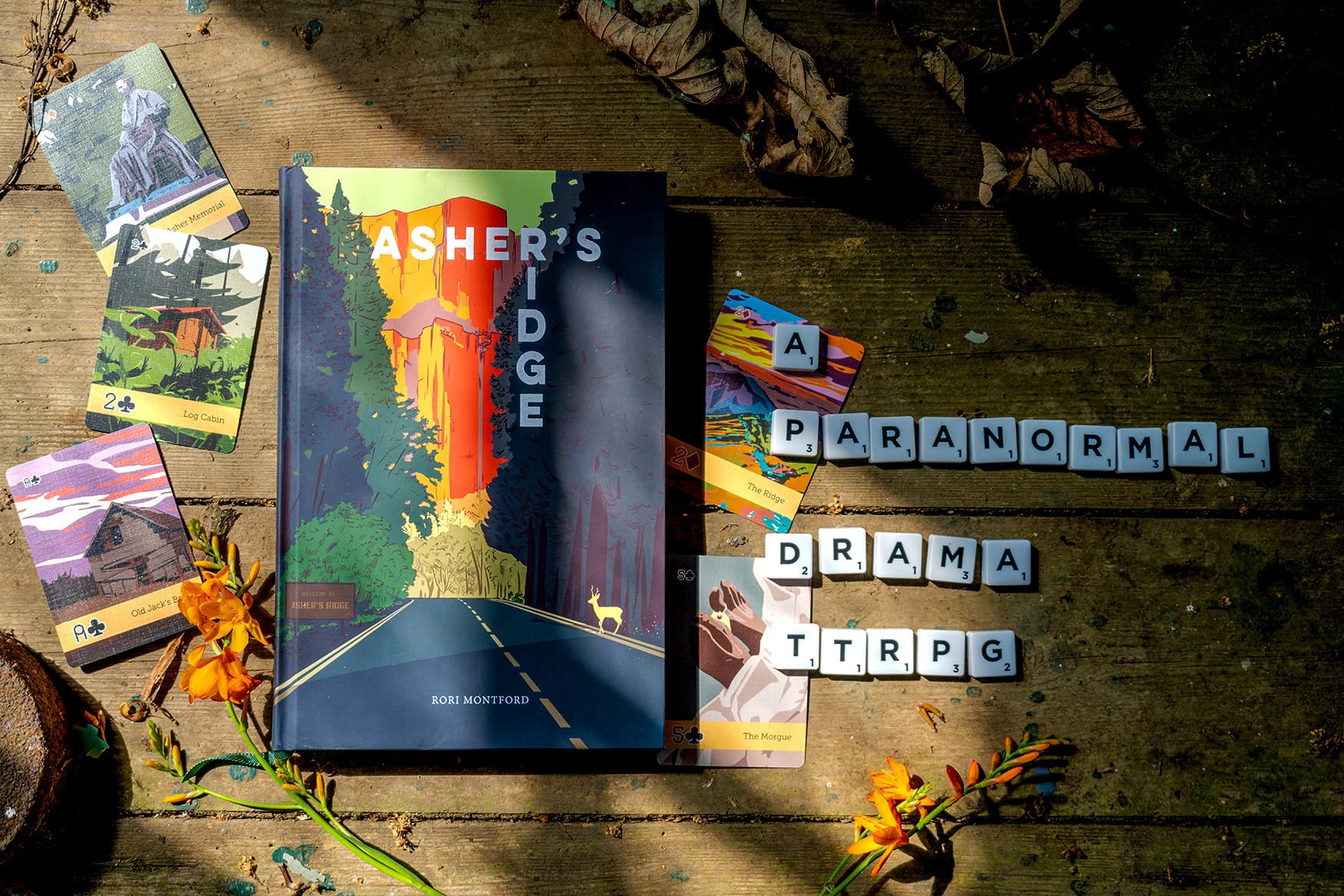
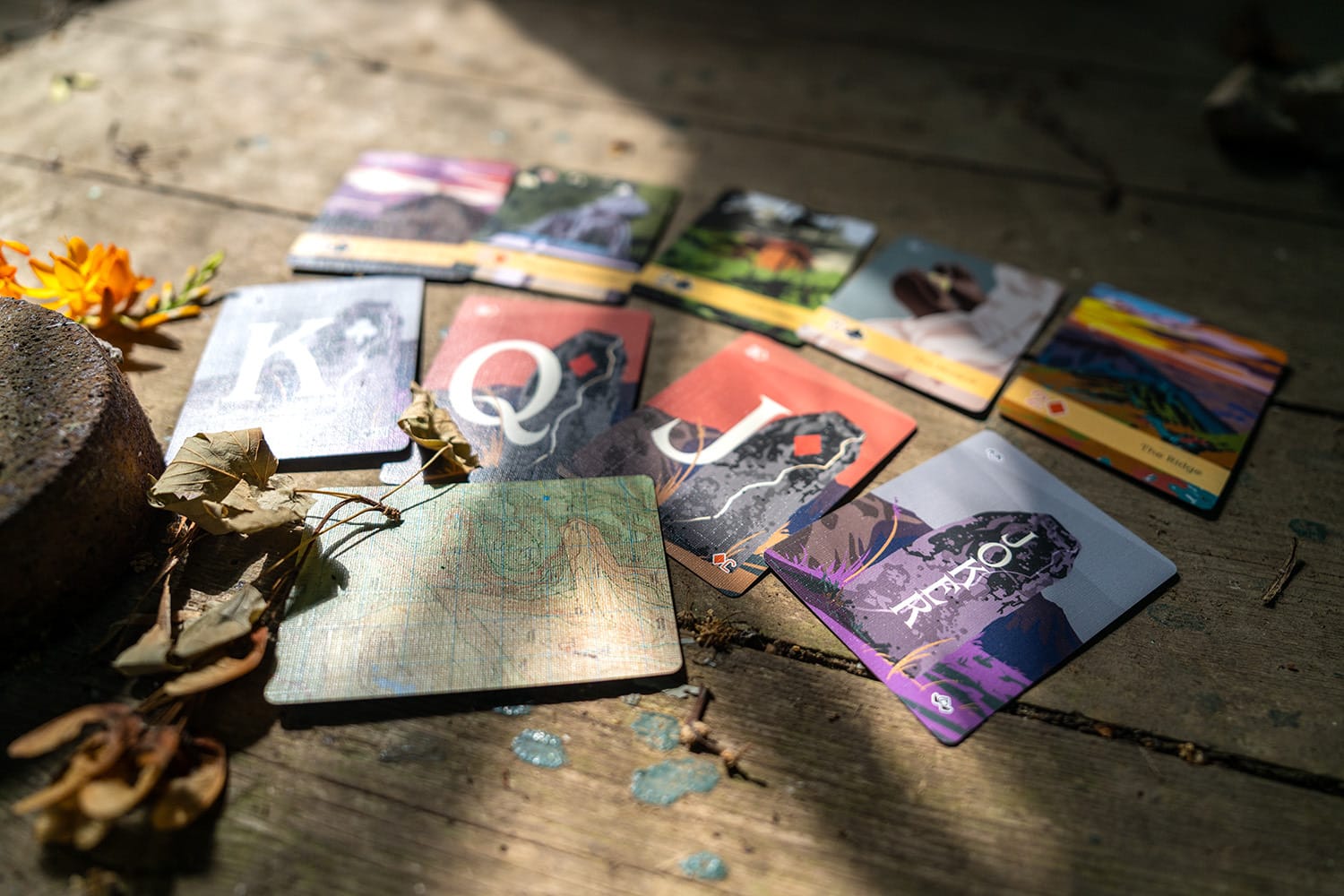
One of the most compelling aspects of Asher’s Ridge is the use of Scrabble-like letter tiles and playing cards as prompts to flesh out the plot of each episode, but without too much exposition that may hinder creativity of the players or dictate how the tale eventually pans out. Playing cards introduce both locations and risks — the latter representing the notion that a character may do something particularly risky (like the horror movie logic of a character investigating some disturbances in a dilapidated hut, alone). Risks and Locations are divided into two decks with their suits compared to determine the outcome of the encounter that the characters face. Embracing risks is essential for characters to grow however, with more letter tiles being added as the session pans out. This offers the opportunity for additional scenes to take place, allowing the attitudes of individual characters — the way they perceive and address events in Asher’s Ridge — to evolve, while representing the mounting dangers they face.
Montford’s experiences with prompt-based solo journaling RPGs deeply informed the design of her latest game. “One of my favorite things about solo RPGs is taking a prompt and figuring out how it fits into, or changes, the story I’m making,” she said. “Using Scrabble tiles was an interesting way for me to discover the minimum viable prompt. A word on its own was too little, but a word in the context of a location and other words you’ve drawn and connected it to felt exactly right. Using playing cards to represent locations meant the same place could be used multiple times.” We put Montford through the R7 wringer to find out more about this Twin Peaks-esque game.
Responses have been edited slightly for clarity.
1. If your game had walk-on music or a climactic needle drop, what song would it be?
I’m torn on this, but I think it would need to be something that begins in a quiet and understated way like “The Thrombey Family Theme” from Knives Out by Nathan Johnson, that evolves over the course of a few threads into a more confident and sassy “Dance of the Dream Man” from Twin Peaks by Angelo Badalamenti.
2. If your game grew like a plant, what was the seed of the whole thing? And what about you made you the right kind of soil to receive and nurture that idea?
The seed was nothing more than the desire to play out a mystery and delight and surprise myself with the conclusions I came to. I’m an impulsive puzzle/mystery/plot predictor, so I had no option but to see where it led!
3. If your game was food, what would it be?
I think the individual parts of Asher’s Ridge are deceptively simple, and it's the combination of it all that really makes the game sing. So, for that reason (plus being on holiday as I write this), I’m going to compare it to shopska salad. On the surface it's “just” cucumber, tomato, and sirene (a delicious, salty white cheese), but put it all together and it’s a delight.
4. If your game was a machine and we could break it down into parts, which is the smallest part that you think best captures the essence of what you're trying to do?
The idea of a logline to ground your episode, bring everyone onto the same page, and keep referring back to as you play. It’s the little blurb you get in the TV guide about a show, but it encompasses everything that’s about to happen next.
5. If we broke your game down into parts, what's the thing we wouldn't see? What do you think only emerges out of the entire thing moving together?
The choice of threads and how they’re connected together has such an effect on the story players tell together. It is an amazing feeling when you realise you have the letters available to completely flip the script on its head.
6. If your game had to commit a crime, what crime would it be?
One that would lead a crack team of detectives on a thrilling, multi-episode, manhunt before it vanishes through a door to elsewhere in the woods, with no-one being any the wiser about what exactly it did.
7. If your game was to win an Oscar, who would it thank in its acceptance speech?
My partner, son, extremely tolerant friends, and amazing art teachers. Plus my cat, who managed to restrain himself from getting covered in paint.