Ashcans, Playtesting, Conventions and God-Killer Prophecy
Design process and advice through the eyes of God-Killer Prophecy Oracle edition funding now.
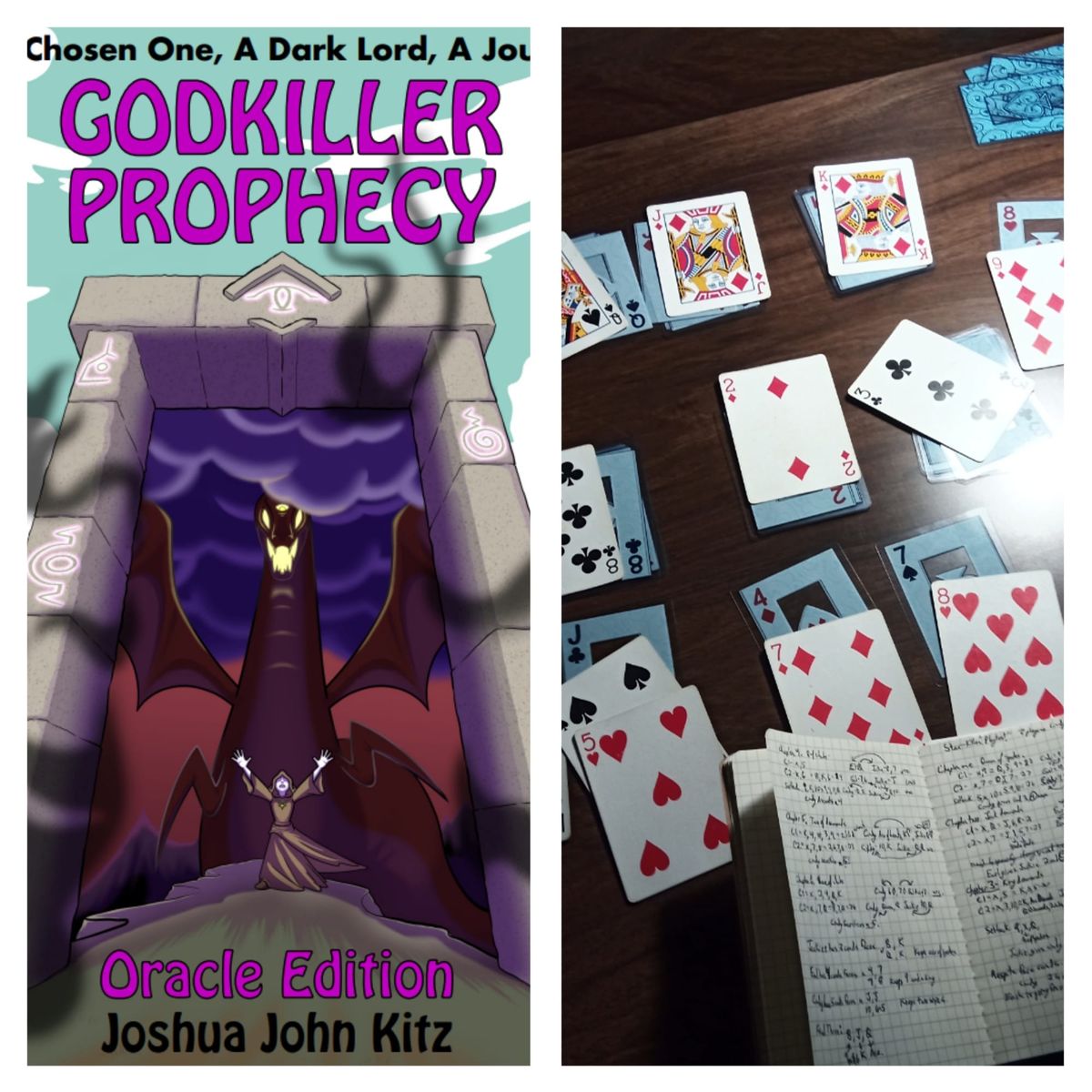
God-Killer Prophecy: Oracle Edition is funding on kickstarter now, ending October 31st. Naturally this has me reflecting on the design process and the many people who helped get it this far. So let’s examine the role that conventions, ashcans, and playtesting have in getting a game to market.
God-Killer Prophecy was created in response to two questions:
What did I miss most when playing one-shot story-games?
What was my favourite fantasy story that longer-form multiplayer RPGs were unsuited for?
The answer to the later was the high fantasy epic of a Chosen One on a quest to slay a dark lord. The answer to the former was the tension and strategy of striving to avoid failure (or rather striving for success). I had been tinkering for the past few years with playing card based mechanics and suddenly I found myself with a perfect concept where I could leverage all the strengths of cards.
Thus I found myself with a clear design goals, and immediately brainstormed up a rough playtest document and experimented with the card mechanics myself. This first version was playtested with some canny gamers at a pick-up session at CanGames 2023 (Ottawa, Canada – the oldest game con in Canada). Players included Chris Challice, the designer of Vanagard, one of the mechanical inspirations for GKP. We had four players. There were some rough bits but the core was solid, and the kind of story we created and the tension at the table (while not quite realized) was exactly what I hoped.
One of the challenges of playtesting RPGs is that the right group can have fun with anything. The important questions are therefor: did this specific piece produce the type of result you designed it too? Can that piece be improved? Can it be made more reliable across play groups? Do the pieces combine into the intended experience?
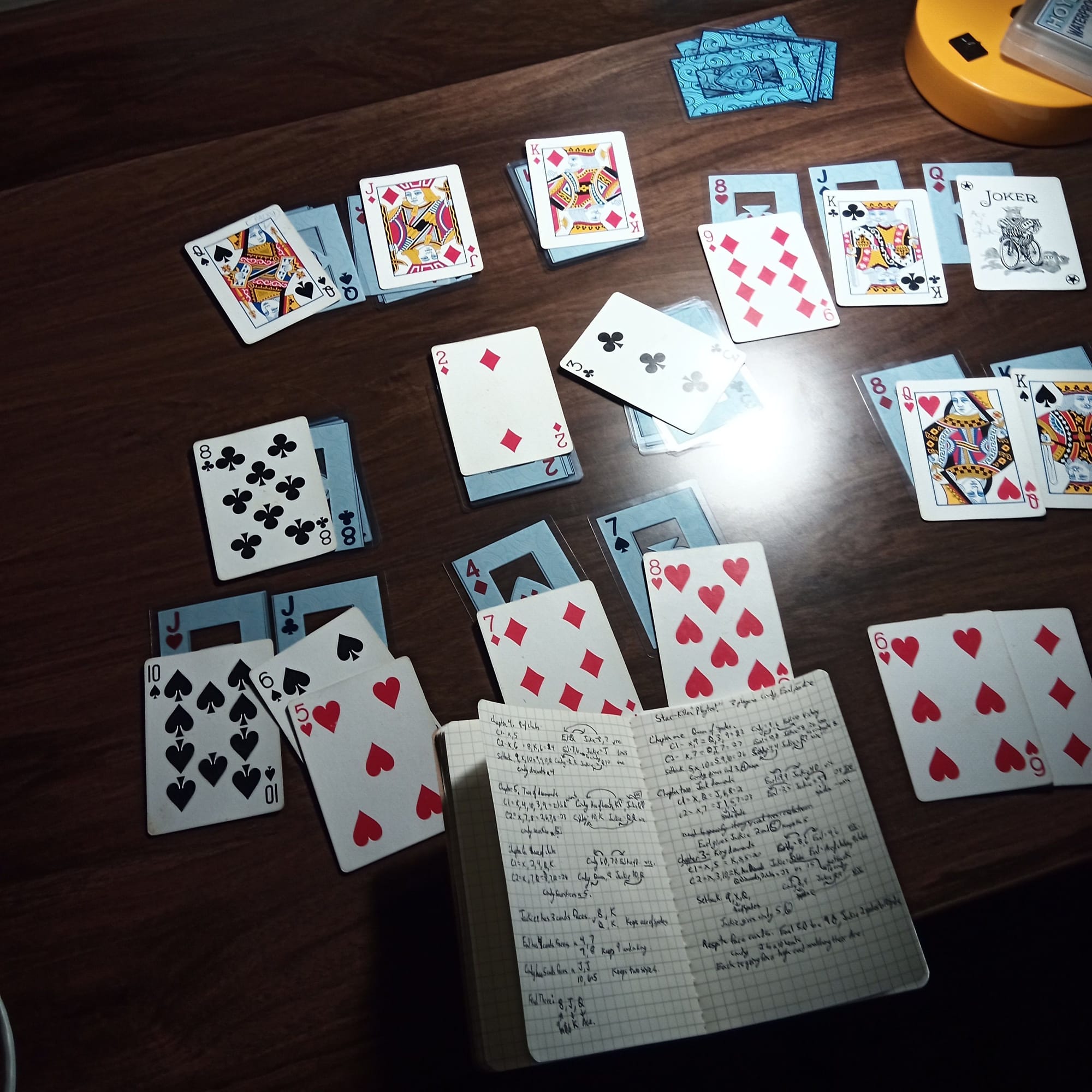
With these questions in mind, I revised and expanded the prompts and procedures in the playtest document. My parents were recruited to play through a couple games with only the card mechanics. Some aspects of resetting the deck and special cards were refined. This led to the an ashcan edition of GKP.
Ashcan editions were popular in the naughts and early 10s. They are a playable version of the game that you could show off and maybe even sell at conventions. These helps you showcase your game, get feedback and experiment with how to present and talk about your game. All of my (Compose Dream Games) titles have had some kind of print ashcan.
God-Killer Prophecy Augury Edition was a home printed zine with hand drawn and hand-written covers. This suited a game that featured illustrating or map-drawing as a key part of play. Since each cover was unique, most had slightly different tag lines as well. This gave me a chance to experiment with what would appeal more to people.
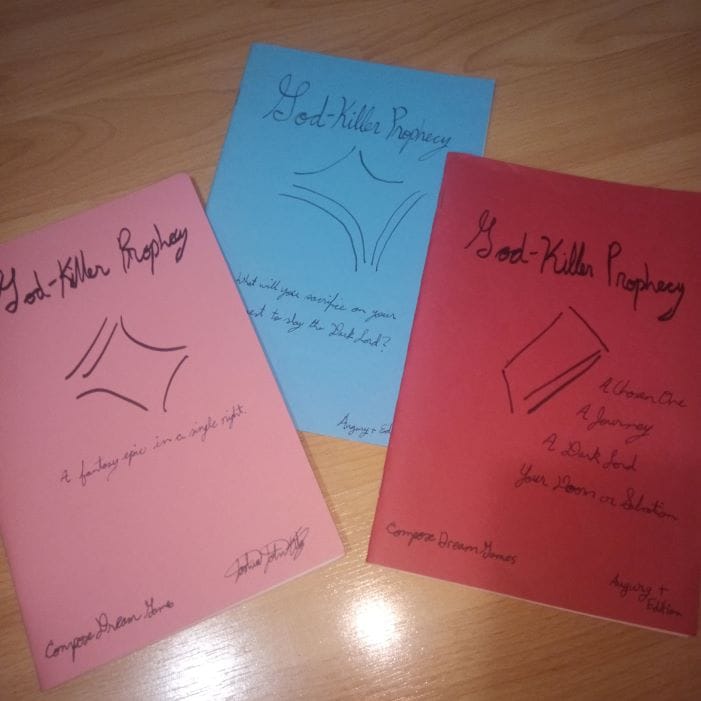
The Augury Edition was put together just in time for Phantasm 2023 (Peterborough, ON). Copies were for sale at the Compose Dream Games Marketplace booth, and I ran a game session. The game session was stupendous and many fine gamers picked up copies. Players included Nick Gralewicz, Giles, and Eric Palermo. Nick had yet to release HOME Mech x Kaiju a game with some similar conceits (map drawing, escalating threats), and Eric Palermo’s art will now grace the final pages of the upcoming Oracle edition.
Several months passed, local games were run and a cleaner more refined version of GKP, now called the Augury+ edition, was prepared for Breakout Con 2024 (Toronto, ON). At Breakout a 3 player game with James Kerr, and Eric Palermo took place. This time our chosen one slew the dark god but it was a near thing!
Eventually a few question prompts were tweaked and a companion character replaced with a more suitable archetype. This became the Augury ++ edition, made available at UK Games Expo, Tabletop Scotland and Essen Spiel.
And with that, I put the game to bed for a while to let it rest and mature. Feedback trickled in, and I worked on other projects so that when I came back to it I would have fresh eyes.
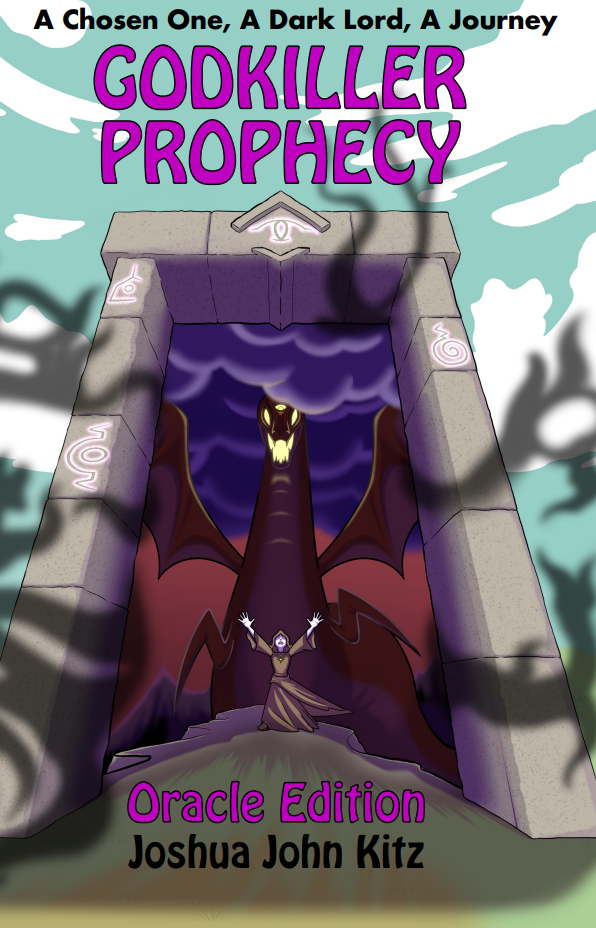
Perhaps the true re-emergence of GKP is due to Eric Palermo, this fine gentleman was determined that GKP deserved a proper cover, interior art, and print run. As art from Eric came in, I determined that another session must be played! And in February 2026, the National Capital Roleplayers stepped up to the plate. A 5 player game was held, including Giles who first played at Phantasm and was keen to give it another go. And . . . I immediately realized that I needed a much better presented “Oracle Procedure Sheet” the main spread that you hand around during play. If it hadn’t been both a 5 player game and over a year since I ran the game I may not have realized this!
A game at Tabletop Scotland 2026 was meant to occur while the kickstarter was running, but due to both a kickstarter bug, and a basement flood, this game took place before launch. The TTS game had 5 excellent players, some who had never played a GMless game before. It was also the first time in a long time that I played the Chosen One. It was exactly the type of game session that GKP is meant to produce. The players warmed up to illustrating things on the chapter cards, and to having a different player assume the GM-like 'Oracle' role each chapter. The tension in the last couple chapters and in the final battle was exquisite.
This game including the illustrations has been memorialized in the video promoting the kickstarter. Thanks to the players at TTS!
Core Advice
Shall we conclude and distill down this journey into core bits of advice?
a) Playtest early and focus on whether a specific mechanic or procedure produces the kind of experience you desired (and communicated).
b) Consider creating an Ashcan version; something you can show off and hone your skills of how you present, write and talk about your game.
c) Leverage local roleplaying games and conventions to let you run games for a mix of experience levels and preferred rp paradigms.
d) Revise, improve, and as some point let it rest. Work on something else and come back to it. Like all the best food games take time to mature, time to reach the perfect flavour pallet.
e) With luck you’ll find people along the way who love your game and will help it to succeed. Cultivate these folks if you can.
What we do is always the result of many contributions, both large and known and small and unrecognized.
If you played a game with me at any time in my life, it influence God-Killer. If you designed a game I played, or wrote one that influenced a game that I played, it influenced this. If you once volunteered at a convention, or organized a local roleplaying group, you have contributed. Heck if you wrote a song, made some food, paved a road, or said hello with cheer, then you have contributed. Each day we build on what came before, each day we strive to make life better. Today I wrote this, I hope it and God-Killer Prophecy should you ever read or play it will make your life brighter.
On this Thanksgiving day, I am thankful to all who build, and all who create, all who strive to make life better.
Joshua Kitz is the designer of God-Killer Prophecy, Fabrication: A Game that Makes Games, and Simple Superheroes #0. He runs Compose Dream Games Marketplace which sells and distributes RPGs in Canada and the UK. He also organized the Canada Roles Awards.