Before larp arrived, Australians had their own brand of freeform roleplaying
Wordplay, down under.

In the roleplaying world, “freeform” is a wriggly word. If you casually try to pin its meaning down, it’ll slip out of your grasp. Part of this is because, as Lizzie Stark wrote in an influential 2014 article, freeform “has several specific regional meanings.” Stark’s article is part of a long tradition of piecing together the squiggly history of what is a pretty common term in RPG circles.
Benjamin Laird, a researcher at Flinders University, believes that while there’s probably been some amount of parallel evolution of the word in different spaces, Australia might be one of the places of origin. Australian Freeform, as Laird refers to it, has a history dating back to at least 1982. These initial games were inspired by tabletop RPGs like Traveller but were designed to be played with a large number of people and some simple mechanics that didn’t need a GM to be present all the time. At that time, the word “larp” didn’t really mean anything in Australia. “Freeform” was instead used for a specific kind of larp — usually three hours long for convention play, pre-generated characters, mostly open-ended scenarios driven by social interactions. Basically, it’s what is called “parlor larp” in the American context.
Laird's talk begins at 49:24
Australian freeforms (lower-case freeform is a noun as in larp, upper-case for the name of the Tradition) flourished at regional gaming conventions alongside war games and tabletop RPGs. Because these events were usually organized by university-based clubs on large campuses, staff could spread them around so each type of game had its own space. Local designers kept writing new scenarios each year, experimenting with different ideas — and continue to do so. At Conquest in Melbourne or Phenomenon in Canberra, there’s always freeforms on the schedule. But the history and lineage of this thriving, creative, and diverse school of game design doesn’t have a lot of visibility, even in Australia.
Building off, among other things, a number of articles in gaming magazines (yay, games journalism), Laird is piecing together this history. He argues that at least the UK larping community, which has its own interesting trajectory, adopted the term “freeform” from Australia. The use of the word in Scandinavia and the US might have a completely different lineage because, as Stark also notes in her article, the term tends to have a more tabletop-adjacent implication in those countries.
Rascal sat down with Laird for an interview to discuss his work documenting this fascinating corner of gaming history.
(This is an excerpt of a longer interview that has been edited for clarity.)
***
Thomas Manuel: Can you tell me about your background and how you came to be working on this subject?
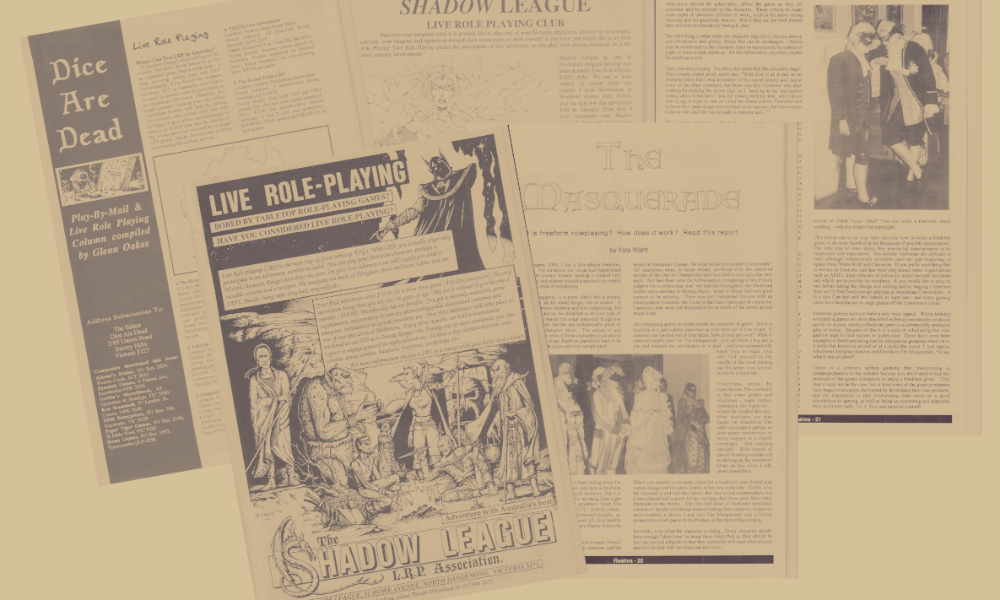
Benjamin Laird: I have been a tabletop gamer since the ‘80s, and then in 1989, I saw a GM Magazine article about live roleplaying in the UK, and I thought, this is what I want to do. I'm still quite young. A year later, I went to Conquest, and the Shadow League Live Role-Playing Club was there. I didn't join immediately, but then I joined the following year, started that form of live-action role-playing, and then simultaneously started playing freeforms. This was a period before the word ‘larp’ had arrived in Australia. I understood these two different forms as the live role-playing, which was foam weapons, fantasy, you dress up in costumes, you go to parks, or camp out for weekends, and then the freeform, which is very different. So that’s my gaming background.
My technical background is: I have a background in software engineering and computer science. I've worked as a software engineer. I also have a creative writing background, and my creative practice is poetry. And I continued with that to do a poetry PhD and then this project, the Australian Creative Histories and Futures project with AusStage as a post-doc, came up. With my arts background and my technical background, I got this role as both a creative arts researcher, but also a research software engineer. It's a combined role. So, I work on the actual AusStage database. And because my poetry background is interactive electronic poetry, and I also had this background in live-action role-playing, I went, there is a missing part of the puzzle here: this missing history of the [Australian] Freeform.
Manuel: Can you introduce what Australian Freeform is?
Laird: When I started researching the history, I thought I knew what it was. And as part of this, I returned to larping and joined a club in Melbourne. Then I started talking to the other players, and we realized that we couldn't actually define the [Australian] Freeform. Because it meant different things in different periods. In the very early stage, when it was first developing, it may have incorporated people creating their own characters. They were very large events, [and some of them] happened over multiple days. And then as we see it move through the ‘80s, it kind of solidifies to what we see today. And that is a game that almost always is run at conventions (but, as I discovered through my research, freeform clubs came up in the ‘80s.)
The first referenced freeform was in 1982 in OctoberCon run by the Canberra Wargames Society. I've messaged the people that ran the Freeform, but it's all a bit hazy… I'm hoping when I do interviews, I'll surface more of that, but I'm very much relying on ephemera at the moment. What is very clear, because this is documented a lot better, is La Sarten Volador, The Flying Frying Pan, in 1983. It was a Traveller-based Freeform, so it's based on the tabletop roleplaying game system, but with, I presume, a lighter version of those rules that allowed the players to have their characters move around their ship. I have the impression that, based on what Garth Nix has written, they could break off into their own groups and have these smaller games within this larger game. But it's not entirely clear.
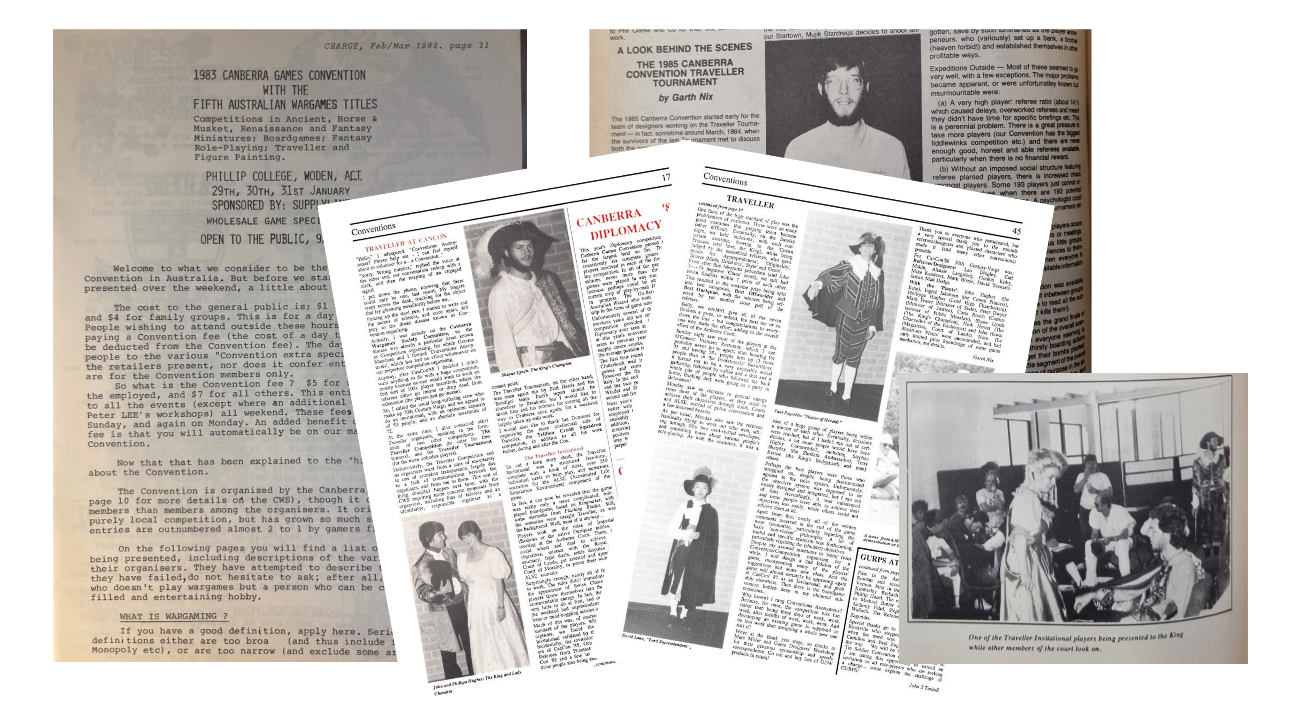
Manuel: This is the sci-fi/fantasy writer Garth Nix (Sabriel, the Seventh Tower series), right? What is his role?
Laird: He was one of the designers of those early Canberra games, so it was originally led by Peter Quinton, who [later] went overseas, and so Garth Nix and some others took over. What makes him a little bit more significant is that he wrote these pieces. There were a lot of other designers involved in the games that he ran, but he wrote about the experiences of running the games in a number of different issues of The Breakout gaming magazine.
Manuel: The sense I get is that these early Freeform designers were people who had discovered the tabletop versions of games like Traveller and AD&D and then invented larp versions of them.
Laird: That is the inspiration. The first freeforms were based on Traveller and AD&D, but then later people came up with their own ideas. Peter Quinton suggested in an email — and I don't know if this was a causal element — that Traveller was more popular than there were people running games in Canberra. So, if you ran a Traveller game, more people than you would expect would turn up. Was it a case of they couldn't get the ratios right? Or was it just that, by the early ‘80s — because we see this in other countries — people going: What's next? We've done tabletop role-playing games for however many years. What is the next logical thing to do? It's to stand up and start interacting with each other.
Manuel: Did these early games have mechanics in the tabletop sense?
Laird: I'm fairly certain the Traveler ones had mechanics, but maybe not the mechanics of the Traveler RPG, because Garth Nix says [in an article] that people didn't like the Freeform system. So, there was a system. Freeforms Unlimited, which is a club that started to arise in the late ‘80s, said in their materials that they play by the standard rules written by Robert Pryor. I found some later rules in one of the Freeform Convention handbooks, where Robert Pryor has a list of rules, including the fact that they have a skills-based system, they used a dice. They had special GM cards where you could spend a GM card to get a GM to come and do something. Then there's versions of AD&D where there's some limited combat rules where you roll a d20, and then you resolve it. So it really depends.
Manuel: Since you’ve played in these games, can you paint us a picture of what the later ones looked like?
Laird: Maybe I can reflect on two games. One from the ‘90s that I played, and then one from earlier this year. In the ‘90s, I played in a freeform called Toorak Heights. This was a freeform where all the characters were attempting to get cast in a soap opera called Toorak Heights. You got your character background, which described that you're an actor, all the different relationships you had with the other characters, and then they also handed out scripts. You had to remember your script, and then they “filmed” the scenes of this show, Toorak Heights, and when you weren't in a scene, you were interacting with the other characters — either just playing your characters, or trying to land a shot on this actual show by making sure that you talk to the right people and end up getting cast. So, that was a little bit of a different kind of freeform, where they were experimenting, but it was representative of what was happening in the ‘90s, where you started to get this diversity.
And a recent one was a Regency farce called Of Cards and Convenience, where my character had a terrible gambling history, and I was the second son. My brother had disappeared in a shipwreck, presumed dead, and so I was left to head up the family. But I had this lifestyle that meant that I was almost bankrupting everyone, and therefore, had to find someone rich to marry. That had an interesting mechanic, where you would dance with somebody in a set time. It would be timed, [so you had] three minutes to talk to that person, in order to find out more information about them, so that you could later on propose. And then running in the background, there were other plots, such as a highwayman, and some other political dealings that I wasn't really aware of until the debrief at the very end. But then I eventually find out that my brother was at the party — it's a masked ball. He had amnesia, we found a bag of money so we're rich again, and even though I made a proposal to someone that was apparently poor, it turns out that she was actually going to inherit all this money from the grandfather, who'd only disowned her parents, and so on.
Manuel: In your talk at Generation Analog, you mentioned that you believe that the word freeform propagated from Australia into the wider gaming lexicon. What’s that idea based on?
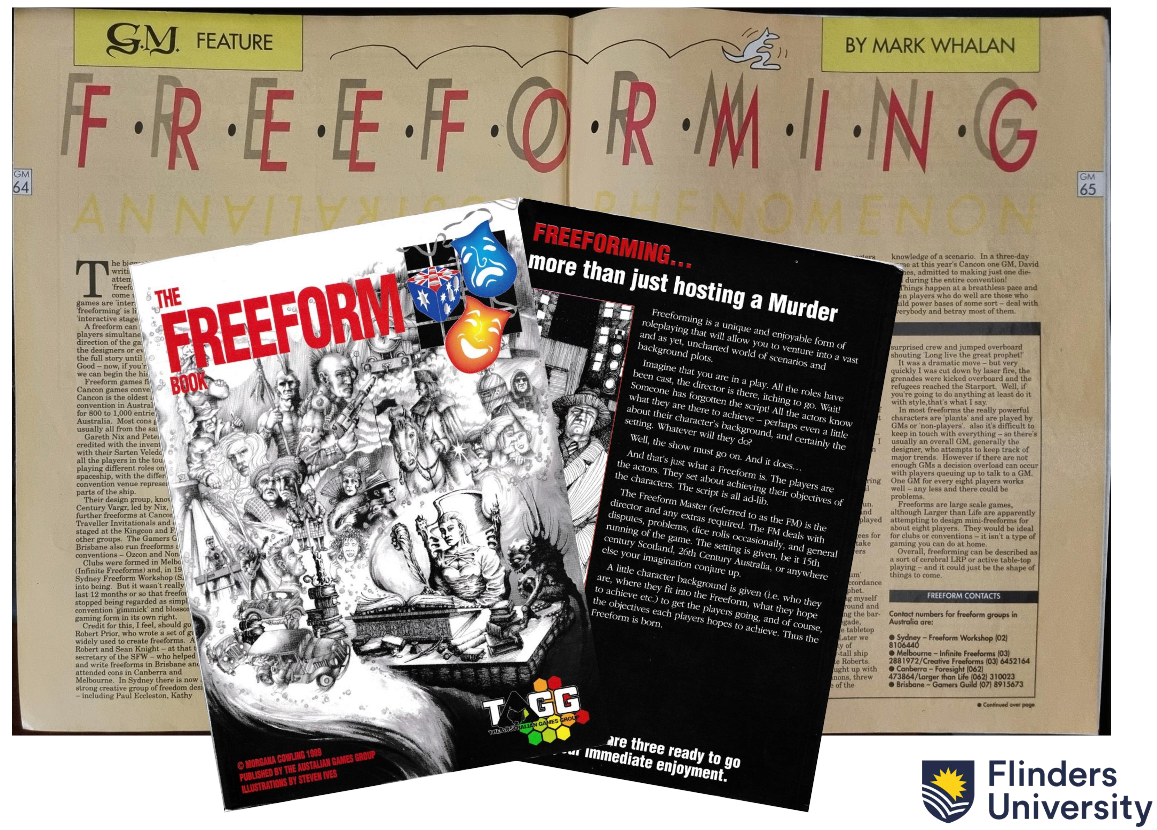
Laird: TAGG (The Australian Games Group) published Morgana Cowling's The Freeform Book in 1990. That's an interesting book because it has three freeform scenarios in it [as well as] how to run freeforms, how to write freeforms, and a rule set. Morgana Cowling was the first president of Freeforms Unlimited, which was one of those freeform clubs that I talked about earlier. She wrote and ran freeforms quite a lot in the ‘80s and ‘90s. The other thing that happened is, in 1989, Mark Whalen wrote an article called Freeforming: An Australian Phenomenon and that article appeared in GM Magazine, which was a UK-based magazine. I know it was distributed in Australia because I had a copy of that magazine with Mark Whalen's article in it. I haven't found any references to people talking about that article, but I know it would have been seen. I do know that The Freeform book was picked up by people in the UK who went on to call themselves freeform designers.
Steve Hatherley (designer and author of Writing Freeform Larps) attributes Morgana Cowling's The Freeform Book with the use of the term freeform. And Tony Mitton says that he used it when he wrote some Vampire: the Masquerade freeforms in the early ‘90s that he ran at the European Gen Con. I don't know what the audience of the European Gen Con was like in the early ‘90s, but that would have then seen a distribution of the term as well.
Manuel: In 2026, when these games happen at conventions, what language do they use? Do they call them larps or freeforms now?
Laird: The Australian conventions still call them freeforms, and then they qualify them by saying theater-style or parlour larp. In 1993, Minds Eye Theatre was published. You start seeing Camarilla groups begin in the mid-90s in Australia. That becomes a dominant form of larping. And the World Wide Web starts influencing how people see [larping]. So, you'll see something like Good Society advertise that they have a larp. I mean, in many ways, it's probably more like a larp in that you do some character generation in it, as opposed to just being given your characters. While the conventions have kept on to freeforms, they have to clarify it because people find gaming through online sources, and America and Nordic larp dominate a lot of the conversation.
(For more information, the Australia page of the larp wiki has some links to additional context.)