Dice Exploder’s Sam Dunnewold is running out of things to say about RPGs
New hosts, Seraphina Garcia Ramirez and Em Acosta, will be taking over from next year.


Thinking about games critically is more than just playing them; for one, it’s about deconstructing their systems, and examining how individual components can influence the way these games are experienced. This can be a time-consuming, laborious craft, and that’s partly why Dice Exploder creator, Sam Dunnewold, is leaving the show after the podcast’s current season. After recording 100 episodes of the podcast, he feels that he had simply run out of things to say about RPGs after. Then there’s his screenwriting career, which is beginning in earnest ever since he sold a screenplay to a Hollywood studio.“That reason [about movies] is much flashier so I understand why many people I’ve talked to have focused on it, but I want to underline the [first reason] as at least as important,” said Dunnewold to Rascal in an email. “I’ve said a lot of things about RPGs in the past three and a half years!”
But Dice Exploder isn’t going away. Instead, Seraphina Garcia Ramirez (who wrote a wonderful essay on this site) will be taking up the reins after Dunnewold’s departure, alongside ENNIE-nominated game designer and current editor of the show, Em Acosta. “I’ve gradually been taking on more of the community side of things for a while now, going from a listener to a moderator on the server, but that space has always had the podcast at its core as both the cornerstone of our approach to game design conversations and specific inspiration for shared discussion,” said Ramirez to Rascal in an email. “Sam’s been a wonderful friend, and knowing he’s putting his trust in me to carry that project forward means the world to me.”
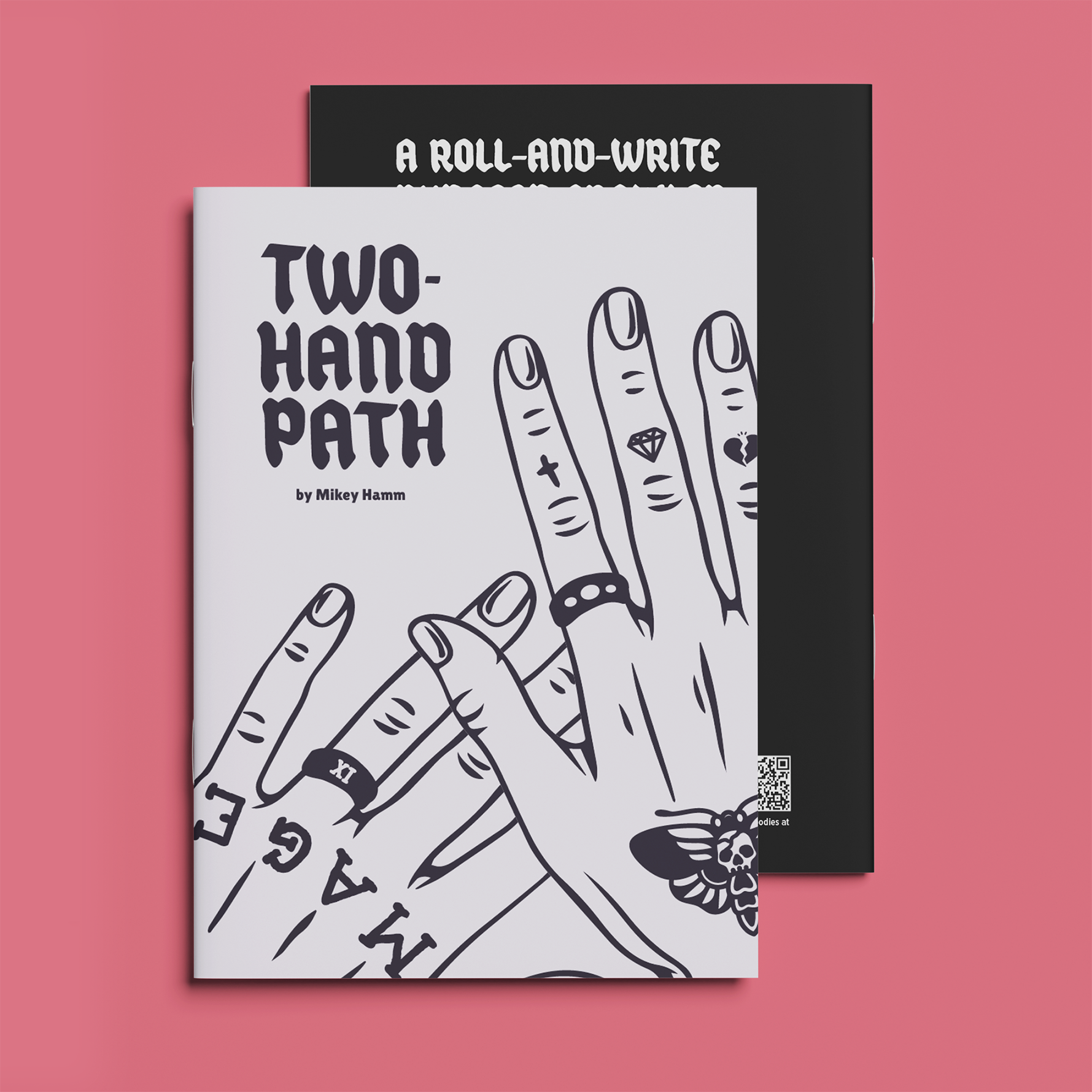
Since its inception in 2023, Dunnewold has dissected a dizzying variety of tabletop RPG mechanics in Dice Exploder, alongside several notable designers, be it its namesake mechanic Exploding Dice with Slugblaster designer Mikey Hamm, or the colouring sheet in Two Hand Path with Field Guide to Memory designer Jeeyon Shim, in which players get to draw tattoos and rings on an image of their characters’ hands. Among some of Dunnewold’s favourite episodes are on pity points from Kagematsu with Star Crossed designer Alex Roberts (“[It] still makes me tear up when I listen to parts of it,” said Dunnewold); otherkind dice from Psi*Run with Blades in the Dark designer John Harper; and spotlight scenes with Lumberjills designer Moyra Turkington. “Moyra’s so articulate and intelligent while also so obviously full of love, passion, and care for people in that episode even as she’s staring right at all kinds of world horrors,” he said. “I learned so much talking to her. Everyone should listen to that one.”
On the other hand, Ramirez’s picks include the episode on transparency with Fiasco designer Jason Morningstar, as well as a special episode called Dice Exploder: Afterimage on City of Winter. Dice Exploder eventually branched out to discussing Actual Plays for one season in 2025, with one of Ramirez’s favourite episodes being about Last Train to Brooklyn, an actual play of Last Train to Bremen. “[Last Train to Brooklyn was] recorded and played on a New York City subway car,” she said. “I love Last Train to Bremen, I love New York City (I grew up in Queens!) and I love how deep they dive into the production and the choices that went into it. Especially because of Sam also bringing his passion for filmmaking to this episode, it really feels like everything’s firing on all cylinders. It’s just a great example of the power of getting specific and personal, which is where Dice Exploder shines.”
We reached out to Dunnewold and Ramirez to find out more about how they feel about the show’s storied legacy, as well as future plans for the series.
This interview has been slightly edited for clarity.
Khee Hoon Chan: Sam, how will you continue to be involved in the tabletop space after your departure from Dice Exploder?
Sam Dunnewold: With movies, I’ll have a month or two where I watch five movies a week, and then a month or two where I synthesize all my thoughts into new ideas and creative projects. The same thing is true with games, except it takes so long to play many of the most compelling games in indie RPGs that my cycle is on years instead of months (the fact that it takes so long to play most RPGs has all kinds of weird effects on the industry and hobby). I think these past three years of Dice Exploder have been me synthesizing all kinds of thoughts after a few years of intense play and design during and after lockdown. Now I’m entering the part of the cycle where I take in art instead of putting out thoughts.
So I’m certainly not leaving games, I’m just rotating my primary role from critic to player for a while (an underrated role to have in the hobby). [It’s] less public, but I’m not stepping back from any of my three weekly games. I’ll be in any one of a hundred discords listening and occasionally speaking. Then in a few years, when I’ve gone through the consumption phase of my cycle again, I’ll hit a new synthesis phase and be back with another three years of things to say.
Chan: How did Dice Exploder begin?
Dunnewold: In the late 2010s my main RPG community was the hacking channels of the Blades in the Dark Discord. That got turbo-charged by lockdown, and I spent so many hours talking about games there in 2020 to 2021. That’s also when I designed my first couple games and started lurking on the then-active-but-dying-down indie scene on Twitter.
During that time, I had a lot of frustrations with how design conversations happened online. It was all the same complaints you still see today about discourse: we get the same arguments over and over, communities are often hostile to people with different tastes (often without understanding that’s what they’re doing), and the biggest one for me: people love talking about taxonomies and big picture philosophical thoughts, but those tend not to have any practical applications when you actually get into the nuts and bolts of playing and designing. The best conversations I was having were like “How does this dice pool’s mouthfeel change when you roll an average of 2.5 vs 3.5 dice?” and realizing different games preferred different answers. Not only were these immediately applicable to my design work, I was also learning a lot more from them generally.
Meanwhile I’d always wanted to host a podcast. I was coming out of a few years of professionally producing podcasts for other people, I’d developed a lot of opinions about how they should and should not be made, and I was itching to put those opinions into practice, but I felt like if I was gonna be another white guy with a podcast I better actually have something new to contribute. When I realized I had identified a kind of conversation I thought was missing from RPG design communities and it would be a good fit for a podcast... I mean the first thing I did was to think, “No one’s going to care about me or what I have to say.” But the second thing I did was pitch the idea in the Blades discord, which at that point had a small podcast network. Ray Chou responded, “Sick, when are we recording the first episode?” and we were off.
Shoutouts also to The Hard Move, the RPG podcast I basically stole the show’s format from, and Good One, a podcast that at the time had essentially the same format but for stand up comedians and their material.
"So I’m certainly not leaving games, I’m just rotating my primary role from critic to player for a while (an underrated role to have in the hobby)."
Chan: Were there anything you would have done differently, or any topics you want to have covered that you didn’t have the opportunity to?
Dunnewold: I wish I’d had more people of color on the show. I was pretty committed to that when I was booking the first couple seasons and I think I did an okay-good job, but I fell off more and more as the show went on.
A lesson I learned quickly was that I think the show is at its best when I stick tightly to the limited format of “we’re talking about one mechanic”. To this day I’m still publishing episodes on broader topics, and some of them are fantastic, but I always wish I’d stuck to my guns more of “Let’s get more specific, let’s keep the discussion focused, let’s not drift off into big picture theorizing without an example to ground us.” The big ideas get more color and texture when they’re grounded in examples, they become more true and useful to me.
In terms of topics, I have two more miniseries I’d like to have done in earnest: play by post and adventure design. Play by post hit my radar hard after I got deep into Over/Under last year, but like many others I was so burned out after O/U ended and I lost the momentum for it. I feel inexperienced at play by post, so part of why this one fell by the wayside was lack of personal knowledge.
The same is more or less true for adventure design (when I say that I’m talking about games from the OSR, NSR, post-OSR, elfgame, Mothership, or whatever other community label you want to throw around). When I started Dice Exploder, I had grand visions of being a place where I could take all these different scenes within the hobby and synthesize them. Often the work and conversations I find most interesting are people taking ideas from two different schools of design and blending them together. I still see a ton of potential learning that my storygame-based scene could do from adventure designers and vice versa, but I have also encountered so much friction between the communities behind these two styles of play that I’d like to really know my shit before I do this series. If I had to guess, I’ll be back diving into adventure design in a couple years after I’ve played a lot more games in that vein.
Chan: Seraphina, how does it feel to take over the podcast from Sam? Do you have a specific vision moving forward?
Seraphina Garcia Ramirez: Lots of big emotions. Dice Exploder has been the source of a lot of joy and passion for me over the past few years, and having the opportunity to give back and create that space for others is an honor.
It’s also an exciting challenge. Like Sam said, he’s already put out about a hundred episodes of the show. What else is there to say? Part of why I wanted to take this on is my belief that the answer is everything! The heart of the show has always been curiosity about different experiences and perspectives, and there are so many more games and designers to learn from and talk to. I’ll be talking with some names you recognize about games you’ve heard of, but my hope is to also introduce our audience to people and art they haven’t seen before. Part of the magic of the show for me has been how it pushes the boundaries of my brain further out in every direction, and a diverse group of perspectives is the best way to serve that goal.
To that end, my vision for the show is to continue doing what it does best: talking to smart people about specific game mechanics in great detail and seeing what we can learn from them. I’ll be bringing my voice and thoughts but the heart of the show is going to be the same as always.
Chan: What does Dice Exploder mean to you?
Dunnewold: Fuck, I don’t know. Dice Exploder has been a place, a community, a passion, a goal. It’s a way to structure my thinking and engagement with a medium, a way to connect with and befriend dozens of amazing, smart people both on the show and through the show’s discord, a way to practice so so so many things in my life like delegating or knowing when to leave a conversation. Many valuable lessons I’ve learned from making Dice Exploder have had nothing to do with RPGs.
It’s such an accomplishment to have made something that feels bigger than I am, that’s going to live on after I leave, that’s already done so much for a few hundred strangers who listen without me seeing or understanding those effects. Making stuff like that feels like one of the points of life to me, and I feel very proud to have accomplished what I have with it, even as the whole project of understanding games also feels like a never-ending road, an ideal to strive towards. We’ll never fully understand games or each other, but Dice Exploder has been one way I’ve tried my best to make a little progress.
Ramirez: It’s been, sincerely, life changing. I’ve gone from a passionate fan on the sideline of the hobby to someone putting her own thoughts and words out there and existing as a peer to some incredibly talented people who I also get to call friends. I’ve attended some amazing conventions, playtested an abundance of brilliant work, and been involved in helping other people create some of those works. That all starts in earnest with joining the Dice Exploder server a little more than two and a half years ago, and bingeing those first episodes of the podcast.
Not only has it been a direct link to meeting new people and discovering new games, it’s also been a crucible where I’ve learned how I want to be talking and thinking about games. I’m always saying that whenever I say something smart, it’s only because I have been told a lot of smart things by a lot of smart people, but the deeper truth is that I’m able to sound smart because Dice Exploder taught me a lot about how to think about media and art. Focusing on specific examples, defining our terms, establishing the scope of a discussion, lenses instead of boxes — these are principles I carry with me to every conversation I have about games and that starts with being shown those principles in action through Dice Exploder.
It’s also been a source of joy on a personal level. I’ve had some difficult times in my life personally the past few years. When I’ve struggled to see the light, having reminders that people care passionately and deeply about creating the details that often go overlooked gives me some much needed perspective. There’s beauty and value in the details, as well as a human voice I want to listen to. That’s what Dice Exploder means to me.
"It’s been, sincerely, life changing. I’ve gone from a passionate fan on the sideline of the hobby to someone putting her own thoughts and words out there and existing as a peer to some incredibly talented people who I also get to call friends."
Chan: What plans are in place for the future for Dice Exploder? I heard that Em Acosta is joining as co-host.
Dunnewold: Em’s been one of my best designer friends going back to 2019 and has always been one of my favorite cohosts to have on. They started editing the show at the beginning of 2026, so they know their way around it pretty well. There are no plans as far as I know for Em to become a permanent or even regular cohost, though they are certainly invited to do so, but I gave them the open invitation to do episodes here and there if it strikes their fancy. I think they’ll do a handful a year.
As to the future of the show at large, I’ll shut up. The whole point of all this is so I don’t have to worry about that anymore.
Ramirez: Em’s going to be crucial for making me sound coherent and concise (to the extent the latter is possible). They’re also going to be my editorial partner for the show, beyond just editing the pod; more than one brain thinking about how to make the show as useful and thoughtful as possible is going to be crucial. To that end, they have my blessing to use the platform whenever they like.
Bigger picture? The plan is at least one season of classic format Dice Exploder in the early spring, with a majority of episodes co-hosted by people of color, followed by however much more I can fit in my schedule over the following months. I’m not committing to anything else specific, but I’d love to have at least two people other than me hosting episodes in 2027. The miniseries Alex and Sharang did for the show on love, sex, and romance produced some of my favorite conversations, and I really appreciated the opportunity Sam gave Lady Tabletop and I to host an episode promoting the Femininomen Jam way back when. I want to invite more people better positioned to host for specific topics than me, and I want to extend others the same opportunity and platform Sam has shared himself.
I also have some bolder visions further down the roadmap. Sam’s made me cry more than once with his work on Dice Exploder: Afterimage and I have some ideas for new entries in that series. That mixes with some interest I have in video work. I have outlines of essays on death and grief in games and on metafictional play, and giving those a visual focus would rule. I also want to keep a close eye on the community side of things; we have a really vibrant discussion space, but I’m thinking about how to leverage that into more action. Maybe a blogwagon or a jam? Stay tuned on that front.
Otherwise? The plan is to do this for as long as I can, and to hopefully do for others what the show has done for me. I agreed to take this on because I want to give back to a space that has given me so much. If I can manage that, even a little, I’ll be happy.