In Mousetrap, metagames and Shakespeare meet with Firebrands mini-games
The cursed game-within-a-game has landed on Kickstarter


Two Companion Games on Kickstarter
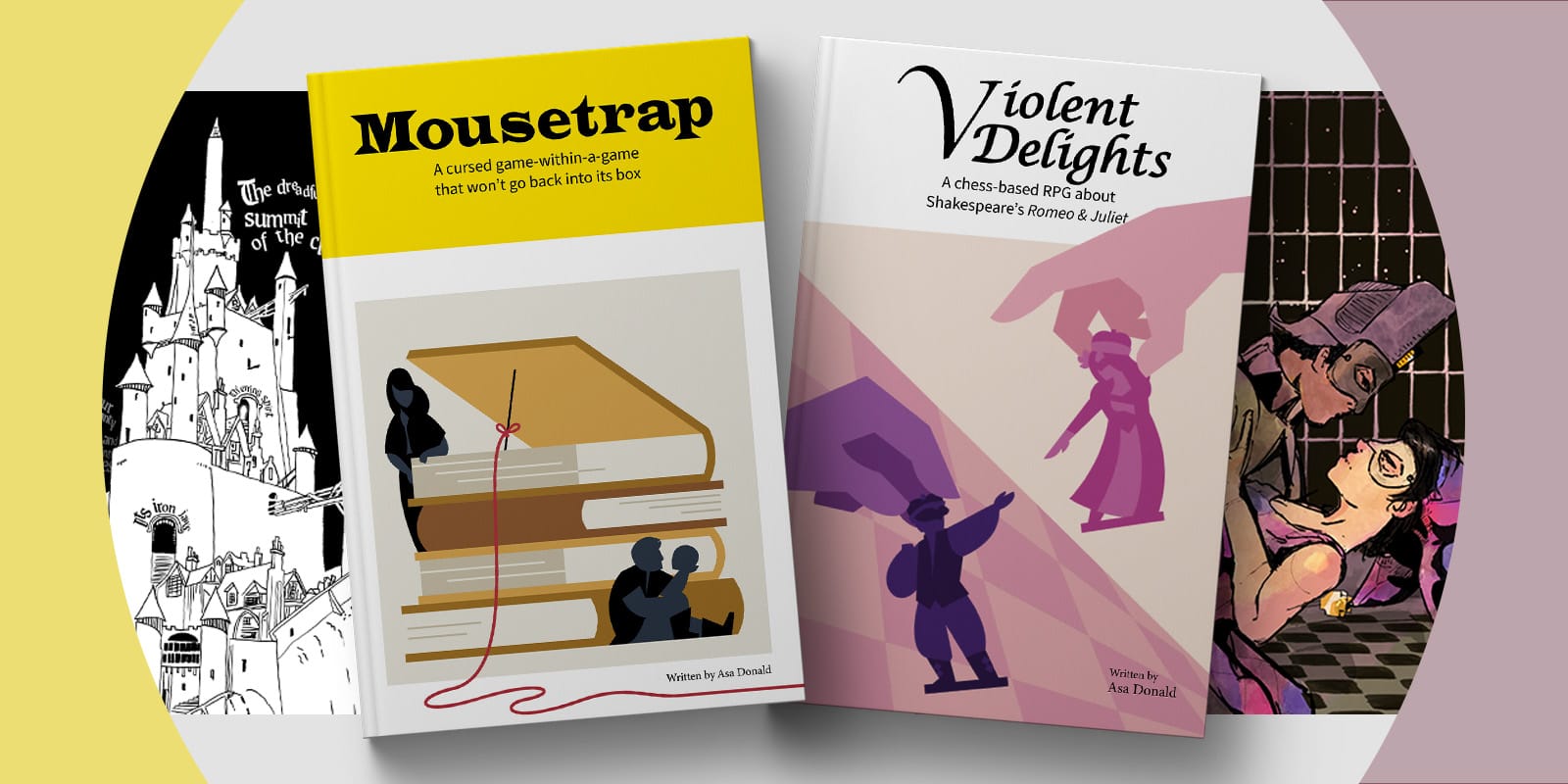
Five months ago I announced Violent Delights, my chess-based RPG about Shakespeare's Romeo & Juliet. I originally planned to fund the game on its own on Kickstarter, but I was working on another game at that time as well: Mousetrap. In fact, I had been working on Mousetrap prior to Violent Delights, and the games informed each other in development. Violent Delights has been nearly complete for a while now, but I found that I can't bring myself to move one forward without the other. So, now I'm funding them together on Kickstarter.
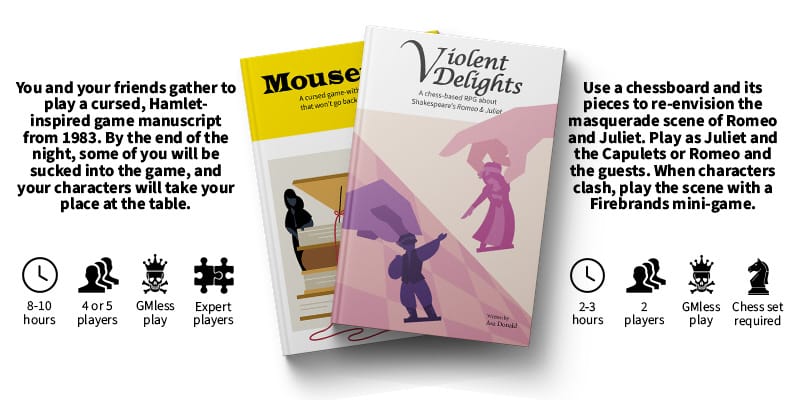
Violent Delights and Mousetrap are companion games in which Shakespeare's plays meet Meguey and Vincent Bakers' Firebrands mini-games. One of these games is about forbidden love and defying the systems that forbid it. The other is a cursed game-within-a-game that won't go back into its box.
If either sounds like something you’d be into, the Kickstarter is in prelaunch! You'll be able to pick the one that interests you most or get them both and save on shipping.
Both are games about Shakespeare and Firebrands mini-games. Both are also "metagames."
Mousetrap and Metagames
If you liked my last game, SPINE, chances are that you will like Mousetrap too. Both are experimental. And although Violent Delights is experimental too, it's much more unassuming compared to SPINE and Mousetrap, which are games for true "sickos":
It’s game night. You and your friends gather to play a Hamlet-inspired game manuscript from 1983. But there’s a catch… The game is cursed. By the end of the night, some of you will be sucked into the game — trapped inside a castle with a vindictive ghost — and your characters will take your place at the table. What will they do with their newfound freedom? How will your friends get you out?
Secrets are scattered throughout the game, and you learn you aren’t its first victims. The game text, which was found and reconstructed by Dr. Cornelia Foote, is lined with her notes. They may be the key to rescuing you — and breaking the curse for good. But you will have to play again. And again.
In Mousetrap, there are two layers of fiction: players at the table and the nested world of their characters. You alternate between them, playing “table talk” mini-games and "vignettes" — mini-games that depict common scenarios between players and scenes that depict your characters in the fictional Castle Muldoon.
And then your player and your character swap.
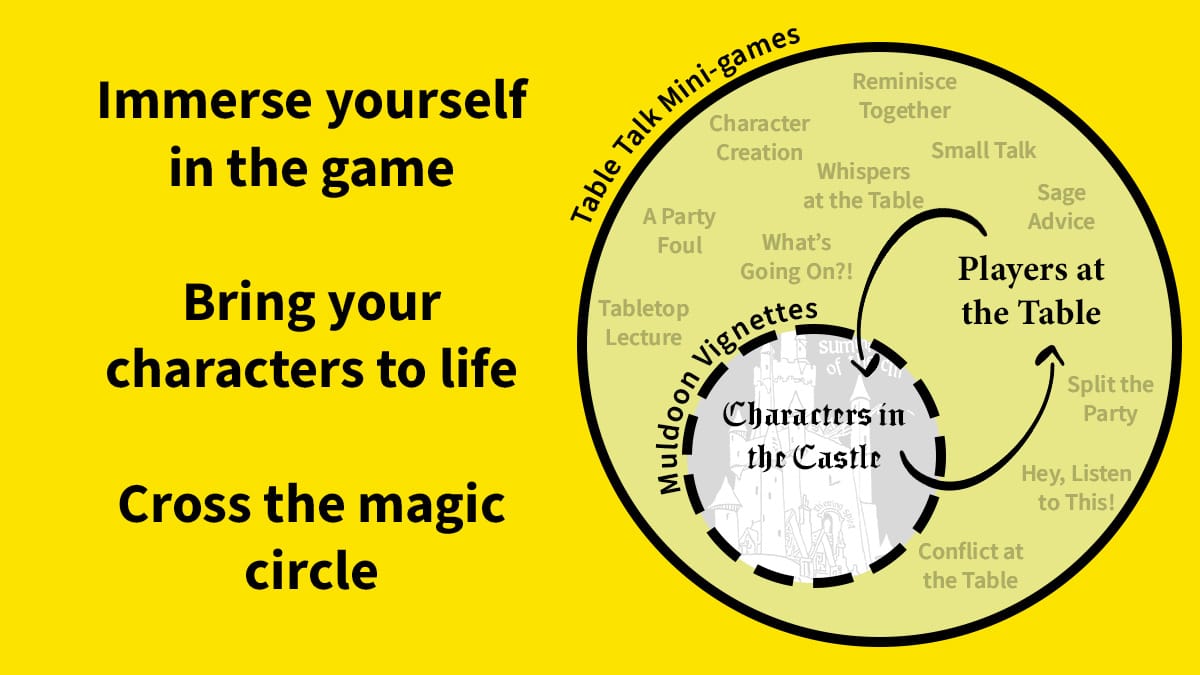
As you can imagine, Mousetrap is designed to mix up realities and create disorienting situations. It starts with absurdity, and you can't help but laugh at yourself. But it can become quite serious, inviting you to think about the games and the characters that you play from a new perspective.
In this way, Mousetrap is a metagame. It's a game about games, a game that draws attention to itself as a game and to the players' frame of reference at "the table." There are already a number of metagames by popular indie RPG designers, like Kieron Gillen's DIE RPG, Dungeon by Jay Dragon, and The Yellow Curtain by Emily Allen. I'm especially interested in trying Game Night by Jason Morningstar, in which you LARP as players of a fantasy TTRPG. These games draw attention to formal or conventional qualities of the art form, revealing them, breaking them, distancing us from them. They expand our awareness of them and the culture that surrounds them, including some qualities of metagame RPGs that I find uniquely challenging and exciting.
Here's one: Whereas metatheatre tends to be for the audience more so than it is for the performers and stage hands, that’s not the case in tabletop RPGs. As players of tabletop RPGs we take on a dual role. We are both performers and one another’s audience. When the effect of a metagame is to disorient the audience, do you not also disorient the performers? How do you design around that?
Shakespearean Mini-games
Mousetrap functions as a metagame largely through its game-within-a-game structure. Its name derives from the title of Hamlet's play-within-a-play, which Hamlet uses to "catch" Claudius' guilty conscience. Shakespeare flirted with metatheatre frequently in his plays, from the broken play-within-a-play of The Taming of the Shrew to the epilogues of A Midsummer Night's Dream and The Tempest. And a Shakespeare game without awareness of its own form feels wrong to me. Violent Delights is a metagame as well, thematizing the most popular board game in the world to say: "In chess, the kings may never kiss. Has this game been about forbidden love all along?"
When writing these games, something Shakespearean about the Bakers' Firebrands, The King is Dead, and In Dreaming Avalon drew me to the mini-game format. On the one hand, the influence of A Midsummer Night's Dream is explicit in In Dreaming Avalon, which ends with Puck's Farewell. One can sense Shakespearean drama in Firebrands, which the Bakers have described as "Romeo & Juliet in mobile frames" (+1Forward, 15:18). And I can't play The King is Dead without thinking of the Wars of the Roses, which Shakespeare dramatized in his first tetralogy of history plays.
On the other hand, the mini-game format is especially dramatic. Most of its mini-games set up discrete scenes, which characters select on their turns. Each of these games reproduces a type of scene that players fit into an overarching story, such as “Stealing Time Together,” “Meeting Sword to Sword,” or “A Free-For-All.” Narrative time is telescoped in the gaps between scenes, events happen “off-stage,” and unimportant action can be skipped between scenes.
The mini-game format is more script-like than most tabletop RPGs, too. They are packed with structure and story beats. They even include scripted components that invite performance – lines like: "I've been hoping we would meet, ever since I saw you. Will you walk with me?" (A Chance Meeting, In Dreaming Avalon). Only solo games rely on the game text for facilitating play as much as Firebrands-style games.
Poetic Fragments
Whereas Violent Delights is meant to convey its Shakespearean influence, Mousetrap has a postmodern angle. And as I was working on it, I found myself interested in fragmentation — in how Firebrands-style mini-games fracture not only the narrative into discrete scenes but also the play experience into discrete games, each with their own internal rules and logic. In fact, in Firebrands, the narrative can also fracture into synchronous drama: while some players play a mini-game together, others can play the solitaire mini-game on their own.
This fragmentation is exciting and challenging to design with, and even the Bakers' games take different approaches to constructing a narrative. The King Is Dead has a clear narrative arc that the games combine into. In contrast, In Dreaming Avalon is designed in such a way that you don’t need an overarching story. It is an ephemeral dream space, and its mini-games are episodic. And then there is Firebrands, which is most likely to thwart expectations around narrative. I don't have space to dig into it here, but it's the most interesting of the games to me, which the Bakers built in such a way that it could be integrated with the Mobile Frame Zero LEGO games: Rapid Attack and Intercept Orbit.
I've already compared mini-games to scenes of a play but if I had to compare the fragmented structure of mini-games to another form, I would gesture toward a another genre that was popular among Shakespeare and his contemporaries: the sonnet sequence. A sonnet sequence is a series of short poems assembled into a collection, which implies a narrative about the poet's infatuation when the poems are read in order. Except in Firebrands-style games, the players are the ones assembling the sequence, as they take turns picking and directing scenes.
Personally, I think The Bard would eat all of this up — the mini-games and metagames, that is – if not merely for his own love of metatheatre. I'll be digging into some of these topics in my newsletter, first with a series on metagames and eventually in a series on Shakespeare games.
But there you have it. That is why Violent Delights is still in prelaunch 5 months later. That's why the Kickstarter will remain in prelaunch for at least 3 more months, as I continue to shore up Mousetrap with additional playtesting and accumulate some more followers.
And if any of what I described here is of interest to you, please drop by the Kickstarter page and follow the campaign.