Digital elbow grease saves largest actual play database
Anne Monteverdi made sure Series Seeker stuck around to keep track of all the RPG hobby's stories.


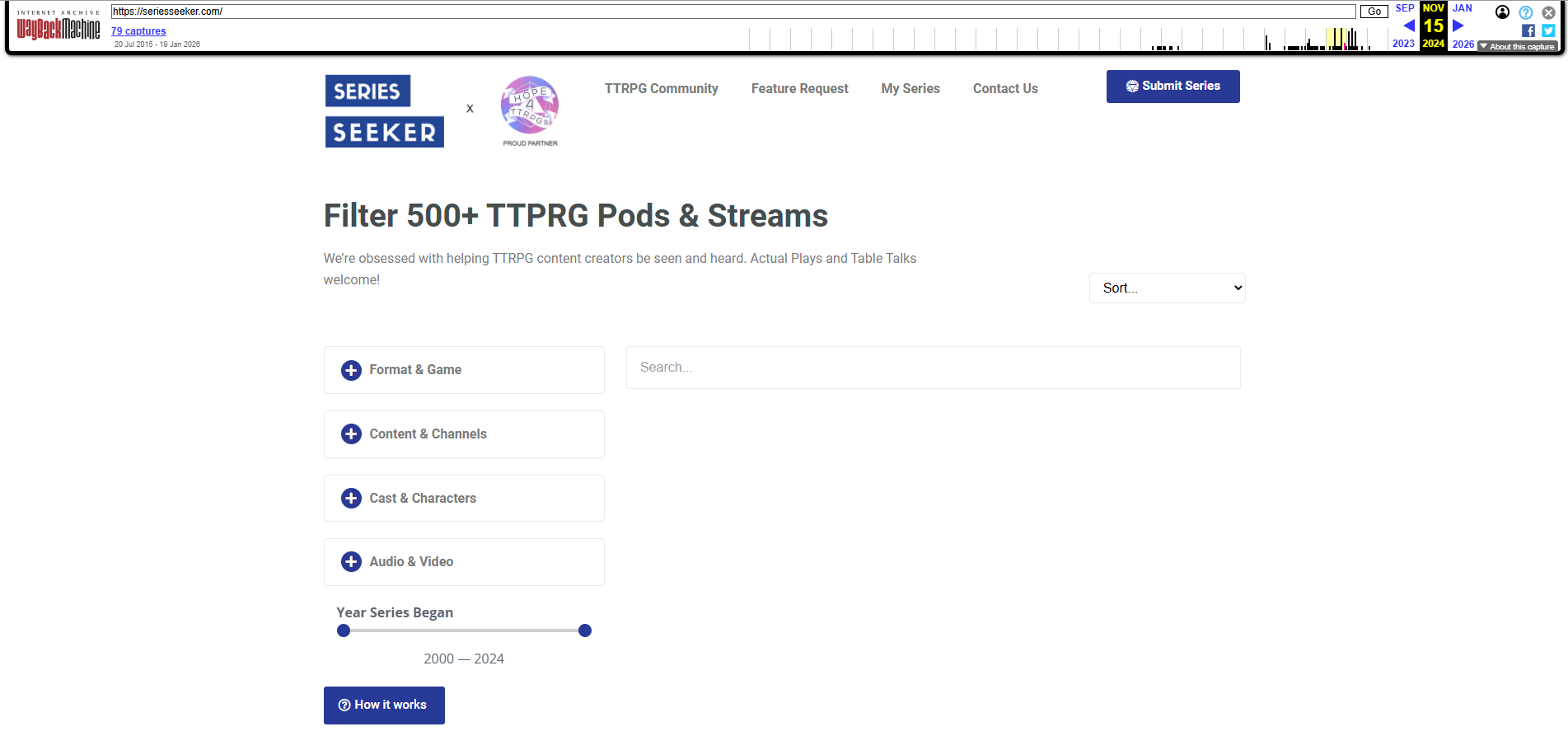
When Anne Monteverdi (also known as Gnome Anne online) realized that Series Seeker — a website that had hosted data on hundreds of Actual Plays — was down, she immediately began to investigate. First, they tried to find the owner of the sites (the person behind the social media account Hope4TTRPGs established the site in 2021), but didn’t have much luck getting in touch with them. Luckily, someone had thought to archive the site on the WayBack Machine and Monteverdi was able to extract the HTML backup there in order to access the data associated with the site, and, in doing so, help preserve the digital history of Actual Play.
“When I saw that the Series Seeker site was down, it felt like just another loss, another tiny corner of a niche history that would be wiped away,” Monteverdi wrote to Rascal in an email. They wanted to pursue archiving the site because they were, simply, “tired of losing digital culture and information.” They added, “A big part of it was that I found a small battle I could fight and possibly win.”
The original Series Seeker website domain had likely lapsed in April of 2026 — Monteverdi had done a WHOIS domain lookup and was able to determine that the current site had been registered in mid-April, likely by a ‘parker’. A site parker will find lapsed domains and buy them in order to attempt to extract a kind of digital ransom before they return the site to the original owner. “While I don't know for sure it's a parker, judging by the fact that it was scooped so quickly and goes to various scam or shopping sites, it seems likely,” they wrote.
Monteverdi alleges that Series Seeker “might have been” the largest publicly available digital database of Actual Plays in the world. The site hosted user-generated content from both creators and fans which allowed site visitors to search for shows based on genre, format, date, cast, and even episode length. It was a wealth of information, all done, as the site stated, to help “TTRPG content creators be seen and heard.”
“Series Seeker was made as a discovery portal,” Monteverdi wrote. But, she argues, in the context of tabletop history, it became something more important than just a free lookup tool. “It represents the first standardized metadata schema I've ever seen being used to meaningfully describe AP as more than just a digital object. It's also (as far as I'm aware) the largest repository of descriptive metadata about APs. From an information science, archival or historic perspective, it's an important resource for documenting and preserving the context of the medium.”
She continued, “earlier this year, I lost the website where I maintained the record of all the APs I've guested on (ironically, I was literally studying digital archives at the time, but managed to not practice what I preach). I had a friend (Candace the Magnificent) lose all the videos they recorded during lockdowns that were meaningful to her. I don't have any pictures of myself from the years 2009-2015. Films are disappearing when their license agreements expire. The US government keeps removing public material from their websites. It feels like the global digital infrastructure is crumbling under our feet.”
Monteverdi outlined exactly how she was able to extract the Series Seeker data on her site and in a Bluesky thread. After downloading the entire site she stripped it of the HTML which likely would have been protected by copyright, teamed up with a coder, Jayme Howard who “parsed the HTML into JSON, removing all the copyright material and leaving just the crowd-sourced data.” The full dataset is available via a JSON file, an open file format for storing information. She was then able to set up a website that searched the raw data so that it could be shared — “sharing is preservation!” — and then she archived her own website using the Wayback Machine, which “[provided] an institutional level of preservation that I wouldn't be able to offer on my own.”
😮💨 AP folks rejoice: the SeriesSeeker data is safe. Let me regale you with an adventure in digital archives 🧵 allmyfriendsarestories.neocities.org/AParchive/Se...
— Gnome Anne (@annethegnome.bsky.social) May 16, 2026 at 10:08 PM
[image or embed]
“My main interest is in the data's historic value but that's not actually their primary purpose: the data are meant to be used,” wrote Monteverdi. “A snapshot is great, but ideally this should be an active, living system rather than just an archive.” While there is currently no way to add to the archive, simply having the data archived and accessible gives folks a way to take on the project, if they wanted to pursue another version of Series Seeker using the original data.
“This is a crowd-sourced dataset,” Monteverdi wrote. “I don't think it should have a single steward. That's how we got into this mess. My goal was to save the dataset, preserve it and make it open to anyone else who wants to build on it. I'm still hoping the original creators get back to me, and if not, I'm hoping some folks in the TTRPG community can come together to use the data to make a new discovery portal for AP -- something a bit more open so we don't run into the same problem again.”
Monteverdi has a lot of practice with historical archiving. They work as a digital librarian, and they work with digital archives and have experience with preserving digital materials. “I'm newer to web-archiving and I'm getting more involved as a volunteer with the Internet Archive.” Unlike other “billionaire-controlled” digital assets, the Internet Archive is a non-profit institution that advocates for a free and open internet. It operates as a library as well as an archive, and anything not shared under a creative commons or other accessible license can be digitally lent out.
Her current project is to build out an expansive and comprehensive AP collection on the Internet Archive. “Most AP lives exclusively on commercial platforms that have very little incentive to preserve material long term,” she explained. “AP is a born-digital medium run primarily by hobbyists with very little institutional backing, meaning that it's incredibly fragile. If YouTube decides it wants to clear some server space and remove videos older than 5 years with fewer than 1000 views, that's within their rights and it would be a catastrophic loss for AP. Many podcasts are even more precarious. It costs them money every month to keep that material and I'm nervous that we have a whole medium's existence relying on the on-going benevolence of the rich.”
“There are currently almost 5,000 records when you search ‘actual play’,” they wrote. “But these records are often not well documented. One of the biggest threats to digital preservation is loss of context: if someone stumbles on a video of 5 people playing a game in 30 years, that won't be super meaningful without the surrounding context. Who are these people? What are they playing? When was this recorded? Why? Where was it aired? Who owns the copyright? Can I reuse the material? How?” Monteverdi pointed out that these questions would be typically be answered in an archival record, but “that’s different from what you'd put in a YouTube description: you can't assume the links will resolve (unless you're archiving those sites too), you can't assume people will remember who you are or that they've seen anything else you've made.”
While it’s a noble goal, Monteverdi isn’t trying to do it alone. “My goal is to coordinate the upload of 50 shows so that we can apply for a collection with multiple archivists maintaining it. This would increase visibility and provide obvious points of contact for support in preserving AP. We're currently at 26! I made a checklist to help people through the process and I'm going to continue publishing more material on the topic… We need to collaborate as creators, fans and information professionals, and leverage institutions like the Internet Archive or we don't stand a chance.”
Series Seeker lapsed in part because it was an individual project, not a community effort. Like many things in the TTRPG space — and in the larger world of digital information — the only way that anything survives is through a collective dedication to the cause, and through a collected resource distribution. (Rascal, for example, is one of these spaces.)
However, digital archiving is in a very specific place of precarity. Monteverdi was quick to mention billionaire interests, but there’s also the general enshittification of the internet that makes it more and more difficult to navigate, search, and find any particular website or piece of media. Additionally, with the rise of AI generated text and AI generated search results, a true record of history is eroding. This is made obvious by projects like the recently-reported 4 Pillar Games’ hallucinogenic ‘database’ full of profiles that have incorrect facts, assumptions, and misinformation. While 4 Pillar Games claims to be a historic archival project, it is anything but, and only muddies the already turbulent digital waters. Monteverdi’s work with Series Seeker, Actual Play archiving, and the Internet Archive is a much more effective, nuanced, and considerate task, and shows that digital archiving can be done, even as we wade through so much digital slop.
AP in particular has an uphill battle for archiving. “As a hobbyist, game-based and fan-driven medium, it can be easy to dismiss the importance that AP has culturally, artistically, and as a living folk tradition until it's too late,” Monteverdi wrote. “Our stories aren't painted on ceramics that will survive millenia: they are on corporate servers under government scrutiny and on rotting hard drives in creators' closets. But we're a scrappy lot! Never underestimate the power of a few devoted nerds. When I put a request out for a coder to help with the files, I got half a dozen people willing to help within an hour. If we can devote some of that incredible enthusiasm towards preservation, we'll be ok.”