Does winning the Diana Jones Emerging Designer award help you stand out at Gen Con? The winners say yes.
Come hall or high water, the business cards will go on.

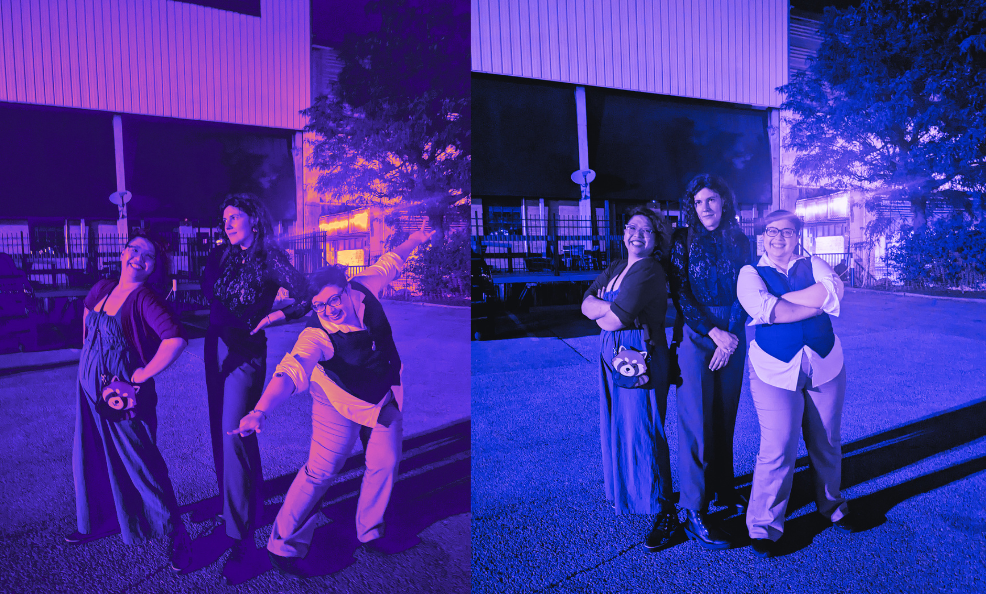
The biggest perk of winning the Diana Jones Emerging Designer award is an expenses-paid trip to Gen Con. The largest American tabletop convention, celebrating its 59th year, broke attendance records in 2026 with 74,000 people attending. But amidst this sea of people (and actual water), all three of this years’ Emerging Designers — Glaiza Champion, J Strautman, and Kodi Gonzaga — were unanimous in their praise for what the award was able to do for them.
While Gonzaga and Champion had been to the Indianapolis show before, it was Strautman’s first time. Like most first-time attendees, Strautman found it “very big and very overwhelming" but felt like the DJA award legitimized their presence. “Having the Diana Jones Award and having that kick off the entire convention [meant] there was a reason that people wanted to talk to me,” said Strautman to Rascal in an email. “So, it was very easy for me to get myself into new conversations and meet new people who are working in games at a level that is way beyond the level that I'm at.”
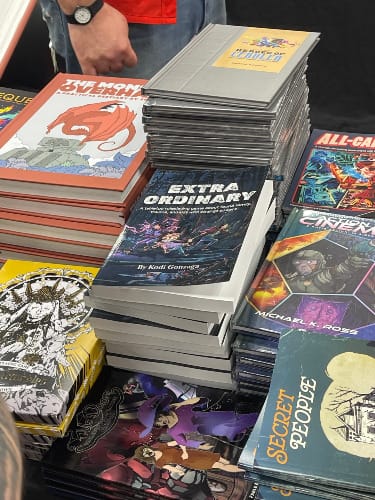
Gonzaga was making their third consecutive pilgrimage to the convention, but it was still a unique experience. Not only were they returning as an award-winner, they also had completed their first crowdfunding campaign earlier this year for Extra Ordinary, a game of children with super powers on the run. “This was the first Gen Con where people walked up to me and were like, oh my god, you're Kodi Gonzaga, I love your game! And I'd be like, what, I don't know who you are!” they said.
Champion had attended the convention once before but echoed the surprise at how much visibility the DJA award seemed to bestow. As someone primarily known as a performer in the actual play scene, discussions about design were a sudden and welcome change. “People were coming up to me asking for my business card,” siya said. “They were asking about my writing skills, my game design skills, my ability to make bespoke mechanics.” Champion described the experience as their “first time being an industry professional,” adding “I like to go on the internet and say I'm just a little guy, I'm just a little dude. Now, I can't do that anymore.”
The three winners spent regular hours at the Diana Jones booth interacting with many people who sought it out intentionally. They ran and demoed games though that ended up a mixed bag. Gonzaga had almost no sign ups, a stark contrast to when they attended on their own dime. “At the 2024 and 2025 Gen Con, I would have set those events up very early on, they would have launched with the rest of the events, and in the past, they filled up pretty quick,” they said. “I either didn't promo them well enough, or they didn't get on the schedule fast enough.” The others had better luck. Strautman fully booked out every game of A Fool’s Errand, their tarot-driven game of space fantasy hijinks they designed with B Marsollier. Champion had the unique experience of gathering a table of people to quietly play a solo game and then discuss their feelings together.
In the evenings, all three emerging designers were pulled by the gravity of Gen Con as the center of the industry into a dizzying variety of mixers and networking events. For Gonzaga, professional socializing was explicitly why they came. “I want to make my career out of writing, and writing TTRPGs as part of that,” they said. “I don't treat this as a hobby; I treat this as a business.”
Strautman is already full-time in games but as a second act, arriving at this industry's shore after more than a decade as a working musician, which is very helpful because they’ve done this whole dance before. “I have spent 15 years at festivals and conferences for music, I have really learned how to be the person that I am when there's 100 people around, and we're all selling ourselves,” said Strautman. “You have to really get used to acting like you belong somewhere, even when it's really uncomfortable.”
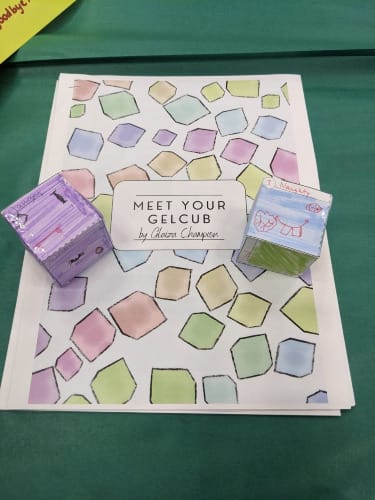
Champion has a career in the tech industry, and when imagining their game design journey, siya saw it as a ten-year process. According to them, the resources from the award (which included a small amount for printing copies) turned Missing Month, their solo game of memory loss and stolen time, from a years-long project to a matter of months. “I think what the DJA Emerging Designer award program does is very, very important,” siya said. “I hope people see the importance of it and continue to support this program because it's really mind-blowing the things that it could do for a person just starting out.”
Almost by definition, an award for an “emerging” talent is a tricky feat. It can’t be judged on past achievement — if someone has found concrete success in the first three years of practice, they might not even need the leg up. It is almost always a leap of faith, an investment in potential. The indie RPG scene, in so far as it exists, is a raucous parade of burgeoning artistry. Because self-publishing a game has become so easy and cheap, there is no dearth of people who take that wonderful first step into this medium. But usually that’s where the journey stops. The second step and the third — every step after that, really — are the challenge. It’s easy to lose motivation when you’re lost in the crowd.
Most people’s potential remains that, never realized. It’s not just about the lack of eyeballs and attention, it’s also about a lack of institutional memory and mentorship and the difficulty of making genuine artistic progress in the craft of game-making. The industry is full of people who walked winding paths to get where they are, and it’s also not-full of people who disappeared along the way. This is the context of the DJA Emerging Designer award. It’s not a perfect panacea by any means, but it seems to be an admirable intervention that would ideally be ten times larger.
All that said, the warmest part of a Gen Con visit remains the ability to meet elusive friends-from-the-internet (maybe for the first time) as well as those beatific souls who have ditched social media but regularly haunt convention floors. This was particularly special for Champion, who brought their whole family including their son to the event. “My friends who are in actual play knew I was pregnant,” siya said. “A lot of them knew [their son] by name… and wanted to see him and meet him for the first time.” It’s a coming together of worlds that might not have happened under any other circumstance.
In the end, it was this feeling of connecting with others on the same wavelength, of talking about games with others who, despite all the industry challenges, shared their enthusiasm, that left these designers energized as they boarded flights and returned to their regular lives. “Getting home, I can't wait to make a game,” said Strautman. “I love being in this industry. I love working with all these people, and I want to be part of the thing that takes us to the next level.”