Alien RPG starter set Hope’s Last Day might be too good of an introduction
When you fill up on chips, but the chips are slathering, murderous predators.

Starter sets for tabletop RPGs attempt to introduce a low-friction slice of the full game to new players. They are an amuse-bouche from the designer that teases the full menu available in the (usually) more expensive rulebook, but players can still see an outline of the full mechanical engine and the larger narrative swings that the studio will make. Critically, starter sets are also supposed to whet players’ appetites for whatever comes next, be it core texts or a bigger, grander campaign setting.
Alien RPG’s newest starter set, Hope’s Last Day, achieves that first task so well that it undercuts the second. I brought it along to a gathering of friends as a rogue addition to our usual horror video game weekend. I figured a starter set worth its salt would be able to teach them Free League’s dice pool-plus-aptitude system while empowering me to guide the story with minimal preparation on either side of the table. Reader, it delivered in spades. We thoroughly enjoyed a roughly four-hour jaunt through a collapsing colony that felt at nearly all moments like playing through the first half of an Alien film. And while I plan to continue onward with the Rapture Protocol cinematic adventure, other groups could easily be satisfied with just the material inside that introductory box.
Rascal played the Alien RPG Starter Set using a review copy provided by Free League.
Hope's Last Day isn't particularly ambitious, and that’s to its credit. Five pregenerated characters, members of a survey team that include a security officer, a scientist, a truck driver, a mechanic, and the team lead, return from a botched expedition to find the colony in active shambles. Everybody's missing and the comms are silent. There's evidence of a fight, but no bodies indicate who died and why. All they know is a Weyland-Yutani corporate suit and her entourage touched down days before they all left to scan a southern mineral deposit. Troubling, but not alarming. Certainly not the prelude to a bloody, mass disappearing act.
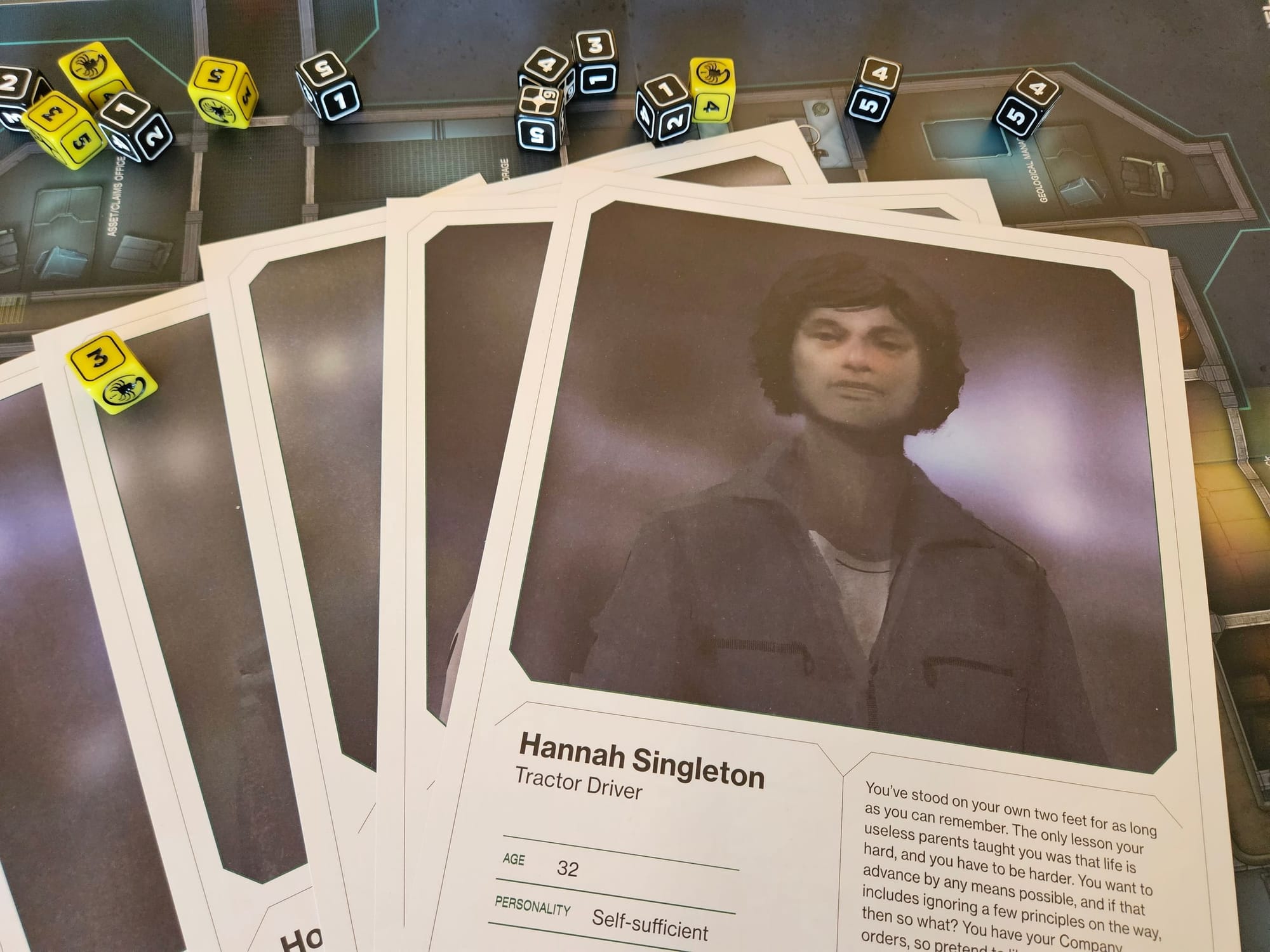
My players have watched Ridley Scott's films and know what's up, but their characters don't. This is one of the ostensible problems with adapting a story as well known and elemental as Alien. The players immediately realized that a Xenomorph had killed nearly all the colonists and facehugged the rest, that the ventilation system now held assured death, and that they needed to get the hell out of this colony. How then do you motivate characters to pick through the wreckage and scratch inquisitively at their potentially doomed heads, instead?
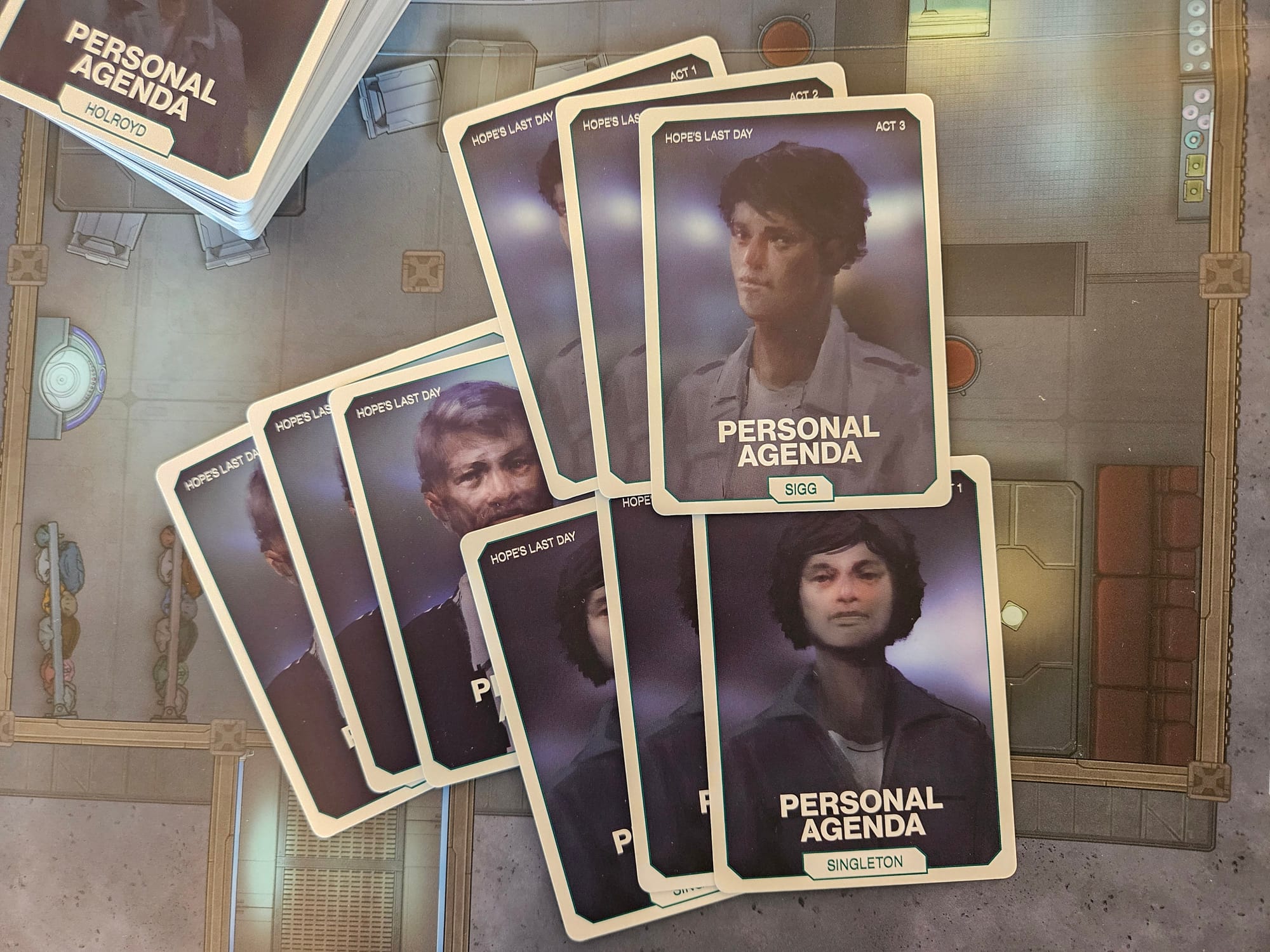
The Alien RPG’s simple solution is character-specific agenda cards. Three for each of the major story acts, these cards were held in secret by players and prompted them to follow certain behavioral clues: seek out the Weyland-Yutani contact and get her out; protect as many colonists as possible; or escape this rock at the expense of everyone else. Agendas evolved over time, replaced by new cards with additional complexity and personal revelations. Receiving these were a highlight of the session, met with as many groans as delighted oohs and ahs.
In the full game, sticking to agendas earn Story Points that can be spent later to directly affect dice rolls. The metacurrency was useless to our single session, but my players still leaned heavily on the cards to steer their roleplay instincts. One player said agendas “generated brilliant moments of tension between my character's directives and the stressful events”, leading to more than a few agonizing moments where they all tossed out objectively correct decisions in favor of logic that was often flawed and selfish (or prone to martyrdom). Why make the baffling decisions that often get horror film characters killed? Well, because the card said so! Dead simple, but extremely effective.
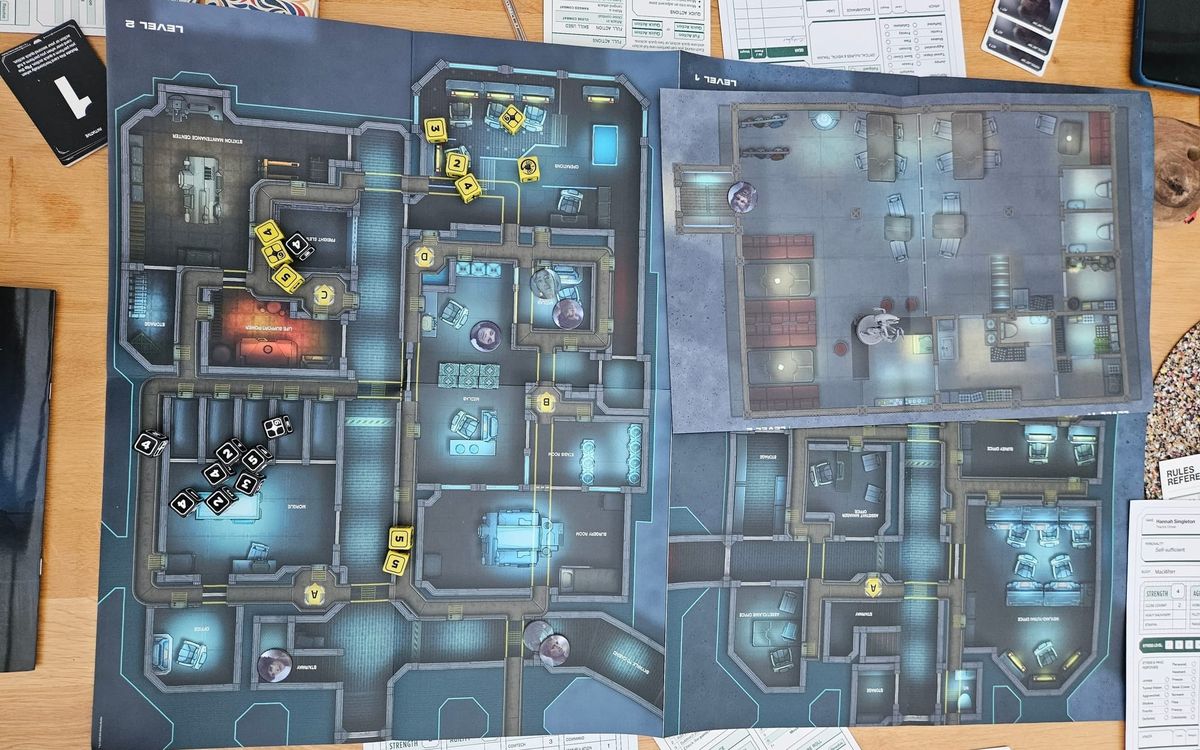
Tools for running the adventure amount to room descriptions, a list of spooky incidents, and exploration hooks, along with some guidance on where and how to deploy Xenomorphs in their various forms. What’s not here is any sort of directed path. Newer GMs will likely feel lost in the metaphorical woods at first but should trust in their player's curiosity and a basic formula of one hour spent in each act. My group managed to freak their own gourds by almost immediately splitting up to rummage through the colony’s first floor. All I had to do then was wait for someone to wander into a dark, isolated corridor. A gunshot and a scream from somewhere deeper in Hadley Station stripped their nerves raw. Crackling voices over the comms unit led to an argument between survival of the most and the most readily available. There's a grisly early reveal that will confirm their worst fears and ramp up the stakes, and it plays exactly like you might expect from a mainline film. Again, let Alien's cinematic lineage act as best principles when in doubt.
This effective and economical storytelling isn't without casualties. Hadley Station is barely more than a blueprint dressed out in metal and glass. Beyond an attached saloon/casino combo, it is devoid of personality; offices, storage closets, a med bay, and armory are locations only insofar as the name promises a certain kind of loot and encounter. The player characters work and live here and should thus have some kind of relationship to the colony. It would even be great to watch this familiar, safe, even banal environment get twisted into a rat maze once the xenomorphs begin hunting them. Instead, they moved dispassionately from common rooms to hallways to refectories making Observation rolls. Without a memorable house, this haunted house is performing with one arm behind its back.
Luckily, Hope's Last Days knows that the greatest monster is human nature with someone’s back against the wall. After witnessing a Xenomorph at the end of act one and securing their tenuous ticket off-colony in act two, the final hour drove the characters’ agendas to their logical, bloody conclusions. This is a game unafraid of killing PCs, often for doing things the Alien RPG signposts as “correct play”. Competency can't hold a candle to sleek black carapace and acidic blood. I won't spoil how our game ended except to say that humans racked up more bodies than the aliens, and nobody felt cheated. We're all just doing a job, right? Collectivity must not be covered in the Weyland-Yutani handbook. Here’s a couple of choice quotes from the players who arrived at that final scene:
“Almost sent that fucker back to hell." - Friend 1, as security officer Morgan Hirsch
“My greatest enemy was not an alien.” - Friend 2, as science officer Sonny Sigg
“Utterly failed to save my fleshy human companions, and ended up punted out of an airlock. 10/10. Would die for nothing again.” - Friend 3, as mechanic Holroyd
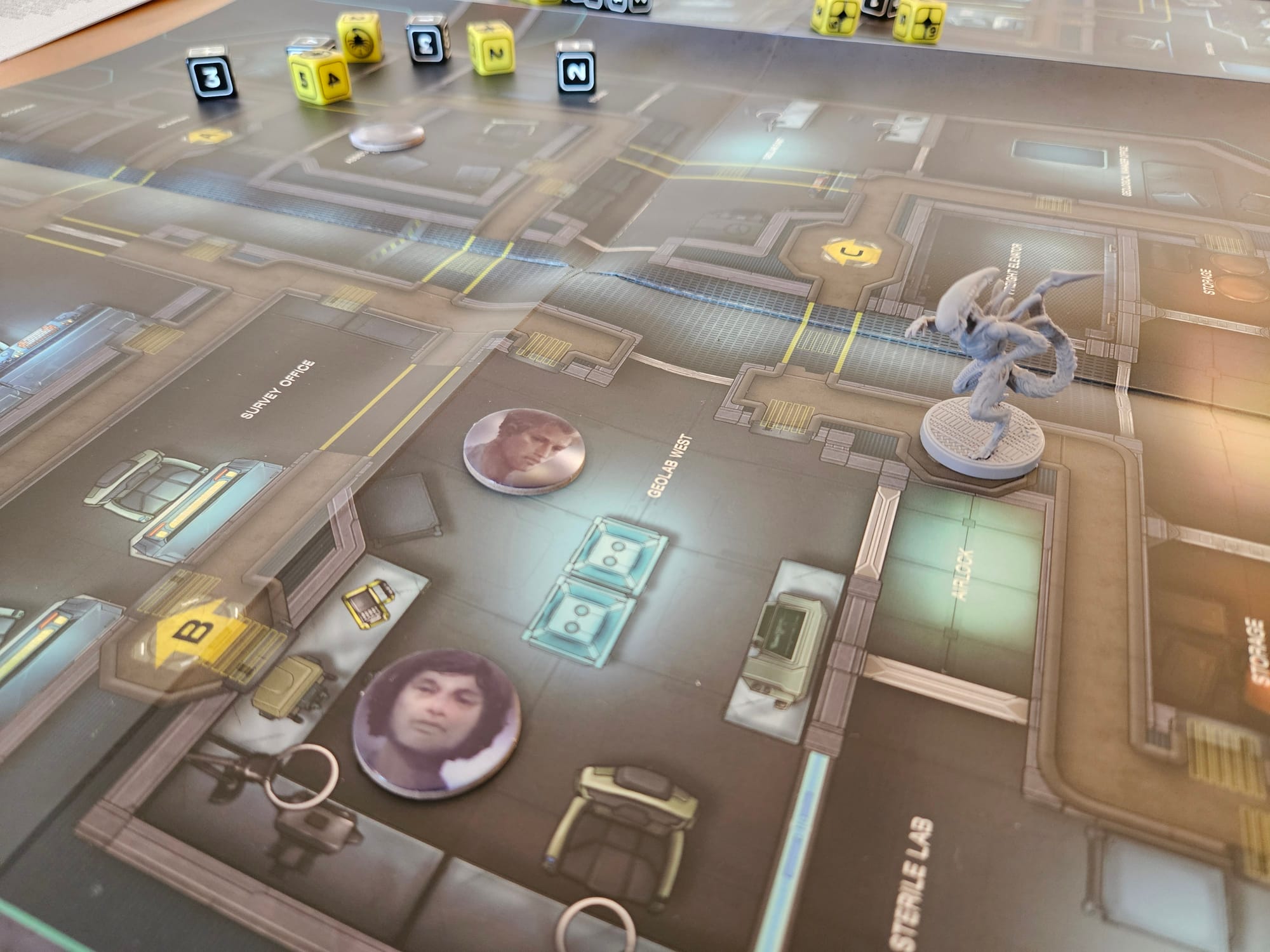
If you're familiar with Free League's Year Zero Engine, the stress mechanic in the Alien RPG won't surprise you with some hidden depth. It’s another resource to manage lest you constantly fail forward. But in the starter set, with virtually no opportunities to rest and reset without dire consequences, all of my characters arrived at the finale stressed to their damn eyeballs. This effectively doubled the amount of dice they rolled for all challenges, but it also guaranteed a consequence in the form of a Stress Response or the worse-by-degrees Panic Response. It was like they were all carrying around guns that couldn't miss but also blew off their hands every single time. The players were visibly exhausted from picking up a double handful of dice and only hoped they would miraculously roll no sixes on the yellow stress dice, indicated by a little facehugger symbol.In for a penny, indeed. We loved it.
I don’t know what else Hope’s Last Day could have added to improve the experience that didn’t also balloon playtime beyond a single session. It intentionally focused on one long accumulation of tension and, at least in our playthrough, its explosive release. Pausing for even a week, or allowing characters an opportunity to fully clear stress would throw a wrench into some well oiled mechanisms. Anyone curious about what the Alien RPG offers should absolutely start here, and I can’t say they’d be wrong to go no further. Campaigns take time, effort, and investment. This starter kit earned 9s and 10s across the board with a scant half-hour of prep.
Maybe Rapture Protocol will force me to eat crow. I’ve peeked in the box and seen an experience that mirrors Hope’s Last Day but expanded on all axes. More characters, more exploration, more subterfuge and intrigue, and absolutely more Xenomorphs. Is that a good thing? History tells me ballooning scope and sequels can easily foul a horror experience — ask me about my opinion of Alien’s various sequels — but the design trio of Dave Semark, Matthew Tyler-Jones, and Free League CEO Tomas Härenstam have earned my curiosity.