Fighting for justice in the cyberpunk city of Ten Thousand Days For The Sword
Where cyberpunk and wuxia collide.

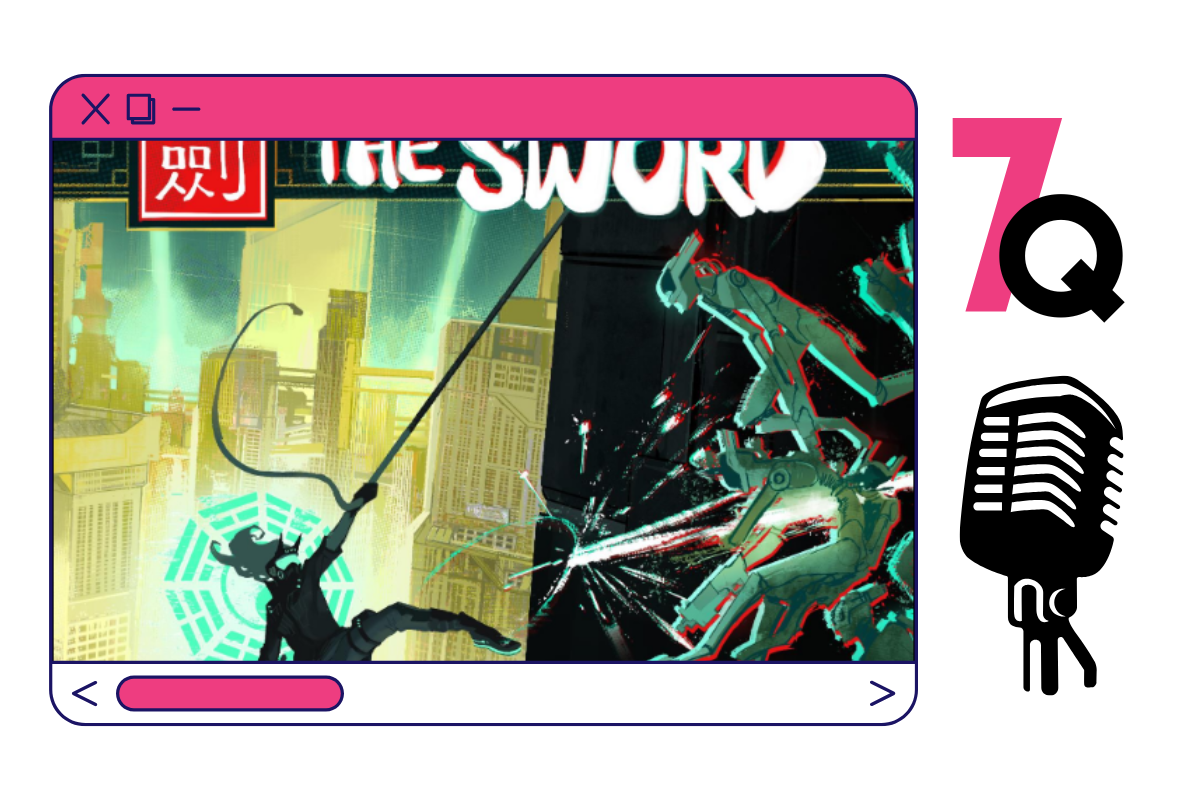
There’s something quite lyrical about the way designer Emily Zhu (朱保敬) has melded two seemingly disparate genres together in Ten Thousand Days For The Sword: the glistening, high tech streets of cyberpunk, and the fantastical, even mystical theatrics of wuxia. The RPG is set in Xiatian, a city characterized by a contrast of dingy slums and shiny skyscrapers, where protests break out as frequently as police crackdowns, and militia march the streets with impunity. Living amongst the populace — made up of thugs, refugees, factory workers, fishermen, and more — are martial artists known as youxia, many of whom belong to eight major Sects, from the Beggars’ Group to the Butterfly Sect. There’s a lot of martial arts, confrontations, and brawls involved. Threading through the rulebook’s passages are commentaries from fellow youxia themselves, as well as a smattering of Mandarin, as if easter eggs left for the benefit of Chinese players.
“Much of the Chinese in Ten Thousand Days is from the tradition of wuxia, or Daoism, or traditional Chinese medicine, etc. The words are only half as important as the context. Really, the whole issue is backwards: in order to understand the words, you understand the game. It feels ass-backwards to say it like that, but I haven't had any complaints yet. Or maybe I just can't understand them,” Zhu told Rascal in an email.
The joy of unfurling Ten Thousand Days For The Sword is in its extensive design and worldbuilding. Zhu takes abundant influences from wuxia classics — books written by beloved authors Jin Yong and Gu Long — as she alchemizes the essence of the genre within the crucible of a sprawling metropolis, one that also finally subverts the long baked-in exoticism of most fictional cyberpunk cities. “Jin Yong's work is the gold standard of wuxia for good reason,” said Zhu. “Gu Long is often considered his peer, but Gu Long's stories float in a sort of timeless dream, whereas Jin Yong's works are very heavily embedded into historical and political context. I wanted to avoid giving a player homework, but a setting without mention of where money or food comes from just rings a little hollow to me now.”
"Much of the Chinese in Ten Thousand Days is from the tradition of wuxia, or Daoism, or traditional Chinese medicine, etc. The words are only half as important as the context."
Xiatian is divided into districts that are home to a predominantly Chinese population; at one point, Zhu even included in the book a recipe for steamed fish with mushroom. “The central idea of the game arose, I think, from two or three tensions colliding at the same time. Ten Thousand Days For The Sword is a crossbreed between wuxia and cyberpunk: a genre tied to traditions, history, mysticism, and a genre of futurity,” said Zhu. “Those are also two genres heavily concerned with Asia, and it has long pissed me off how shallow and thin many portrayals are.” After reading the webcomic Kill Six Billion Demons, Zhu respected, but also disagreed with its portrayal of violence as inherently futile and malicious, and wanted to make a game that reckons with this concept. “In those days, the only way I had to work out the disagreement was to make a game where we could disagree,” she said.
Then, there’s the duels, of course. There’s a lot of emphasis on fights in Ten Thousand Days For The Sword, and that’s because violence isn’t only violence, according to the rulebook itself; it’s also communication, conversation, meditation, and play. In its most simplified form, you’ll need to overcome your opponent’s Stance, build up Momentum, and end the duel with a Finisher. But which fighting style you adopt, which is influenced by your chosen Sect, as well as a litany of factors from Elements to Techniques, can dramatically impact the way combat evolves. It’s an elaborate system that, while fascinating, can be difficult to digest at first glance.
Zhu admitted that there hasn’t really been any other RPGs or even video games she could draw direct comparisons to. “Cyberpunk wuxia seems to be an underfilled niche. Shadowrun is great cyberpunk, for example, and you can use martial arts in it; the CRPGs including Shadowrun: Hong Kong are very dear to me [...] But it's cyberpunk, and it's not wuxia. I have always found the greatest resolutions to be found from the greatest tensions. Quae intentio nisi ex unitate? [What intention, except from unity?]” she said. “Or perhaps I should say that Ten Thousand Days doesn't have any peers, yet.”
“The central idea of the game arose, I think, from two or three tensions colliding at the same time. Ten Thousand Days For The Sword is a crossbreed between wuxia and cyberpunk: a genre tied to traditions, history, mysticism, and a genre of futurity.”
That said, Zhu has shared that her influences are pretty eclectic, drawn from various experiences and reactions. “In this case those include the modular guns in looter shooter [video games], decades of playing and talking about Exalted, childhood memories of Hong Kong, the contempt tokens of Quiet Year, a Good Omens fanfiction called Demonology and the Triphasic Model of Trauma (which is how I learned to phrase the tension between cyberpunk and wuxia in the first place), and lifelong daydreams about knocking down the doors of power and shaking someone by the throat,” she said. “I watched a lot of Sekiro fights when I was building out the combat system, I built the Ways and Passages system largely off of Chuubo's Marvelous Wish-Granting Engine, and the Face system evolved from my reading of Dream Apart. Factions come largely from Blades in the Dark and its predecessor Apocalypse World. And much of my initial imagery for the game came from the movie Nezha Reborn.”
For now, Zhu shared that the current version of the game is a 0th edition, “an ashcan”, and she’s still hoping to add more to it, including art, layout, and more unwritten styles. But demands of real life beckons, and she decided that she had to cut the game loose. Yet, it’s also the very exigencies of current life that have inspired her to write the game in the first place. “I very much hope that people will take the game from me and make it their own; I put it under a Creative Commons license so that they could do so. At a time when nobody can agree what to do except that something needs to be done, in all things: strive.”
Responses have been edited slightly for clarity.
- If your game had walk-on music or a climactic needle drop, what song would it be?
Probably Stand Up Like a Taiwanese by Fire EX, but it's a close race with the arrangement of Decree of the Sichuan General in Kung Fu Hustle.
- If your game grew like a plant, what was the seed of the whole thing? And what about you made you the right kind of soil to receive and nurture that idea?
The seed of Ten Thousand Days For the Sword was a lot of arguments in 2019 and 2020, specifically about riots in Hong Kong and the US, broadly about the role of violence, broadly about Asia. Many of them were online arguments. Regretfully, what made me the planting-place is that I fucking love getting mad online, not engaging in the argument but brooding on it, and then spitting out several thousand words a few months later.
- If your game was food, what would it be?
There are already five recipes in the game! Well, four recipes and an etiquette manual. But Ten Thousand Days itself is probably century-egg congee. It wakes you up in the morning or keeps you going at night, is best enjoyed from a big bowl with others, will take any ingredients you add to it or go great with others. It's a little unpalatable to those who aren't ready for it. Aunties frown a little because they think the youtiao will inflame you. Well, we could all use a little flame in our lives.
- If your game was a machine and we could break it down into parts, which is the smallest part that you think best captures the essence of what you're trying to do?
From the rulebook:
THE SWORD
At the top of your character sheet, write a partial sentence: The sword is ____________. You don’t need to fill it in yet, but you will eventually.
- If we broke your game down into parts, what's the thing we wouldn't see? What do you think only emerges out of the entire thing moving together?
I made it to be intentionally modular, at least partially, because I love hybridizing pieces of games together anyways. But every piece is made to spur you forwards and hold you back. I think playing with only one or two pieces might let you get away with just one or the other. I want to piss you off so bad you start rewriting the game.
- If your game had to commit a crime, what crime would it be?
Arson.
You'd think the answer is something cheeky like treason or unlicensed weaponry or something. But people are terrified of arson. It's treated quite strictly. It is a risk, and if it executes on that risk and hurts people you can get extra charges of manslaughter and so forth. That means that arson, itself, isn't the harm. We're just scared of burning shit down. A set fire is unpredictable, uncontrollable, uncontained. Revolution, education, and liberation are all forms of arson.
- If your game was to win an Oscar, who would it thank in its acceptance speech?
My mom, my dad, and the Hong Kong Legislative Council of 2020.