If “frame a scene” sounds scary, try this one weird trick
Sorry, For The Queen, there’s a new beginner-friendly, card-based story game in town.

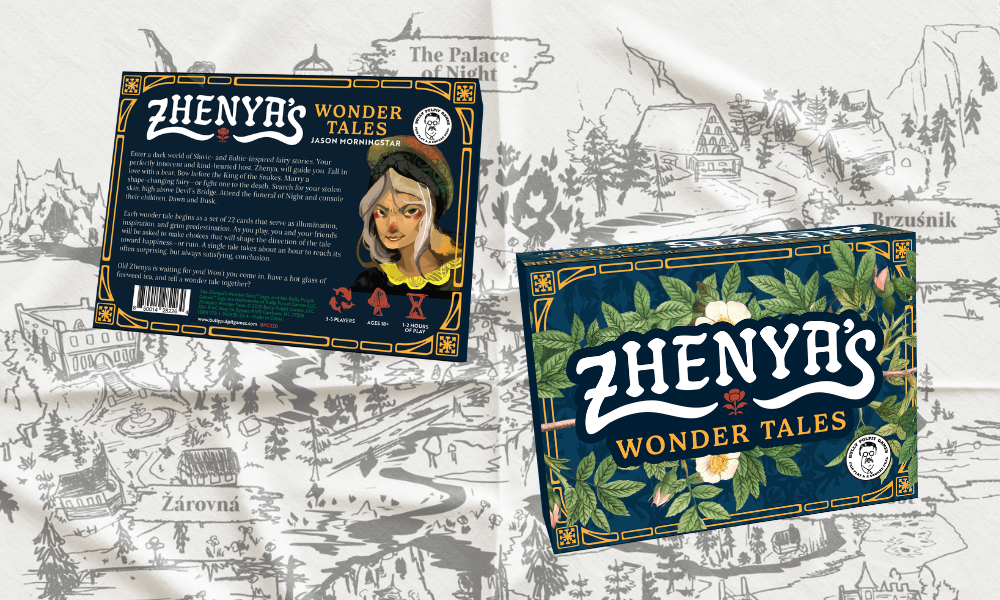
Zhenya’s Wonder Tales is an understated piece of design. The concept — Slavic fairy tale storytelling game — isn’t flashy. Its 16-page rulebook tells you very little, mostly unleashing you on the 100 or so physical cards and trusting you to go from there. The cards come in six sets for six fairy stories or wonder tales. Each set has an introduction, four characters, 16 move cards (three for each character, four more that are open to everyone), and that’s basically it. When it’s laid out in front of you on a table, it doesn’t look like much.
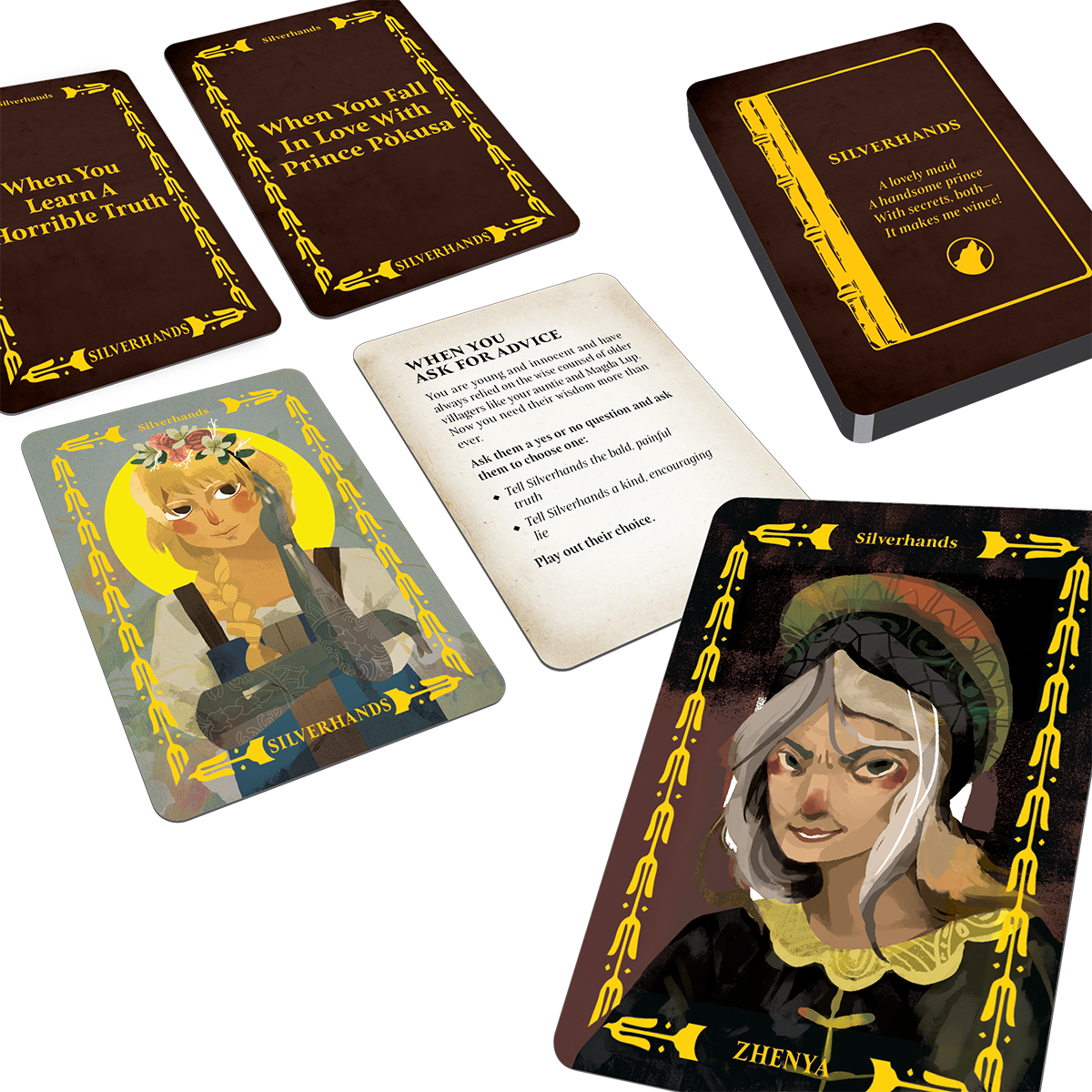
Actually, that’s poor phrasing — it looks visually stunning. The illustrations by momatoes (The Magus, ARC) are the perfect match for the writing, conveying fluidity, pathos, and hidden depth — all qualities of the game itself despite its humble table presence. But it’s easy to assume, as I did, that Zhenya’s Wonder Tales is minimalist because it's happy for you to do all the work. That it’s beautiful and simple and… nothing else. But like with these stories, there’s a lot happening under the surface.
Zhenya’s does require some work — more work than Desperation, a previous game by Jason Morningstar and Bully Pulpit, which is roleplaying-optional. In Desperation, you play cards with dialogues onto characters that could be saying them — story emerges as a byproduct, like molasses when you refine sugar. It’s just there, dark and goopy, despite you not necessarily trying to make it.
In Zhenya’s, there’s no card playing. Instead, once you pick from one of the four character cards, you frame a scene. But scene framing, like refining sugar, is a fun-sounding process that ends up being a bunch of hard work. It’s easy for a game to say “frame a scene”, pat itself on the back, and then go on a smoke break. The challenge is how to make “frame a scene” approachable to my mom.
Zhenya’s trick is to use moves.
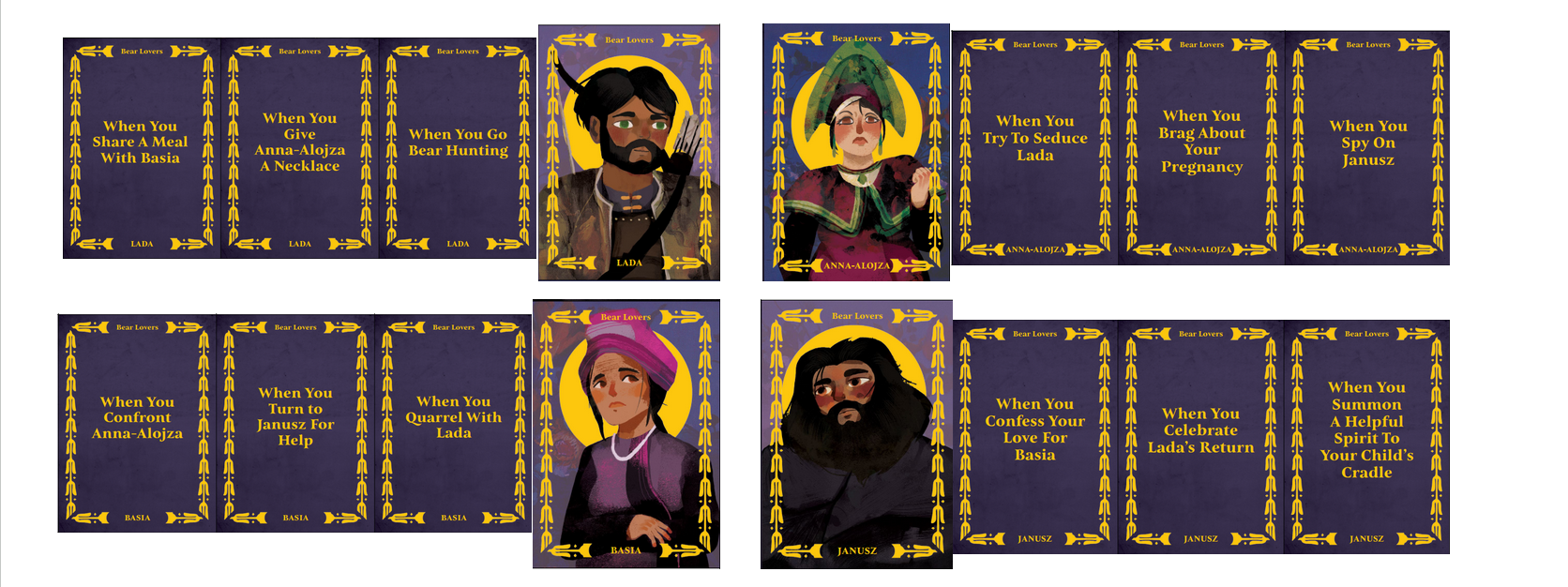
The move cards sit next to the character on the table and act like waypoints. Just as you might navigate a physical space using visible landmarks, players can use the moves to find their way through the story. These moves are the story to some extent. For example, in Bird Rivals, the first tale, the character Klara has the move “When you confess your love to Ondřej”. If you’re playing Klara,and you haven’t made that move yet, don’t think twice. The next scene is a scene where Klara finds Ondřej (pronounced On-dray) and says her piece.
Each move is typically made once, and the story is over when every move has been made. You can end earlier, of course — skipping any unused moves that don’t make sense. The moves work like beats and a timer, and the story just skips easily along until an ending finds you. It might take a play or two to get comfortable with following this rhythm, but you’ll get there. And just like Desperation, Zhenya’s builds complexity and replayability from the syncopation of moves and how you interpret the simple prompts on the back. Despite appearances, you won’t be playing the same story again and again.
One of the great tricks of this game is that it pretends there is a “correct” way the story should go. When you scan the characters and their moves, you can see a particular version emerge — probably a clichéd version. But then you play it, and regardless of whether the tale went as you predicted it, it becomes immediately obvious that there’s another interesting path it could’ve taken. And then you see another path, and then another, and then another. Where things initially seemed so precise and specific, you suddenly see openness and possibilities. In Bird Rivals, a card says “When you get married” but doesn’t specify who. It could be the two lovers, but there are reasons it shouldn’t be. It could be the original announced pairing. Or the two rivals. Or even the two other rivals.
This also gets around the heteronormativity of the source material. All these old stories are about husbands and wives, after all. But any “original” version of the story can still be subverted. Zhenya’s fits in with the ongoing cultural trend of modern fairy tale retellings, like Angela Carter’s seminal The Bloody Chamber to name an example. Just as those retellings play with tradition, Zhenya’s tales are also open to reversals, inversions, genre-bending, and other shenanigans. The game doesn’t tell you to do so, but when did that ever stop anyone? In a genre all about remixing stories, this game doesn’t need to waste its breath.
All that said, there is a particular joy in playing each story for the first time because Morningstar’s penchant for acidity sometimes catches you by surprise. A move will have a pleasant name, and you’ll flip it over to find the most savage couplet lying in wait. Hopefully you find them as funny as I did. You don’t expect to laugh playing dark fairy tales but you do! Or at least, you shake your head ruefully because it’s your own fault forgetting what kind of game you were playing.
It’s hard to not think that a fairy tale game, even a Slavic-inspired one, is going to be saccharine. Melodrama, cliches, and happily-ever-afters — these are stories for children, aren’t they?
Wonder is somewhat orthogonal to joy and sadness. Zhenya’s stories are not edgy, thank god. But they tend towards bittersweet. These aren’t morality tales… but if there’s an educational quality to the stories here, it’s that life is complicated, as are people, and things are often beautiful and sad at the same time. People find different things cozy — coffee shops, cats, power washing sims — but for me, this is it.