In Realis, Surreal is the new Real
Actually, it’s the old Real and here’s 3000 words explaining why.

There’s nothing new under the sun, but there are new suns. — Octavia Butler
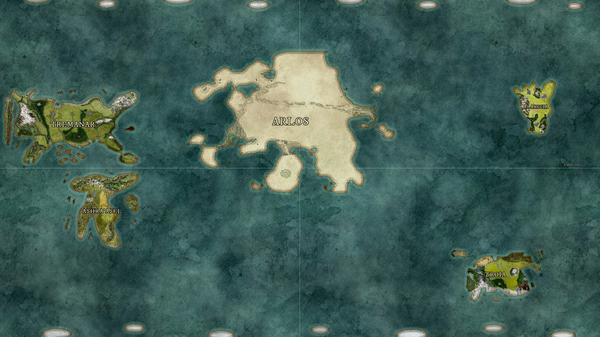
Realis is both a game and a place. It’s a reachable game — a science fantasy adventure — and an unreachable place — a planet that can only be gazed upon from its thousand moons. It is designed by Austin Walker, probably best known in tabletop spaces as the GM of long-running actual play podcast, Friends at the Table. But it’s also not designed by him. The conceit of the text is that Realis was authored by the Wordwrights, a group who use language to shape reality in mysterious ways. It was only translated by Walker (who uses language to shape reality on his podcast in an only-slightly-less-mysterious way).
When the Wordwrights try to capture Realis in their game text, they fail. “What we can offer,” they write, “is a faulty archive of Realis as we have experienced it, not as it fundamentally is.” This is not just about the impossibility of making a map that is the territory. Or, as the book puts it, “any accounting of a place (real or imagined) is endless if it is to be honest.” It’s more than that.
Even the number of moons, despite being surveyed as one thousand, is under question. “How can I know how many moons your Realis keeps when I do not know you?” they ask. The Wordwrights seem to believe that reality cannot be captured — that it’s about what is inside as much as it is about the outside. Instead, the game represents their attempt at capturing the “Narrasoulic truths” of their reality through design and mechanics. These truths they are trying to capture are real but they’re also more than real. They’re surreal.
Surrealism is a slippery term. And a broad one. So broad, in fact, that if you look closely at its spelling, you will find Realis nestled comfortably within.
In day-to-day conversations, we might refer to something unbelievable as surreal — a magic trick, a sunset painted in weird colors, a chance meeting with someone you were just talking about. But Surrealism was — or is — an art school and a political movement. Rather than being about unreality, it was all about reality. Like everything worth knowing, it's hard to define. And its history is full of contradictions.
One way to tell the story of the movement is to say it began with French poet André Breton’s Surrealist Manifesto. Breton and his aesthetic comrades-in-arms were young, hungry, and angry. Politically, the early surrealists were against everything worth being against — white supremacy, patriarchy, standing in lines at the supermarket. They protested the French colonization of Algeria and Vietnam, they pamphleteered with the Communist Party, and they organized mock courts in the streets and cafes of Paris to try former progressive writers who turned nationalist and conservative. Breton, playing the prosecution, would argue for the death penalty for these alleged traitors — maybe a little too passionately.
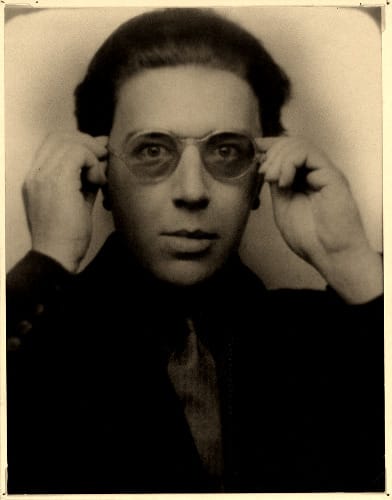
But it was Europe in the 1920s, and there was a lot to be angry about, especially for the young. The first World War had destabilized their view of the world. What felt solid was now soluble. Breton’s manifesto, like many, did not aim low. For him, the goal of surrealism was nothing less than to “transform the world, change life, refashion human understanding from top to bottom.”
As an art movement, it was always more about goals than methods. Breton’s methods revolved around harnessing or revealing unconscious thought by cutting through the barbed fence of reason. These techniques looked, almost by definition, nonsensical. But the goals were more poetic. He wanted to find “a certain point of the mind at which life and death, the real and the imagined, past and future, the communicable and the incommunicable, high and low, cease to be perceived as contradictions.” How long could that take? One Sunday afternoon? Two?
In his book, Why Surrealism Matters, Mark Polizzotti writes, “Breton noted that a work of art can be considered “Surrealist” not by its particular technique but by its ability to externalize a “purely internal model.” What intrigued him was the artist’s inner vision, the ability to make visible that “which is not visible,” rather than the skill with which line or color was applied to paper or canvas. “It is impossible for me to envisage a picture as being other than a window,” he wrote in 1925, adding, “my first concern is then to know what it looks out on.””
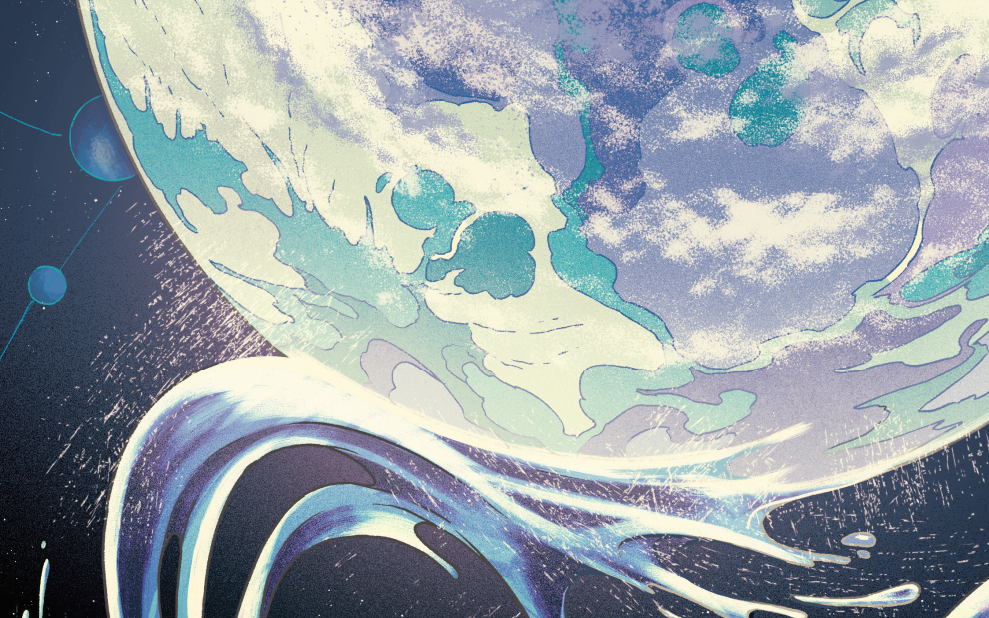
“When I peer from the port window of my chamber, I see Realis as an iridescent orb with the color of a robin’s egg, dashed with swirling clouds of white.” — Realis (Page 117)
Realis tells us what it's about. It’s a love letter to Kentaro Miura’s Berserk. It’s a game about how “characters, which begin iconic and archetypal, become increasingly specific over the length of a story.” More specifically, it is about “the power and vulnerability present in such a transformation.” In the game, sentences are the game mechanics. Players make characters represented by a handful of sentences that start out with the bluster and hubris of youth. They are absolute statements of identity.
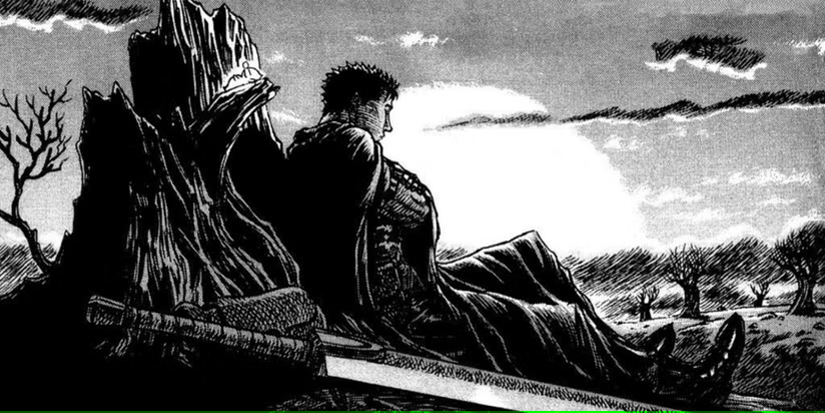
The Berserker, the first class in the game, carries the following sentence slung across its back: “I always kill my foe.” This sounds powerful but it is a lie, a wish, a dream. In this nascent form, despite sounding strong, the sentence is at its weakest. It has no nuance, no texture, no weight to it. When this sentence goes up against other sentences of the world, it will be tested. If the Berserker is faced against an opponent who wields, “I extinguish the flame of those burning with foolish ambition,” they will fail.
But as they wrestle with their failure, they accrue what they lacked before. The sentences grow in length and specificity. Maybe something like: when their back is against the wall, when they have sworn an oath, when their love is on the line. With each addition, the sentence is stronger and the character transforms from naive to self-aware. Which is a process that does not stop. The Berserker will never always kill their foe. But they will learn the conditions under which they are most likely to do so. And maybe eventually, if their sentence is pushed to its limit, they will become someone who is no longer defined by killing.
It’s not just the sentences of other people or groups that might act as obstacles for a character. There are also Moon Sentences, which are basically statements about the world itself. They’re statements about reality that apply as long as the character is on that specific moon. Characters will come into conflict with the world, with reality, and as the game puts it, “When two Sentences are in Conflict, the one which is more Real prevails.” But what does it mean to tell the world that you’re more real than it?
The surrealists weren’t a big fan of the real. Georges Henein was an Egyptian poet and writer who met Breton when he was a student in France in 1934. Back in Cairo, he fell in with a group called Les Essayistes and published an article titled, “On Irrealism.” He wrote, “Nothing is more useless than the real… The only true world is the one we create within ourselves; the only sincere world the one we create against others.”
Henein represents just one tentacle of the now-international octopus of Surrealism. In their monumental book, Black, Brown, & Beige: Surrealist Writings from Africa and the Diaspora, Franklin Rosemont and Robin DG Kelley chronicle the movement’s wider history. Within its pages, the surrealist criticism of the real becomes a global assault. The book zips through dozens of different countries across Africa, America, and beyond. But it begins with good reason in Martinique, the island nation in the Caribbean that remains a colony of France to this day.
Aimé Césaire, the legendary poet and political leader of Martinique, once wrote: “[T]he primary feeling of the black poet is a feeling of uneasiness, better yet, of intolerance. Intolerance of the real because it is sordid; of the world because it holds him caged up; of life because he is robbed of it on the highway of the sun.”

Césaire might not have identified as a surrealist, but his wife, Suzanne, did. In a 1943 essay, Surrealism and Us, she wrote “Many have believed surrealism dead… Childish nonsense: its activity extends today to the entire world and it remains livelier, more audacious than ever.” For Suzanne Césaire, surrealism was the “tightrope of our hope.” It was the artistic movement she felt would inspire the anti-colonial struggle of Martinique, giving her people the tools to think beyond how the world had defined them.
The surrealists were against realistic art because they found the real world miserable. They didn’t deny the misery but saw within it an ideology that trained people to believe that nothing else was possible. They wanted to be able to see past the miserable to the marvelous — and then realize it. "The true task of mankind consists solely in the attempt to bring the marvelous into real life", said René Ménil, another son of Martinique. To achieve this task, the surrealists felt there was no other option but to turn everyone into a poet.
Ménil also wrote, "Reality and the imagination are not opposites the way that being and nothingness are, but rather the way being and what will be are." The surrealists understood that imagination and the power to play with it have never been equally distributed in the world. That was the province of the few that were lucky enough to be poets. But they wanted it for everyone. Or to put it another way, with poetry would come freedom.
“Though Realis began only as a ludic exploration of the valor and vainglory so common in this orbit, we soon found that we’d built a sort of toolbox whose hammers and nails had more resonance with ‘game poems’ or ‘lyric games’ than we could’ve ever anticipated. Indeed, every new class is a poem, every new faction a sketch, every new moon a song.” — Realis (Page 123)
Realis is a game of words. In this sense, it follows in a long lineage of games like FATE, Apocalypse World, and Dream Askew/Dream Apart that asks players to revel in language — to hold phrases up like a T-shirt to see if they fit, to then stretch them nearly to the point of tearing. It’s not a game of skill, but there is skill required. Sentences must be constructed, interpreted, weighed, and balanced. The best sentences are so clear in their intent that to use them is frictionless, but at the same time they must offer the potential for wide application. When they’re too literal, they can feel specialized — hammers built for specific nails, useless elsewhere. But if they’re too vague, they become hammers that turn every problem into a nail. Transforming every situation into one where you simply do what you always do — reduced to pressing X to interact.
The Berserker’s starting sentences are blunt like the class itself: “I always kill my foe,” “I always carry an unstoppable weapon,” “I always learn through violence,” and “I always hurt those close to me.” These four lines are almost the entirety of the class design. If they are a cage, they are a tight one. The Berserker kills and hurts. But there is one pressure release valve. By learning through violence, the Berserker is given an escape — a narrow one — and they must take it.
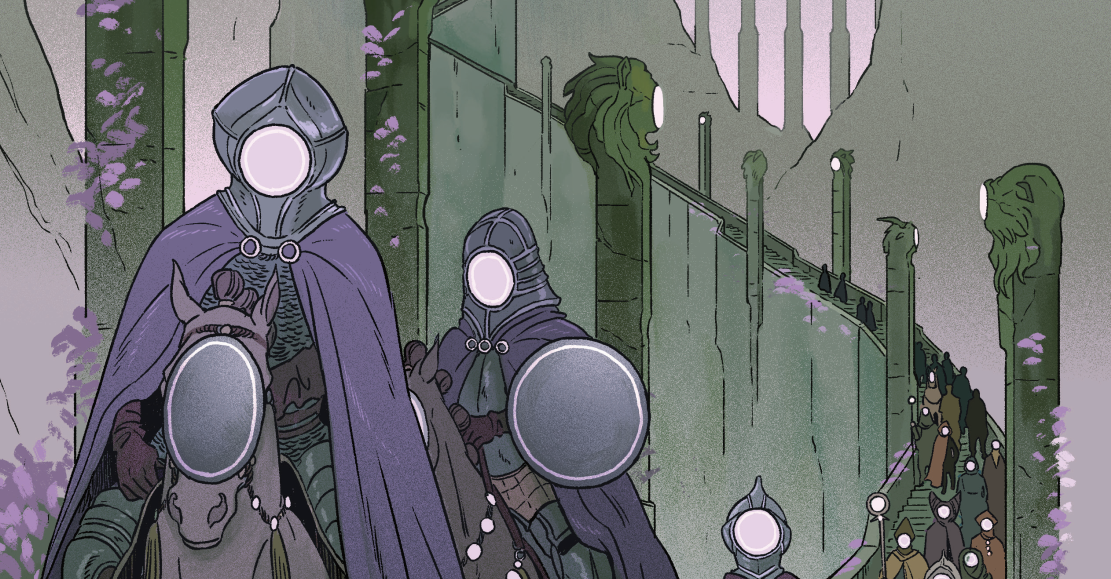
The Syzygist (pronounced ‘syzygist’) has a completely different feel. Its four sentences are: “I always read the future in the spheres,” “I always sense which prediction someone needs to hear,” “I always know how to ritually summon the power of the moons,” and “I am always bound by my own destiny.” These aren’t a cage, but they reveal the use of one — without a cage, there’s nothing for you to rattle. Except the line that aids with persuasion, the sentences don’t suggest the situations in which they’ll be deployed. If you’re looking for ludic handholds, the class offers little. If you want to tell the future, the game asks you to get your hands dirty.
In a similar vein, the GM becomes a poet-in-chief, deploying several compositions — the moon, the factions, the NPCs. They might end up writing and juggling a chapbook’s worth. Their poems have to provide texture to the players’ choices — grate like sandpaper or hug like a blanket, depending on the situation. What these sentences cannot do is honestly represent the world. That isn’t their purpose. They are elements of a story, and they cannot simulate reality because no such thing exists. Or rather, even if reality exists, it’s not a limit worth obeying.

In 2009, poet D Scot Miller wrote The Afrosurreal Manifesto. In his own words, it’s “a declarative and evocative poem” meant to speak directly to manifestos of the past, like Breton’s Surrealist Manifesto as well as the Futurist Manifesto that came out of Italy in 1909. Using a term coined by literary icon Amiri Baraka, Miller connects the work of dozens of African-American artists into a movement — from Basquiat to Toni Morrison to Prince to MF DOOM. By extending the real world, these artists were making space for themselves. But they also existed already, that’s just a fact — which means the world was always wide enough to contain them.
Miller explains the goals of the movement with electric musicality: “Afro-Surreal presupposes that beyond this visible world, there is an invisible world striving to manifest, and it is our job to uncover it”; “Afro-Surrealists use excess as the only legitimate means of subversion, and hybridization as a form of disobedience”; “The Afro-Surrealist life is fluid, filled with aliases and census-defying classifications”; and “Afro-Surrealists create sensuous gods to hunt down beautiful collapsed icons.”
Miller’s agenda was explicitly counter to afrofuturism. “What is the future? The future has been around so long it is now the past,” he wrote in the manifesto. In a 2016 article looking back he added, “Though the first Surrealist Manifesto came fifteen years later, if you placed Futurism against Surrealism, it’s clear that Futurism and the illusion of progress overcame Surrealism. Afrofuturism began to reflect the same love for speed, the same belief in the superiority of technology over craft, and seemed to be working towards establishing nationalism within its core tenets.”
By 2018, Miller’s ideas were very mainstream. An article in the Guardian said we were in a “new age of Afro-surrealism”. Movies like Sorry To Bother You and Get Out, and TV shows like Atlanta were being called hallmarks of the genre. But at the same time, Miller’s role was erased from the conversation. In 2024, he wrote, “The number of times my name and my manifesto aren’t mentioned far outweigh the times when they are, and the original intent and references of the document have been absolutely obscured, mostly so others can claim what they truly have no claim over and turn it into white-led, Black-only capitalist enterprises, and not the Black-led multi-racial coalitions that the manifesto seeks to inspire… Afrosurrealism may not be dead, but in its current perverted iteration, it’s certainly dead to me.” In just 15 years, an arc resolved from start to finish. Real or not, story-shaped things aren’t always satisfying.
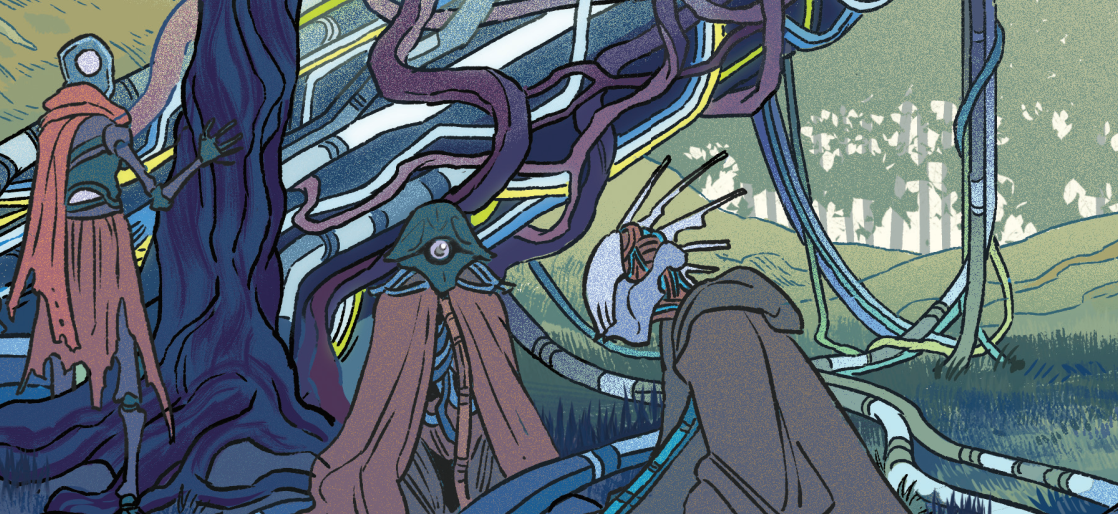
The shape of play in Realis resembles an art school argument. People sitting around, discussing something too big for their hands to hold, bandying sentences at each other none the less. To start with, their claims might be postures — exaggerated, bombastic, or provocative for the sake of it. But over the course of the conversation, they are tempered down by the words and experiences of others. They become more nuanced but not blunt — the awkward edges are exchanged for a more deft handle. They become something that can be wielded to strike their target precisely — not harming just anyone who happens to be in their vicinity.
Like so many arguments, the form that Realis takes can be very frustrating — to make it work takes practice. You have to relearn techniques, substituting all prior gaming tools with words, words, words. How can you make soup with just one ingredient? The game is humble enough to understand the scale of what it's asking players to do, calling it “an act of magic.” It asks a lot: If you're not already a wizard, become one. If you don't already have the soul of a poet, cultivate one. It isn't impossible, it's what the surrealists dreamed for you — a full membership in their Surrealist International.
The many wide open spaces in the text of Realis don't seem to just be a function of it being an ashcan. In multiple podcasts, Austin Walker has repeated the call to change everything that needs changing, to build what needs to be built, to make Realis into raw material, to make it yours. This is a common tune — often played loud to cover up the lack of some design element. But Realis is complete enough, confident enough in its design, that its gaps warrant a closer look.
The surrealists used to play games too. Exquisite Corpse is one of the most famous, but there’s a whole lot of them. In their book, Rosemont and Kelley write that, “In surrealist games… play is regarded not as a matter of power, winning, and losing, but, rather, as a joyful collective dialogue and a source of insight, discovery, beauty, and laughter.” In a sense, just as all roleplaying games have a queer aspect, they have a surreal one. They play with the real, aiming to create something more than that.
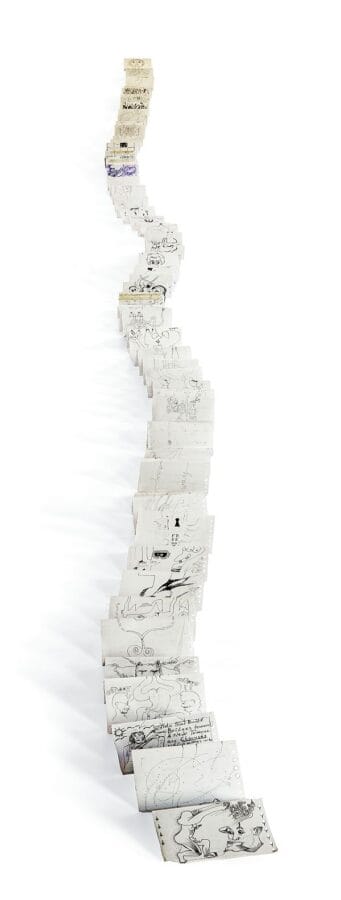
Ted Joans was a jazz musician, beatnik, and surrealist but is best known for his 30-foot chain of drawings called Long Distance Exquisite Corpse. From 1976 to 2003, Joans took it along with him on his travels, amassing more than a 100 contributors along the way. Every person who added to it didn’t see what came before. The end result is bizarre but beautiful. It’s a manifestation of a community — the people who surrounded him. Maybe this is what Realis wants to do: summon a community into being, summon enough people to populate its world. The first Realis game jam happened almost immediately after the ashcan’s release with designers contributing more than 50 new moons. Given that the ashcan starts with only three and a half, that’s an explosive expansion. Maybe 1,000 moons was a provocation. But maybe one day, with enough hands, we could create all of them. Wouldn’t that be marvelous?