Kenna Alexander and Shanna Germain team up to adapt the award-winning Between Earth and Sky series
Rebecca Roanhorse’s unique world full of political intrigue and epic fantasy is coming to the table.


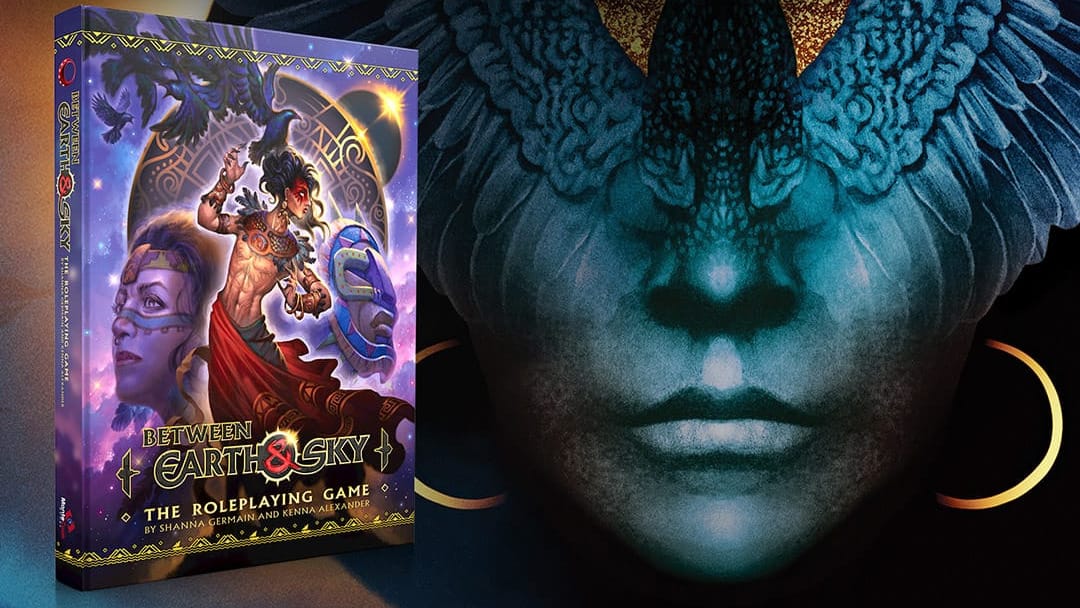
Monte Cook Games’ (MCG) latest title, Between Earth and Sky is an adaptation of a set of novels by Rebecca Roanhorse that won the Hugo Award for Best Series in 2025. The tabletop RPG’s seed was planted when Kenna Alexander was researching the world of Coyote and Crow, her own game set in an alternate future where America was never colonized. Alexander discovered Roanhorse’s first few novels and saw the potential for a game right away. “I was an immediate fan,” she told Rascal over email. “She does the kind of world-building where you end up wanting an entire encyclopedia of all of the incredible places, people, and cultures you get to peek at.” By the time Coyote and Crow was ready for release, Roanhorse had released Black Sun, the first of the series that became Between Earth and Sky.
Alexander knew she wanted to work with Roanhorse some day, but she was also wary of tackling a licensed RPG on her own. Working on Coyote and Crow and other projects kept her busy for close to five years, and the adaptation idea was put on hold — until now, that is. Earlier this year, Alexander contacted Roanhorse and her agent, and then brought the proposal to MCG, which has previously reaped great success with licensed games lines for the Old Gods of Appalachia and Magnus Archives. MCG jumped at the prospect of working on the project with Alexander. “I love the folks there and have been friends with them for some time,” Alexander said. “I would have been fine just playing matchmaker, but both parties were enthusiastic about having me involved in the project as well.”
Shanna Germain, co-founder and senior designer of MCG, will helm the project. Leveraging the framework of the Cypher system, which has its niche as a narrative engine within traditional RPGs, the appeal of the Between Earth and Sky game is about bringing a unique world to life and facilitating grand character arcs for players. The world of the books is inspired by different Indigenous cultures (Polynesian, Yucatec Maya, and Tewa, specifically, according to a review in Strange Horizons) where the gods, previously shut out by humans, are now returning to active and destabilizing presence in the world through mortal avatars.
Germain described the core of the game to Rascal as all about the line between destiny and agency. “The big goal is like, how do you fulfill your prophecy that's given to you by some celestial God while retaining yourself?” she said. Each character has a personal divination while the group is bound together by prophecy that has a ticking clock. “Your divination as a person, as a character, might be very different or at odds from your group prophecy,” said Germain.” I think there's going to be a lot of cool intrigue and shifting and maneuvering.” It’s a race to resolve these conflicts before the timer runs out.
It’s still early days with the release date only scheduled for early 2028 but given the game uses Cypher as a base, players can expect the core of the design to be around character options. The big challenge that the designers are looking forward to is adapting the magic system in the books which feels rooted in culture and society, rather than the mathematical logic associated with traditional RPGs.
Germain has a unique sensibility to her work that often flies under the industry’s radar. Her first major project was No Thank You Evil, a game designed for families to play together, building on her experiences struggling with social cues when she was younger. She also designed We Are All Mad Here, a game that reinterprets fairy tales through the lens of mental illness, that leverages a degree focused on post-traumatic stress disorder, among other things. Neither of these are easy projects to pitch but emerged from a culture at MCG that allows the design team to chase their passions and demonstrate commercial viability as they go. Similarly, Between Earth and Sky was also borne out of shared creative values and passions.
All these projects naturally flow out of Germain’s industry origin story, which was precipitated by a discussion she heard on a public radio program. “These two women were saying this new study had come out that had shown that the vast majority of the growing number of people playing video games was women in their thirties who were super self-sufficient or have their own businesses and were wildly successful,” she said. “And they were just being like, no, that's not possible. I don't know any women like that. And I was sitting in the car thinking: That's me. I am that person. Right away, I was so grumpy about it that I started working for the World of Warcraft magazine because it suddenly made me aware that there wasn't enough representation of women. And particularly, at that time, I thought I was older, even though that was 20 years ago.”
For Alexander, the game is another opportunity to highlight a different kind of Indigenous story. “There are so many incredibly creative Natives out there right now with art and stories to share,” she said. “But many of us don't get any platform to share them, let alone ones the size that Rebecca and I have managed to attain. So right away, I think there's a sense of kinship when Natives see each other working in fiction, whether it's horror, Indigenous futurism, or fantasy circles. There are a growing number of us who yearn for stories that do more than examine current and past Native traumas or real-life issues. We need those stories, but we also need to feel hope and wonder, and to share these incredible imagined worlds we're carrying with us.”