Lessons on play from Jerry Gretzinger and his ever-expanding map
A world composed of more than 4,000 individual paintings arose from the act of ritual play.

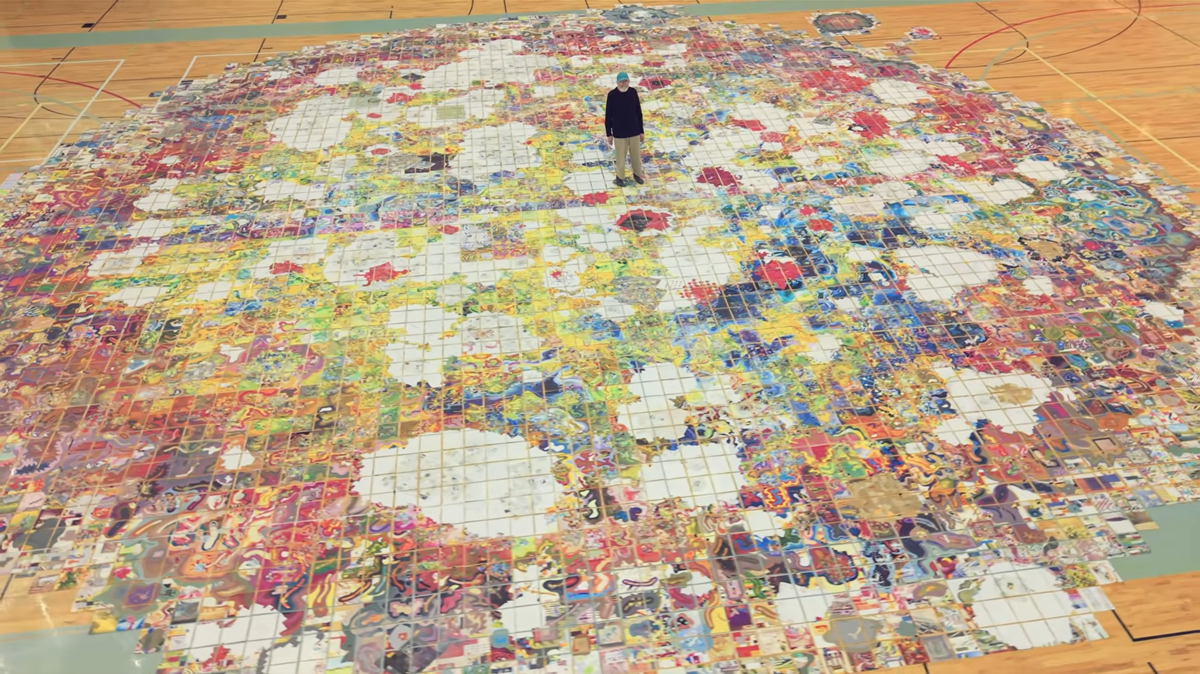
People Make Games’ latest video features Jerry Gretzinger, an artist from Michigan who has spent the majority of his life simultaneously playing and designing his own mapmaking game. One letter-sized panel at a time, the 84-year-old man has been illustrating, collaging, painting, gluing, planning, and annotating an imaginary world of arresting proportions — PMG’s Quintin “Quinns” Smith estimates the size when they recorded at 4,100 sheets.
The documentary is worth a watch for its portrayal of Grezinger and his relationships with the map and — through it — creativity, memory, and mortality. (“I do everything as if I’m going to live forever,” he said at one point. “That probably not going to happen, but it’s a nice approach, I think.”) It also bears emphasizing that the map is not a massive, contiguous thing hanging on the wall of a barn clinging to the shores of Lake Michigan. It took two dozen people three days to transform the inventory of a modest home office into a technicolor representation of someone’s private world.
The PMG crew understate Gretzinger’s relationship to play — intentionally or not is hard to say. Jerry’s Map, as it’s colloquialized by museum exhibits, a dedicated subreddit, and his own website, is absolutely a game. And it can teach us a lot about the tabletop hobby’s own play culture.
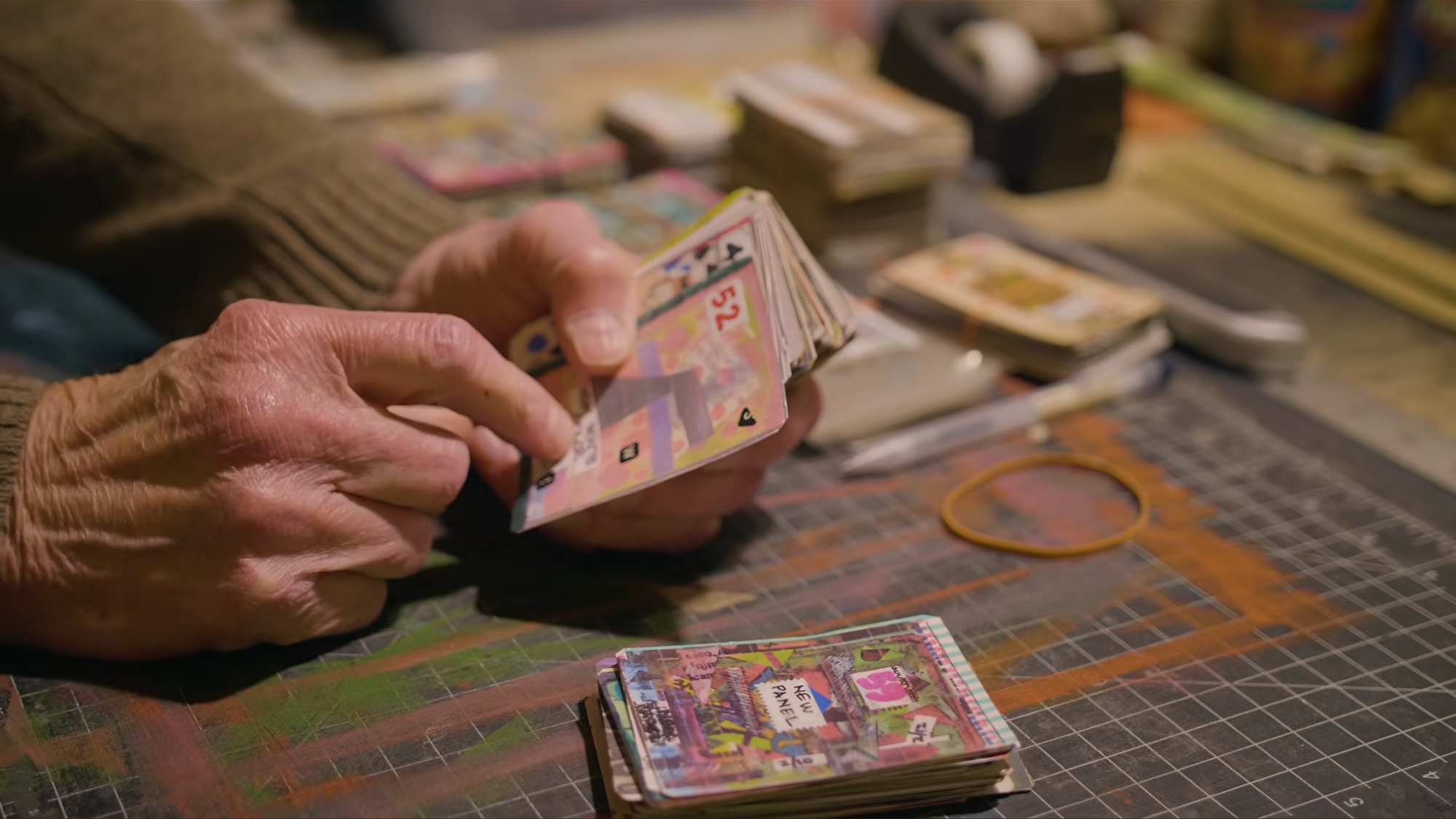
We are introduced early to Gretzinger’s process, “a ritual” according to Smith, which involves a deck of cards layered with a mosaic composed of paint and instructions. Flip a card and follow the prompts; they both indicate which panel to work on and what Gretzinger must do to it. Spatter it with paint, perhaps, or mix a brand new palette color. Another card might dictate creating a new panel, or instruct Gretzinger to give the current panel and its eight surrounding neighbors to wife Meg Staley for screen printing. Sometimes, the deck changes itself through prompts that add, remove, or shuffle cards — because, of course, it would be anathema to modify the card order unless prompted.
This is Gretzinger’s untitled game in its structural totality. He is religiously dedicated to following the cards’ instructions, even when he isn’t pleased with that day’s draw — he hates journaling, for example. The game has flourished holistically for long enough that Gretzinger can’t always remember what inspired the rules. At one point, he reads aloud a prompt to add a 1-inch checkerboard of neutral colors to the current panel before staring past the camera and into the middle distance.
“What was I thinking?” he asks himself with a chuckle.
There is a rulebook, but it has been altered with as much laminated history as the map. Penned instructions in the journal have been redacted by a tapestry of paint palettes so thoroughly that the finger-worn pages crinkle when they turn. Gretzinger didn’t say how often he references this book, but I’d wager it isn’t very often. Maybe only to record amendments and shifts for posterity. The book and map are both outputs, decades-old artifacts of self-directed play.
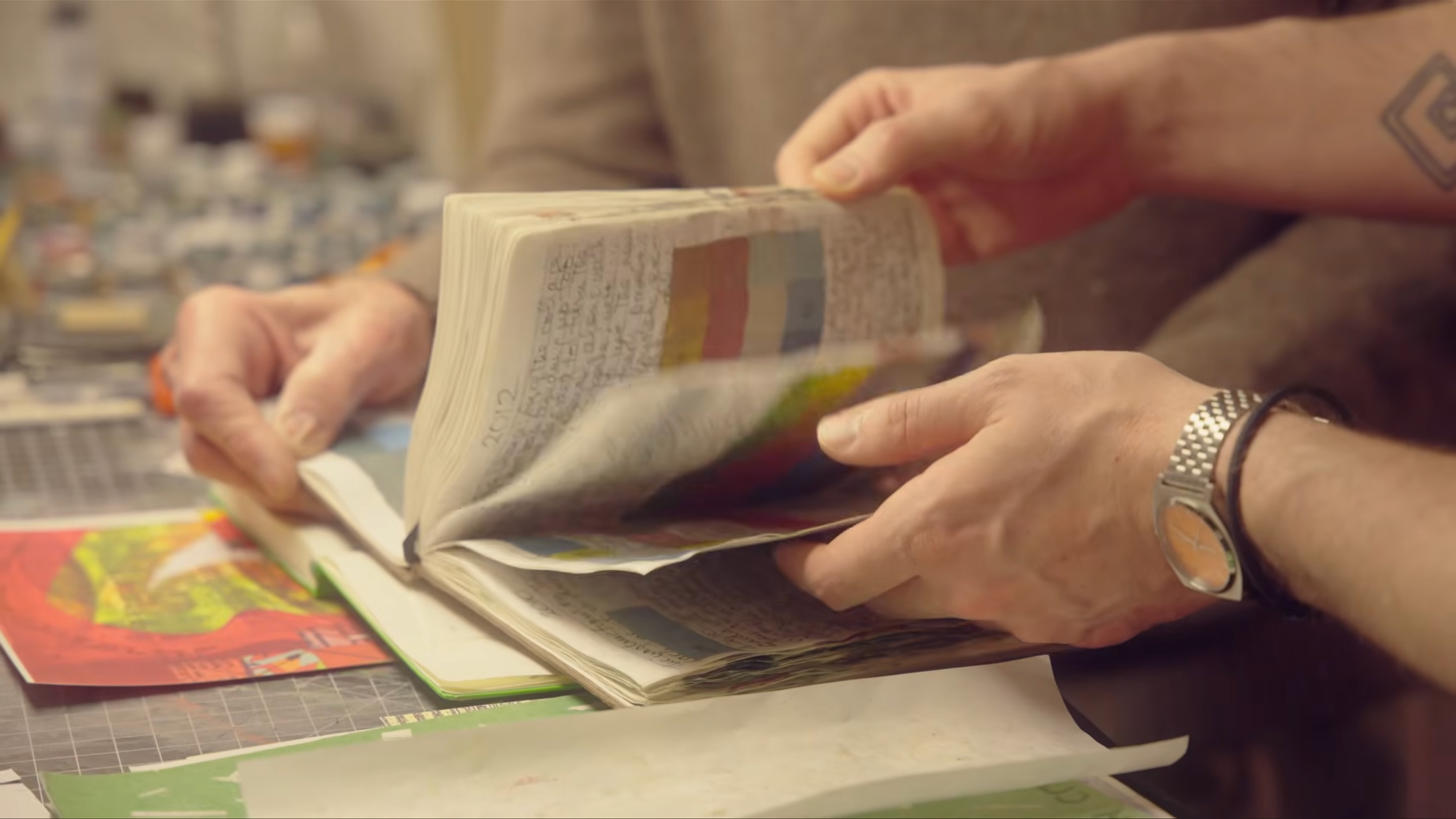
What can we learn from this? For starters, it’s okay to loathe journaling prompts. (Validation!) Additionally, the best oracle isn’t one that comes perfected out of the box but instead shapes the player as much as it is shaped in return. I’m increasingly convinced that games and players should cultivate each other and become something wholly singular. Solo RPGs, especially mapmaking and journaling games, already swim in these waters by instructing players to alter their tools with pens, stickers, and more extreme implements. House rules are the common example for traditional RPGs, but assume that the rulebook persists in a perfect form after the game is done. I want my version of Dungeons & Dragons or Lancer or Mothership to be indelibly marked by interaction such that it cannot resemble the book used at your table. I want to read stories in the cuts and stitches.
Gretzinger doesn’t so much rely on systems as he understands that sustained creativity needs guardrails and structures. Like water, unbound imagination tends to flow out in all directions before dissipating — a beautiful but brief chaos. Smith seems a bit consternated when, upon suggesting that a curving yellow streak evokes a toxic river cutting through the surrounding bright-red landscape, Gretzinger unenthusiastically replies, “Hah… yeah,” before turning back to his collage material. But it’s because Smith’s attempts at improvisation keep banging directly into ironclad girding. Every opportunity for quaint collaborative play has already been colonized by years of Gretzinger’s own exploration. Trust the process.
Jerry’s Map is in many ways the ultimate dream and nightmare of roleplayers — the neverending session, the pinnacle of worldbuilding. But Gretzinger understands the exercise differently. The play is the game, and whatever comes out is valid. There’s a refreshing lack of pretension to the version of ‘doing hobby’ that he practices, unburdened by expectations or categories, so much so that the documentary never labels his artistry as play. But it is, not in spite of Gretzinger’s professional training, gallery exhibitions, and Etsy shop, but in conjunction with it all. Is art not play? Is the opposite not also true?
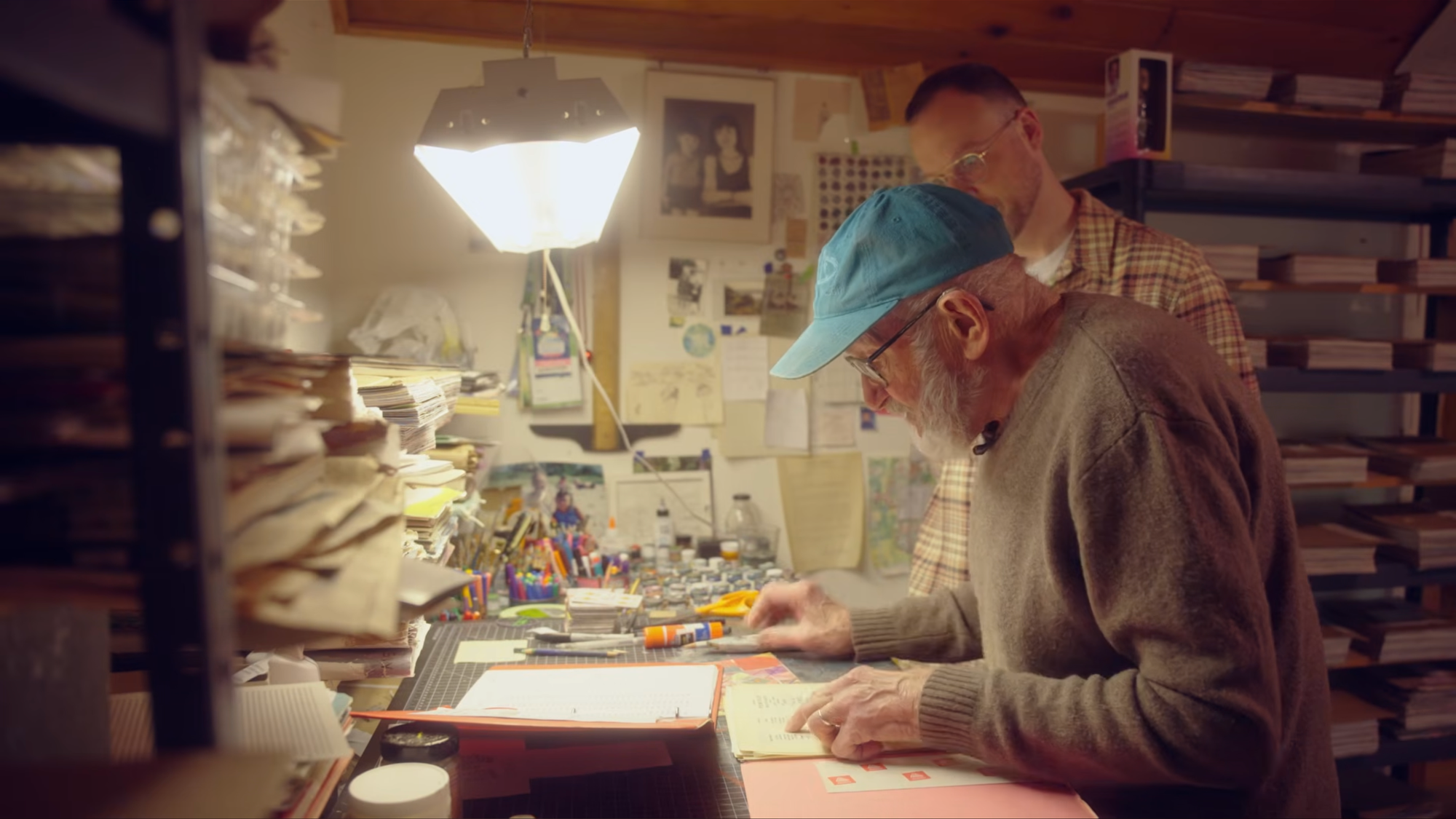
Smith accidentally released an invasive thought species into the garden of Gretzinger’s mind when the former said many people would understand the map world’s dimensional connections, creation theories, and void cosmology as lore. “That’s cool!” Gretzinger said, smiling like a kid holding a frog. “I like knowing that term.” Smith has the awareness to look a little abashed.
Perhaps it is naive to admit that watching Gretzinger play a tabletop game nearly every single day — seemingly without sharing my definition of ‘play’ or ‘tabletop’ or even ‘game’ — was refreshing. He is unconcerned with using the “best” system. He cuts and glues incautious of what the panel will look like, preferring to contemplate the results. Despite knowing what Reddit is, he is unaware of discourse. He reminds me that play is a fundamental human experience, and games exist chiefly to help us channel that urge. I am too often weighed down by seeking right or correct, or even good, play when all I need is friction.
There’s one final lesson to take from PMG’s video, which is the beauty of sharing games and allowing others to transform them. Three days of sticking panels to the gymnasium floor of the local Strongheart Center bound the volunteers and documentary crew into a team with rituals, roles, and a shared goal. The lone artist creating Jerry’s Map and the group assembling Jerry’s Map can be understood as two games played with the same pieces, comprehending different facets of the same artifact. I imagine how magical it must be to alchemize someone else’s artistry by mere touch, and then I remember that’s what all of us do every time we create stories together at the table.