Path Apparatus tackles lifepath systems through scholarship and play
We discuss how lifepath games invite introspection and imagination.


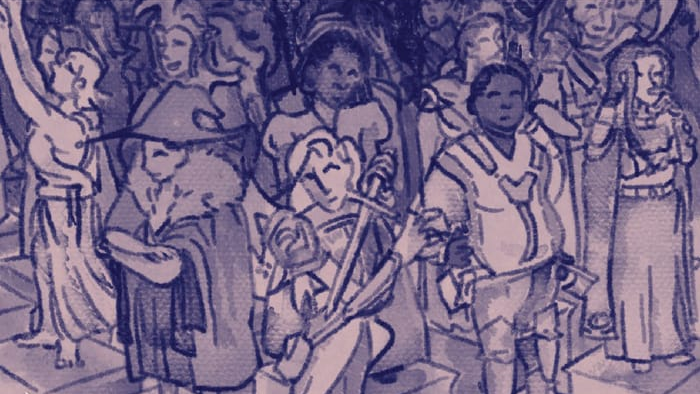
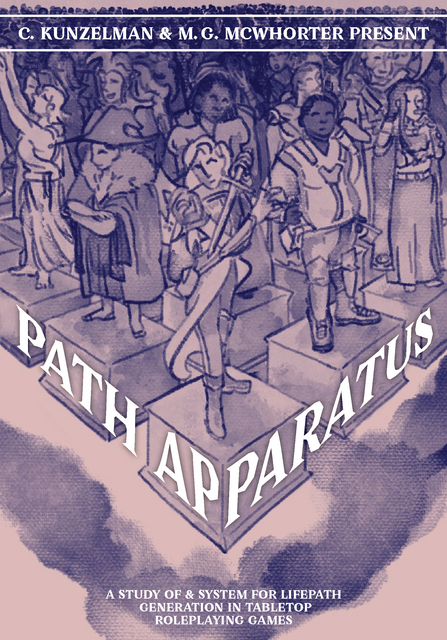
Path Apparatus, an upcoming book by Cameron Kunzelman and M.G. McWhorter, is a bit of an anomaly: it’s equal parts treatise and supplement. The subject is lifepath systems, a way of transforming the character creation process into play, normally accomplished with dice rolls introducing errant elements into characters’ life experiences. Beyond just mechanical attributes, lifepath systems can determine the trajectory of your character’s history, from upbringing and personality to even careers, which adds unexpected depth into these backstories. But rather than pontificating about the merits of their own design, the duo also examines the characteristics of 20 lifepath games from the sci-fi classic Traveller to Maelstrom Doomsday, and how these findings have shaped Path Apparatus as a new lifepath supplement.
This approach is perhaps due to the authors’ backgrounds as writers first rather than game designers; Kunzelman is a seasoned games critic (and occasional contributor to Rascal), as well as an academic with a focus on science fiction and video games, while McWhorter is a poet and short story writer. “[McWhorter] is just a person from a radically different universe who ended up working with me on the research,” Kunzelman told Rascal in an interview. Writing duties for Path Apparatus were split between the two, and the illustrations were predominantly created by McWhorter.
In this interview, Thomas speaks with Kunzelman to find out how the two authors came together to craft Path Apparatus, the quirks and appealing oddities behind the lifepath system, and why Kunzelman is such a lover and a hater of Pendragon. And if you wish to learn more about what inspired Path Apparatus and his thoughts on the myriad games that have incorporated the lifepath system, you can listen to the full interview in this podcast:
This excerpt has been edited for clarity.
Thomas Manual: Would it be accurate to say you have a professional interest in tabletop games?
Cameron Kunzelman: I've been writing, reviewing, and talking about games since 2013. [That was] the first time someone paid me to do it, but I've been doing it for several years before that as part of the video game blogging world. I would say 90% of what I wrote up through 2021, 2022 was in video games, and centered around video games, and engaged with that. I wrote for what was Paste Magazine, and then Paste Games, and then, for a very short amount of time, the AV Club. I had a column at Waypoint for many years where I was writing weekly about this stuff, and I have a different life outside of being a public critic of these things, where I'm a game studies scholar. I work on games and science fiction, so I think about games all the time, but for the most part, I've written a couple books about video games.
I say all of that to say, I've always been a big tabletop person. I've played D&D and games in the TSR-verse, I would say, for most of my life, and have been writing about Magic: the Gathering for a long time. I've always been in the tabletop space, but it was really only [in] 2021 that I dove in and became really invested in thinking about the contours of the tabletop space.
We recorded the actual play podcast over on Ranged Touch. It was during this era called Sword Coast: Coast 2 Coast, and maybe that was a little bit of a prompt of interest, but I covered one of the events that Wizards of the Coast did in the mid-2018 about actual plays. Many of the things that I make or want to produce, I went and looked at how it was being done, and thought, “Oh, this is a really interesting thing. Could you do this, not doing what any of these people do?” Not that they're wrong, but there were interesting parts of it that I thought no one else was particularly interested in. Sword Coast: Coast 2 Coast was this experiment of, could you do actual play without continuity, but not as just a series of one-shots? The answer was no. I couldn't figure it out. I think we made a fun little show, but it was very hard; it was very provocative to me.
Since that time, I have really dove into tabletop. I've written for Rascal a few times, I've covered several events, and even more being into tabletop RPGs, I've really jumped straight into miniature wargaming, and the creative practices of miniature wargaming. I have strong opinions about what makes a good miniature war game, good and bad, and I've played enough and played a lot. But the vast majority of my time is devoted to the creative practice of that, and talking to people who do that: the crafting, the painting, the kitbashing, all that.
"I say all of that to say, I've always been a big tabletop person. I've played D&D and games in the TSR-verse, I would say, for most of my life, and have been writing about Magic: the Gathering for a long time."
Manual: Is there any reason Path Apparatus was the project you’re working on, or did you just fall into it?
Kunzelman: Path Apparatus is a really interesting confluence of a bunch of different things. I guess the first thing I'll say is, I don't think there's anything that I've ever written about as an aesthetic object that I have not done. Sometimes that's professionally, sometimes it's non-professionally, sometimes that's to great success, and sometimes that's to immaculate failure.
But I have a really hard time understanding how to talk about something without understanding some of the processes involved in it. And I don't mean that in a [way] like, only makers can do the thing. I do think it helps me a whole lot to understand, or at least have a schematic, big structural thought about what it takes to put something together, what the pieces are, and how that happens.
And maybe that's just for me. I'm often reading extensively about whatever I'm working on or studying. I've collaborated with Chris Hunt many times to make films, and I've written a lot about film, and I've made several video games for a while, but I haven't in a long time. I've made several tabletop things, whether that's writing complete adventures that just never went anywhere, or they never saw the light of day because they were for me. I would say I've done a lot of game design work. I've done some consultancy work in that realm too, so I would say I've made a lot of tabletop stuff, but the things that I think are worthwhile to put out into the world, or that would do something for me to be put out into the world, I would feel like it would be important, not just for my own internal process, but to get it out into hands — they're relatively thin. The release of an object is not that important to me overall. The creation of the thing does more for me.
"Sword Coast: Coast 2 Coast was this experiment of, could you do actual play without continuity, but not as just a series of one-shots? The answer was no. I couldn't figure it out."
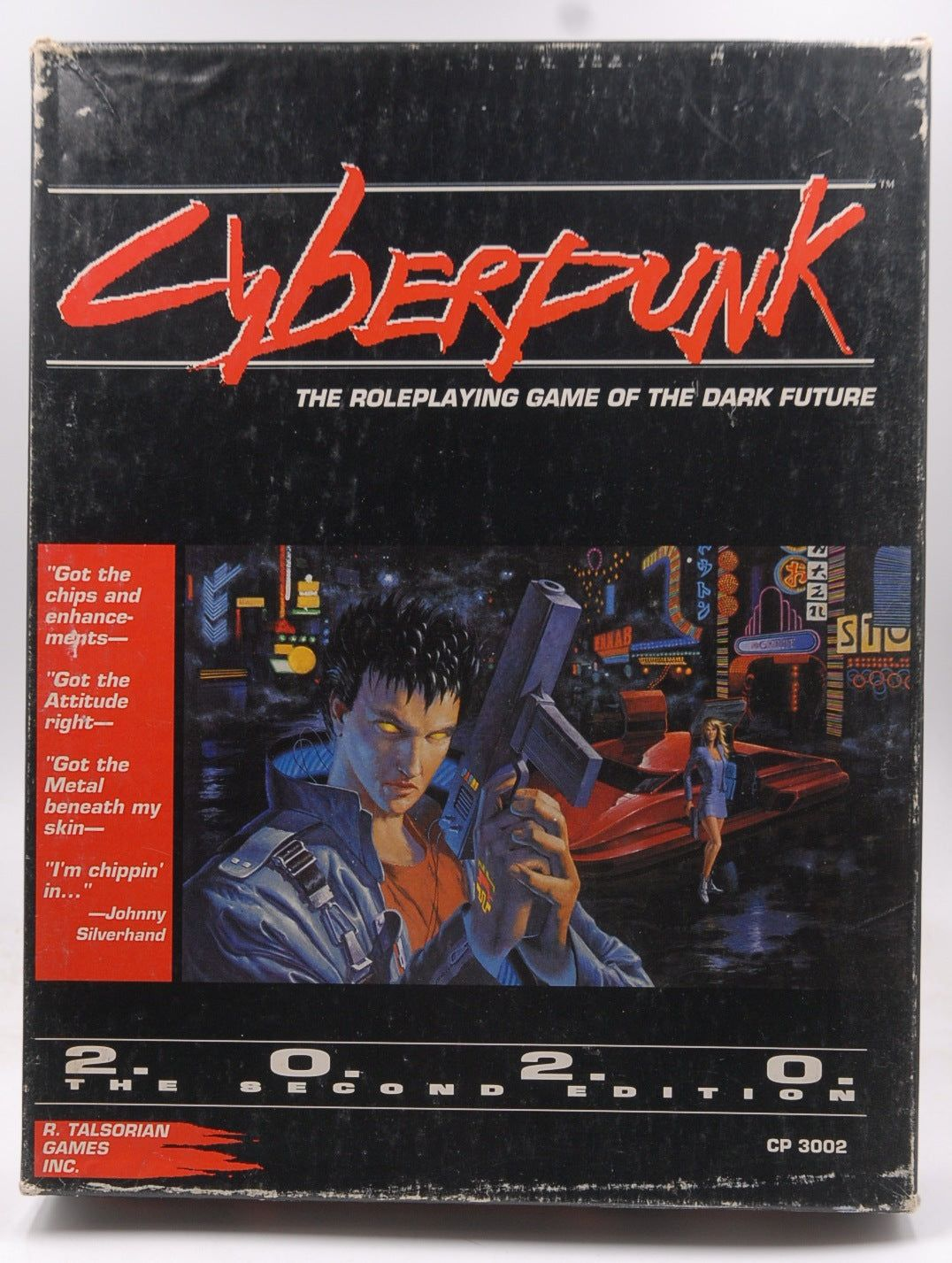
No one's looking for the next RPG from me. People are coming to me, hopefully, to read interesting thoughts, or listen to me talk on podcasts. I don't feel impressed upon to do that. So Path Apparatus comes not really from a desire to put a thing out, necessarily, at least from the beginning, but it came from a research project that M.R. McWhorter [and I] were working together [on] last year, and we spent several months. We worked through and read through about 20, give or take, different lifepath games. That's, of course, the classic Cyberpunk, but Maelstrom Doomsday was a really important one that came out of that for us.
We had the opportunity to write a research paper, and we did not have any investment in doing that. That was not a thing we wanted to do, because we didn't have to. There was no forcing mechanism to it. What we ended up doing was making our own version of these things, taking the parts of all of them that we liked the most, and squishing them all together into one lifepath book.
Manuel: What is it about lifepath games that you find fascinating?
Kunzelman: The interesting thing about lifepath games to me, across the board, is that famous one that people talk about. The good old classic is Traveller [where] you can die in character creation. It's a meme within the world of TTRPGs, but what's very special about Traveller is that it’s actually kind of common to have done that, it's more likely if you go down a particular military route. You can die in character creation, but it's actually after a bunch of decisions you've already made. You've already begun playing when you die in character creation.
Cyberpunk has similar things going on. Every time you're making these random rolls, you're making really interesting choices about how you want to characterize those charts that you're rolling on into your character. Doomsday Maelstrom has probably the one that was the most influential on us, which is that within that game, you both are rolling for a series of jobs that you proceed through, so it's not like life events that happen to you, but you're a woodcutter, you roll on the chart, you have this life event happen to you, you roll on the chart again, you have an exit chart, your exit is to herbalist. Now you're an herbalist. Roll to see how long you were an herbalist. Now you've spent the next eight years as an herbalist. It has this very time-sensitive practice to it, very influential. We take a lot of that kind of time and experiential stuff from Maelstrom Doomsday, and it's in Path Apparatus.
Manuel: What makes the Traveller lifepath so interesting is that it has no fictional information apart from the headings of the columns. You're forced to stitch together something like, “I was in the military for 7 years, and then I became a scout and a criminal, and then I died.” You engage in a really creatively interesting bit of storytelling. So if you’re thinking about lifepaths, you’re thinking about gaps, right?
Kunzelman: Traveller is the kind of thing where we, after doing 20-some-odd games, spending many months talking about this, at the end we were like, “Which of these things that we engaged with do we think did it the way that is, not the best, but most interesting?” Obviously Maelstrom Doomsday was at the very top, but we kept talking about Traveller. Sometimes the first time is just the best time. You really have to do this work to piece this person together if you want to use it in a game. If you would like to play Traveller, you got to put something in that game, and that's really special.
The second part about the lifepath generating stuff for Traveller that I love is that the gamebook is really explicit in saying, you've completed creating one character, now do this a few more times. And then when you're done, pick one that you like, and the rest should be characters in the world. It's this really simple maneuver that's, I think, two sentences or something in that book. It's this wonderful moment in Traveller where it says what you've actually been doing is, you've been building out a social world. Imagine how these people are together. Imagine how they might coexist in this science fiction space that you're doing. To me [that] is also a really cool gap…
Another thing that's really cool to me is the way that people love to have negative opinions about Dungeons & Dragons. Dungeons & Dragons exists, for the most part, in this post-Tolkien fantasy space… It imagines fantasy, for the most part, happening in a post-apocalypse every time.The gamebooks are telling you that you need to imagine that there was something here before, so there's ruins and dungeons and abandoned places and all this stuff. You have to imagine a world that was annihilated so that your world can exist to hollow it out. Dig in there, and find all the stuff. It says, one must imagine the world as a series of points of light, and then your adventures, and your world design fill in the space in between. But it's like: big shining city, everything in the middle is where adventuring takes place. That's the big framework they give you which is the world is dark and dangerous, with all the colonial overtones of that. It's all of the old adventuring stuff. The heart of the adventure genre is in colonial fantasy.
"At the end we were like, “Which of these things that we engaged with do we think did it the way that is, not the best, but most interesting?” Obviously Maelstrom Doomsday was at the very top, but we kept talking about Traveller. Sometimes the first time is just the best time."
But that's how most games that ask you to use the process to create something interesting to play within, that's how it imagines production and imagination anyway. In the Traveller creation system, [you] make a bunch of characters, those are your points of light. These are people that you will adventure through the world in order to talk to, and you'll be able to hold onto, and you'll have a sense of what they are, and you've made them, and you've done that. That's one of the things that's really interesting to me, is that lifepath games are just conditions for emergence. That's all they are.
On the design side, it's about the level of specificity you want to put in there. Traveller gives you none. Maelstrom gives you pretty explicit stuff. We've tried to hit dead in the middle [with Path Apparatus], I would say. Most of the design hours that go into Path Apparatus went into getting a draft out of all the different events that could happen in these jobs that you're moving through, and then figuring out, does each piece of text have enough of each event? Does it have enough gap? Does it have enough to make something emerge for you creatively, thoughtfully, but not foreclose other options for you?
Over the course of the book, there's like maybe 110 of those or something — individual events that occur outside of some specialized stuff. There's some starter classes that are a little bit more explicit, but making all those speak to one another without overriding each other, or purposefully overriding each other, giving some that make you make a choice or turn from one way to the other.
Manuel: Path Apparatus made me think about how people who are interested in certain aspects of games would want to dispute them, and even make a game about their points. If you could see more things being done in this format, what are some cool places that people could do some work in?
Kunzelman: Our pitch was, we want to publish the tool Path Apparatus, but we also want to write about it. We want to explain how we got there. That probably comes from [how] when people talk about how the sausage is made, I think it's good for people to go look for an interview, and I love to go read an interview with someone who did it, but it's even better when it's just in the book.
I'm trying to think about why we thought to do that, but it might come from Pendragon. I've just been Pendragon-pilled over the past year. Not because it's particularly good, I find it very frustrating to play actually. Every time I'm engaging with Pendragon, I'm kind of mad, but as a document, and as an explanation for what one would try to do, it's ideal. Every other page, it'll be like, rules text, and a long two paragraphs about why it is this way. I find that to be really interesting.
I know there's been a lot of controversy about bullet points recently, right? How much text should there be? I am on the side of, give me the big weird paragraphs. I don't want the bullet points. I don't need anything to be… God forbid, something be usable. Give me the hard one! Path Apparatus is like this inversion of the thing. We took the form, we figured out what it looked like, and then we turned it inside out to show you all the pieces on the inside.
"The second part about the lifepath generating stuff for Traveller that I love is that the gamebook is really explicit in saying, you've completed creating one character, now do this a few more times."
After making Path Apparatus, there was a little bit of a provocation to me and [McWhorter], and to some other people of like, “Oh well, we know how to do it, we've done it, we figured out a format that we can do the thing we want to use.” I'm working actively now on a version of Path Apparatus that's about making models (kitbashing), which will be really interesting. I would love to see someone do a pull-down and reconstruction of the popular, low rules-level games; I am not using words like OSR on purpose here. I would love to see someone pull MÖRK BORG apart, pull it into its constituent pieces, and then show how you can recombine them into different things.
The strongly imagistic world of rule-of-cool dominant, rules-light stuff… I find MÖRK BORG and all of its mini variations fascinating. I enjoy reading those books. I don't enjoy playing that game whatsoever. At the end of the day, I'm a Pendragon guy. I want to roll dice and hate every minute of it.