Reading Club: Blades in the Dark/Doskvol
This ain't Swords in the Light.

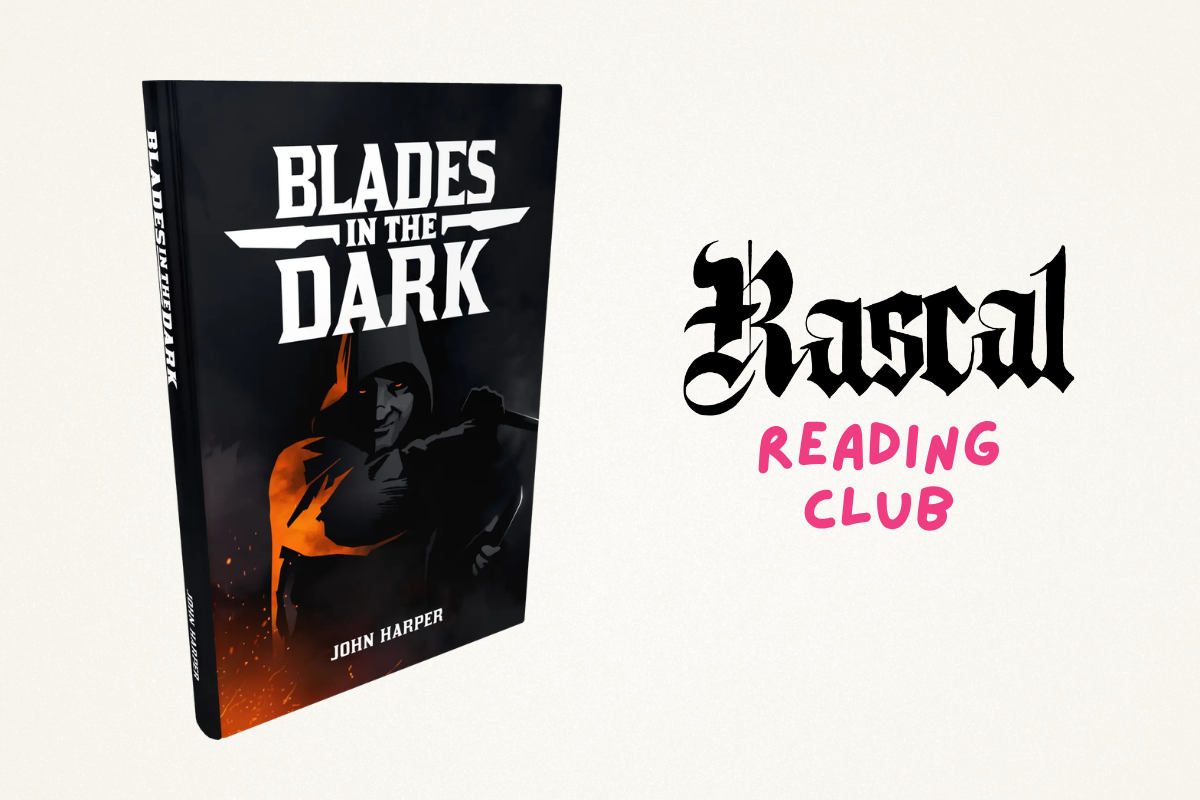
Welcome back to the Rascal Reading Club! This is the first episode of season two and it's all about location, location, location because we're talking settings. And we're kicking off with the iconic Blades in the Dark by John Harper and Evil Hat. Sharpen your knives because we're going to Doskvol.
Excerpt
I picked [Blades in the Dark] not necessarily for the setting's thematic contents, not for the specifics of the factions or the, or the NPCs or even how it's laid out. I'm picking Duskwall because I think one of the things that it does is it elaborates on one of the most important things that I think settings do for us as GMs: that settings help us figure out causality.
That's a very sort of serious way to put it. But basically, here's the thing, as a GM, one of the big things you're doing is that you are playing the world, no matter what kind of game you're doing. If you're a GM, one of your big responsibilities is you play the world. Now, what does playing the world mean? I want to put something big and interesting and juicy to sort of chew into right up top. So I think one of the big things that you're doing as a GM is that you're figuring out how to make players' decisions matter. The players are going to take actions, and you're going to try to show the consequences of their actions, the effects on those actions. You want to make those actions and those decisions seem important, right? They need to have an effect. If your players' actions don't affect anything, again, my opinion, just not a very good game. It feels different as a player, it feels different as a GM. This is one of the coolest skills you can have as a GM. It's one of the most effective things you can do to make a game feel spectacular to players.
A good setting is one that helps you figure out how to play it. And how to embody it, how to use it at the table. And one of the things that it does is it teaches you — it should show you — it should give you something to make it easy to respond to the players. It should give you things for the players to do, and it should tell you what happens when they do them. So settings are in ways like webs of relationships, webs of cause and effect, and a good setting will show you those webs so that when players touch this one, you know it reverberates there.
When we think of setting, we think of, okay, here's an encyclopedia about a world. Here's a list. Here's an atlas. Here's an almanac. Here's a bunch of cities and a bunch of people in those cities, geographic names and locations, histories, calendars, timelines. But what is the point of all of that? The bottom line is that it's giving you something cool to describe, it's giving you something cool for the players to interact with, And those two sections are I think well understood. I'm going to the next part which is I think what they do is they also tell you what happens when players interact with them.
Another way to think about this is that there was a very classic thing that used to happen in games of a certain time period where, you would get these big elaborate setting books, and you would read them and you would go like, "Okay, so what do I actually do?" That question of like, "Hey, what do I actually do?" for me is the failure state of a setting.... If you need a separate adventure module to come in and translate the setting into a scenario that you can actually play with, I think that's a problem — it's not an intractable problem but it is a problem.
And if you heard that and you're like, "Hey, isn't that also kind of what rules do? Aren't rules just also a way of thinking about, when the GM says a cool thing and when the players say a cool thing and, you know, how to do cause and effect? Don't rules also have that?" Yeah, that's a big part of the way I see settings. I do not really truly see a difference between the word rule and the word setting. I know that they are pointing at different things, but if I tell you that Duskwall, for example, has an hour in which it's so covered with fog that nobody can see anything, five feet in front of their face, and an hour every day where that happens Is that a rule or is that a setting? Because, you know, in D&D we have rules about how far you can see, and in Blades in the Dark we have setting that says how far you can see. What's the difference?
Discussion Questions
- What are your thoughts on Duskwall?
- Do you have a cool example of a moment in the game that came out of factions and their interconnections? As a GM or as a player?
- What do you think about the idea that Duskwall is “a city designed for heists”?
- Do you feel a strong difference between the rules in systems and the rules of the setting? Do you think one is easier for you to remember or forget?
- What do you think about the idea that a good setting helps you figure out cause and effect so that it’s easier to make players’ decisions and actions be meaningful?
As always, you can participate in the discussion! Please respond by September 9th, either by sending in an audio recording, posting in the official discord, or writing to thomas@rascal.news and we'll include your responses in the talkback episode.
Participation is open to everyone, including non-subscribers!
If you're a member of Rascal’s Party Member tier, you can nominate a book and decide what we discuss next in the series.