Reading Club: Eberron
What does it mean to make a setting for D&D?

Listen to the latest episode in your podcast player of choice!
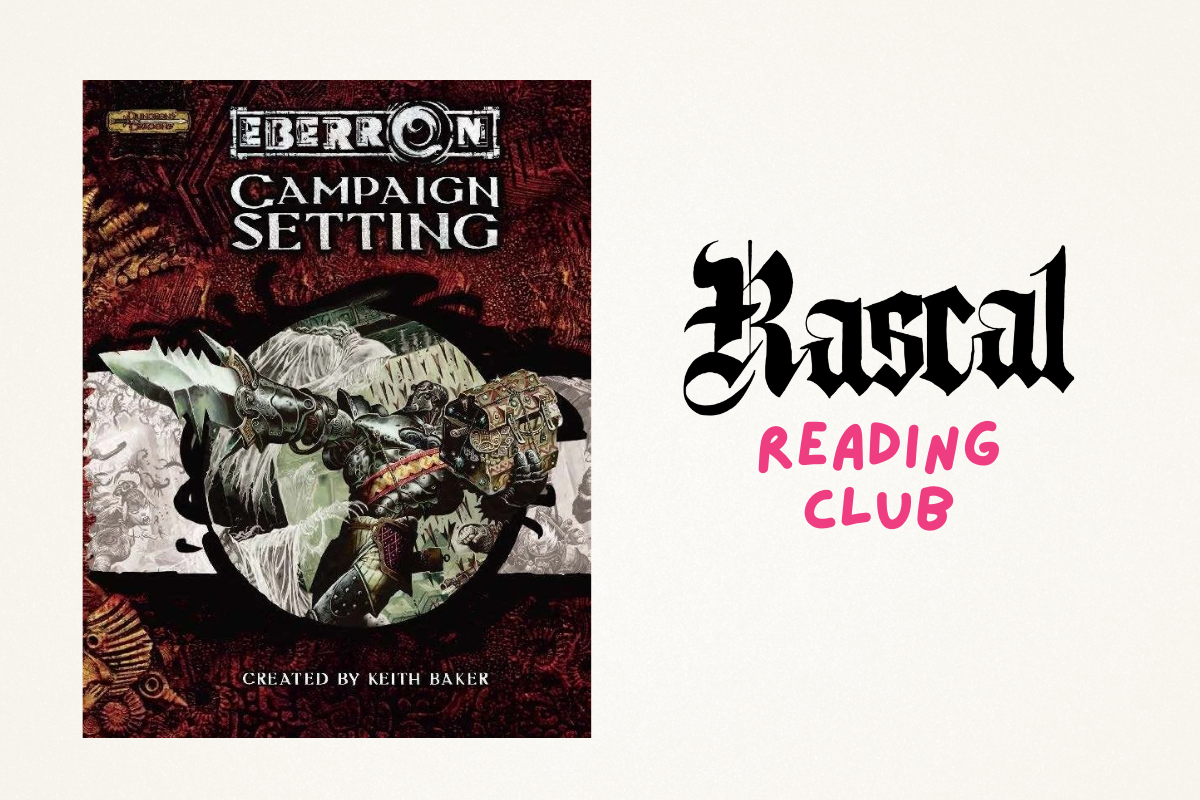
Welcome back to the Rascal Reading Club! We return with a walk through memory lane by revisiting Eberron, the D&D setting by Keith Baker that was introduced in 2004. We talk about how it changes alignment, the general "encyclopedia" style of setting, and how orientalism is also a format.
Excerpt
But maybe the sort of like grander problem of this mode of "the encyclopedia of a fantasy world" is that it's fundamentally orientalist — and this is again is something that Aaron Trammell talks about in his book... And Trammell makes the argument that Gygax is very explicitly an Orientalist. He comes from a time in which Orientalist was like a position at a university. It was a mode of engaging with the world, It was a field of scholarship. And basically the idea is that in the way that scholars used to talk about the real world, hey would write these books about what Africa was like, what Asia was like, and they'd write about them in a certain way. They would take this sort of logic of, my job is to quantify certain things, my job is to make certain like, certain abstractions, and my job is to structure this world, this place, this real place that I am not a part of, may have visited, or I may not even have really spoken to anybody from there. It's sort of my job to order the information about this place that can be gathered into a certain form.
And here's the thing: the form that it takes is essentially the form of a colonial survey. It is a document that has academic purposes, of course, but also almost always, if it was made at a certain point of time, it also had administrative purposes. It's an anthropological document, but it's going to the desk of the English East India Company official in that region. He's going to use it to decide which of these communities that he governs is inherently criminal, which one of them is trustworthy and honest and, and thus make good servants. Both of these are not examples I've made up, but absolutely, you know, things that either became official policy or unofficial policy.
The problem isn't that it's sort of like appropriation or something. This is really has nothing to do with being offensive. Especially because we are talking about fantasy, but the idea is that like that mode of saying this is how one talks about a place, like that mode of thinking is also how when people are doing world-building and fantasy, making these world-building books, that's how they talk about their fantasy world. They don't talk about their fantasy world from the point of view of anyone who lives in that place. It's always this position of 'I can abstract this like world out to you', and I can tell you that the population of Aundair is 2 million people, 51% humans, 2% changelings. Remember it is sort of bizarre to tell you that to that detail. What does it mean to you that Aundair has 11% elves and 5% halflings? You might be interested in what is the majority of a place and what are the minorities of a place, but the idea that there are 11% elves and 5% halflings in a place is a fact that nobody in that place can ever know.
There is no society, magitech or otherwise, that is doing sophisticated surveys at that point of time without a level of governmental control that is beyond anything in the book. To be able to do census-level information like this, you have to be talking about a world that is so, so far away from the world in this book. So not only is it kind of nonsensical because nobody can know this information, it's also not actionable. It's a double whammy of being more or less completely useless in its specificity. Its specificity is confusing and bizarre.
As always, you can participate in the discussion! Please respond by October 7thth, either by sending in an audio recording, posting in the official discord, or writing to thomas@rascal.news and we'll include your responses in the talkback episode.
Participation is open to everyone, including non-subscribers!
Discussion Questions
- What do you think of Eberron? What are your favorite parts?
- Do you like encyclopedia style setting books? Has your relationship to that kind of book changed?
- If you’ve played it, what was your campaign about? How did you use the setting? Which part jumped out and grabbed you?
- How do you think about the pleasure of reading versus playability? Is this a binary or are there games that do both?