Reading Club: Realis
Fire the anti-canons.

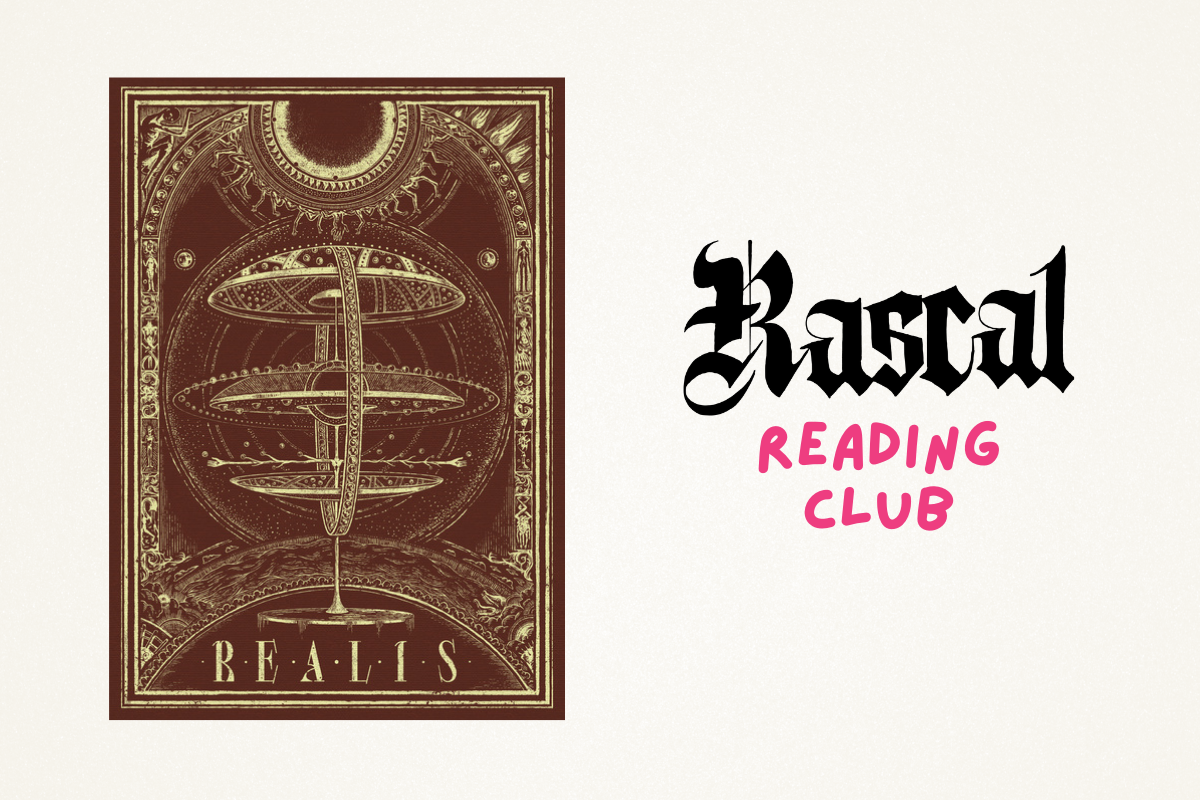
The second season of the Rascal Reading Club continues with an episode about Realis by Austin Walker and published by Possible Worlds Games. We continue the season's focus on setting by digging into how this game thinks about setting, worldbuilding, and GM prep.
Excerpt
The grandest part of Realis — the most interesting question at the heart of it — is the question of "anti-canonicity". When we're thinking about anti-canon games, we're thinking about games where there is a kind of a level of customization, like from table to table. Your version of the setting is not my version of the setting. The answers are not necessarily pinned down. Stone Top, we praised its, reliance on questions rather than answers because, that is a kind of pillar of the way people design anti-canon stuff in games... It is different with Realis.
At the heart of Realis is the sentence we don't know... Realis itself is unknowable. Realis itself is never described. Realis itself is a mystery. And the game is named after the thing that you cannot know. It's not just that it's not written down in the book. There is a sense of the whole setting is imbued with this grand unknowing of what is really happening and what it is really about. It is not just that the game resists lore in the way that we were talking about it in the talkback to Eberron, where Duamn was talking about this trend in recent years to catalog everything. A trend that I, as a nerd, participate in. I love learning a world and cataloging it and feeling that sense of mastery over its details, over the big and the small.
But Realis is not just un-wiki-able, it is about being un-wiki-able. Not just, "Hey, resist the siren song of lore," but be motivated to discover the thing that's not discoverable... Be really excited about the fact that you can't find this thing. See the infinite possibility as a motivation to play and to discover and to create And that will lead to the joy of the game.
This makes me think a little bit about the fruitful void of rules... The idea of game design being you construct around something to create the potential space for it. You create the space for it, but you don't fill that space and that's kind of why it's called a fruitful void and Realis does that for setting. The setting has a kind of space in it for you to project your desire to know a setting in the first place. There's a sort of awareness that what is really cool about setting is just learning all about it, and it gives that pleasure a face — the planet of Realis — and says, the answer, it doesn't exist....Nobody knows... But that shouldn't stop you. In fact, that should be really exciting for you.
We can think about Realis itself, the planet, metaphorically. It is almost explicitly enlightenment. Those who visit the planet are described as the Radiant. There is a kind of revolutionary change to the soul that happens that leaves you forever marked and transcended out of humanity. If you wanted to, you could read Realis as a heaven-on-Earth sort of thing – Tolkien's Valinor, the undying lands where the elves live. And in some sense, the enlightenment, the great thing that the game sort of like holds out for you, is that you can write your own answer. It is not about discovery as much as it is about authorship and inviting you to a certain kind of authorship.
And yeah, there is just like a kind of beauty to that idea and the way that it's expressed in Realis is very seductive, very arresting.
As always, you can participate in the discussion! Please respond by November 11th, either by sending in an audio recording, posting in the official discord, or writing to thomas@rascal.news and we'll include your responses in the talkback episode.
Discussion Questions
- What do you think about Realis? Have you read the ashcan or even the latest version? Have you played it?
- How do you feel about the anti-canon approach to setting writing? (Less the weak version of “rule zero, change this however you want”, more the strong version of “here are the questions, answer them at your table”.)
- What’s your experience with the trad process of prepping a new campaign (from deciding the premise to worldbuilding to communicating that to players)? Does this game's design and approach to prep feel like it alleviates some of the pitfalls of that mode or inspire you to try it?
Participation is open to everyone, including non-subscribers!
Schedule
And as a reminder, here's the schedule for the rest of Season Two:
December - Stars without Number (Kevin Crawford)
January - Wildsea (Felix Isaacs)
February - Blades '68 (Tim Denee)