Realis ditches traditional character sheets for prose poetry
How players in Austin Walker’s upcoming tabletop RPG arm themselves with Sentences.

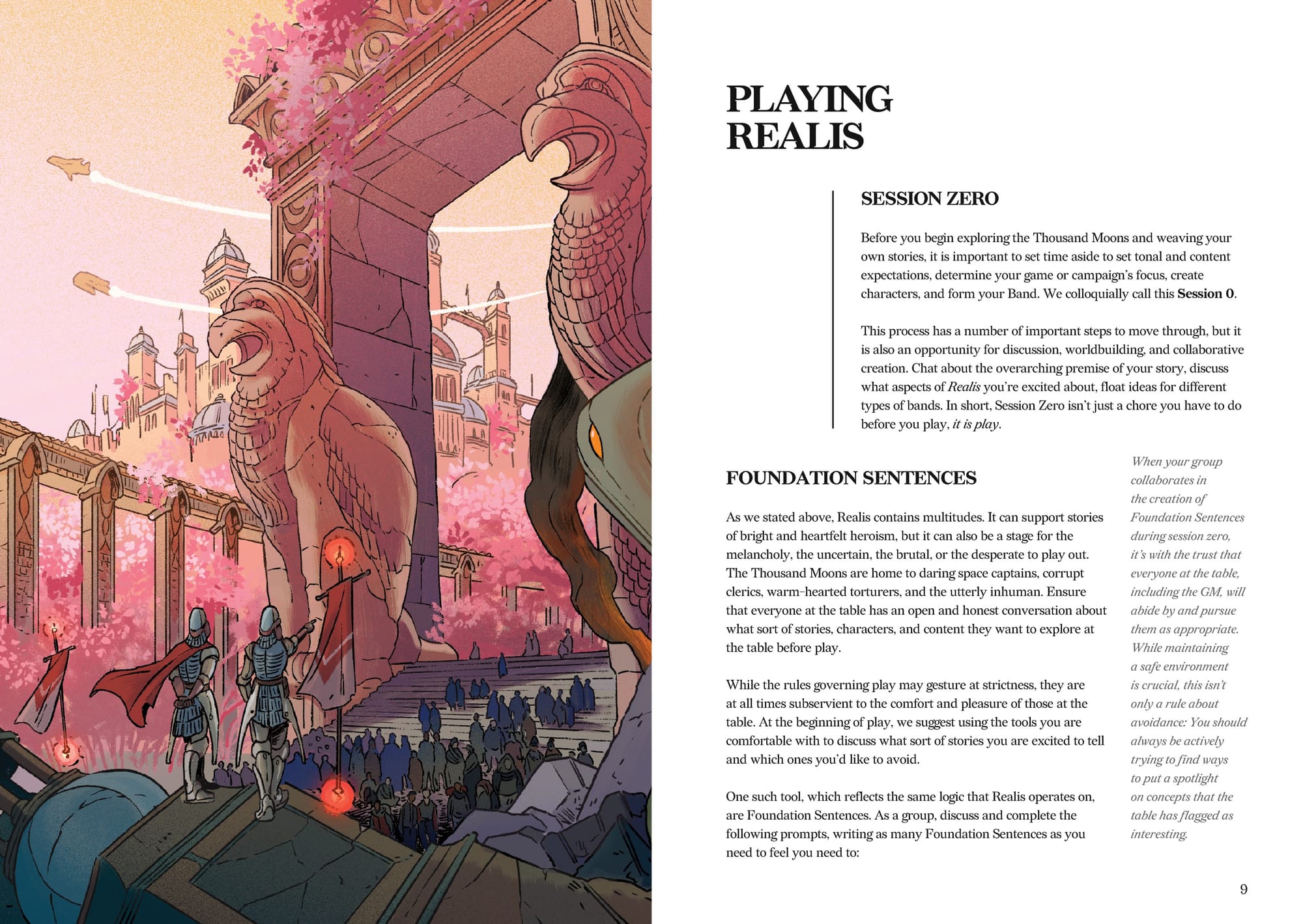
Reading through the ashcan of Realis feels like a series of obvious revelations blossoming in front of you. Of course Sentences can be functional roleplay levers, the verbs I use to make story happen. So, of course those Sentences can be improved to increase effect (Realis achieves this through two means—more on that later). And then of course, improving those sentences requires limiting the scope of their narrative power. Character archetypes are broad, but they accrue individuality through play to become real, lived in.
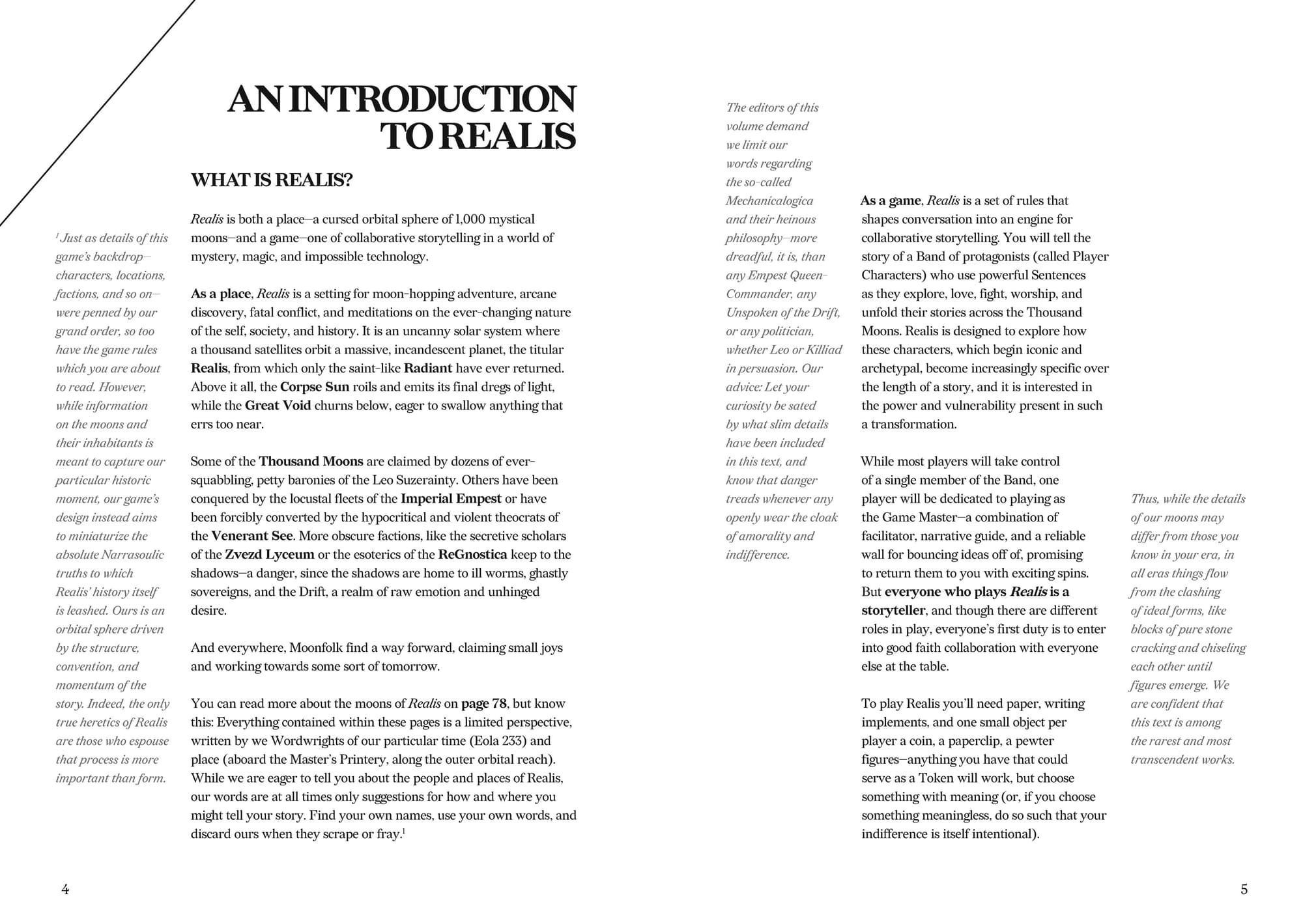
Following on Rascal’s first interview with Realis designer, Austin Walker, we dive into how all these proper nouns collide on the table and create delicious tension. Walker is clear about Realis existing largely as a storygame, “a set of rules that shapes conversation into an engine for collaborative storytelling,” according to the ashcan version you can preorder on itch.io. So, it’s worth briefly explaining what happens when a character encounters a challenge, be it the environment, an adversarial NPC, or the celestial will of one of the Thousand Moons made terrifyingly manifest.
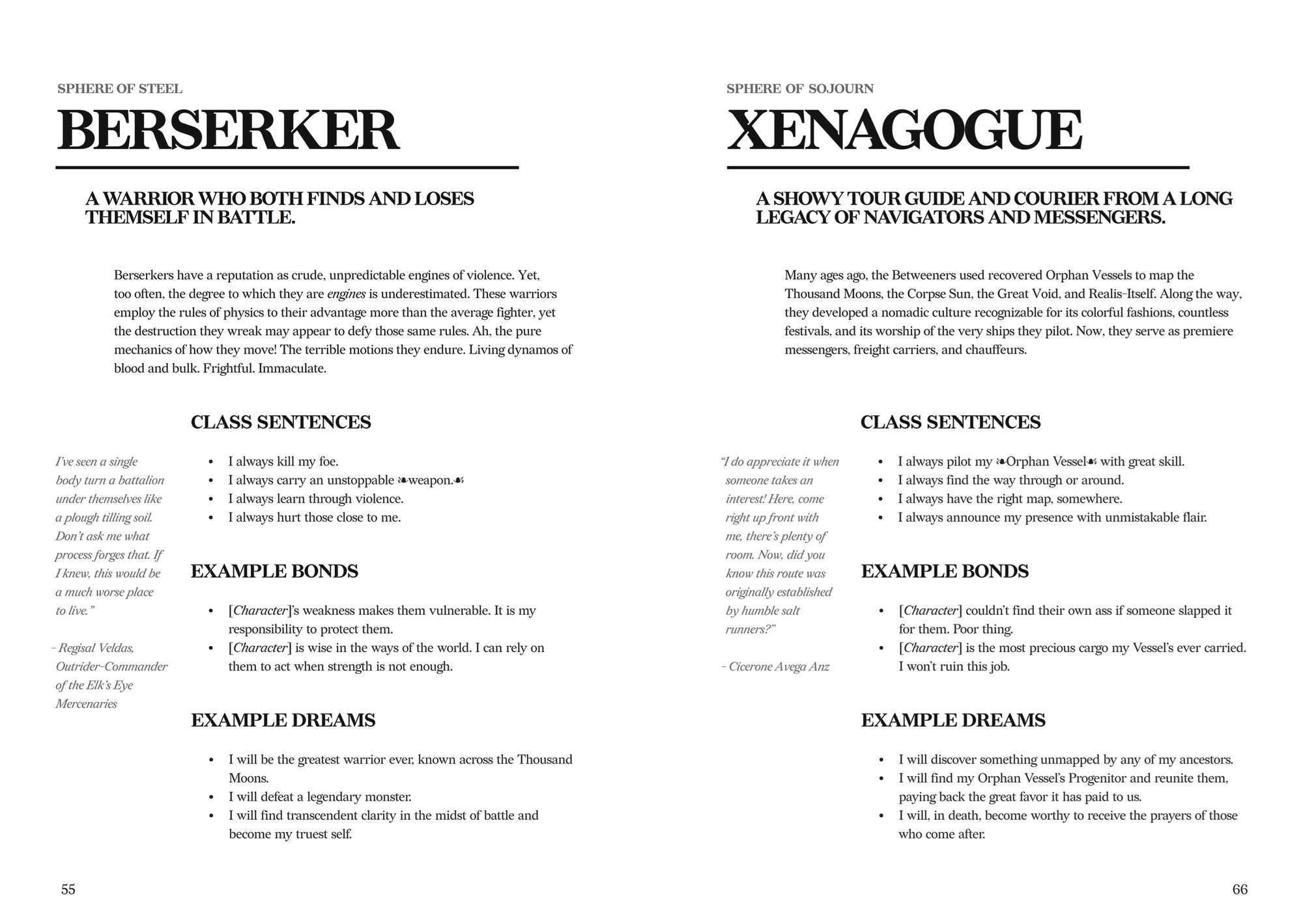
Realis’ conflict, with a bullet, is a contest of willfully asserting one’s identity into reality. Characters comprise four key Sentences, two Bonds, a potent Dream, a Token, and a Band Sentence. These are called Means. During conflict, both the Actor and Counteractor bring one of their Means to bear on the other. Both compare how Realized their Means are, a ranking of +0 to +3, and ties are awarded to the Counter.
Sentences level up (or Realize) through failure to overcome a Counter’s Sentence, whether the player is scarpering down a treacherous landscape, arguing against locust royalty from the Imperial Empest, or denying the existential gravity of a Moon composed of living meat. Almost everything acts upon the world and its inhabitants through Sentences, which become more specific and powerful over time until they are retired into the past tense. Critically, Realization also adds conditional phrases to Sentences. The Peregrine’s +0 I always have the determination to continue is widely applicable but weak. They could achieve a +1 by modifying it to When bloodied, I always have the determination to continue at the cost of restricting the possibility space.
This is Realis’ juiciest meat. This is where Walker is staking his bona fides as a designer. He has partnered with Possible Worlds Games to create a physical book late 2025 or early 2026, but an ashcan (effectively complete rules document) can be preordered through itch.io. Walker guided Rascal through mechanical heritage, doing endings well, and creating space for all GM styles.
This interview has been edited for clarity and length.
Carter: One of the first things you notice as you begin reading through the rules is that there are no dice in here. Did you eventually discard them, or were they off the table from the jump?
Walker: It was the latter, and it was pretty quick that I came to it. Some of the earliest mechanical questions were what if a character was nothing but Burning Wheel instincts? That's already kind of like No Dice, No Masters, right? That's not the term that Avery [Alder]'s using, but there was some of that here. Here's what I do, here's what triggers what I do, et cetera. Apocalypse World is also a game of triggers and actions.
I was thinking, what if once per session, you can defeat any amount of enemies no matter the odds? Once per situation, almost like [Dungeons & Dragon’s] daily and encounter powers. Almost really gamey-gamey. What if it felt like doing a Choose Your Own Adventure book? What if it felt lock-and-key, or like a tactics game that has hard counters? I think that in the full version, I'll do an optional rule for dice. But I realized I don't need it. It becomes a different game when you don't need it. It also helps underscore that the word always means always. It doesn't mean always on a six. It doesn't mean always on a four, five, or six. It means always. You always do it, right? And that becomes really powerful.
Again, I went back to [Berserk’s] Puck. The exact line Puck says isn't “always outrun my foe.” I don't think it's playtested yet, which is part of why I'm not including it in the ashcan, but the sentences on the Fairy are: I always escape dangerous situations; I always console those in distress; I always heal those who've been harmed; and I am always unarmed. And I was like, okay, how do I get something that feels iconic and archetypal in four sentences? Then, these things just come into conflict. One theory of stories is that characters come into conflict with the world or other characters. Unsurprisingly, a little Marxist of me that I've made the synthesis game. That two things come into conflict and then synthesis occurs, the world changes, and it leaves both of those things marked. Or leaves at least one of those things marked.
Carter: How does your preference for facilitating a game as GM reflect the cognitive and emotional labor that Realis asks of that role?
Walker: It's a job I've been doing now for 10 years, and I like doing it. It is labor. Anybody who GMs in front of a microphone will tell you it's labor intensive. But I think it's funny because I think I've seen Realis run in both directions. I've seen the facilitator who's running a not-quite-West Marches game. I know somebody who ran a straight up dungeon delve in this game. Pre-prepped dungeon, used the Moon Sentence to do traps and chambers and stuff like that. But I've also seen it run where the goal is to get from point A to point B, and I am playing characters in the more traditional tabletop way. I think it has space for both of those. But if you have players who want to pick up the world, they can do it in this game. And you do get to lean back and be that other type of facilitator.
"It's putting the pen into the player's hands. It really is about the breadth of design authority and giving that design authority directly to the player."
I'm currently running Fabula Ultima, which has been a joy. But I sit down at Roll20 before we run every session, and I make sure all of my little critters are in the system. That is not the sort of prep that you need to do for Realis. You can pick NPC classes from the book, give them to characters and run them. You can be on your lunch break with your phone typing out sentences. That, to me, is a huge part of what makes it appealing. You do have to do that work. You have to conceptualize the spaces. You have to think about the characters, but you're not doing any math to stat out what level a character is or what type of fire spell they need to have. You could say that they have a +2 fire Sentence and then write with that Sentence does.
I've made a lot of stuff that has great fan reaction with incredible fan art, fan fiction, music, animation and everything that you can imagine. I've never made anything that has so quickly inspired people to say, I want to make my own class, I want to make my own thing, in the way that great tabletop games can do. Because it's just so easy. You have an idea for class, you write down four sentences, two bonds, and a few dream ideas. And the bonds and dreams aren't even necessary. They're like bonus things. Cool, done. Got it out.
Obviously that means I don't think that people will be able to make single class supplements for this game necessarily. But I do think that there's gonna be a lot of people who see it and make their ideas immediately clear in the game world and at their table. It's just fun to make stuff for Realis in an almost crafty, hobby way. It feels like putting together miniatures, but with words.
Carter: You're kitbashing with Sentences.
Walker: Exactly.
Carter: When you describe taking a character from archetypal to the specific, that feels like an echo of what you and the Friends at the Table crew do whenever you play a new system. Of course, that’s just what games are.
Walker: That’s what games do, obviously. The magic trick [of Realis] is pointing at the magic trick. Do you know what I mean? All games are about this. It's rare that I don’t just qualify something. At this point, what I would normally do is kind of back off and be like, yeah, you're right. Of course, all games do this. And they do. But I really do think that there is something different about what Realis does compared to Blades in the Dark. I think there is something different about the Duelist, over the course of a campaign, going from, I always impress those who see me in combat to, I always impress those who see me win a one-on-one fight, then finally to, I always impress those who see me take a life in a one-on-one fight.
Those are huge changes. You're chipping heavier at the stone than just choosing a move from a class in a Forged in the Dark game that says, if someone sees you fight, take +1 on your next roll against them. It's putting the pen into the player's hands. It really is about the breadth of design authority and giving that design authority directly to the player. I do think that's distinct in terms that all games let you chip away at the block, the archetype, until there's the particular. Most of them aren’t chipping away at the block. Most of them are additive. They're interested in you putting the new piece of equipment on your player character, or giving them the new spell, or unlocking a new ability. And that's really useful. I love running those games. When I say you act as a small gang in a fight, I know how it's going to feel as a player. It's going to feel great.
I think it's different when a player sits down and says, okay, here's what I can do. Now, how do I restrict myself while making it stronger? What do I decide to do there? Again, if you look at the character sheets from people who've played long campaigns, what you end up asking is what led you here? What got you to this place? You have the block of stone, and you're removing bits of it to reveal something underneath. Which is different than putting the really cool LEGO backpack on your miniature, or putting the laser gun onto your ship. It isn’t just kitbashing.
Carter: Let’s talk about endings. A lot of RPGs stumble here. Not to overly bash D&D, but the game is designed to deliver players to level 20 where they –
Walker: Become a god.
Carter: Exactly. That’s not what happens in most stories, though. Well, not good stories at least. But you've intentionally designed endings and retirement into the Sentences.
Walker: Yeah, it's really fun. What is the end result of a character? The thing that happens a lot in play is someone will retire a Sentence and still have three other Sentences that aren't retired. They still keep playing the campaign with those three others. I mean, they get to keep the retired sentence, too. It doesn't stop being a Sentence, just always a +0 Sentence. And that intermediary has been extremely interesting to hear people talk about. It feels like aging a little bit. It feels like, I don't have that friend anymore, or I used to have this skill that I let deteriorate. Or this thing used to be important to me, or I took this injury. I used to be an athlete, but my knees just don't work like that anymore.
Carter: I was listening to you on A More Civilized Age covering the Timothy Zahn books. And it feels like how he writes Han [Solo] wondering in the aftermath of the films, what the fuck am I now? All of his sentences have been retired.
Walker: One hundred percent. Han used to always have an alibi. Han used to always hide his cargo. Han used to always keep a weapon concealed. Han's Orphan Vessel still always mostly works. Han's prime for retirement by the time we get to the Zahn books. It's been like this ever since I made this game. It's been years of, that's it right there. I was watching Hunter x Hunter after making Realis. A friend read the playtest documents and told me, “you made a Hunter x Hunter game.” I was like, what do you mean? He's like, just keep watching. And by the time you get to the Yorknew City arc and Kurapika is making conditions with himself in order to get his powers to be stronger, they're just Realis Sentences. When I am fighting a Phantom Troupe member, I can always capture them with chains, you know? When I play Gungi, I cannot be defeated. And it's not an influence. I mean, it's a post-influence, but it's not in the core game.
"One theory of stories is that characters come into conflict with the world or other characters and then synthesis occurs. The world changes, and it leaves both of those things marked."
One way to think characterologically is to think about what leads players to do the actions they do. When are they capable of doing the actions that they're doing? And I will say high level play in Realis really engages with this. There's no explicit way to help or aid in this game. There are bonds, but no one's spending their token to give you a +1 on the Sentence you use. It's not how the world of Realis works according to the Wordwrights. But the Thaumaturge can use one of their sentences to lift you higher so that you have higher ground, so that you can use the Sentence, When I have higher ground, da da da da da.
If your whole character arc is about trying to upend the Empest, Realis’ bug Roman empire, you might have, When I fight an Empest of note alone in the dark, I always win. Okay, well how do you get an Empest of note alone in the dark? There's almost a sort of reverse heist movie thing happening. I have the kill shot, I have the goal, I have the thing that we need to win this fight. Maybe you have, When I can offer a relic of great value, I can always convince anyone of anything. The other way it happens is Realizing the Sentence, but the most powerful way can almost never be used again. That’s really fun. That ends up shaping how the game plays.
How do I take away something that I know my enemy has by removing that fictional position from the board? In the play example, there's a moment where the Juggernaut tries to destroy anything that's casting a shadow so that the Blackguard can't hide in shadows. It has to be there for it to be there, right? Which is also something that's missing from the ashcan release. There's not a big best practices and GM guide. I want to see how it plays and how people react without some of it.
In my mind, I think of Realis as almost four little books: here are the rules; here are the classes; here's a section on the world, which includes factions and moons and NPCs; and then guidance on how to play and run this game. Guidance on how to hack this game. Here are some ways that you could think about changing this game and what it seems like those changes do. What happens if you start Realizing Sentences in two ticks instead of three? What happens if you start retiring Sentences at four instead of at three?
Carter: Speaking of higher level play, using Sentences, tokens, and honing almost becomes a bluffing game between what the GM knows and what the players know. You can tease out an opponent’s Sentence Reality and then put yourself in a better position to get the upper hand. I think that's very fascinating in a game that is not explicitly tactical. Realis is not a game of resource management, it's a game of resource deployment.
Walker: Oh, that's a really good way of thinking about it. That is how it's played. I've seen this happen again and again, 100%. If a character has something like, When I'm in my territory… you get them off their territory. They can't use the sentence. I'll spoil a moment from deep in the Realis campaign. One character had, On my territory, I always [blank]. So, I had some of that character's scouts walk into the woods where the party was traveling, blow the horn, and make an announcement that's like, we declare that these woods are under the protection and control of such and such. It's like, okay, does anybody try to stop this? But why would they try to stop that? The thing that they're trying to do is hide from them. So you start playing those games, and it is about resource deployment. It is about setting up future things that can be deeply, deeply scary if it breaks bad for them.
Carter: You list Warhammer as one of your inspirations, which I thought entailed the science fantasy perspective. But there is a bit of massive board tactical deployment. I'll just set three little Orkz over here, and you will forget about them until this very pivotal moment.
Walker: The Warhammer thing here is mostly setting, but you're right. There is a sense of what have I put in play? Where are we focusing our action? Where am I spending my action points this round? Or, who gets to move this round? What do I care about happening? That's there, too.
Most of my games have stayed pretty focal on characters, especially characters in groups. But Realis does work at the zoomed out perspective, that higher scale. Another touchstone here that I should add directly to the list is Legacy: Life Among the Ruins, which explicitly mechanizes a thing I fucking do all the time, which is zoom in, then zoom out.
You can preorder the Realis ashcan document on Austin Walker’s itch.io page.