The only real boy in Apocalypse World
Playing an ordinary teenager casts the game’s blunt violence into sharper relief.


At the end of the penultimate game in a twenty-session Apocalypse World campaign, my character — a fifteen-year-old boy named Godammit who had been traumatized, abused, infected, and forced to become a killer a dozen times over — looks at a giant, impossibly ancient, defective war machine encased in a glacier and thinks… that’s my brother. Playing as a child whose only recourse in any situation is to pick up a gun had turned my teenage character into a weapon who could only see himself as a force for violence in a violent, unforgiving world. The great tragedy of Godammit’s life wasn’t his abusive first parents, nor the death of his adoptive father, the scarcity, the fear, the struggle… The tragedy of his life is that he never knew how to hope for better. The most that he ever hoped for was that maybe, one day, he wouldn’t feel so angry anymore.
Apocalypse World isn’t a game explicitly meant to be populated by child characters — whether they’re NPCs or PCs — but the current edition (Burned Over, often referred to as a third edition — I played a version that my GM affectionately called “2.75” that was still pretty charred) was written as an attempt by Vincent and Meguey Baker to create a game that their young, teenage children could play with them. The edges have been sanded down: “less swearing, less confrontational sexual material, less grotesque interpersonal violence, this kind of thing,” said Vincent Baker in an interview with TTRPG Insider earlier this year. The biggest mechanical shifts are the wholesale removal of Sex Moves and more comprehensive Basic, Standard, and Advanced Moves. While there is certainly a maturity to the prose in the new edition – fewer “motherfuckers” and more “furious hordes” — Baker did admit that “a darker tone has definitely crept back in.”
There is simply no way to play Apocalypse World as a child character and not have it be extremely dark — perhaps even darker than a game played completely by adult players and player characters. Sure, you could play this game with kids, or even as a kid, but why would you? While it might have started from an in impetus to invite children to play at the table, Burned Over has ended up at a much more complicated place than “AW for teens.” As Meguey Baker said in an interview with Rascal; “the time for a softer, gentler Apocalypse World was gone.” Apocalypse World — by its very nature, by its very premise, with its scale, themes, and teeth grown long — made playing a child character one of the most impactful and intense gaming experiences of my life.
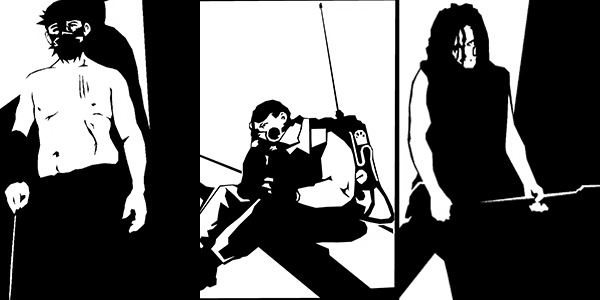
Inspired by the bits of Furiosa (2025) that focused on the titular character as a young child, DC Comics’ Jason Todd, and that one scene in Pacific Rim (2013) where, as a child, Mako Mori is separated from her parents in the middle of a Kaiju attack, I confidently announced at our session zero that I would be playing a teenage Volatile named Godammit. He had fragile eyes, a hair-trigger temper, and a self-destructive streak that began well before he started puberty. By the end of session zero, Godammit had a father (Cheem, the Undaunted), a brother (CT, the Mechanical), and an uncle (Father Dust, the Hocus), alongside a handful of other NPC siblings; alive, dead, and exiled. We hadn’t intended the game to surround this found family, but it coalesced naturally as soon as I decided to play a kid. I guess in retrospect it seems obvious; a child needs a family.
Godammit was the kind of character who kept his cards close to his chest, but he never left a conversation without making sure you knew exactly what he thought of you, even if you didn’t know what he was going to do next. I didn’t want Godammit to be loud or particularly over-the-top with his anger. He was a kid traumatized by the circumstances he was being forced to live in, recalcitrant and mean, quietly angry all the time. When we travelled across the shatters the first time, GM Sam Dunnewold told us that we received visions. Cheem saw a pulsating, fleshy landscape, CT saw three androids just like him charging through the snow, and Godammit saw nothing but fire.
Two sessions later Godammit hid and watched as a five-year-old boy named Bean was irrevocably hurt by Fosko, his own father, and decided that he was going to rescue every child trapped in the Cult of the Iris. The Cult hurt children because they’re the easiest target for violence. Because a five year old’s attempts to fight back will always be ineffective against a grown man. Godammit watched this happen and vowed revenge for Bean, seeing his own past in the young boy. Godammit might still be a child, but he wasn’t five years old anymore. And now he had guns.
He saw this injustice against Bean as a personal failing, embodying a naive, flawed sense of justice that you can often find in children who demand fairness from a world deeply skewed towards endlessly delivering the “tough shit, kid” response. This was only amplified in Apocalypse World, where unfairness, injustice, and even unkindness is the norm. What happens to a kid when every single part of their entire world is seeped in the horrific truth that it will never get better than this? What happens to Godammit when he wants to be good, but all he can use to do good is a gun? Kindness, love, empathy, curiosity; it wasn’t enough to save Godammit — not from the world, not from the Psychic Maelstrom (which had coalesced into a whirling hunger called Mother), not from himself.
One of the things that consistently gnawed at me during play was the horror of forcing a kid into these deeply violent, deeply traumatic situations over and over without respite. Nothing good ever happened to Godammit. Not for long. Just before the halfway point of the campaign, Godammit was infected by Mother, and I was asked to take a move from the Contaminated playbook. I took Ravenous; whenever Godammit was near death he had to pursue it ruthlessly or roll Act Under Fire to resist the compulsion. It wasn’t two sessions later when the ravening came over him. He had accidentally injured his father when the shrapnel from his bad shot (courtesy of my poor roll) tore Cheem apart, leaving him with five out of six segments on his harm clock filled. He raced across town towards his father, intending to save him, but instead I honored the Ravenous contamination and pursued the moment of his death without hesitation. A child in the middle of the battlefield, his father’s sternum cracking against his knuckles, his mouth red with gore, holding Cheem’s heart in his hands and squeezing until it stopped.
After Cheem died, Godammit not only lost the character who was consistently looking out for him and trying to teach him to be a better person, but I — the player — lost the only other character in the game who had been limited to more “grounded” stakes and abilities. Cheem never returned; Chris instead took one of Cheem’s kids (and Godammit’s sister), Slug, as his player character. While this meant that Godammit was no longer the only kid around, Slug was always… a little odd. She was a Brain Picker, and later in the series it was revealed that Slug was an interdimensional traveller who had seen the hunger come before. A weird kid is one thing, a +Weird kid (to use AWBO’s parlance) is something else. I felt this deep sadness that persisted across the rest of the game because Godammit, despite loving his sister and still having a brother-in-arms with CT (and even with the return of his older sister, Ula, an NPC) was still an ordinary boy. But now he was surrounded by all these people who were distinctly interested in extraordinary and technologically advanced problems — a seam in the fabric of the universe, the maelstrom, and Mother, the ancient technological hive-mind — and who had other goals beyond the immediate nature of Godammit’s urges; eat good, sleep safe, protect your family.
In fiction, we often see Slug’s archetype: a very special, extraordinary boy (or girl) who uses their talents to make sense of a world that is shaped by adults. One of the playbooks from a previous edition was the Child Thing — meant to embody a weird psychic kid connected to the metaphysical forces of the world. The Child Thing was updated in Burned Over’s’s expanded playbooks, and remained an extraordinary child, not an ordinary one.
Extraordinary child characters are often the focus of the story or provide the macguffiny plot points the story revolves around; Melanie from The Girl With All The Gifts, Edward and Alphonse from Full Metal Alchemist, Alia Atreides in Dune: Messiah, Enola from Waterworld, even Aang from Avatar: The Last Airbender. These children are uniquely suited to the environment because of their special powers, value, or abilities. A child with too much knowledge and the ability to wrestle with the Maelstrom directly, to turn it towards purpose. This child possesses, inherently, some kind of knowledge of why things are as terrible as they are. They understand some fundamental, evil truths of the world that exist beyond what they experience.
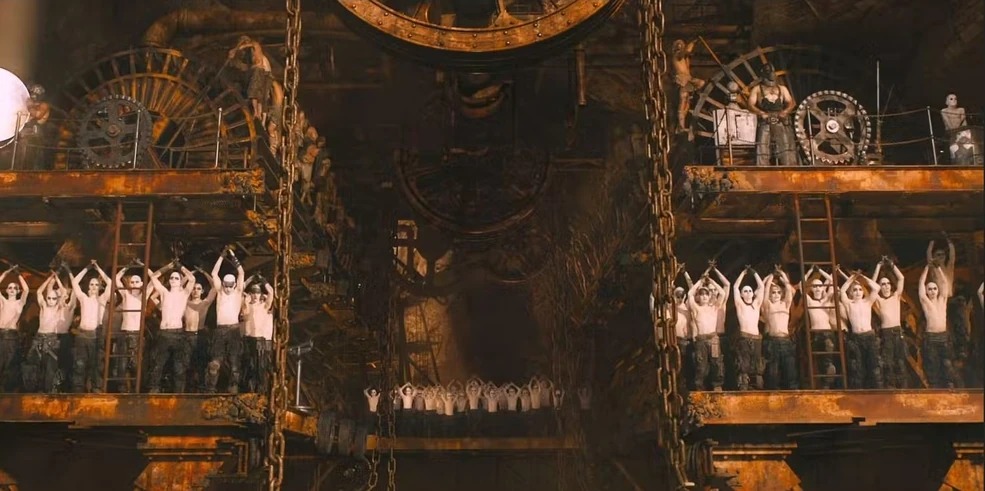
The idea of an ordinary child, with ordinary trauma, and ordinary means to understand the world, levering into any other playbook besides Child Thing is — was — horrific. When ordinary kids appear in media like Apocalypse World, such as the Train Babies born on Snowpiercer or the War Boys in Fury Road (or the feral cargo cult kids in Thunderdome), they’re typically side characters or even plot fodder. Something sad, pathetic, and only there to be protected or picked off by more important characters, rarely there to exhibit any agency themselves. An ordinary, non-special kid still has value, but only in the ways that they are leveraged against the adults. To give a child power, to give a child a gun and tell them ‘good luck,’ telling them that their only way out of this world alive is with fire and gunpowder, is a unique sort of cruelty.
For a lot of the campaign, it felt like I was playing a different game than everyone else. Slug and Dust both had magic, augury, and moves that granted them access to the psychic maelstrom and the metaphysical entities that populated the world. CT was a cyborg, and a major part of his plotline surrounded his mysterious origins, his AI overlord, and the other cyborgs who were connected to him via his hive mind. Godammit had the ice under his boots, his guns, a naive sense of justice, and enough (un)righteous anger to make a small army sweat.
Because Godammit was in play, violence against children was never fully off the table. Godammit was a child. The entire table had to be good with him experiencing and enacting violence. This led to a game in which violence against children became a recurring theme. It was grim and brutal, but it was true to the fiction and honored the story we were telling. Godammit himself was one of the perpetrators; when the Cult of the Iris came to visit Godammit’s town, they travelled with Millie, a very pregnant woman. In the middle of the night, while her husband was being murdered, Godammit snuck into Millie’s cabin, successfully avoided her guards’ attempts to kill him, and then held his knife to her belly. “This is my kid,” he said. “I’m not going to let you keep it.” He allowed Millie to escape back to the cult, but not before telling her that he’d be coming for all the children, not just hers.
(Two months later he did just that, leading a small team north and rescuing the children of the Iris, killing Millie himself and burning down the entire settlement.)
Throughout play I emphasized Godammit’s childlike qualities as often as I could; his stature (small, undernourished), his cracking voice, the adult soldier-sized armor hemmed to fit his frame. Most distressingly for me (and for the rest of the table too) was the casual way he would talk about killing a man, as if it was a matter of timing and the timing was always right now.
For Godammit, it was this simple. We finished the campaign over the weekend and while Godammit had a body count in the triple digits he never — not once — took a single harm. And not for lack of trying. More than one session ended early because a Volatile playbook equipped with a gang can make slaughter look like, if you’ll forgive the pun, child’s play. Halfway through our campaign, the game’s tactical meta hinged on a teenage warlord with anger issues.
And at the end of it all, he had nothing to show for it but a hollow machine too big for his undersized body. He had killed his father in a moment of madness. One of his only friends went feral and killed her entire family before running into the shatters. His sister was trapped in another dimension. His older sibling had abandoned him. His brother’s body had been disintegrated, and his consciousness was now a part of the Legion — an ancient, connected group of machines built to contain and exterminate Mother. This included the Centurion — the massive mecha that Godammit strapped himself into in an attempt to do what the game had told him was the most effective method of confrontation; find the biggest gun possible and turn it on the weakest target you can find.
One thing that never came up, however, was sex. Part of this was because of the game; Sex Moves had been removed from play, and while we certainly could have added them back in, we wanted to play Burned Over pretty much as written. But halfway through the game I was left wondering… if part of the reason that Burned Over existed was to make Apocalypse World more “kid-friendly” or even “kid-approachable,” (even if that framework was later shifted, made more nuanced by the context of the last decade) what did it mean to remove sex moves wholesale but retain weapons, war, harm, and murder? Why, in an attempt to create a game that was simultaneously more mature and more community-focused, as the Bakers have said in an interview with Rascal just a few months ago, were these rules emphasizing a revolutionary movement without the structural underpinnings of love? The Sex Moves are about power and manipulation, but they also encourage players to think about the role of sex — and often the role of love — in their games, creating messy hexagonal relationship maps within the campaign.
Again, this didn’t matter much to our table — by framing family as the locus of the sharpest emotional stakes we centered love as the source of our violence. Removing Sex Moves doesn’t make the game inherently safer or more child-friendly — and, frankly, I don’t think that the Bakers would argue this at all. But the question remains at the forefront of my mind because the removal of the Sex Moves feels pointed — like sex is particularly inappropriate for children, while violence is perfectly fine to encourage within the rules and framework of the game itself. Under the surface of play I continually felt myself bristling as I brushed against the just slightly disingenuous feeling in a game where awkward fifteen-year-old fumblings weren’t encouraged, but children could still be given fictional guns. Magnitudes more real-life teenagers have had sex than have killed people.
So, what was it about Sex Moves that merited removal? I haven’t quite been able to figure it out. I don’t think teenagers (fictional or real) need to be protected from fictional sex, even if that sex is clearly manipulative and coercive — the world is so mean already. What’s a shitty, manipulative relationship going to do to Godammit that hasn’t been done to him before? But maybe if I can protect him from something, the rest of the post-Apocalypse World violence feels more manageable.