With the release of Umdaar, we might be at the end of Fate
Fred Hicks talks about the birth, life, and maybe death of the gaming line that launched his company.

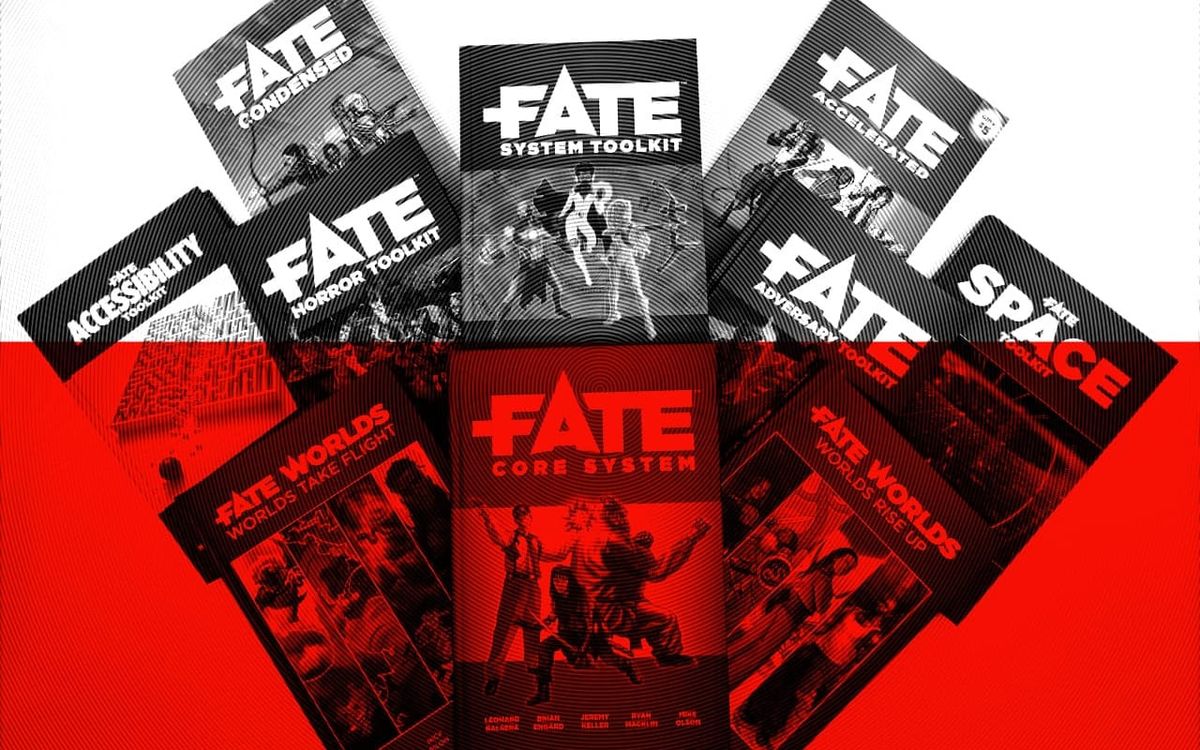
There was a point in time when Evil Hat Productions was synonymous with their flagship house system, Fate. The crowdfunding campaign for Fate Core broke records, bringing in more than $400,000 through 10,000 backers. But 2013 was a long time ago.
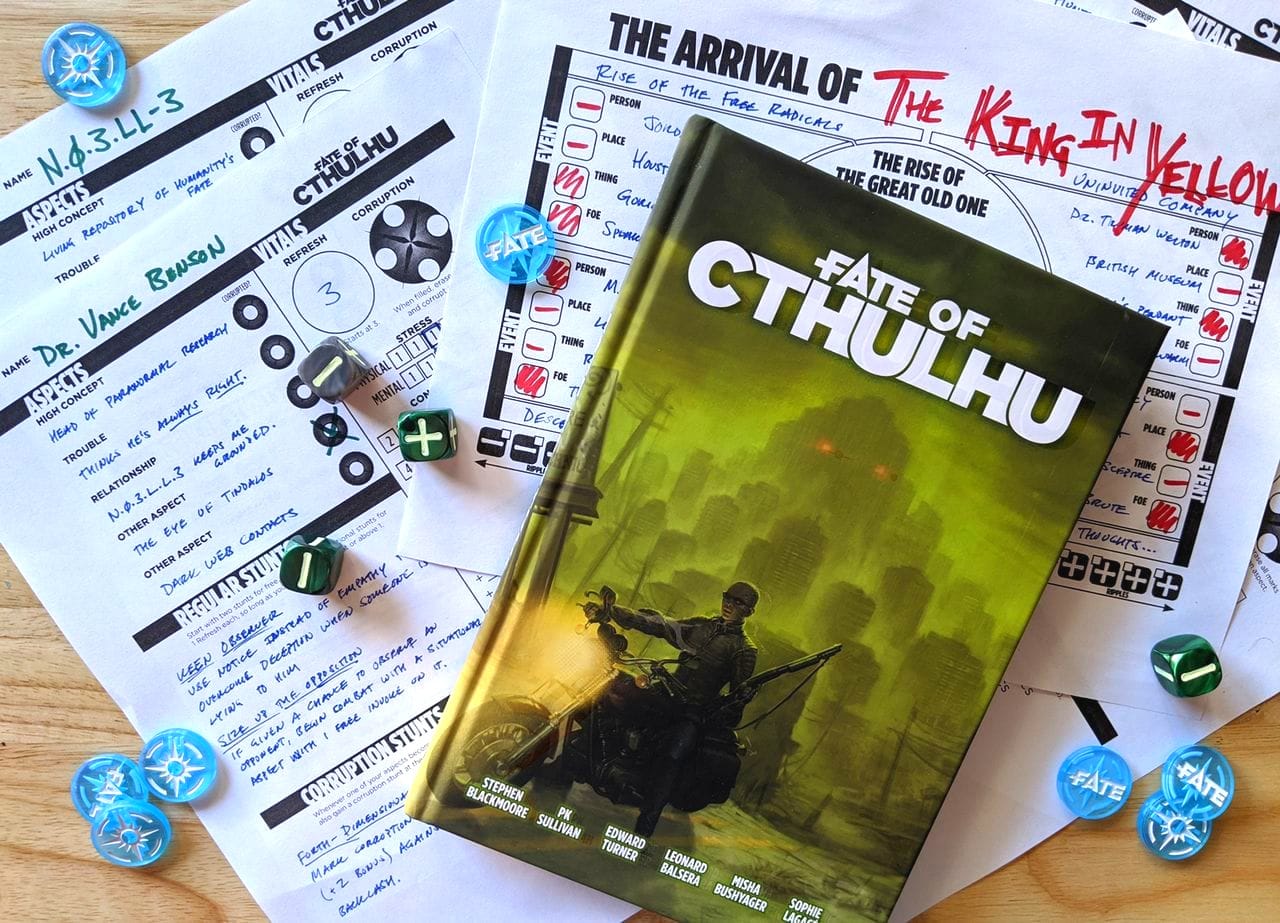
Ever since the release of Blades in the Dark and The Adventure Zone’s explosive spotlight on Monster of the Week, those two games have become the twin pillars of Evil Hat’s business. Fate, on the other hand, has steadily declined to less than 5% of the company’s sales. It’s been seven years since the last official game in that line (Fate of Cthulhu), and what should’ve been the next one, Umdaar, is set to be released only as a PDF.
It looks like this might be the end of a once influential line of games. But picking through both the history and pre-history of Evil Hat, the strangled end of Fate might well have been fated from the start.
The story of Fate begins around the turn of the millennium, circa 2000. Evil Hat co-founders Fred Hicks and Rob Donoghue were on the way back from a road trip to Lake Tahoe, and they were in the middle of a conversation so nerdy that Hicks’ wife asked to switch to the next car. The catalyst was, as per Donoghue, that the character traits that many games thought of as disadvantages were actually the opposite. In GURPS, for example, if you were to take on a negative trait, you’d get points back as per its system — points you could invest in positive traits. But Donoghue argued that those negative traits often resulted in the character spending more time in the spotlight.
“The fact that you have a rival who's hunting you across the continents is fun — it's good,” said Fred Hicks in an interview with Rascal News. “That's a thing to aim for. And once you start having that notion of story hooks, spotlight time, etc., being mechanized, you then can start seeing where a lot of Fate grew out of — modeling fiction not physics has been the mantra.” Thinking about games like this wasn’t necessarily new, even in 2000. Hicks and Donoghue were always building atop other existing games. Two games, and two communities, specifically defined those early years of experimentation. And they parallel the story of the early internet.
The first was Fudge, a toolkit for making your own RPG. In the late ‘90s and early 2000s, there was an active online community where gamemasters hacked, mutated, and soldered on bits and pieces of rules and setting and notes from their game sessions to expand on the original kit. Hicks and Donoghue built Fate as a hack of Fudge. And it was into the Fudge mailing list that the two designers shared the first (and then quickly second edition) of Fate in 2003. It immediately felt new and exciting and caught the attention of the community and dominated the discussion, crowding out Fudge until Fate spawned its own mailing list.
(Both Fudge and Fate started out as acronyms: Fudge initially stood for Freeform Universal Donated Game Engine, and Fate ponderously expanded to FUDGE Adventures in Tabletop Entertainment — but for the sake of sanity, this article uses the current lower-case stylization throughout.)
The second important game and community was the innovative RPG Amber Diceless and the MUSHes (yet another acronym) that spawned around its source material. MUSH stands for Multi User Shared Hallucination, which sounds weird because it’s technically a backronym — the abbreviated form came first. It’s a play on MUD, or Multi User Dungeon. These were some of the first real-time digital roleplaying communities — imagine an array of specialized chatrooms for roleplaying, and you’ve mostly got the right idea. It was through AmberMUSH that Hicks and Donoghue met the novelist Jim Butcher. Well, he wasn’t even a novelist then. It was the mid-’90s, and he was just someone who spent his time writing 5,000 words a day playing pretend in the world of Roger Zelazny’s Amber. It wasn’t just Butcher — a number of people who became professional writers or game designers were MUSHing in the ‘90s, including Cam Banks (Cortex Prime) and Jenna Moran (Nobilis). Hicks and Butcher kept in touch beyond the roleplay chatrooms, and when the latter’s urban fantasy series, The Dresden Files, began to take off, Hicks managed the mailing list and website.
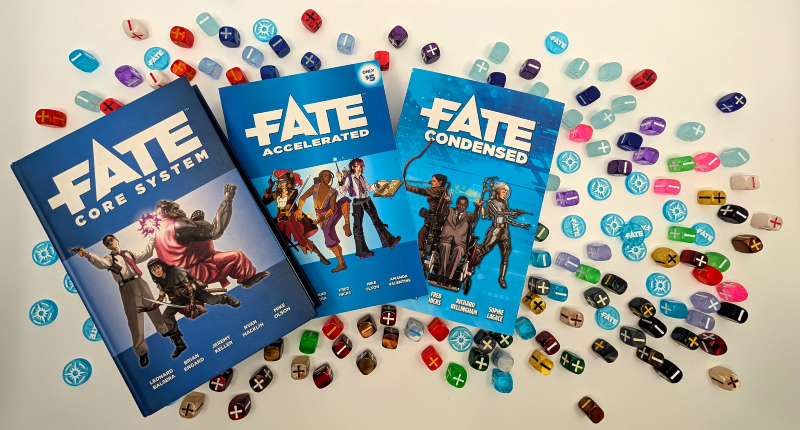
After Fate came out in 2003, it won Best Free Game at the Indie RPG Awards. Despite being a relatively new and niche award, this news somehow filtered down to Jennifer Jackson, the literary agent of Butcher. Jackson had been forwarding requests from publishers who wanted to adapt Butcher’s urban fantasy Dresden Files series, but the author kept rejecting them. The reason: he didn’t want to trust strangers with his work. At which point, Jackson reminded him that he had friends who were now apparently award-winning game designers.
The offer from Butcher to publish an officially licensed Dresden Files game spurred the existence of Evil Hat as a company. Before that, Hicks was clear that he “had no ambitions whatsoever of being an RPG publisher.” When Butcher’s proposition came through, Hicks knew this could be a life-changing moment: “I had to pick my jaw off the floor,” he said.
Hicks and Donoghue initially thought of Fate as a free game because that was what everyone who worked with Fudge did. (As per Shannon Appelcline’s Designers and Dragons, they later separately claimed low self-esteem and savvy business strategy as reasons, which suggests that no single justification was behind the decision.) The Fudge community, like so many early internet spaces, were built around an ethos of open communication, sharing, and free experimentation. And they inherited those values to some extent from the first ever open internet community, Usenet. As the first online mega-forum or discussion space, Usenet represented the best and worst of the internet. It was where Tim-Berners Lee announced the World Wide Web and where Linus Torvalds announced Linux. It was also famously compared by one technologist to “a herd of performing elephants with diarrhea.” Which is a sentiment every social media user today should recognise.
The fact that Hicks and Donoghue both worked in the tech industry (Donoghue still does) and had formative experiences in a more open online ecosystem influenced the kind of company they founded. Evil Hat still embodies a lot of those early values — all of the Fate PDFs are pay-what-you-want, for example. In fact, Hicks takes some credit for DrivethruRPG fast-tracking a feature that allowed designers to sell their products in that way: “DriveThru had, behind the scenes, been working on putting together a pay-what-you-want feature for the site. And following the Fate Core Kickstarter — I might have the timing on this a little munched — but I was like, oh, we can't put that out there because we can't make it pay-what-you-want, and they're like, we might be able to roll out this feature early. So [it’s] partly my fault,” he said.
In the same way, it’s also possible to connect the ethos of the Bits and Mortar initiative by Evil Hat, where game store owners and publishers can offer customers free PDFs with physical purchases, back to the same history of internet spaces. Speaking generally, publishers like Evil Hat and games like Fate come across as products of the technological ecosystem that they emerged from — whether it’s PDFs, print-on-demand (Lulu as an early pioneer here), crowdfunding, or anything else. It’s also clear the ecosystem has changed drastically. The internet looks very different in 2026.
The origins of Evil Hat do not actually lie with Fate. In 1999, Hicks, Donoghue, and Lydia Leong, among others, were running original larps at a convention called AmberCon NorthWest. These larps contained about 16-24 people, which is big for a relatively modestly-sized con. Some were Amber-themed, like The Crisis of Infinite Corwins, where every player was Corwin and all woke up in a weird hospital and had no idea what had happened to them. Regardless of the theme or content of the larps, the important thing, as Hicks put it, was that, “No two games were alike.”
They organized these larps under the name “Evil Hat”, which came from a social MUSH where Leong wrote that she perched on Hicks’ head like an evil hat. “I'm like, Evil Hat, that's a good brand name. I like that name,” said Hicks. “It's the early internet. Okay, let me register evilhat.com. Cool, we've got evilhat.com. Now, what do we want to do with it?”
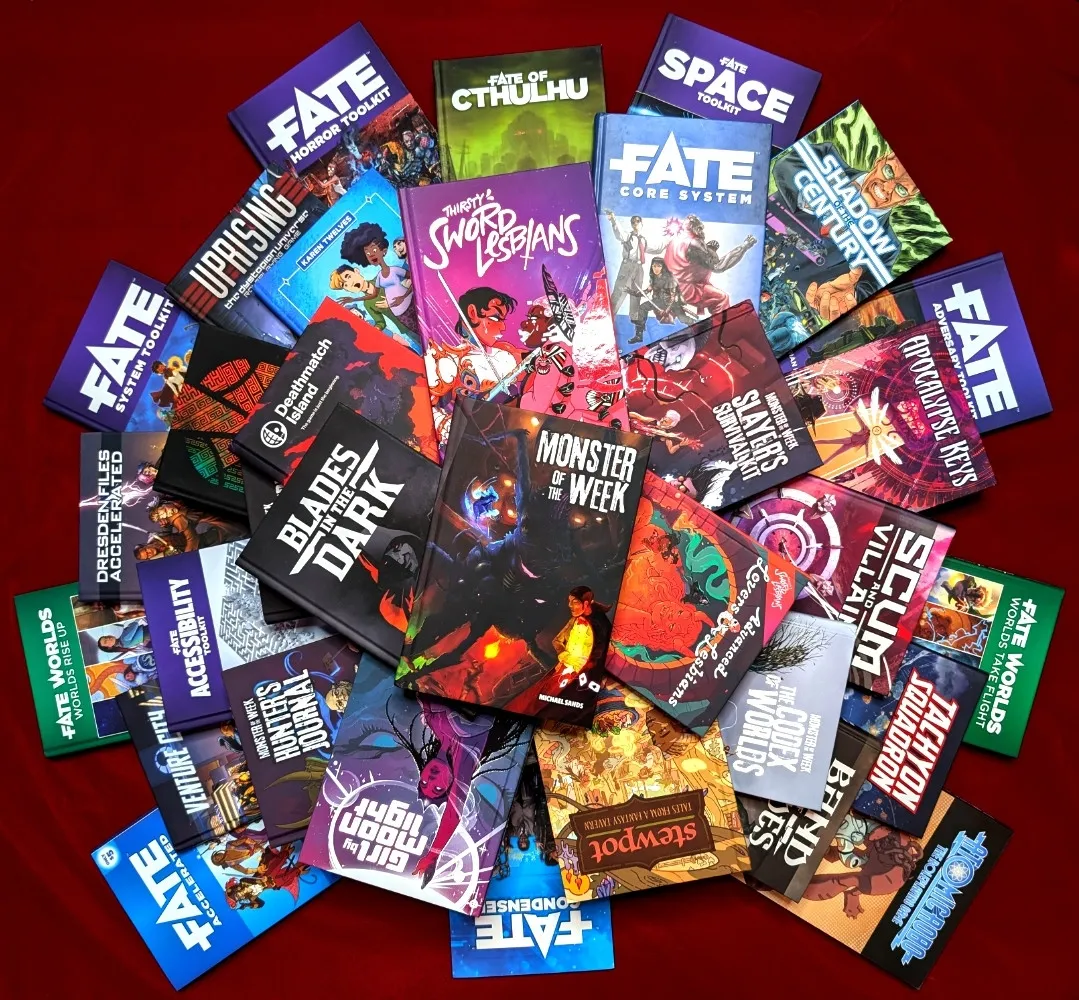
These larps were the first “Evil Hat Productions”, but the ethos of no two games being alike has remained a strong presence over the company’s entire life. After the success of The Dresden Files Roleplaying Game and the release of Fate Core, Evil Hat found itself at an inflection point. “We had achieved all the goals that led to the creation of the company,” said Hicks. “Outside Fate, it led to things like us experimenting with board games for a while, experimenting with fiction, and somewhere in there deciding we would occasionally partner up with some people. Oh, there's this thing that John Harper did, I'm sure it's fine. It's Blades in the Dark, and he doesn't want to be doing the publishing work, so we'll help out. Monster of the Week, I ran this campaign, I loved it, but it's only available on POD, and the guy’s in New Zealand. Why don't I help them?” These proved to not be a string of coincidences but a pattern and, soon, a publishing strategy.
Despite Blades in the Dark and Monster of the Week becoming Evil Hat’s biggest sellers, the RPG lines remain relatively shallow. Blades in the Dark has only two other current products — Deep Cuts and more recently Blades ‘68. Another company might see this as a fatal lack of monetization. Instead, they continue to publish new games. Most of them tend to be in the neighbourhood of the Powered by the Apocalypse family, but that isn’t the case for all. And while there’s been discussion about potential new editions among fans, Hicks isn’t even sure that’s what Evil Hat should be doing: “I don't know that we really are a new edition kind of company… unless it's got a really strong case for it.”
The diversity has become, to some extent, their brand. Hicks recalled an incident at a previous Big Bad Con where, after playing a game, someone he had just met realized he had heard his name before. “He's like, oh, Evil Hat, y'all are like A24: I never know what I'm going to get, but I know at a certain level, it's gonna be good,” said Hicks, clearly delighted by the comparison. “'I am gonna take that to my grave.”
Through the 2010s, development and iteration on Fate continued. Fate Accelerated was released, and the company got its first taste of a now-common internet phenomenon — fandom disputes. The size of the Fate community was never so large to attract outside attention, but within their spaces, participants passionately argued for their preference — Fate Core or Fate Accelerated — over the other. Personally, Hicks was baffled as he tried to convince both sides that they were both more or less the same game. As is often the case in certain spaces: the lesser the distinction, the greater the fracas.
Fate Worlds of Adventure became a huge library of micro-settings and adventures written by a diverse roster of creators. One of the most popular was a book called Masters of Umdaar, written by Dave Joria and released in 2015. Joria’s 51-page book had all the color and pulp machismo of John Carter of Mars, Flash Gordon, and He-Man. And in 2019, he pitched Evil Hat on the idea of turning it into a full, standalone game.
By 2019, there was a clear trend that the products that appealed to the “gearheads” as Hicks put, like the Horror Toolkit or Space Toolkit, sold better than settings and adventures. But the toolkits were too resource intensive to develop — and Hicks himself was more picky about them than other products. But Umdaar seemed like a good bet. Evil Hat seemingly lost track of the project during the COVID-19 pandemic that started in 2020. When Joria submitted his draft, it was massive — the scope had ballooned. Hicks felt like it needed more work. Suddenly, it was 2025. Various people were pulled in to edit and develop the game, but in those five years, the reception to the latest release in the line, Fate of Cthulhu, had been mixed. Hicks felt that a lot of people who bought it were surprised to not see Call of Cthulhu done in Fate but instead a much more specific game with a Terminator-like premise where the Great Old Ones were changing the past to create a future where they successfully emerge.
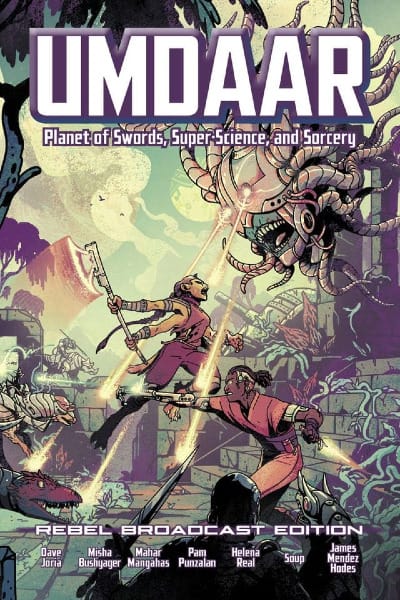
Even as Umdaar’s text came closer to being finished, it wasn’t clear to the team at Evil Hat there would be an audience for it. “It just started to look like we're aiming at a market that's too small for what our usual thing would be here — do a crowdfund, put a huge art budget on it, put out a large print run, and then maybe past the crowdfunder, end up with something that will find some traction in distribution … but by the historical trend, won't,” said Hicks. “Especially when we're living in a world with tariffs and other economic stressors hitting game companies especially hard.”
So, they took the call to release it first as POD and as a PDF that was, obviously, pay-what-you-want. It’s a return to form — another repetition in the pattern of how Fate began and how it’s continued through the last two decades. Depending on the reception, depending on the number of downloads, Evil Hat will make a call whether to stop there or invest further resources into it.
“There's a part of me that acknowledges that there's a little bit of sadness there,” said Hicks. “But there's also part of me that looks at the scope of history that we've been talking about and acknowledges that Fate is a game of the early 2010s. It has had its impact. What is it becoming in the 2020s?” To Hicks, Umdaar then becomes an experiment that will answer those questions: “I'm wired to be somebody who likes to know that there are questions, but I like it even more when I've found the answers to them,” he said. “So any outcome here, it's satisfying, because it engenders a conclusion.”
He’s hoping the new Masters of the Universe movie can help: “If the movie bombs, people will come back from that going: I really wish that could have been better. And in fact, speaking of better, look at this gigantic PDF that I got for however much I wanted to pay for it.”
But even as he worried about the numbers lining up, Hicks doesn’t doubt that there is an audience for Fate. “I will still encounter people today who will be like, yeah, I was watching a movie, and figuring out what the aspects were of each of the characters as it was happening,” he said. He doesn’t believe that Fate is dead – how can it be when it’s still easily playable. As a company, Evil Hat is still wrestling with whether it’s even possible for their games to be out of print, given the existence of electronic formats. For now, Hicks isn’t ruling anything out. He’s just waiting to see what happens.
(Disclosure: Fred Hicks is a current subscriber to Rascal News at the Paragon level.)