Wraithborn reaches for MÖRK BORG style and substance but exceeds its grasp
MÖRE BORG.

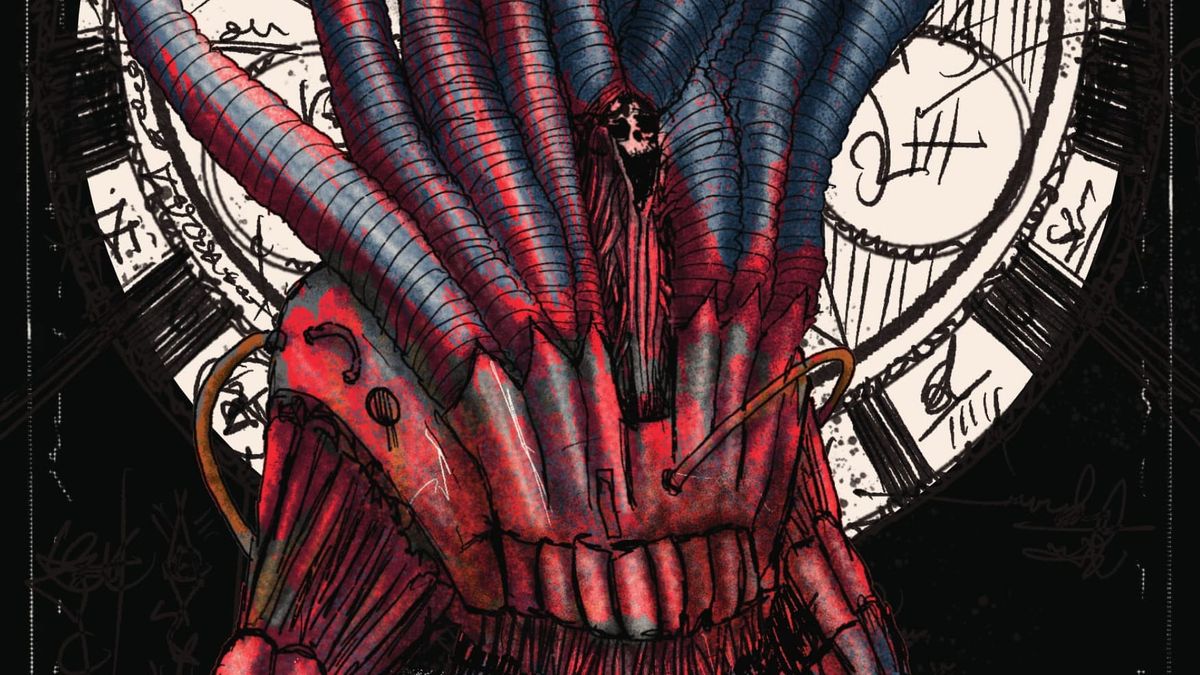
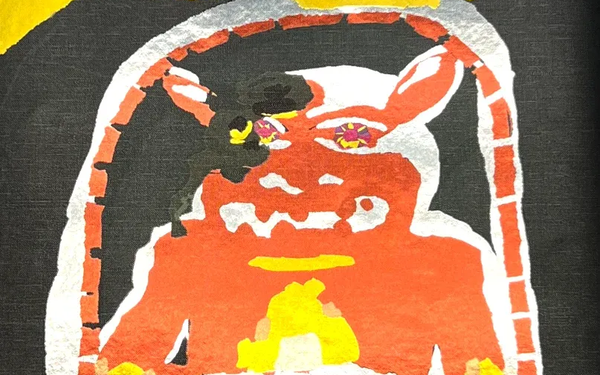
Wraithborn is Theatre Macabre’s answer to the question of what MÖRK BORG would look like with more meat on its bones, taking the ubiquitous OSR system and grafting on even more slabs of flesh and miscellaneous spiky bits. What if it had over three times the page count, a separate campaign setting book, more robust mechanics, a ritual magic system, way more classes, solo rules, and was just generally more? MAXI BORG, which would make an excellent drag name.
I adore maximalism — in dark fantasy and sci-fi, especially (I realise this is a huge surprise, coming from a noted Warhammer, Dark Souls, and anime enjoyer.) There’s just something about taking a big bucket of stuff from the fevered imagination of a fourteen-year-old metalhead and slamming it together into a grotesque, baroque abomination that makes my brain happy. Probably the bit of it that will always be a fourteen-year-old metalhead. Wraithborn has a really big bucket of really good bits.
Published under the MÖRK BORG third party license, Wraithborn doesn’t stray far from its roots. It’s still a D20-based dark fantasy game in the OSR tradition, featuring weird and horrible guys (gender neutral) crawling through dungeons and dealing with various factions and powers who are even more weird and horrible than they are.
The titular wraithborn are inhabitants of the plane of S’Gath, a purgatory of sorts, from which their souls can’t escape. These hapless undead don’t remember their mortal lives, and when they die, they’ll eventually be reborn, similarly unaware of past incarnations. As a result, most live a mundane existence, scrabbling to make an unliving in a dismal realm where they’re at the mercy of exploitation and abuse from fae, vampires, and each other. Kind of like living in Britain, except with the knowledge that it’s your fault you’re there, and that you’ll never escape.
Any one of the classes could be the protagonist of a particularly edgy ‘90s Image comic. Can I interest you in a warrior soulbound to their undead wyvern mount? How about a soul slammed into an ungodly chimera of a dhampyr and giant spider? Or a demon imprisoned in the constantly rotting corpse of a dead fae? You can play a common-or-garden wraithborn if you really want to, but even then, you’re not exactly a regular fantasy adventurer.
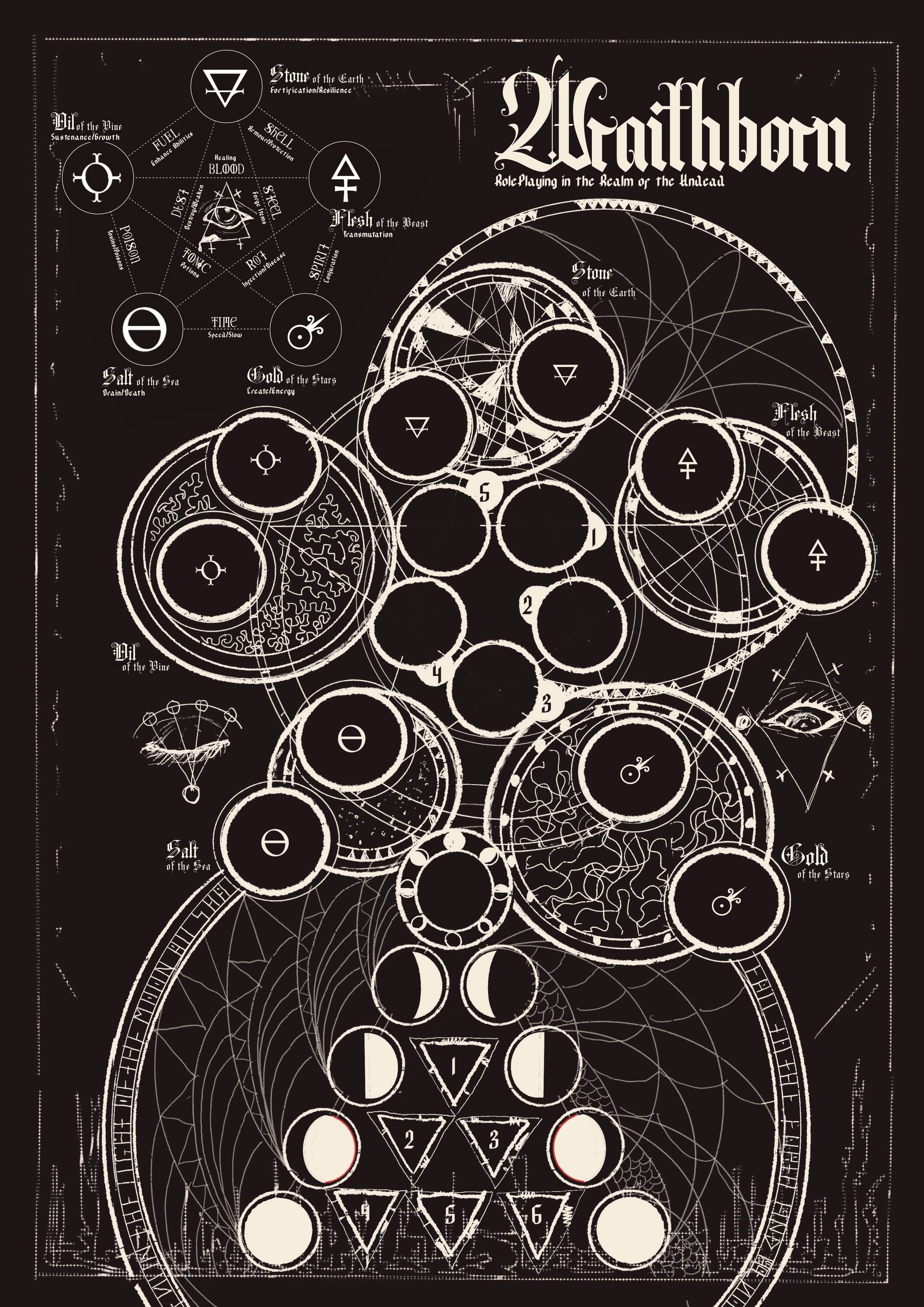
Magic in Wraithborn feels suitably esoteric. Built on a foundation of the five elements of flesh, gold, salt, oil and stone, casting spells involves physically placing dice of various values on slots of a ritual circle. D6’s are replenished daily based on character level and D4’s are awarded throughout the day by completing tasks (or rolling crits and fumbles). To cast a spell, a player must assign dice with a total value that reaches the spell’s casting threshold, and the results of the D20 casting roll not only determine success or failure, but whether or not the dice are expended in the process.
It’s not an overly complex system, but the use of the ritual circle makes it easy to track your stocks of magical mojo and feels flavourful, particularly with higher level casting. Each combination of two elements produces a new one — flesh and oil make blood, gold and stone make steel — increasing the array of spells available. It also enables more powerful spells. The ritual circle only has two slots for each element, which means the highest casting threshold possible is twelve, requiring 2D6 to be assigned. With two elements, the number of slots is doubled, allowing more difficult, and thus more powerful, spells to be cast. Some spellcasting-focused classes add extra wrinkles, like Stormbringers who can attune to specific elements each day for extra oomph, or the fae Lunari Mages and their ability to draw on the power of the moon.
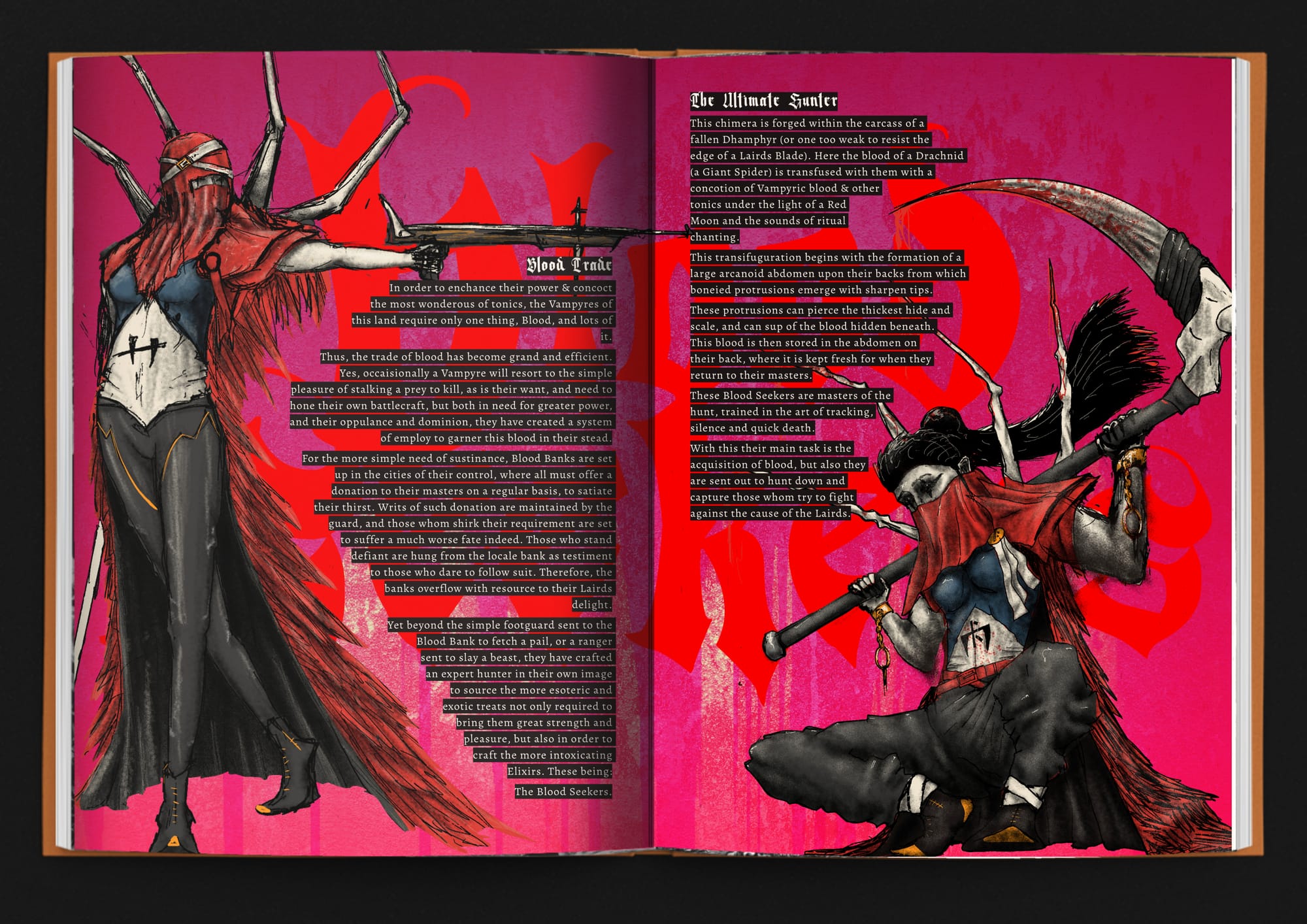
Since Wraithborn comes equipped with solo rules, it would be remiss of me not to dive in and have a play with the game’s systems myself. Campaigns are crafted using a system called the Lyrical Oracle, instructing you to pull lyrics from beloved songs and weave them into a cohesive tale based on themes of Conflict, Desire, Change, Struggle, and Power. It’s not particularly structured, but it was a lovely excuse to spend time really listening to a handful of songs. I created a Blood Seeker — one of the vampire-arachnid hybrids I mentioned earlier. Blood Seekers are created to serve vampires as blood-gatherers, but gain more free will and individual drive as they get older. Their elders have formed Blood Covens dedicated to gaining more power and freedom for their kind, while placating their masters. I chose More by The Sisters of Mercy as my Source Oracle, envisioning a story of subterfuge and deceit, betrayal and vengeance.
D'you get scared to feel so much?
To let somebody touch you?
So hot, so cold, so far, so out of control
Hard to come by, and harder to hold
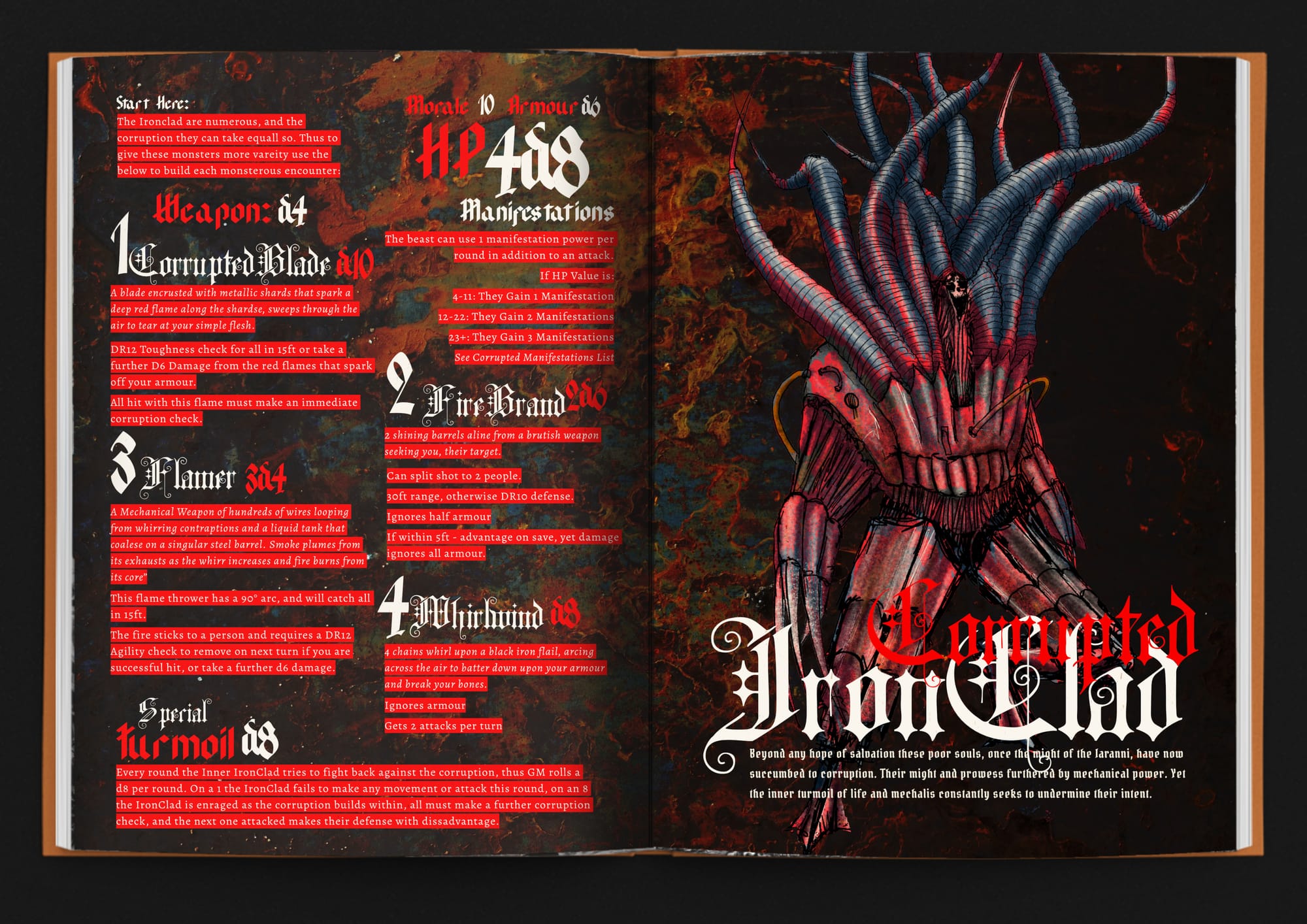
The gloriously meaty chunks stitched together to create Wraithborn don’t form a very cohesive construct, which I only realized during character creation. I hate to say this, but the books are just a pain in the arse to read. They look fantastic, all moody and gothic, but they’re hard on the old eyeballs, especially when trying to reference rules. In drawing inspiration from MÖRK BORG, Wraithborn demonstrates what an achievement of graphic design that game is. MÖRK BORG is also a fraction of the size, a much more streamlined affair, and has an accessible, easy-to-read version available. Simply creating a character in Wraithborn was a chore, involving constantly moving back and forth between the character creation, solo play, and character class sections, not to mention checking various magic rules and spell lists.
It’s a cumbersome beast, especially for a first time GM or player, and especially when taking into account that all nine classes have unique rules and systems. My fledgling Blood Seeker had access to Blood Tonics, Blood Curses, and various inherent Blood Seeker abilities, as well as the core ritual magic. For solo players, there are also divine blessings and spirit summons to contend with. It’s a lot to get your head around just for a single class, let alone GMs having to parse all this discrete information for each and every class their players select.
I persevered (I’ve played GURPS Supers, no character creation on Earth can hold me back for long) and eventually emerged with a completed character and a campaign outline. However, that’s as far as I got. I thought the dungeon generator — a fairly standard collection of random tables — would be a good starting point, but discovering that it was only four pages long worried me. The delve started off pretty well, with my initial rolls creating a cavern full of soldiers, decorated in a vernacular style. I pictured some kind of elaborate trench warfare complex, which seemed pretty cool. Further rolls told me it was to be six rooms across one level, and those rooms included a summoning chamber, a lake, living quarters, an observatory, a study, and another summoning chamber. These were all equally possible on a D20 chart that gave me the impression that every dungeon was going to feel like a hodgepodge wizard’s lair. Each room mentioned one or two lines about its contents, but they didn’t go far enough. One might say that it contains 1d4 basic monsters and one mid level monster, but there’s no indication of what either of those categories mean. Trying to find that information, if it exists, is a nightmare because — again — the book is so hard to parse.
Maybe this is my unfamiliarity with solo journaling games coming through, but I expect a reasonable amount of scaffolding for what is essentially a creative writing exercise, especially for a game that posits a bunch of unique classes and rules as a major selling point. The lack of structure here means that it doesn’t feel like Wraithborn is a playable solo game at all. It has a novel method of creating inspiration for a campaign and rules for beefing up a character in lieu of having a whole party, but it doesn’t shoulder any of the GM burden. The result is something that feels more like a duo game that expects you to take on both the GM and player roles. It’s akin to a competitive board game stating that it has solo rules, but when you read them it just instructs you to play against yourself. To me, that isn’t a solo game experience. Just writing Wraithborn fanfic strikes me as a much easier and more fulfilling endeavor.
This lack of connective tissue is pervasive and Wraithborn’s critical flaw. It also recalls our recent discussion of crunch. As much as crunch and fluff are handy for talking about a game’s rules and setting content, there’s also a lot of material that it doesn’t cover. GM advice, for example, or “What is an RPG?” They’re not strictly rules, but they do provide guidance on how a game is intended to be played. Other than a page exhorting players not to revel in the general horribleness of Wraithborn’s factions alongside discussing safety tools, there’s no suggestions of what to actually do with the cornucopia of grim delights Wraithborn presents. What does a Wraithborn campaign look like? How are your players supposed to form a party of characters from the disparate and frequently opposing factions the classes represent? I don’t need to be told how to play an RPG, but I’d love some advice on how Wraithborn is intended to be played.
There’s nothing inherently wrong with presenting an audience with a setting and rules and letting them get on with it, but it’s a lot of work to put on GMs. I’d like to run Wraithborn at some point, but I have a sneaking suspicion that every opportunity would be better spent running something that put less of a burden on me, whether it’s in the form of Mythic Bastionland’s support for GM improvisation, or the detailed, yet easy to run campaigns of Doomsong. At the same time, I’d jump at the chance to play in a Wraithborn campaign run by a confident GM. Wraithborn is an ungainly and overstuffed homunculus, but it’s also a weirdly charming one that I just can’t get out of my brain. I doubt that I’ll ever get it to the table, but I won’t deny that I’ve enjoyed the time I’ve spent wrestling with it.